Commercial real estate purchase and representation documents in Ontario are a structured set of legally binding contracts that govern the transfer of commercial property and the agency relationships between brokers and their clients. These documents authorize representation, establish contractual obligations, allocate risk, and ultimately enable the lawful purchase or disposition of commercial assets. The process is most notably issued by the Ontario Real Estate Association applied in accordance with statutory requirements under the Trust in Real Estate Services Act, 2002, and enforced through regulatory oversight by the Real Estate Council of Ontario.
Rules and documentation structures vary significantly across jurisdictions:
- In Ontario, OREA forms and TRESA govern transaction structure and brokerage conduct
- In British Columbia, the Real Estate Services Act applies, with forms issued by the BC Real Estate Association
- In Alberta, the Real Estate Act governs, supported by the Alberta Real Estate Association forms
- In Quebec, transactions are governed by the Civil Code of Québec and regulated by the Organisme d’autoréglementation du courtage immobilier du Québec
Using the wrong jurisdictional framework or incorrect forms can compromise contractual validity and expose parties to regulatory liability.
Within Ontario, commercial transactions are typically structured through a defined sequence of OREA forms:
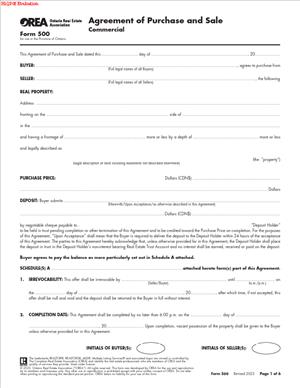
- Form 500 Agreement of Purchase and Sale Commercial
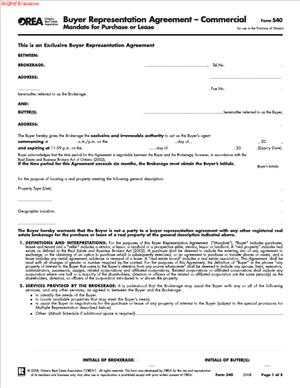
- Form 540 Buyer Representation Agreement Commercial
- Form 320 Confirmation of Co-operation and Representation
- Form 201 Seller Customer Service Agreement Commission Agreement for Property Not Listed
- Form 120 Amendment to Agreement of Purchase and Sale
Selecting the appropriate forms, representation model, and disclosure sequence is the first critical step in any Ontario commercial real estate transaction. Errors at this stage can affect enforceability, delay closing, or result in regulatory breaches.
Access structured Ontario commercial real estate form templates with RunSensible forms and find the needed documentation for your transaction.
How Commercial Real Estate Purchase Agreements Work in Ontario
The Ontario commercial real estate form system functions as a coordinated legal framework. The standardized forms issued by the Ontario Real Estate Association create enforceable rights, define brokerage authority, allocate risk, and ensure compliance with the Trust in Real Estate Services Act, 2002. Each document has a specific role and must be used in the correct sequence.

At its core, the framework can produce the following outcomes:
- Impose binding contractual obligations: An Agreement of Purchase and Sale creates enforceable duties for the buyer to pay the purchase price and for the seller to deliver title in accordance with agreed terms. Once conditions are satisfied or waived, the agreement becomes fully binding and enforceable
- Establish and define brokerage authority: A Buyer Representation Agreement creates an exclusive mandate between a buyer and a brokerage, defining the scope of services, duration, and compensation. A Seller Customer Service Agreement permits a brokerage to engage with an unlisted property under a defined commission arrangement
- Confirm representation and satisfy disclosure requirements: A Confirmation of Cooperation and Representation records the status of each party at the time of offer presentation and fulfills mandatory disclosure obligations
- Grant rights and impose restrictions: Exclusive representation provisions limit the ability to engage other brokerages during the term of the agreement. Holdover clauses extend commission entitlement beyond expiry in specified circumstances. Representation structure determines the extent of confidentiality and advocacy permitted
- Allocate and manage transactional risk: The Agreement of Purchase and Sale governs deposits, title requirements, risk of loss, and tax allocation, including HST. It also imposes strict timing requirements, where missed deadlines may result in loss of rights or termination of the agreement
- Support enforceability and compliance: Standardized forms issued by the Ontario Real Estate Association align with requirements under the Trust in Real Estate Services Act, 2002, ensuring that agreements meet formal legal standards for validity and disclosure
The framework also regulates key transaction variables:
- Conditions such as financing, due diligence, and regulatory approvals, requiring written fulfillment or waiver
- Deposit handling and release in default or failed condition scenarios
- Tax obligations, including HST allocation and non-resident considerations
- Multiple representation, including consent and limits on brokerage conduct
- Commission entitlements, including holdover periods
- Post acceptance changes through formal amendments
Its limits are defined. It does not govern corporate share sales, business transfers, lease assignments requiring third-party consent, or joint venture structuring. These require separate legal agreements outside the standard form system.
Common Stages of Commercial Real Estate Transactions
Ontario commercial real estate transactions follow a defined sequence driven by standardized forms and strict procedural requirements under the Trust in Real Estate Services Act, 2002. Each stage serves a specific legal function, and continuity between steps is essential to preserve enforceability, regulatory compliance, and deal integrity.
Step 1 — Establishing Representation and Authority
The process begins with the execution of a Buyer Representation Agreement using OREA Form 540, which creates the legal mandate for the brokerage to act. This document defines the scope of services, geographic parameters, property type, term, and compensation structure, and must be signed before any substantive services are provided. Disclosure of fees and expiry is mandatory under oversight by the Real Estate Council of Ontario. Failure to execute the agreement properly can eliminate commission entitlement and leave the relationship legally undefined.
Step 2 — Off-Market Seller Engagement Where Applicable
Where a property is not publicly listed, OREA Form 201 establishes a limited customer service relationship between the seller and the introducing brokerage. It authorizes the brokerage to present a buyer and secure a commission if a transaction is completed within the term or holdover period. This step does not create full agency representation for the seller, and misunderstanding this distinction can lead to disputes over duties and compensation.
Step 3 — Offer Preparation and Contract Formation
The transaction becomes legally operative through the Agreement of Purchase and Sale using OREA Form 500, which sets out all material terms, including price, deposit, conditions, tax treatment, and closing date. Once signed, it is fully enforceable. Proper completion requires accurate party identification, legal property description, delivery provisions, and structured schedules addressing financing, due diligence, and regulatory review. Strict timing applies, and missed deadlines can automatically terminate the agreement.
Step 4 — Disclosure and Representation Confirmation
At the time of offer presentation, OREA Form 320 documents the representation status of all parties and confirms commission arrangements. It also records any multiple representation scenario and requires a signed acknowledgement. Completion of this step is mandatory before the offer is presented, and errors can create regulatory exposure and undermine commission claims.
Step 5 — Due Diligence and Condition Management
Following acceptance, the transaction moves into the condition period, where financing, inspections, lease review, and regulatory checks must be completed. Each condition must be satisfied or waived in writing within the specified timeline. Failure to deliver proper written notice or to meet deadlines results in automatic termination of the agreement and return of the deposit, making procedural accuracy critical.
Step 6 — Amendments and Extensions
Any modification to the Agreement of Purchase and Sale must be formalized using OREA Form 120. This includes extensions of condition deadlines, revisions to closing dates, or changes to financial terms. The amendment must clearly reference the original agreement and be signed by all parties. Verbal changes have no legal effect and cannot alter enforceable obligations.
Step 7 — Pre-Closing Compliance and Preparation
Before closing, both parties must complete legal and financial requirements, including title searches, adjustment calculations, tax compliance, and preparation of transfer documents. Legal counsel coordinates the delivery of all required materials, and jurisdiction-specific obligations, such as non-resident tax compliance, must be addressed. Failure at this stage can delay closing or introduce financial liability.
Step 8 — Closing and Registration
The transaction concludes on closing, where funds are transferred, documents are exchanged, and the conveyance is registered. Legal ownership transfers upon registration, and brokerages finalize commission payments in accordance with the agreement. Delays in funding or documentation may constitute a breach and trigger legal remedies, including damages or court-enforced completion.
Ontario Commercial Real Estate Forms and Documents
Ontario commercial real estate transactions are structured around a defined set of standardized instruments issued by the Ontario Real Estate Association. Each form performs a specific legal function, and their combined use determines whether a transaction is enforceable, compliant, and procedurally complete.
OREA Form 540 Buyer Representation Agreement Commercial
This form establishes the buyer’s legal relationship with the brokerage and is the required starting point for any transaction. It defines the scope of the mandate, including property type, geographic area, term, and commission structure. The agreement must be executed before services are provided to comply with the Trust in Real Estate Services Act, 2002.
Structural accuracy is critical. The agreement must clearly state fee arrangements, including any shortfall obligations, and identify all intended purchasing entities where applicable. The holdover clause extends commission rights beyond expiry and must be understood at the outset. Errors in this form undermine fee enforceability and create ambiguity in representation authority.
OREA Form 500 Agreement of Purchase and Sale Commercial
This is the primary contract governing the transaction. It identifies the parties, property, purchase price, deposit, conditions, tax treatment, and closing date. Once executed, it creates binding legal obligations enforceable by damages or specific performance.
The form requires precise completion of all core terms, including legal property description and HST allocation. Commercial transactions rely heavily on attached schedules to address financing, environmental review, zoning compliance, and lease due diligence. Failure to properly draft or reference these schedules is a common source of dispute. Strict timing provisions apply, and missed deadlines can terminate the agreement automatically.
OREA Form 320 Confirmation of Cooperation and Representation
This form governs disclosure and brokerage cooperation at the time of offer presentation. It records which parties are clients or customers and confirms commission arrangements between brokerages. It also captures consent for multiple representations where applicable.
Completion is mandatory before an offer is presented. The distinction between client and customer relationships is legally significant, affecting duties of loyalty and confidentiality. Inaccurate or incomplete disclosure exposes registrants to regulatory risk and may affect commission entitlement.
OREA Form 201 Seller Customer Service Agreement Commission Agreement for Property Not Listed
This form applies to off-market transactions where a seller has not listed the property. It authorizes a brokerage to introduce a buyer and establishes a commission obligation if a transaction occurs within the term or holdover period.
The relationship created is customer service, not full representation. The brokerage does not act as an agent for the seller and cannot advocate on their behalf while representing the buyer. Misunderstanding this limitation is a frequent source of legal and commercial conflict.
OREA Form 120 Amendment to Agreement of Purchase and Sale
This form is the exclusive mechanism for modifying a binding Agreement of Purchase and Sale after acceptance. It is used to extend deadlines, revise financial terms, or adjust closing arrangements.
To be effective, the amendment must clearly reference the original agreement and be signed by all parties. Delivery must comply with the notice provisions in the underlying contract. Verbal modifications have no legal effect under the Statute of Frauds, and failure to execute amendments properly can result in breach or unintended termination.

How Mortgage Closings Work in Ontario: Forms, Registration, Guarantees, and Enforcement
Supporting Compliance, Registration, and Notice Requirements
Beyond the core forms, the transaction depends on additional legal steps that support enforceability. Title transfer must be registered in the land registry system to give legal effect to ownership. Tax compliance, including land transfer tax and potential non-resident withholding obligations, must be satisfied at closing. Brokerages must also comply with privacy and anti-money laundering requirements when handling transaction data.
Equally critical are notice and delivery procedures embedded in the Agreement of Purchase and Sale. Condition waivers, fulfillment notices, and amendments must be delivered in writing within specified timelines and in accordance with contractual notice provisions. Failure to document delivery properly can invalidate otherwise valid actions and expose parties to dispute.
Access structured Ontario commercial real estate forms through RunSensible, identify the correct OREA documents for your transaction, and generate a complete, filing-ready document. Download compliant documents with built-in error checks and jurisdiction-specific guidance through RunSensible Form Finder and match your situation to the correct forms.
Aftermath: Enforcement, Compliance, and Ongoing Obligations
Once a commercial real estate transaction in Ontario is completed or fails to close, the legal effect of the executed documents becomes fully operative. The Agreement of Purchase and Sale and related representation agreements transition from negotiated instruments into enforceable legal obligations that govern rights, remedies, and post-closing conduct.
Final Legal Effect
A completed transaction results in the transfer of legal title to the buyer through registration in the provincial land registry system. The buyer acquires the property subject only to permitted encumbrances identified in the agreement. If the seller fails to deliver a good and marketable title, the buyer may pursue remedies for breach of contract, including damages or specific performance, which is commonly granted in real estate matters due to the unique nature of land.
If the buyer fails to complete the purchase, the seller may retain the deposit where the agreement permits, resell the property, and pursue additional damages if losses exceed the deposit amount. Strict compliance with closing obligations is required, as contractual timelines are typically binding and enforceable.
Enforcement of Agency Duties
Representation agreements govern brokerage rights and obligations beyond the transaction itself. Commission entitlements established through written agreements remain enforceable, including where a transaction closes during a holdover period. A brokerage may pursue legal action to recover unpaid fees where a valid agreement exists.
Where a brokerage breaches its statutory or fiduciary duties, affected parties may seek civil remedies. In Ontario, complaints may also be filed with the Real Estate Council of Ontario, which has the authority to investigate and impose disciplinary measures, including fines, conditions on registration, or suspension.
Regulatory and Tax Compliance
Following the closing, legal counsel completes registration of the transfer and ensures compliance with statutory requirements. This includes payment and reporting of applicable land transfer taxes and any harmonized sales tax obligations. Where required, additional filings such as lease registrations or corporate disclosures must be completed to maintain legal validity and priority.
Record Keeping and Documentation
Both brokerages and legal professionals are subject to statutory record-keeping requirements. Under Ontario regulatory standards, transaction records must generally be retained for a minimum period, commonly six years. A complete transaction file should include:
- Executed the Agreement of Purchase and Sale and all schedules
- Representation agreements and disclosure forms
- Amendments, waivers, and extensions
- Trust accounting records and deposit documentation
- Correspondence and negotiation records
Maintaining a complete and organized record supports audit compliance, tax reporting, and dispute resolution.
Post Closing Rights and Continuing Obligations
Certain contractual obligations may survive closing. These can include indemnities, warranties, repair obligations, or undertakings agreed to within the transaction documents. Buyers may retain limited rights to enforce these provisions where breaches arise after closing.
Amendment provisions, assignment rights, or conditional clauses may also affect post-closing conduct where triggered prior to completion. However, once the title has transferred and obligations have been fulfilled, the primary contractual relationship is typically concluded.
Risks of Non-Compliance
Failure to comply with contractual or regulatory obligations exposes parties to legal and financial consequences:
- Breach of contract claims for unpaid amounts or unmet obligations
- Loss of deposit or additional damages arising from default
- Regulatory penalties for non-compliance with disclosure or licensing rules
- Enforcement of continuing obligations, such as warranties or covenants
In practice, the enforceability of the transaction depends on the integrity of the documentation and adherence to its terms. Courts and regulators rely on the executed agreements as the definitive record of the parties’ intentions and obligations. Proper compliance, accurate documentation, and disciplined record keeping significantly reduce the risk of dispute and facilitate efficient enforcement where required.
Common Mistakes and Best Practices
Procedural precision in Ontario commercial real estate transactions is essential. The OREA forms function as binding legal instruments, and their enforceability depends on strict compliance with statutory requirements, including those under the Trust in Real Estate Services Act, 2002, and general contract law principles. Most transactional failures arise from avoidable procedural errors rather than complex legal disputes.
Common Mistakes
The following errors occur frequently and can affect enforceability, compliance, or closing outcomes:
- Using incorrect or outdated forms
Applying residential templates or outdated commercial forms can omit required clauses or fail to reflect current regulatory standards - Failing to establish proper representation
Not executing a Buyer Representation Agreement before providing services may eliminate enforceable commission rights and create regulatory exposure - Incorrect party identification or authority
Omitting legal owners or using unauthorized signatories, particularly in corporate transactions, can invalidate agreements - Incomplete or inaccurate disclosures
Failing to disclose material facts, attach required schedules, or properly complete representation confirmations can lead to disputes or regulatory action - Errors in key transactional terms
Mistakes in HST allocation, deposit structure, condition deadlines, or property description can delay closing or create financial liability - Missed deadlines and ineffective notices
Ignoring strict timelines or relying on verbal waivers instead of written amendments can terminate rights or conditions - Improper deposit handling
Failure to deliver or hold deposits in accordance with trust requirements may breach contractual and regulatory obligations - Documentation and record gaps
Missing executed copies, amendments, or delivery confirmations can weaken enforceability and complicate dispute resolution
Best Practices
Risk can be significantly reduced through disciplined use of forms and structured compliance practices:
- Use current standardized forms
Always work with the latest OREA templates and complete all required fields, schedules, and initials - Execute representation agreements early
Ensure Form 540 is signed before any advisory or transactional work begins, with a clearly defined scope and duration - Maintain strict procedural compliance
Follow all notice, delivery, and timing requirements exactly, and document every step of the transaction - Use formal amendments for all changes
Execute Form 120 for any modification to the Agreement of Purchase and Sale, regardless of how minor the change appears - Verify authority and legal capacity
Confirm that all parties have proper authority to sign, and obtain supporting corporate or legal documentation where required - Ensure clarity and completeness
Fully describe property details, inclusions, exclusions, financial terms, and conditions to avoid ambiguity - Keep comprehensive records
Maintain organized files with all executed documents, correspondence, trust records, and delivery confirmations - Engage legal review where appropriate
Involve legal counsel for complex clauses, tax treatment, schedules, and risk allocation provisions
Apply these best practices with RunSensible Forms to select the correct Ontario commercial real estate documents, complete them accurately, and generate compliant, execution ready forms.

Final Thoughts
Commercial real estate transactions in Ontario follow a structured legal pathway built on standardized OREA forms. The process begins with establishing representation, proceeds through execution of the Agreement of Purchase and Sale, and continues with disclosure, amendments, and closing formalities. Each stage must be completed using the correct form and in the proper sequence to ensure enforceability.
Two principles govern the entire process. First, sequencing: representation agreements must be in place before services are provided, disclosure must accompany the offer, and amendments must be executed before deadlines expire. Second, documentation discipline: all terms must be clearly recorded, notices properly delivered, and records retained to support compliance and enforcement.
From negotiation to closing, the Agreement of Purchase and Sale defines the core obligations, while supporting forms maintain alignment as the transaction evolves. Final registration and compliance steps confirm legal ownership and complete the process. Throughout, adherence to Ontario’s statutory framework under the Trust in Real Estate Services Act, 2002, and oversight by the Real Estate Council of Ontario is required. A transaction that follows the correct pathway, uses the proper forms, and maintains procedural accuracy is positioned for smooth completion and enforceability.
FAQs
What is the difference between a Buyer Representation Agreement and an Agreement of Purchase and Sale?
A Buyer Representation Agreement, such as OREA Form 540, is a contract between a buyer and a brokerage that establishes an agency relationship. It defines the scope of services, duties owed, and how the brokerage will be compensated. An Agreement of Purchase and Sale, such as Form 500, is a separate contract between buyer and seller that governs the actual transfer of the property. The representation agreement regulates the relationship with the brokerage, while the purchase agreement governs the transaction itself.
When does a commercial Agreement of Purchase and Sale become legally binding?
An Agreement of Purchase and Sale becomes legally binding once it is signed by both parties and the acceptance is communicated. At that point, enforceable obligations arise. If the agreement includes conditions, it remains conditional until those conditions are fulfilled or waived in writing by the specified deadlines. Once conditions are cleared, the agreement is fully firm and enforceable.
Do I need a signed Buyer Representation Agreement before working with a brokerage?
Yes. Under the Trust in Real Estate Services Act, 2002, a brokerage must have a written agreement in place before representing a buyer as a client. Without a signed Form 540, the brokerage may not have enforceable rights to compensation and may be limited to providing only customer-level services rather than full representation.
What is the difference between a client and a customer in Ontario real estate transactions?
A client has entered into a formal representation agreement with a brokerage and is owed fiduciary duties, including loyalty, confidentiality, and full disclosure. A customer receives limited services, where the brokerage must act honestly and fairly but does not provide advocacy or strategic advice. This distinction affects how information is handled and what duties the brokerage owes.
What is OREA Form 320, and when must it be completed?
OREA Form 320, the Confirmation of Cooperation and Representation, must be completed before or at the time an offer is presented. It confirms the representation status of each party and documents the cooperation arrangement between brokerages. It also captures required disclosures, including multiple representation consent where applicable.
What happens if a condition in the Agreement of Purchase and Sale is not met on time?
If a condition is not fulfilled or waived in writing by the deadline, the agreement typically terminates automatically. The buyer’s deposit is usually returned. To avoid termination, the parties must execute a written amendment, such as Form 120, before the deadline expires. Verbal extensions are not legally effective.
How do I properly amend a signed commercial real estate agreement?
Amendments must be made using a formal written document, typically OREA Form 120. The amendment must clearly identify the original agreement and specify the exact changes. All parties must sign the amendment for it to be enforceable. Informal communications, such as emails or verbal agreements, do not legally modify the contract.
What is a holdover clause, and why does it matter?
A holdover clause, commonly included in Form 540, extends a brokerage’s right to commission for a defined period after the agreement expires. If the buyer completes a transaction involving a property introduced during the agreement term, the brokerage may still be entitled to a fee. This prevents parties from avoiding commission by delaying a transaction until after expiry.
What happens if one party breaches the Agreement of Purchase and Sale?
The non-breaching party may pursue legal remedies, including damages or specific performance. Specific performance is frequently used in real estate because each property is considered unique. If a buyer defaults, the seller may retain the deposit and seek additional damages. If a seller defaults, the buyer may seek to compel the transfer of title or recover losses.
Can a signed Agreement of Purchase and Sale be cancelled or changed?
A signed agreement cannot be unilaterally cancelled once it is firm, unless a contractual condition allows termination or both parties agree. Any change must be documented in writing and signed by all parties. Without proper documentation, the original terms remain enforceable, even if the parties informally agreed otherwise.
Resources
- Trust in Real Estate Services Act, 2002 (TRESA) – Government of Ontario
https://www.ontario.ca/laws/statute/02t30 - Real Estate Council of Ontario (RECO) – Regulatory Guidance and Compliance Resources
https://www.reco.on.ca - Ontario Real Estate Association (OREA) – Standard Forms and Professional Resources
https://www.orea.com - Landlord’s Legal Rent Increase Guide for Canada 2025-2026
https://forms.runsensible.com/blog/real-estate/landlord-legal-rent-increase-guide-canada/
Disclaimer: The content provided on this blog is for informational purposes only and does not constitute legal, financial, or professional advice.
Contents