The California probate process is the court-supervised way to settle some estates after a person dies. The court may appoint a personal representative. That person gathers property, gives notice, handles valid debts, keeps records, and asks the court to approve distribution. The case may involve a will, but it does not always require one.
Probate rules can feel hard because many steps depend on dates and forms. County courts may also require local documents. This guide explains the main path in plain English. It gives general legal information, not advice for a specific estate.
When the California Probate Process Is Required
Not every asset must pass through formal probate. First, list what the person owned and how each asset was titled. An asset with a named beneficiary may pass outside the estate. Property held in a living trust may also avoid formal probate. Jointly owned property may pass to the surviving owner, depending on the title.
California also has simpler procedures for some estates. The correct path depends on the type of property, its gross value, the date of death, and who is entitled to receive it.
For deaths on or after April 1, 2025, current California court materials list adjusted values that include:
- Up to $208,850 for the small-estate personal property procedure.
- Up to $69,625 for the affidavit process for real property of small value.
- Up to $750,000 for a petition involving a decedent’s primary California residence.
These amounts can change. They also do not apply the same way to every asset. Check the current Maximum Values form, DE-300, and the California Courts guide before choosing a procedure.
California Probate Process or a Simpler Transfer Route?
The California probate process may be needed when estate property does not pass by trust, beneficiary designation, joint ownership, or a small-estate procedure. Formal probate is also common when the estate needs a court-appointed person to collect or transfer assets.
A surviving spouse or registered domestic partner may have another option. Form DE-221 asks the court to decide that certain property belongs to the survivor. A small real-property interest may qualify for Form DE-305. These procedures have their own rules and waiting periods.

Do not compare only the total value of everything the person owned. Some property is excluded when deciding which procedure applies. A court self-help center or probate lawyer can help when the title or value is unclear.
Key People and Papers in the California Probate Process
The words used in probate describe each person’s role:
- Decedent: the person who died.
- Petitioner: the person who asks the court to open the case.
- Personal representative: the person the court appoints to manage the estate.
- Executor: a personal representative named in a will and appointed by the court.
- Administrator: a personal representative appointed when there is no acting executor.
- Heir: a person who may inherit under state law.
- Beneficiary: a person or group named to receive property under a will or trust.
- Probate referee: a court-appointed professional who values certain estate property.
A will does not give an executor full power by itself. The court appointment and issued Letters provide authority. Before Letters issue, the proposed representative should avoid selling, giving away, or mixing estate property with personal property.
California Probate Process Timeline at a Glance
The San Diego Superior Court’s probate timeline says a case may take about nine months to one and a half years, or longer. That is an estimate, not a promise. Court calendars, property sales, taxes, creditor issues, missing heirs, and disputes can add time.
Table description: California probate process phases, core tasks, and common forms.
| Phase | Main work | Common forms |
|---|---|---|
| Before filing | Find the will, identify property, list heirs and beneficiaries, choose the possible representative | Local cover sheets; will-related attachments when needed |
| Open the case | File the petition and supporting papers | DE-111, DE-147, possible DE-142 |
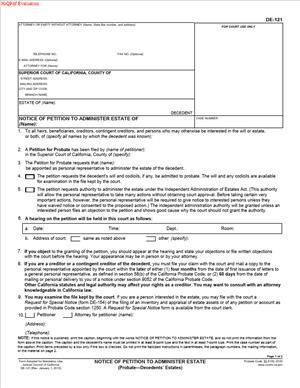
| Give notice | Mail notice and arrange newspaper publication before the first hearing | DE-121 |
| Appointment | Obtain the court’s order and proof of authority | DE-140, DE-150 |
| Administer estate | Protect property, prepare the inventory, address creditors, keep records | DE-160/GC-040, DE-172, DE-174 |
| Seek distribution | File an accounting or permitted waiver and petition for final distribution | Pleading or county form; DE-120 for hearing notice |
| Close the case | Distribute as ordered, file receipts, ask for discharge | DE-295/GC-395 |
The exact packet varies by county. A local court may require an extra cover sheet, e-filing format, publication list, or probate notes response. Always check the court in the county where the case will be filed.
Step 1: Gather Records Before Starting the California Probate Process
Good records make every later step clearer. Start with facts, not guesses.
Collect these items:
- Certified death certificates.
- The original will and any codicils, which are signed changes to the will.
- Trust documents, if any.
- Deeds, vehicle titles, and account statements.
- Life insurance and retirement beneficiary records.
- Recent tax returns.
- Mortgage, loan, credit card, and medical bills.
- Names and current addresses for heirs and beneficiaries.
- A list of digital accounts, business interests, and valuable personal property.
California law generally requires the holder of a will to deliver it to the clerk of the proper superior court within 30 days after learning of the death. The holder must also send a copy to the named executor. The San Diego court timeline repeats the 30-day point.
Next, make a property list. Record the owner shown on each title, any co-owner, and any named beneficiary. Do not move assets into a personal account. Keep receipts for urgent costs paid to protect the property.
This first review may show that the California probate process is not the right path. It may also show that only part of the estate needs formal probate.
Step 2: File the Petition and Opening Forms
The Petition for Probate, Form DE-111, asks the superior court to open the estate and appoint a personal representative. It includes facts about the decedent, the will, heirs, estimated property, bond, and the authority requested.
The petitioner normally files in the California county where the decedent lived at death. Different rules may apply when the person lived elsewhere but owned California property.
The opening packet often includes:
- Petition for Probate, DE-111.
- Duties and Liabilities of Personal Representative, DE-147.
- A copy of the will and codicils, when there is a will.
- A bond waiver or will-proof form, if it applies.
- County-specific forms and cover sheets.
The court sets a hearing after filing. Filing does not make the petitioner the personal representative. Authority comes later, after notice, review, a court order, and issuance of Letters. That safeguard is central to the California probate process.
Fees and filing methods vary. Some counties allow or require e-filing for certain users. A person who cannot afford court fees may ask for a fee waiver using the current court forms. Check the local fee schedule instead of relying on an old dollar amount.
Step 3: Give Notice Before the First Hearing
Notice protects the right of heirs, beneficiaries, creditors, and other interested people to know about the case. Form DE-121 gives the hearing details and names the person seeking appointment.
The current San Diego probate packet explains two main notice tasks:
- Publish the notice three times in a qualifying newspaper. The first publication must be at least 15 days before the hearing, with the required spacing between publications.
- Mail or personally deliver notice to each person or entity entitled to receive it at least 15 days before the hearing.
Local court instructions matter. Courts may keep a list of approved newspapers. A newspaper may file its proof of publication, or it may send that proof to the petitioner. The petitioner remains responsible for making sure the proof reaches the court.
The petitioner cannot sign as the person who mailed the notice if the petitioner is a party. Another adult who is not a party usually completes the proof of service.
Notice errors are a common reason for delay in the California probate process. Check names, addresses, hearing details, publication dates, and proofs before the hearing.
Step 4: Prepare for the Hearing and Obtain Letters
Many probate courts post examiner notes before the hearing. These notes list missing papers, unclear answers, or other defects. Review them early. Follow the local method to correct each item.
The proposed Order for Probate, DE-140, states whom the court appoints and what authority the court grants. Letters, DE-150, provide proof of that authority after the clerk issues them. A bank, title company, or other institution may ask for a certified copy.
The representative may also need to sign the Duties and Liabilities form. If the court requires a bond, Letters may not issue until the bond is in place. Bond is a type of protection for the estate. A will or signed waivers may affect bond, but the judge decides what is required.
The California probate process changes at this point. The representative now has legal duties. Those duties include protecting property, keeping estate money separate, avoiding conflicts, following the order, and keeping clear records.
What Authority Does the California Probate Process Give?
The order may grant full or limited authority under the Independent Administration of Estates Act. This law can allow some actions without a separate court hearing. Important acts may still require advance notice or court approval.
Read the Order and Letters together. Do not assume that appointment permits every sale or transfer. If a planned act affects real property, a business, or a beneficiary dispute, review the notice and approval rules before acting.
Step 5: Protect, Inventory, and Value Estate Property
After appointment, the representative should secure the estate and create a clean paper trail. Common tasks include changing mailing details, safeguarding a home, maintaining insurance, opening an estate account, and collecting income owed to the estate.
The representative prepares Inventory and Appraisal, DE-160/GC-040. Cash and certain cash-like items may be listed by the representative. A probate referee values many other items. The San Diego timeline directs the representative to prepare the inventory within four months after Letters issue and send it to the assigned referee for valuation work.
For each asset, keep support for:
- The exact title or account name.
- The date-of-death value.
- Any lien or loan information.
- Income received after death.
- Costs paid to protect or maintain the asset.
Do not use today’s balance when the form calls for date-of-death value. Do not omit an asset because family members have already taken it. If new property is found later, ask what supplemental filing is required.
The inventory is a key checkpoint in the California probate process. It affects court reporting, bond, referee fees, tax work, and the plan for distribution.
Step 6: Handle Creditor Claims and Taxes
Estate debts need a formal review. The representative must identify known and reasonably ascertainable creditors and follow the required notice rules. The San Diego timeline points to Notice of Administration to Creditors, DE-157, within four months after Letters issue.
A creditor can file Creditor’s Claim, DE-172. The representative then decides whether to allow or reject the claim, in whole or in part. Form DE-174 records that decision when applicable. A rejected creditor may have a short time to act, so the notice must be accurate and properly delivered.
Do not pay every bill as soon as it arrives. Some expenses have priority. Some claims may be late, unsupported, disputed, or outside the creditor-claim rules. Paying the wrong claim too soon can reduce funds needed for taxes or higher-priority costs.
Tax work may include the decedent’s final income return and a return for income earned by the estate. Larger or complex estates may have more duties. A tax professional can help identify the returns, dates, identification number, and records needed. The California probate process does not replace tax filing duties.
Transfer on Death (TOD) Designations: How to Create, Cancel, and File the Affidavit of Death
Step 7: Manage Property and Keep an Accounting
The representative acts for the estate, not for personal benefit. Keep estate funds in a separate account. Record every receipt, payment, sale, transfer, and distribution. Save statements, invoices, canceled checks, and closing papers.
Before selling or transferring property, confirm the authority granted. Full authority can reduce the need for separate approval, but some proposed actions still require notice. Limited authority may require a court order for important transactions.
Use a simple monthly log:
- Date.
- Money received or paid.
- Payor or recipient.
- Reason.
- Asset or claim involved.
- Supporting document location.
- Current estate balance.
Regular updates can also reduce confusion among beneficiaries. Share facts, not promises. Do not promise a distribution date before debts, taxes, and court approval are settled.
The best defense against a later accounting problem is a complete record made at the time of each event. Rebuilding the California probate process from old emails and bank statements is much harder.
Step 8: Ask the Court to Approve Final Distribution
When property is ready, valid debts and taxes are addressed, and the required claim periods have run, the representative prepares a final report and petition for distribution. The filing explains what came into the estate, what was paid, what remains, and who should receive it.
An accounting may be required. In some cases, eligible people can waive a formal accounting. A waiver does not remove the duty to keep accurate records.
The representative gives notice of the final hearing. Form DE-120 is commonly used for a hearing involving a decedent’s estate or trust. The court reviews the report, fees, reserve, accounting, and proposed distribution. If the papers are complete and no issue blocks approval, the judge can sign an order for final distribution.
Do not distribute everything before the court permits it. Keep enough money for approved costs, taxes, and closing work. A premature payment may be hard to recover.
Final distribution is one of the last major court stages in the California probate process, but the case is not closed yet.
Step 9: Distribute Property and Request Final Discharge
Follow the signed distribution order exactly. Transfer property to the people or entities named in the order. Obtain signed receipts and file them when required.
After all ordered transfers are complete, the representative can ask for final discharge. Judicial Council Form DE-295/GC-395 is used to tell the court that distribution or liquidation has been completed and to request discharge without another hearing when the requirements are met.
Final discharge ends the representative’s court appointment and releases the representative and surety from later acts, as stated in the order. Keep the final order, receipts, tax records, and account statements in a secure file.
The California probate process ends only after the court closes the appointment. Emptying the estate account is not the same as being discharged.
Common Mistakes That Slow the California Probate Process
Most delays come from missing, inconsistent, or late work. Watch for these problems:
- Using a simplified procedure without checking the date-of-death limit.
- Filing in the wrong county.
- Failing to lodge the original will.
- Leaving out an heir because that person is not named in the will.
- Publishing in the wrong newspaper or missing the notice dates.
- Letting names, case numbers, or hearing details differ across forms.
- Ignoring probate examiner notes.
- Acting before Letters issue.
- Mixing estate and personal money.
- Missing the inventory deadline.
- Paying claims without checking priority and validity.
- Selling property beyond the authority granted.
- Making early distributions without a safe reserve.
- Failing to keep receipts and a running ledger.
- Using an old statewide form or missing a county form.
Create one master calendar. Add every hearing, notice date, claim date, inventory target, tax date, and review date. Save a filed copy of each document and proof of delivery.
When Professional Help May Be Worth It
Self-represented people can use court self-help materials, but some estates carry greater risk. Consider legal or tax help when:
- Someone contests the will or appointment.
- Heirs are missing or disagree about property.
- The estate owns a business.
- Property is in more than one state.
- A creditor claim is large or disputed.
- The estate may not have enough money to pay all debts.
- The representative wants to sell real property.
- There are tax questions or foreign assets.
- A representative may have a conflict of interest.
- Deadlines have already been missed.
Court staff can explain filing procedures. They cannot give legal advice or choose the best path for an estate.
California Probate Process Checklist
Use this list as an organizing tool. It is not a substitute for the current forms, law, or local rules.
-
Identify probate and non-probate property.
-
Check whether a small-estate or spousal procedure may apply.
-
Deliver the original will on time, if one exists.
-
List heirs, beneficiaries, creditors, and addresses.
-
File DE-111 and all required state and local documents.
-
Calendar the hearing and notice dates.
-
Complete publication, service, and proofs.
-
Review and clear examiner notes.
-
Obtain the signed DE-140 and issued DE-150.
-
Open an estate account and protect property.
-
Prepare DE-160/GC-040 and work with the probate referee.
-
Give creditor notices and review filed claims.
-
Complete required tax work.
-
Keep a full ledger and supporting records.
-
File the final report, accounting or waiver, and petition for distribution.
-
Give notice of the final hearing.
-
Distribute only as ordered and collect receipts.
-
Request final discharge and keep the closing records.
Conclusion
The California probate process is easier to manage when each task is tied to a document, date, and proof. Start by deciding whether formal probate is needed. If it is, move in order: petition, notice, appointment, inventory, creditor and tax work, accounting, distribution, and discharge.
Use current statewide forms and the local court’s packet. Read every signed order before acting. Keep estate money separate and save proof of each step. When property, claims, taxes, or family disputes add risk, get advice early.
Frequently Asked Questions
How Long Does the California Probate Process Take?
The San Diego Superior Court’s general timeline says the California probate process may take about nine months to one and a half years, or longer. This is only an estimate. County schedules, property sales, tax work, creditor claims, and disputes affect the actual time.
Do You Need Probate If There Is a Will?
Sometimes. A will says who should receive property and may name an executor. It does not transfer every asset by itself. Formal probate may still be needed for property held only in the decedent’s name. Trust property, jointly held property, and assets with named beneficiaries may pass another way.
Can an Executor Act Before Letters Are Issued?
The named executor does not receive full estate authority from the will alone. The court must appoint the representative, and the clerk must issue Letters. Before that, the proposed executor can protect property but should not assume power to sell, transfer, or distribute it.
Which Form Starts the California Probate Process?
Petition for Probate, DE-111, commonly starts a formal estate case. The complete opening packet can include DE-147, will-related forms, a bond waiver, and local documents. Check the county court’s current packet.
What Is the Four-Month Inventory Deadline?
The personal representative generally must file the Inventory and Appraisal within four months after appointment. The representative lists the estate property, and the probate referee values many non-cash assets. Check California Probate Code section 8800 and local instructions for details.
Does Every Estate Need a Probate Referee?
Not every transfer procedure uses a probate referee in the same way. In formal probate, the court normally appoints a referee to value property that the representative cannot appraise. Cash and certain cash-like items are handled differently on the inventory.
Can Court Fees Be Waived?
A person who cannot afford court fees may request a fee waiver. Eligibility and the effect of a waiver depend on the person’s financial facts and the current rules. Use the current California court fee-waiver forms and check the local court’s instructions.
What Happens If the Representative Misses a Deadline?
The court may continue a hearing, require a corrected filing, order a status report, or take other action. The result depends on the missed task and the case. Act quickly, review the docket and local rules, and seek help when the delay could affect property or rights.
Resources
- California Courts, “Guide to property after someone dies”: https://selfhelp.courts.ca.gov/probate
- California Courts, “Overview of formal probate”: https://selfhelp.courts.ca.gov/probate/formal-probate
- California Courts, “Small estate affidavit to transfer personal property”: https://selfhelp.courts.ca.gov/probate/small-estate
- California Courts, “Maximum Values for Small Estate Set-Aside & Disposition of Estate Without Administration,” DE-300: https://selfhelp.courts.ca.gov/jcc-form/DE-300
- San Diego Superior Court, “Probate Timeline (Decedent’s Estate),” PR-195: https://wwwprod.sdcourt.ca.gov/sites/default/files/sdcourt/generalinformation/forms/probateforms/pr195.pdf
- San Diego Superior Court, “Decedent’s Estate Packet,” PKT-057: https://www.sdcourt.ca.gov/sites/default/files/sdcourt/generalinformation/forms/probateforms/pkt057.pdf
- California Legislative Information, Probate Code: https://leginfo.legislature.ca.gov/faces/codesTOCSelected.xhtml?tocCode=PROB
Disclaimer: The content provided on this blog is for informational purposes only and does not constitute legal, financial, or professional advice.
Contents