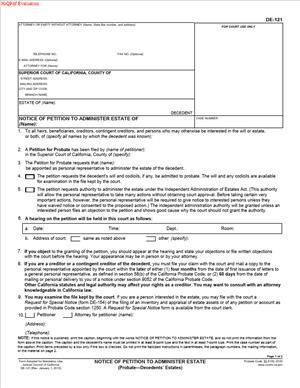
DE-121 – Notice of Petition to Administer Estate (Probate – Decedent’s Estates)
Fill out nowJurisdiction: Country: United States | Province or State: California
If you are starting a probate case in California, DE-121 – Notice of Petition to Administer Estate (Probate – Decedent’s Estates) is one of the key documents you will encounter. This form is used to formally notify interested parties that a petition has been filed to open a probate estate.
When someone dies, and property must be transferred through the court, a petition to administer the estate is typically filed. DE-121 – Notice of Petition to Administer Estate (Probate – Decedent’s Estates) gives public notice of that petition. It tells heirs, beneficiaries, and others when and where the court hearing will take place.
If you are filling out this form, you are likely acting as the proposed personal representative. That may mean you are named as executor in a will, or you are asking the court to appoint you as administrator because there is no will.
This document matters because it protects everyone’s right to be informed. Probate involves money, property, and legal authority. The court requires proper notice so that anyone affected has a fair chance to respond or object.
Understanding what this form does will help you complete it accurately and avoid delays in your case.
What is DE-121 – Notice of Petition to Administer Estate (Probate – Decedent’s Estates)?
Clear definition
DE-121 – Notice of Petition to Administer Estate (Probate – Decedent’s Estates) is a formal court notice used in California probate cases. It informs interested parties that a petition has been filed to open an estate and appoint a personal representative.
The form identifies the deceased person, the court where the case is filed, the case number, and the date, time, and location of the probate hearing. It also states who is seeking appointment and in what capacity.
This document is not the petition itself. It does not ask the court for authority. Instead, it announces that such a request has already been filed and will be heard on a specific date.
Who typically uses this form?
You typically use this form if you are filing a Petition for Probate and asking the court to appoint you as executor or administrator.
In many cases, the person named in the will as executor prepares this notice. If there is no will, a close relative seeking appointment as administrator often completes it.
A probate attorney may prepare the form on behalf of a client. However, self-represented individuals frequently fill it out themselves when handling a straightforward estate.
Court staff does not complete this form for you. It is your responsibility as the petitioner to ensure it is properly prepared, served, and, when required, published.
Why might you need this form?
You need this form because California probate law requires notice before the court can appoint someone to manage an estate. The court will not move forward unless proper notice has been given.
This notice gives heirs, beneficiaries, and creditors the opportunity to appear at the hearing. They may support the appointment, raise concerns, or object.
Without this notice, the court may continue your hearing or reject your submission. Proper notice is a core part of due process in probate cases.
The form also creates a record that you informed all required parties. That record can be important if disputes arise later.
Typical real-life scenarios
- A parent passes away, leaving a will that names one child as executor. That child files a Petition for Probate and prepares this notice to inform siblings and other heirs of the upcoming hearing.
- An individual dies without a will. A surviving spouse files to be appointed as administrator. The spouse uses this form to notify adult children and other relatives who may have a legal interest.
- A decedent owned a house and several bank accounts in their name only. No assets can be transferred until a personal representative is appointed. The proposed representative files the petition and issues this notice so the court can proceed.
- Two family members both believe they should serve as administrator. One files first and prepares this notice. The other receives the notice and appears at the hearing to raise an objection.
When would you use DE-121 – Notice of Petition to Administer Estate (Probate – Decedent’s Estates)?
You use this form after filing a Petition for Probate with the superior court in the county where the decedent lived or owned property. The notice is tied directly to that petition and its scheduled hearing.
This form is commonly used at the beginning of the probate process. It is not a later-stage document. It comes into play before the court appoints a personal representative.
If you are requesting an appointment as executor under a will, you use this form. If you are requesting an appointment as an administrator because there is no will, you also use this form. In both situations, notice is required.
The form may also be used when seeking special or limited authority, depending on the type of petition filed. The exact details depend on the petition that accompanies it.
If a hearing date changes, an amended or corrected notice may be required so that all interested parties receive accurate information.
Legal characteristics of DE-121 – Notice of Petition to Administer Estate (Probate – Decedent’s Estates)
This form is a notice document. Its effectiveness depends on accurate information and proper service. It must match the details in the filed petition, including the decedent’s name and the hearing date.
For the notice to be valid, it must generally be served on all required parties within the time frames set by court rules. In many cases, it must also be published in a local newspaper. The publication requirement helps notify unknown creditors and interested persons.
Common problems include incorrect hearing dates, misspelled names, incomplete lists of interested parties, and failure to file proof of service. These issues can delay the hearing or require re-noticing.
California probate courts may have local procedures that affect how notice is handled. While the core requirements are statewide, local practices can influence timing and formatting.
This document does not grant authority to manage the estate. It does not transfer property. It does not resolve disputes. It simply provides notice that a request for authority will be heard by the court.
Is it legally binding?
DE-121 – Notice of Petition to Administer Estate (Probate – Decedent’s Estates) is legally significant, but it is not a contract. It does not bind parties to any agreement.
Its legal force comes from the requirement that notice be given before the court acts. If notice is properly completed, served, and documented, the court may proceed with the hearing.
If notice is defective, the court may decline to appoint a personal representative until the issue is corrected. In that sense, proper completion and service are essential to moving the case forward.
The form becomes part of the official court record. Statements made in the notice must be accurate because they relate to a court proceeding.
How to fill out DE-121 – Notice of Petition to Administer Estate (Probate – Decedent’s Estates)
Step 1 – Complete the case caption
At the top of the form, enter the name and address of the person filing the petition, along with contact information. Fill in the name of the superior court, the county, and the court address. Add the case number exactly as it appears on the filed petition. The decedent’s name must match the petition and death certificate.
Step 2 – Identify the hearing details
Enter the date, time, and department of the probate hearing. These details must match the information provided by the court when the petition was filed. Double-check accuracy because incorrect hearing information can invalidate the notice.
Step 3 – Provide information about the petitioner
State the name of the person seeking appointment and the role requested, such as executor or administrator. If the petition requests specific authority, ensure the description in the notice aligns with the petition.
Step 4 – List publication information if required
If publication is required, include the name of the newspaper and the location where the notice will be published. Publication details must be consistent with court requirements and local practice.
Step 5 – Review for consistency and accuracy
Compare the completed notice with the filed petition. Confirm that names, dates, and case numbers match exactly. Small errors can result in delays or the need to reissue the notice.
Step 6 – Arrange for service and publication
After completing the form, ensure it is served on all required parties within the appropriate time frame. If publication is required, coordinate with the selected newspaper to publish the notice as directed by court rules. Retain proof of service and proof of publication for filing with the court.
Legal terms you might encounter in DE-121 – Notice of Petition to Administer Estate (Probate – Decedent’s Estates)
- Decedent: The person who has died. This form identifies the decedent by full legal name and may include aliases. You must use the exact name that appears on the death certificate so the court record matches other official documents.
- Petitioner: The person asking the court to open the probate case and appoint a personal representative. The petitioner’s name and contact information appear in the notice, so interested parties know who is seeking authority over the estate.
- Personal Representative: The individual the court may appoint to manage the estate. This could be an executor (named in a will) or an administrator (if there is no will). The notice informs readers that someone is asking to be formally appointed to this role.
- Executor: A type of personal representative named in a valid will. If the petition requests appointment as executor, the notice will reflect that and may refer to the existence of a will.
- Administrator: A personal representative appointed when there is no will or when the named executor cannot serve. The notice may state that the petitioner is seeking appointment as administrator of the estate.
- Hearing Date: The scheduled court date when the judge will review the petition. The form lists the exact date, time, and department. Anyone who wants to object must pay close attention to this information.
- Interested Person: Anyone who has a legal interest in the estate. This often includes heirs, beneficiaries, creditors, and sometimes government agencies. The notice is designed to alert these individuals so they have an opportunity to respond.
- Publication: The process of publishing the notice in an approved newspaper. The form may include details about where and when the notice will be published. Publication helps notify unknown creditors and interested parties.
- Objection: A formal statement opposing the petition. The notice explains that interested persons can object to the appointment or other requests in the petition. Objections usually must be filed before or at the hearing.
- Bond: A type of insurance that protects the estate from misconduct by the personal representative. The notice may indicate whether the petitioner is requesting to serve with or without a bond. This detail matters because it affects financial safeguards for the estate.
FAQs
What exactly does DE-121 – Notice of Petition to Administer Estate (Probate – Decedent’s Estates) do?
This document tells heirs, beneficiaries, and creditors that someone has asked the court to open a probate case and be appointed to manage the estate. It provides the hearing date, the court location, and the name of the petitioner. It does not appoint anyone by itself. It simply gives public notice, so others have a chance to object or appear.
Do I need to send this document to every family member?
You must send it to all “interested persons,” which usually includes heirs and beneficiaries named in a will. If you leave someone out, the court may delay the hearing or require you to redo service. Check the petition and the will, if there is one, and make sure every listed heir or beneficiary receives proper notice.
What happens if the hearing date changes after I complete this form?
If the court continues or reschedules the hearing, you may need to provide updated notice. The original document lists a specific date, time, and department. If those details change, interested persons must be informed of the new information so their right to object is preserved.
Do I need to attach the will when serving this notice?
If there is a will, a copy is typically served along with the petition and notice. This allows recipients to see the terms that affect their inheritance. Make sure the copy is complete and legible. Missing pages or attachments can create disputes and delays.
How do I know if a publication is required?
Publication is often required to notify unknown creditors and interested parties. The court or local rules will indicate whether publication applies in your case. If required, you must arrange for the notice to be published in an approved newspaper and obtain proof that publication occurred.
What if someone files an objection before the hearing?
An objection means the court will consider the dispute at the scheduled hearing. The judge may ask questions, continue the matter, or require additional filings. You should review the objection carefully so you understand what part of the petition is being challenged.
Can I correct mistakes on this form after it has been served?
Minor clerical errors may be corrected, but significant errors—such as the wrong hearing date or incorrect decedent name—may require re-serving the corrected document. The information on this form must match the petition and court scheduling details exactly. If it does not, the court may require you to start the notice process again.
Does filing this form mean I am officially appointed as personal representative?
No. Filing and serving DE-121 – Notice of Petition to Administer Estate (Probate – Decedent’s Estates) does not grant authority. An appointment happens only after the court reviews the petition and issues formal orders. Until then, you do not have full legal authority to act on behalf of the estate.
Checklist: Before, During, and After DE-121 – Notice of Petition to Administer Estate (Probate – Decedent’s Estates)
Before
- Confirm the decedent’s full legal name matches the death certificate exactly.
- Verify the correct court location, department, and case number.
- Confirm the scheduled hearing date and time with the court.
- Review the petition to ensure all names and roles match the notice.
- Identify all heirs, beneficiaries, and interested persons.
- Determine whether publication is required in your case.
- Obtain a complete copy of the will, if one exists.
- Prepare a mailing list with accurate addresses for service.
During
- Complete every required section of the notice clearly and legibly.
- Double-check that the hearing details match the court’s notice.
- Ensure the petitioner’s contact information is correct.
- Arrange for proper service on all interested persons.
- Coordinate newspaper publication if required.
- Keep proof of mailing and proof of publication.
- Make copies of the completed notice for your records.
- Review the entire packet before filing to confirm consistency.
After
- File proof of service with the court.
- File proof of publication if publication was required.
- Calendar the hearing date and any response deadlines.
- Monitor for objections filed by interested persons.
- Bring copies of all filed documents to the hearing.
- Keep a complete probate file with stamped copies.
- Update your contact information with the court if it changes.
- Prepare to answer questions about the notice at the hearing.
Common mistakes to avoid with DE-121 – Notice of Petition to Administer Estate (Probate – Decedent’s Estates)
- Mistake: Listing the decedent’s name differently than it appears on the death certificate, which happens when people rely on nicknames; this can confuse the court record and delay the case, so do not forget to match the legal name exactly.
- Mistake: Using the wrong hearing date or department because of a reschedule; this leads to defective notice and possible continuance, so do not forget to confirm the current court scheduling before serving.
- Mistake: Failing to serve all interested persons due to incomplete family information; this can invalidate notice and require re-service, so do not forget to review the will and family tree carefully.
- Mistake: Skipping required publication because you assume it is optional; this may prevent the court from proceeding, so do not forget to verify publication requirements early.
- Mistake: Not keeping proof of mailing or publication, which often happens when documents are sent informally; this creates problems at the hearing, so do not forget to retain written proof.
- Mistake: Making handwritten corrections after service without re-serving the corrected document; this can undermine the validity of the notice, so do not forget that significant changes usually require fresh service.
- Mistake: Forgetting to attach a copy of the will when required, which leaves recipients without full information and may prompt objections, so do not forget to include complete attachments.
- Mistake: Assuming filing the notice grants authority to act for the estate; this misunderstanding can lead to unauthorized actions, so do not forget that authority comes only after court appointment.
What to do after filling out DE-121 – Notice of Petition to Administer Estate (Probate – Decedent’s Estates)
Once you complete the notice, your focus shifts to proper delivery, filing, and preparation for the hearing. Accuracy and documentation are critical at this stage. You are building a clear record that everyone received fair notice.
Start by reviewing the entire document one more time. Compare it side by side with the petition. Names, dates, and case numbers must match exactly. Even small inconsistencies can cause delays.
- Step 1: Make several copies of the completed notice, including one for your records and one for each person who must receive it.
- Step 2: Arrange for service on all interested persons according to the required method, typically by mail through someone who is not you.
- Step 3: If publication is required, contact an approved newspaper and schedule the notice for publication within the required timeframe.
- Step 4: Obtain written proof of mailing from the person who served the documents.
- Step 5: Obtain proof of publication from the newspaper after the notice has run.
- Step 6: File the original notice and all proofs of service and publication with the court.
- Step 7: Confirm that the court clerk has accepted the filings and that they appear in the case record.
- Step 8: Calendar the hearing date and set reminders to review the file before appearing.
- Step 9: Check the court docket for any objections or additional filings before the hearing.
- Step 10: Organize a hearing folder with copies of the petition, the notice, proof of service, proof of publication, and the death certificate.
Keep all stamped copies in a dedicated probate file. You may need them later if questions arise about whether notice was properly given.
As the hearing approaches, review the petition again so you are prepared to answer basic questions. Be ready to explain how and when notice was provided. Judges often confirm that proper notice was given before making any appointment.
After the hearing, if the court grants the petition, follow through promptly with any additional required documents. The notice process is only one part of opening probate, but it is a foundational step. When you handle it carefully, you reduce the risk of delay and help the estate move forward smoothly.
Disclaimer: This guide is provided for informational purposes only and is not intended as legal advice. You should consult a legal professional.