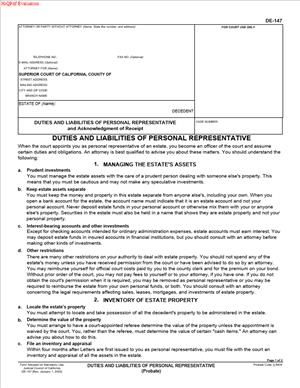
DE-147 – Duties and Liabilities of Personal Representative (Probate)
Fill out nowJurisdiction: Country: United States | Province or State: California
When someone dies, and a probate case is opened in California, the court appoints a personal representative to manage the estate. DE-147 – Duties and Liabilities of Personal Representative (Probate) is the document that explains what that role involves.
This form is not a contract you draft yourself. It is a court-issued notice that outlines your responsibilities once you are appointed. If you are becoming an executor or administrator, this document sets the ground rules for how you must act.
DE-147 – Duties and Liabilities of Personal Representative (Probate) matters because it explains your legal obligations in plain terms. It tells you what you are allowed to do, what you must do, and what could create personal liability.
If you are about to accept an appointment in a probate case, this form helps you understand the risks and expectations. Reading it carefully can prevent costly mistakes later in the estate process.
What is DE-147 – Duties and Liabilities of Personal Representative (Probate)?
Clear definition
DE-147 – Duties and Liabilities of Personal Representative (Probate) is a California probate court form that describes the legal duties of a personal representative. A personal representative may be called an executor (if named in a will) or an administrator (if appointed without a will).
The document explains how you must manage estate property, handle debts, communicate with beneficiaries, and follow court supervision rules. It also explains that you can be held personally responsible if you fail to carry out your duties properly.
This form functions as an official summary of your fiduciary responsibilities. A fiduciary is someone who must act in the best interests of others, not in their own interest.
Who typically uses this form?
You will see this form if you are being appointed as a personal representative in a California probate case. The court provides it at the start of the administration process.
Executors named in a will commonly receive it after filing a petition for probate and before or at the time letters are issued. Administrators appointed when there is no will also receive it.
Attorneys handling probate matters often review this document with their clients. However, many people handle probate without a lawyer. If you are self-represented, this form becomes even more important because it outlines the core responsibilities in writing.
Court staff and judges rely on this document as part of the formal appointment process. It serves as a written acknowledgment of the duties attached to the role.
Why might you need this form?
You need DE-147 – Duties and Liabilities of Personal Representative (Probate) because you cannot properly serve as a personal representative without understanding your obligations.
The form explains that you must gather and protect estate assets. This includes bank accounts, real estate, vehicles, and personal property. You must keep these assets separate from your own property.
It also explains your duty to pay valid debts and expenses. This includes funeral costs, taxes, and creditor claims that meet legal requirements.
The document highlights your responsibility to account to the court and to beneficiaries. You must track income, expenses, and distributions carefully. Poor recordkeeping can create serious problems.
Finally, it warns that you may be personally liable if you mismanage the estate. This means your own money could be at risk if you violate your duties.
Typical real-life scenarios
- A parent dies and names you as executor in their will. You file a petition with the probate court. When the court appoints you, you receive this form. It explains what you must do before distributing any inheritance.
- A relative dies without a will. You apply to be appointed as administrator. After the court grants your request, you receive this document. It outlines the same fiduciary duties that apply even though no will exists.
- You are helping a sibling who is the personal representative. They are unsure about selling the decedent’s home. The form explains when court approval may be required and what standards apply to managing estate property.
- You are handling a modest estate without an attorney. You want to understand what could expose you to personal liability. This document explains the risks tied to improper distributions or failure to follow court procedures.
When would you use DE-147 – Duties and Liabilities of Personal Representative (Probate)?
You encounter this form at the beginning of a probate administration. It is tied to your official appointment. You do not usually file it independently; it is part of the court’s probate process.
You use it when you are stepping into the role of fiduciary for an estate. This applies whether you are acting under a will or without one. The duties described apply in both situations, although specific powers may vary.
The form becomes especially relevant when you are making decisions about estate property. For example, before selling real estate, investing estate funds, or paying large claims, you may review the duties described in the document to understand your limits.
It also matters when you are preparing reports or accounts. The document explains that you owe a duty of full disclosure and accuracy to the court and interested parties.
If disputes arise among beneficiaries, this form provides a baseline. It describes the standard of conduct expected of you as a personal representative. Courts often evaluate actions against these fiduciary standards.
Legal characteristics of DE-147 – Duties and Liabilities of Personal Representative (Probate)
This form is an official California probate court document. It reflects statutory duties that apply to personal representatives. Its authority comes from state probate law, not from a private agreement.
For it to be effective in context, there must be an open probate case. You must be properly appointed by the court and issued letters testamentary or letters of administration. The duties described apply once that appointment is in place.
Problems commonly arise when a personal representative acts outside the scope of authority. For example, distributing assets too early, failing to notify creditors, or mixing estate funds with personal funds can create liability. Ignoring court supervision requirements may also cause issues.
Another common problem is misunderstanding the difference between independent administration and court-supervised administration. In California, some estates allow broader powers without prior court approval, while others require more oversight. The duties remain fiduciary in nature in both cases.
This document does not transfer property by itself. It does not appoint you. It does not replace the will. It does not eliminate the need to follow probate statutes or court orders. It is a summary of obligations, not a substitute for the full law.
Is it legally binding?
Yes, the duties described in this form are legally binding once you are appointed as personal representative. They reflect legal obligations imposed by California probate law.
You do not “agree” to them in the same way you sign a private contract. Instead, by accepting the appointment and acting in the role, you become subject to these duties automatically.
If you violate these duties, the court may impose consequences. This can include removal from office, surcharge orders requiring repayment to the estate, or other remedies designed to correct harm.
The binding nature comes from your status as a fiduciary. The law expects you to act with honesty, care, and loyalty. The form puts those expectations in writing so you understand them before proceeding.
How to fill out DE-147 – Duties and Liabilities of Personal Representative (Probate)
Step 1 – Review the case information at the top of the form
At the top of the document, you will see the court name and location. Confirm that the county and court address match your probate case. Check the estate name and case number for accuracy. These details connect the form to the correct probate file.
Step 2 – Read the introductory explanation carefully
The opening section explains that you are a fiduciary. Read this part slowly. It sets the tone for the entire document and clarifies that you must act in the best interests of beneficiaries and creditors. This section outlines the standard of care expected from you.
Step 3 – Understand your duty to manage and protect estate assets
The form describes your obligation to take control of estate property. This includes locating assets, securing them, and preventing loss. As you read, think about what property exists in the estate and how you will safeguard it. The form emphasizes separation between estate funds and your personal funds.
Step 4 – Review the rules about collecting debts and paying claims
The document explains that you must collect money owed to the estate. It also explains how to handle creditor claims. Pay attention to the requirement to follow formal procedures before paying debts. Improper payment of claims can create personal liability.
Step 5 – Study the guidance on sales and transactions
The form addresses selling estate property and entering transactions. It notes that some actions may require court approval, depending on the level of supervision in the case. As you review this section, connect it to your estate’s administration status.
Step 6 – Examine the accounting and reporting obligations
You are required to keep accurate records of all receipts and disbursements. The form explains your duty to provide accountings to the court and interested persons when required. Make sure you understand that detailed documentation supports every transaction.
Step 7 – Review the warnings about personal liability
Toward the end of the document, you will see clear statements about liability. These warnings explain that misuse of estate assets, conflicts of interest, or failure to follow court orders may result in personal financial responsibility. Read this section carefully so you understand the risks involved in the role.
Step 8 – Confirm acknowledgment if required by your court process
In some probate procedures, you may be required to acknowledge receipt or understanding of the duties described. If your case requires a signature or acknowledgment, ensure the information is accurate before signing. Verify that your name is spelled correctly and matches the appointment documents.
Legal terms you might encounter in DE-147 – Duties and Liabilities of Personal Representative (Probate)
- Personal Representative: The person appointed by the court to administer the estate. This may be called an executor (if named in a will) or an administrator (if there is no will). In this document, you are the personal representative once the court appoints you and issues authority.
- Fiduciary Duty: Your legal obligation to act in the best interest of the estate and its beneficiaries. This document explains that you must act honestly, avoid conflicts of interest, and manage estate property carefully. If you violate this duty, you can be held personally responsible.
- Letters: The official court documents that confirm your authority to act for the estate. They are often called Letters Testamentary or Letters of Administration. This form works together with those letters by explaining the responsibilities that come with that authority.
- Inventory and Appraisal: A detailed list of all estate assets and their values. As a personal representative, you must identify, gather, and report estate property. This term appears in the context of your duty to account for everything under your control.
- Notice to Creditors: A formal notification process that informs creditors about the probate case. The document explains that you must handle creditor claims properly and within required timelines. Failing to give proper notice can extend your responsibilities or expose you to liability.
- Creditor Claim: A written demand for payment from someone who believes the deceased owed them money. This form reminds you that you must evaluate and respond to claims correctly. You cannot ignore valid claims or pay improper ones.
- Accounting: A financial report showing what money and property came into the estate and how it was spent or distributed. The document explains that you must keep clear records and may need to present an accounting to the court or beneficiaries.
- Bond: A type of insurance that protects the estate if you misuse funds or fail to perform your duties. In some cases, the court requires a bond before issuing your authority. The form reminds you that you are financially responsible for mistakes, even if a bond is in place.
- Self-Dealing: Using estate property for your own benefit or entering transactions that create a conflict of interest. This document warns that self-dealing can lead to personal liability and court sanctions.
- Surcharge: A court order requiring you to repay the estate for losses caused by your actions or inaction. The form explains that you may be personally responsible if you fail to follow your duties.
FAQs
Do I have to sign DE-147 – Duties and Liabilities of Personal Representative (Probate)?
In most cases, this document is provided to you for review when you are appointed. Whether you must sign a separate acknowledgment depends on the court’s procedure. You should check the case file to confirm if a signed acknowledgment is required and make sure your name matches exactly as it appears on your Letters.
When do my duties officially begin?
Your duties begin when the court appoints you and issues your Letters. The effective date is usually the date shown on those Letters. This form explains the responsibilities that start from that point forward, not from the date of death or the date you filed the petition.
What happens if I disagree with something in this document?
This document outlines legal obligations that apply to personal representatives. You cannot modify it. If you are unsure about a specific responsibility, review the related court order and your appointment paperwork to understand how it applies to your case before taking action.
Do I file this document with the court?
Often, the court provides this form as part of the appointment packet. In some cases, a signed acknowledgment may be filed in the case record. Check your court’s instructions and confirm whether a copy appears in the docket after submission.
What if my name is spelled differently on different documents?
Your name must match exactly across your Letters, petition, and any acknowledgment tied to this form. If there is a discrepancy, request a correction before you begin acting on behalf of the estate. Inconsistent names can delay acceptance of filings or cause banks to reject your authority.
Does this form give me the authority to sell property?
No. Your authority comes from the court’s appointment and the specific powers listed in your Letters. DE-147 – Duties and Liabilities of Personal Representative (Probate) explains the limits and risks associated with exercising that authority, including when court approval may still be required.
Am I personally responsible for estate debts?
You are not personally responsible for the deceased person’s debts simply because you are the personal representative. However, you can become personally liable if you distribute assets before paying valid claims or if you mishandle estate funds. This document explains those risks so you can avoid them.
What changes in the public record after I receive this document?
The public record reflects your appointment through the court’s order and issued Letters. This document does not change ownership of property by itself. Instead, it confirms that you have been informed of your duties and that you are expected to follow them while administering the estate.
Checklist: Before, During, and After DE-147 – Duties and Liabilities of Personal Representative (Probate)
Before
- Confirm that the court has officially appointed you as personal representative.
- Obtain copies of your Letters showing your authority.
- Review the case number and party names for accuracy.
- Read the entire document carefully without skipping sections.
- Make a list of immediate estate assets you must secure.
- Identify deadlines for inventory, notices, and filings.
- Determine whether a bond is required and confirm its status.
During
- Follow the instructions and warnings described in the document.
- Keep estate funds in a separate, dedicated account.
- Track every dollar received and spent.
- Provide required notices to creditors and beneficiaries.
- Evaluate creditor claims before paying them.
- Seek court approval for actions that require it.
- Avoid any transactions that benefit you personally.
- Maintain written records of all communications and decisions.
After
- File any required acknowledgment with the court.
- Store a copy of the document with your estate records.
- Begin preparing the inventory and appraisal.
- Calendar important probate deadlines.
- Communicate your appointment to financial institutions.
- Monitor claims and response periods.
- Prepare for a future accounting to beneficiaries or the court.
- Review your actions regularly to ensure compliance.
Common mistakes to avoid with DE-147 – Duties and Liabilities of Personal Representative (Probate)
- Mistake: Assuming you can act before receiving official Letters, which happens when you want to move quickly; this can invalidate transactions and expose you to liability, so do not forget to confirm your authority date first.
- Mistake: Mixing estate funds with personal funds because it seems convenient; this creates accounting problems and potential personal liability, so do not forget to open and use a separate estate account.
- Mistake: Paying beneficiaries before resolving creditor claims, often due to family pressure; this can force you to repay the estate from your own money, so do not forget to verify claim periods and priorities.
- Mistake: Ignoring small assets because they seem insignificant; missing assets can result in incomplete inventories and court issues, so do not forget to document every item of value.
- Mistake: Entering into transactions that benefit you personally without court approval; this can lead to surcharge or removal, so do not forget your fiduciary duty.
- Mistake: Failing to keep receipts and written records because you rely on memory; poor documentation weakens your accounting and credibility, so do not forget to retain proof of every transaction.
- Mistake: Overlooking deadlines for inventory or notice requirements due to a lack of organization; missed deadlines can delay probate and trigger court scrutiny, so do not forget to calendar key dates.
- Mistake: Assuming a bond protects you completely; bonds may reimburse the estate, but the surety can pursue you for repayment, so do not forget that you remain personally responsible for misconduct.
What to do after filling out DE-147 – Duties and Liabilities of Personal Representative (Probate)
Once you have reviewed this document, treat it as your operating manual for the probate process. It outlines the standards you must follow from your first action to final distribution. Your next steps should focus on compliance and documentation.
- Step 1: Confirm the date your Letters were issued and record it in your estate file as your official start date.
- Step 2: Make at least two copies of this document—one for your working file and one for secure storage.
- Step 3: If required, file any signed acknowledgment with the court and verify it appears in the case record.
- Step 4: Open a dedicated estate bank account using your Letters and tax identification information.
- Step 5: Secure physical property such as real estate, vehicles, and valuables to prevent loss.
- Step 6: Begin compiling information for the inventory and appraisal, including account statements and ownership documents.
- Step 7: Notify financial institutions, government agencies, and other asset holders of your appointment.
- Step 8: Calendar deadlines for creditor notice periods and required filings.
- Step 9: Set up a tracking system, digital or paper, to log all income, expenses, and correspondence.
- Step 10: Review your authority limits before selling, transferring, or encumbering any asset.
- Step 11: Communicate clearly with beneficiaries about timelines and procedures to reduce misunderstandings.
- Step 12: Periodically review your actions against the duties described in this document to ensure you remain compliant.
Stay organized. Act transparently. When in doubt, pause and verify your authority before taking action. Careful administration protects the estate and protects you.
Disclaimer: This guide is provided for informational purposes only and is not intended as legal advice. You should consult a legal professional.