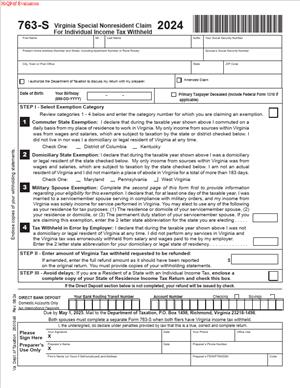
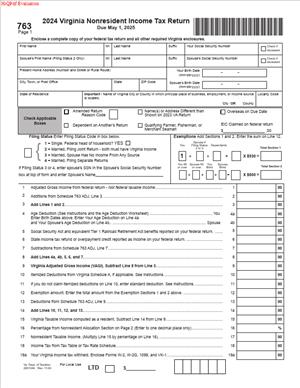
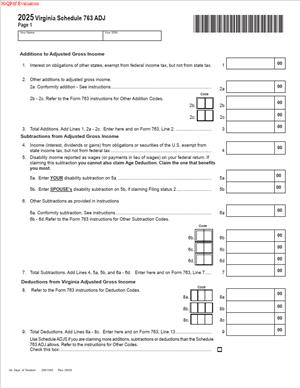
Form 763-S – Virginia Special Nonresident Claim for Individual Income Tax Withheld (2024)
Fill out nowJurisdiction: Country: United States | Province or State: Virginia
If you are a nonresident who had Virginia income tax withheld in 2024, Form 763-S – Virginia Special Nonresident Claim for Individual Income Tax Withheld (2024) is the document used to request a refund of that withholding. It is designed for people who do not live in Virginia but have Virginia tax taken out of certain payments.
This form focuses on a narrow situation. It is not a standard resident income tax return. It is a special claim used when Virginia tax was withheld from income that may not be taxable to you as a nonresident.
You are likely looking at this form because money was withheld in Virginia, and you believe you are entitled to get some or all of it back. The form allows you to formally report the withholding and claim the amount you believe should be refunded.
Understanding how this document works helps you avoid delays. When you complete it accurately and include the required information, it gives the Virginia Department of Taxation what it needs to review your claim.
This guide explains what the form does, when it applies, and how to complete each section clearly and correctly.
What is Form 763-S – Virginia Special Nonresident Claim for Individual Income Tax Withheld (2024)?
Clear definition
Form 763-S – Virginia Special Nonresident Claim for Individual Income Tax Withheld (2024) is a state tax document used by nonresidents to claim a refund of Virginia income tax that was withheld from certain payments made to them.
It is not a full-year income tax return for Virginia residents. Instead, it is a special claim form. You use it to report specific Virginia-source income and the amount of Virginia tax that was withheld on that income.
The form tells the Virginia Department of Taxation who you are, what income was subject to withholding, and how much tax was taken out. It then calculates whether you are entitled to a refund.
Who typically uses this form?
You typically use this form if you live outside Virginia and received income connected to Virginia. This often includes payments such as winnings, distributions, or other income where Virginia law required withholding at the source.
It is commonly used by individuals who do not maintain a home in Virginia and are not considered Virginia residents for tax purposes. Even so, they may have had Virginia tax withheld from a specific transaction.
Nonresident individuals who are not otherwise required to file a full Virginia nonresident return may use this form to claim back the withheld amount.
Why might you need this form?
You may need this form if Virginia tax was withheld from a payment, but your actual Virginia tax liability is lower than the amount withheld. In some cases, you may not owe any Virginia income tax at all.
Without filing this claim, the withholding remains with the state. The form creates a formal request for a refund based on your nonresident status and the type of income involved.
It also provides a structured way to document the withholding. This helps prevent disputes about how much tax was taken out and whether you are eligible for a refund.
Typical real-life scenarios
- You live in another state and received a one-time payment from a Virginia source. Virginia tax was withheld before you received the funds. You later determine that, as a nonresident, you may not owe the full amount that was withheld.
- You participated in an activity in Virginia that generated income, but you do not otherwise work or live in the state. The payer withheld Virginia income tax as required. You now need a way to reconcile that withholding.
- You received a distribution connected to Virginia real estate or another Virginia-based transaction. The withholding was automatic. After reviewing your situation, you believe the withholding exceeds your actual Virginia tax obligation.
- You are not required to file a regular Virginia nonresident income tax return for 2024, but tax was still withheld from a specific payment. This special claim form gives you a way to request a refund without filing a full return.
When would you use Form 763-S – Virginia Special Nonresident Claim for Individual Income Tax Withheld (2024)?
You use this form when you are a nonresident and Virginia income tax was withheld from certain payments made to you during the 2024 tax year.
This often happens when the payer is required by Virginia law to withhold tax at a flat rate or percentage. The withholding may not reflect your actual tax liability. The form allows you to calculate what you truly owe, if anything.
You might also use this form when the withholding was applied to income that is partially or fully exempt under Virginia rules for nonresidents. The form provides space to report the income and determine the correct tax amount.
In some cases, a nonresident may have only one Virginia-related transaction during the year. Instead of filing a more detailed nonresident return, this special claim can be used if it fits your situation.
The form is generally relevant to individuals, not businesses. It applies to personal income situations where withholding occurred at the source.
Legal characteristics of Form 763-S – Virginia Special Nonresident Claim for Individual Income Tax Withheld (2024)
This form is an official state tax document issued by the Virginia Department of Taxation. It must be completed accurately and signed to be processed.
For the claim to be effective, you typically need to provide complete identifying information. This includes your name, address, and taxpayer identification number. You also need to report the exact amount of Virginia tax withheld, as shown on supporting documents.
Claims are often delayed or rejected when required attachments are missing. For example, if you do not include proof of the withholding, the state may not be able to verify your claim. Math errors and incomplete sections can also cause processing issues.
The form applies specifically to the 2024 tax year. Using the wrong version of the year can lead to confusion or rejection.
Tax forms vary from state to state. Other states may have different procedures for nonresident withholding claims. Virginia’s process is specific to its own tax rules and definitions of residency and Virginia-source income.
This form does not change your residency status. It does not register you as a Virginia resident or create ongoing tax obligations by itself. It only addresses the withholding and potential refund for the 2024 tax year.
Is it legally binding?
When you sign and submit this form, you are making a formal statement to the state about your income and withholding. The signature typically includes a declaration that the information is true and correct to the best of your knowledge.
That declaration carries legal weight. Providing false or misleading information on a tax form can lead to penalties. The form is therefore legally significant.
However, the form itself is not a contract between you and another person. It is a tax filing. Its legal effect comes from tax law and the administrative process that follows submission.
Once processed, the state’s acceptance or adjustment of your claim determines the outcome. The form starts the review process.
How to fill out Form 763-S – Virginia Special Nonresident Claim for Individual Income Tax Withheld (2024)
Step 1 – Confirm your eligibility
Before entering any information, review whether you are a nonresident for Virginia tax purposes for 2024. Make sure the income in question had Virginia tax withheld and that this special claim form applies to your situation rather than a full nonresident return.
Step 2 – Gather your withholding documents
Collect all documents that show Virginia income tax withheld. This may include forms provided by the payer that list the gross income and the amount of Virginia tax deducted. You will need the exact figures shown on those documents.
Step 3 – Enter your personal identification information
Provide your full legal name, current mailing address, and taxpayer identification number as requested on the form. Use the same identifying number that appears on your withholding documents to avoid mismatches during processing.
Step 4 – Report the Virginia-source income
Enter the amount of income from which Virginia tax was withheld. Follow the line instructions carefully so that you place each figure in the correct location. Use the gross amount shown on your supporting documents unless the form directs otherwise.
Step 5 – Report the Virginia tax withheld
Enter the total amount of Virginia income tax withheld for 2024. If you have more than one withholding document, add the amounts together and report the combined total on the appropriate line.
Step 6 – Calculate your Virginia tax liability
Complete the calculation section of the form. This typically involves applying the relevant tax rate or formula to the Virginia-source income. Follow the line-by-line instructions and double-check your math before moving on.
Step 7 – Determine your refund amount
Subtract your calculated Virginia tax liability from the total Virginia tax withheld. If the withholding exceeds your liability, the difference is generally the amount you are claiming as a refund. Ensure the final figure is clearly written in the correct box.
Step 8 – Review for accuracy and completeness
Carefully read through the entire form. Confirm that all required fields are filled in, numbers are accurate, and totals are consistent with your supporting documents. Missing information is a common cause of delays.
Step 9 – Sign and date the form
Sign and date the form in the designated area. Your signature confirms that the information provided is accurate to the best of your knowledge. If the form allows for a preparer’s information, complete that section if someone assisted you.
Step 10 – Attach required documentation and prepare for submission
Attach copies of all documents that show Virginia tax withheld for 2024. Place them with the completed form as instructed. Make sure the copies are legible and clearly show your name, the income amount, and the tax withheld. Once assembled, the form is ready for submission according to the filing instructions provided with it.
Legal terms you might encounter in Form 763-S – Virginia Special Nonresident Claim for Individual Income Tax Withheld (2024)
- Nonresident: A nonresident is someone who does not live in Virginia but earns income from Virginia sources. On this form, you confirm that you were not a Virginia resident for the tax year but had Virginia tax withheld from certain income. Your residency status affects how your income is taxed and how your refund is calculated.
- Virginia-source income: This refers to income that is connected to Virginia. It may include wages earned while physically working in Virginia or income from a Virginia business or property. The form requires you to report only the portion of income tied to Virginia.
- Withholding: Withholding is the amount of Virginia income tax taken out of your pay or other payments during the year. Your employer or payer sends this money to the state on your behalf. This document helps you claim back any excess withholding.
- Tax year: The tax year is the calendar year for which you are reporting income and withholding. For the 2024 version, you report income earned and tax withheld during 2024. Make sure all documents you attach match the same year.
- Refund: A refund is money returned to you when the amount withheld exceeds your actual Virginia tax liability. This form is typically used to request a refund of Virginia tax withheld when you do not owe tax as a nonresident.
- Tax liability: Your tax liability is the amount of Virginia income tax you legally owe based on your Virginia-source income. On this form, you calculate whether you owe anything or whether you are entitled to a refund.
- Supporting documentation: These are the forms you attach to prove the amount of Virginia tax withheld. Common examples include wage statements or other income statements showing Virginia withholding. Without these documents, your claim may be delayed or denied.
- Signature under penalty of perjury: When you sign the form, you are declaring that the information is true and correct to the best of your knowledge. This makes your submission legally significant. Providing false information can lead to penalties.
- Identification number: This is usually your Social Security number or other taxpayer identification number. It connects your claim to your tax record. If this number is wrong or missing, your claim cannot be processed properly.
FAQs
Do I need to file Form 763-S – Virginia Special Nonresident Claim for Individual Income Tax Withheld (2024) if I never lived in Virginia?
You may need this form if Virginia income tax was withheld from income connected to Virginia, even if you never lived there. Check your wage or income statements for Virginia withholding. If tax was withheld and you believe you do not owe Virginia income tax, this document is used to request a refund.
What documents do I have to attach to this form?
You must attach copies of statements that show Virginia income tax withheld for the tax year. Look for forms that list Virginia as the state and show a specific amount withheld. If you do not include proof of withholding, your claim may be rejected or delayed.
What if my name is spelled differently on my income statement?
The name on this document should match your official tax records. If there is a small spelling error on your income statement, enter your legal name on the form and keep the document as issued. If the difference is significant, you may need to correct the income statement with the payer before filing.
Can I file this document electronically?
Whether you can file electronically depends on the filing options available for that tax year. Review the submission instructions that come with the form to see if electronic filing is accepted. If you file by mail, follow the mailing instructions carefully and keep proof of mailing.
What happens after I submit this form?
After submission, the tax authority reviews your information and attachments. They verify the amount of withholding and confirm that you qualify as a nonresident. If everything is correct, they process your refund and send it to the address or account you provided.
How do I know if I calculated my refund correctly?
Double-check the amount of Virginia-source income you reported and compare it to the tax withheld shown on your documents. Make sure you followed the tax calculation steps provided in the instructions. Errors in math or copying numbers are common reasons for adjustments.
What if I accidentally leave a section blank?
If required fields are blank, the processing agency may return the document or request additional information. Review every line before signing, especially identification numbers and withholding amounts. Incomplete forms slow down refunds.
Does filing this form change my residency status for other taxes?
No. This document only addresses your claim for Virginia income tax withheld for a specific year. It does not automatically change your residency status in other states or for other tax purposes. Your residency status is determined based on your living and working situation.
Checklist: Before, During, and After Form 763-S – Virginia Special Nonresident Claim for Individual Income Tax Withheld (2024)
Before
- Confirm that you were a nonresident of Virginia for the tax year.
- Review your income statements to see if Virginia tax was withheld.
- Gather all documents showing Virginia withholding for 2024.
- Verify your legal name and identification number.
- Check that all documents relate to the same tax year.
- Read the form instructions from start to finish.
- Make sure you understand how to calculate your Virginia tax liability.
During
- Enter your full legal name exactly as shown on your identification.
- Provide your correct Social Security number or taxpayer identification number.
- Report only Virginia-source income.
- Copy withholding amounts exactly as shown on your documents.
- Complete all required calculations carefully.
- Attach copies of all supporting withholding statements.
- Review every line for missing or inconsistent information.
- Sign and date the form in the required area.
After
- Make a complete copy of the signed form and all attachments.
- Submit the form using the approved method for the tax year.
- Keep proof of mailing or electronic submission.
- Monitor your mail or account for confirmation or requests for more information.
- Respond promptly if additional documentation is requested.
- Record the date you filed and the amount of refund claimed.
- Keep your copy and attachments with your tax records.
Common mistakes to avoid with Form 763-S – Virginia Special Nonresident Claim for Individual Income Tax Withheld (2024)
- Mistake: Reporting all of your income instead of only Virginia-source income, which happens when you copy totals from a federal return; this can lead to an incorrect tax calculation and delay your refund, so do not forget to separate Virginia income from other income.
- Mistake: Forgetting to attach proof of Virginia withholding because you assume the state already has it; this often results in processing delays or denial, so do not forget to include copies of all required statements.
- Mistake: Entering an incorrect Social Security number due to a typing error; this can prevent the claim from being matched to your records and may cause rejection, so do not forget to double-check every digit.
- Mistake: Leaving the signature line blank because you focus only on the numbers; an unsigned form is not valid and will not be processed, so do not forget to sign and date before submitting.
- Mistake: Using the wrong tax year’s version of the form, which happens when downloading an outdated copy; this can cause confusion or rejection, so do not forget to confirm you are using the 2024 version.
- Mistake: Miscalculating the refund due to simple math errors; this can trigger adjustments and slow down payment, so do not forget to review all calculations carefully.
- Mistake: Providing an outdated mailing address because you recently moved; this may result in a lost refund check or missed correspondence, so do not forget to update your current address.
- Mistake: Assuming you qualify as a nonresident without reviewing the definition; this can lead to filing the wrong form and possible penalties, so do not forget to confirm your residency status for the tax year.
What to do after filling out Form 763-S – Virginia Special Nonresident Claim for Individual Income Tax Withheld (2024)
Once you complete the form, slow down and review everything with fresh eyes. Small errors can delay your refund. You want your submission to be accurate, complete, and easy to process.
- Step 1: Review every page for accuracy. Check names, identification numbers, income amounts, and withholding figures against your source documents.
- Step 2: Confirm that all required attachments are included. Each withholding amount you claim should be supported by a document showing Virginia tax withheld.
- Step 3: Make a full copy of the signed form and every attachment. Keep both a paper copy and a digital scan if possible.
- Step 4: Choose your filing method. Follow the official instructions for mailing or electronic submission for the 2024 tax year.
- Step 5: If mailing, use the correct address listed in the instructions and consider a mailing method that provides delivery confirmation.
- Step 6: Record the date you submitted the form and the amount of refund you claimed. Keep this note with your tax records.
- Step 7: Monitor your mail and, if applicable, your bank account for your refund or for any request for additional information.
- Step 8: Respond quickly to any notice asking for clarification or more documents. Delays in responding can slow down your refund.
- Step 9: Once you receive your refund, compare the amount to what you calculated. If there is a difference, review the notice explaining the adjustment.
- Step 10: Store the final processed form, attachments, and any correspondence with your long-term tax records. You may need them if questions arise later.
Staying organized after filing is just as important as completing the form correctly. Good records protect you if there are questions about your nonresident status or the amount of tax withheld. They also make next year’s filing easier.
Disclaimer: This guide is provided for informational purposes only and is not intended as legal advice. You should consult a legal professional.