Form 763 – 2024 Virginia Nonresident Income Tax Return
Fill out nowJurisdiction: Country: United States | Province or State: Virginia
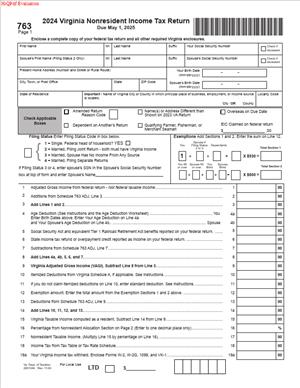
The 763 – 2024 Virginia Nonresident Income Tax Return is the state income tax form used by people who earned income in Virginia but did not live there during the tax year. It helps Virginia calculate how much tax applies specifically to the income connected to the state.
If you worked in Virginia while living elsewhere, this form may be part of your annual filing. It separates your Virginia-source income from income earned in other states or countries. That separation matters because Virginia taxes only certain income of nonresidents.
This document is designed for individuals, not businesses. It focuses on wages, business income, rental income, and other earnings tied to Virginia. It works alongside your federal income tax return but serves a different purpose.
Filing this form correctly helps ensure your tax is calculated accurately. It also allows you to claim credits or adjustments that apply to nonresidents. A careful review before submission can prevent delays or notices from the state.
What is the 763 – 2024 Virginia Nonresident Income Tax Return?
Clear definition
The 763 – 2024 Virginia Nonresident Income Tax Return is a state tax form issued by the Commonwealth of Virginia – Department of Taxation. It is used to report income earned from Virginia sources by individuals who were not Virginia residents during the tax year.
The form calculates the portion of your total income that is taxable by Virginia. It starts with figures from your federal return. Then it applies Virginia-specific rules to determine the correct state tax amount.
This document is separate from the Virginia resident return. It is specifically structured for nonresidents. It allocates income based on where it was earned, not where you live.
Who typically uses this form?
You might use this form if you live in another state but commute to a job in Virginia. Many employees in border areas fall into this category.
Independent contractors who perform services physically in Virginia often use it as well. The same applies to consultants, temporary workers, and project-based professionals.
Business owners who operate in multiple states may also need this form. If part of your business income is connected to Virginia activities, that portion may be reported here.
Military spouses, remote workers with Virginia-based assignments, and individuals who sold Virginia property while living elsewhere may also encounter this filing requirement.
Why might you need this form?
You may need this form because states generally tax income earned within their borders. Even if you live elsewhere, Virginia can tax income that has a clear connection to work or property in the state.
Filing the correct nonresident return helps avoid double taxation. It can also support credits claimed in your home state for taxes paid to Virginia.
In some cases, Virginia income tax may have been withheld from your paycheck. This form allows you to reconcile that withholding with your actual tax liability. You may owe additional tax or qualify for a refund.
Submitting the proper documents also keeps your state tax record accurate. It reduces the risk of notices related to underreporting or mismatched wage information.
Typical real-life scenarios
- You live in Maryland but drive to Arlington for work every weekday. Your employer withholds Virginia income tax. At year-end, you complete a nonresident return to report only your Virginia wages.
- You live in North Carolina and run a consulting business. During the year, you complete several in-person projects for clients in Richmond. The income from those projects is connected to Virginia and may be reported on this form.
- You moved out of Virginia early in the year and became a resident of another state. For the remainder of the year, you continued earning rental income from a property in Virginia. That rental income is typically Virginia-source income.
- You reside in another state and sell a house located in Virginia. The gain from that sale may be treated as Virginia-source income. The nonresident return helps determine whether Virginia tax applies to that gain.
When would you use the 763 – 2024 Virginia Nonresident Income Tax Return?
You would use this form during the annual tax filing season if you were a nonresident of Virginia for the entire tax year and earned income from Virginia sources. The timing usually aligns with federal and other state tax deadlines.
This document is often used by employees whose primary residence is outside Virginia but whose job location is inside the state. It may also apply to people who split their professional activities between multiple states.
If you receive a Form W-2 showing Virginia wages and state tax withholding, that is a common indicator that this return may be relevant. The same applies if you receive certain tax forms reporting income connected to Virginia real estate or business operations.
This filing may also arise when you receive a notice from Virginia requesting clarification about income earned within the state. In those cases, the return provides a structured way to report and calculate any tax due.
If you are involved in a partnership, S corporation, or similar entity operating in Virginia, you may receive a statement showing your share of Virginia-source income. That allocation often flows into this nonresident return.
Legal characteristics of 763 – 2024 Virginia Nonresident Income Tax Return
This form is an official state tax document issued by the Commonwealth of Virginia – Department of Taxation. Its structure, calculations, and required attachments are defined by state tax rules.
For the filing to be effective, it must generally be complete, accurate, and signed. Required schedules and supporting documents are commonly attached. Omissions, math errors, or missing identification details can cause processing delays.
Accuracy in allocating income is especially important for nonresidents. The form typically requires you to distinguish between total income and the portion attributable to Virginia. Misclassifying income can lead to adjustments or additional review.
State tax agencies often use data matching systems. They compare the information on your return with wage statements and other filings. Inconsistencies may result in notices or requests for clarification.
This document does not change your residency status. It reports income based on nonresident classification for the tax year. It also does not replace your federal tax return or your home state return. Each serves a separate legal and administrative purpose.
Tax rules may vary slightly depending on the type of income involved. For example, wages are often sourced differently from business or rental income. The form is structured to reflect these distinctions at a high level.
Is it legally binding?
Yes. When you complete and sign the return, you are declaring that the information is true and correct to the best of your knowledge. That declaration carries legal significance.
Your signature confirms that you reviewed the figures and that they reflect your Virginia-source income. If the return is filed electronically, the electronic authorization serves a similar function.
Once submitted, the return becomes part of your official tax record with the state. The state may assess tax, issue a refund, or request additional information based on the contents of the filing.
The form itself does not create a contract between you and another private party. Instead, it fulfills a statutory reporting obligation. Its legal effect arises from state tax law, not from negotiation or agreement between individuals.
How to fill out 763 – 2024 Virginia Nonresident Income Tax Return
Step 1 – Gather your federal return and income documents
Start by collecting your completed federal income tax return for 2024. Much of the information on this form is based on your federal adjusted gross income.
Have your Forms W-2, 1099, and any schedules showing business, rental, or investment income. You will use these to identify which portions are connected to Virginia.
If you received a statement allocating income from a partnership or similar entity, keep that document nearby. It often shows the Virginia-source amount separately.
Step 2 – Enter your personal identification information
Fill in your name, current mailing address, and Social Security number in the spaces provided. If filing jointly, include your spouse’s information as required.
Indicate clearly that you are filing as a nonresident for the 2024 tax year. Confirm that the identifying details match your federal return to avoid processing issues.
Double-check spelling and numbers. Small errors in identification fields can delay handling of your submission.
Step 3 – Report your total federal income
Transfer the requested income figures from your federal return to the appropriate lines. This typically includes your federal adjusted gross income and other referenced amounts.
These entries establish your total income from all sources. The form then uses this baseline to determine what portion is taxable by Virginia.
Make sure the numbers match your federal filing exactly where required. Differences may trigger review.
Step 4 – Allocate Virginia-source income
Identify the income that was earned from Virginia sources. This may include wages for work performed in Virginia, business income tied to Virginia operations, or income from Virginia property.
Enter the Virginia-source amounts in the designated column or section. The form is designed to compare total income with Virginia income side by side.
Review your allocation carefully. The distinction between total and Virginia-only income drives the tax calculation.
Step 5 – Apply Virginia adjustments and deductions
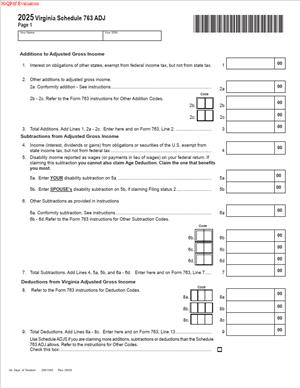
Complete the section for additions, subtractions, or other adjustments required under Virginia rules. Some adjustments differ from federal treatment.
Follow the line instructions to determine which items apply to nonresidents. Only include amounts that relate to Virginia-source income when required by the form’s structure.
After adjustments, calculate the Virginia taxable income as directed.
Step 6 – Calculate the Virginia tax and credits
Use the tax tables or rate schedules provided with the form to compute the tentative Virginia tax. Apply the calculation to the taxable income determined in the previous step.
Enter any allowable credits in the appropriate section. Credits may reduce the amount of tax owed, depending on your situation.
Subtract credits from the calculated tax to determine your net Virginia tax liability.
Step 7 – Reconcile withholding and payments
Enter the amount of Virginia income tax withheld from your wages, as shown on your Forms W-2. Include any estimated payments made during the year, if applicable.
Add these payments together and compare the total to your net Virginia tax. This step shows whether you have overpaid or still owe tax.
If payments exceed your liability, the difference may be treated as a refund. If liability exceeds payments, the remaining balance is the amount due with your filing.
Step 8 – Review, sign, and prepare for submission
Read through the entire return once more. Confirm that all required schedules and supporting documents are attached as indicated in the instructions.
Sign and date the return in the designated area. If filing jointly, ensure both required signatures are included.
Make a copy of the completed return for your records. Then prepare it for submission according to the filing method you choose.
Legal terms you might encounter in 763 – 2024 Virginia Nonresident Income Tax Return
- Nonresident: A nonresident is someone who did not live in Virginia during the tax year but earned income connected to Virginia. On this form, you confirm that you were not a full-year resident. Your filing status as a nonresident determines how your income is taxed and how it is allocated.
- Virginia-source income: This refers to income earned from work performed in Virginia, business conducted in Virginia, rental property located in Virginia, or other Virginia-based activities. You must report only the portion of your total income that is attributable to Virginia. This calculation directly affects how much Virginia tax you owe.
- Adjusted Gross Income (AGI): This is your total income after certain federal adjustments, taken from your federal return. The form starts with your federal AGI as the baseline. From there, you make Virginia-specific additions and subtractions to determine your Virginia taxable income.
- Additions and Subtractions: These are adjustments required under Virginia tax law that increase or decrease your federal income for state tax purposes. Examples may include interest from other states’ bonds or certain retirement income adjustments. You must enter these amounts carefully because they change your taxable income.
- Allocation Percentage: Nonresidents calculate a ratio of Virginia-source income to total income. This percentage determines how much of your overall income is subject to Virginia tax. A small miscalculation here can significantly change your tax result.
- Withholding: This is the tax already taken out of your wages or other payments for Virginia. You report the total Virginia tax withheld as shown on your wage and tax statements. This amount reduces what you owe or increases your refund.
- Estimated Tax Payments: These are payments you made directly to Virginia during the year, usually in quarterly installments. You include these payments when calculating your final balance. If you forget to report them, you may appear to owe more than you actually do.
- Tax Credits: Credits reduce your Virginia tax liability dollar for dollar. Some credits are refundable, meaning you could receive money back even if your tax is zero. You must meet eligibility rules and provide the required details to claim them.
- Filing Status: Your filing status usually mirrors your federal status, such as single or married filing jointly. The status affects tax rates and standard deduction amounts. Make sure it matches your federal return unless specific instructions require otherwise.
- Refund or Balance Due: After subtracting withholding and payments from your calculated tax, you either have a refund or an amount owed. The form walks you through this final calculation. The result determines whether you receive money back or must pay additional tax.
FAQs
Do I need to file 763 – 2024 Virginia Nonresident Income Tax Return if I only worked in Virginia for part of the year?
If you earned income from work physically performed in Virginia while living elsewhere, you may need to file this form. Even short-term or temporary work can create Virginia-source income. Check your wage statement for Virginia withholding and confirm that your employer reported Virginia wages.
What documents should I have in front of me before completing this form?
You should have your completed federal return, all wage and income statements, and any records showing Virginia tax withheld. You will transfer figures such as federal adjusted gross income and itemized deductions directly from your federal return. You also need documentation of estimated payments and any credits you plan to claim.
How do I know what counts as Virginia-source income?
Look at where the work was performed or where the property is located. Wages for days worked in Virginia, rental income from Virginia property, and business income tied to Virginia activities generally count. You may need to allocate income if you worked in multiple states during the year.
What happens if the name or Social Security number on this form does not match my federal return?
A mismatch can delay processing or cause the return to be rejected. Always enter your name and identification number exactly as shown on your Social Security card and federal return. Double-check spelling, suffixes, and number sequences before submitting.
Do I need to attach my federal return when filing this document?
In many cases, you must include a copy of your federal return and supporting schedules, especially if you claim certain deductions or credits. The information on this document is based on your federal figures. Attaching the required pages helps the tax agency verify your entries.
Can I file this form jointly with my spouse if only one of us earned Virginia income?
You generally follow your federal filing status. If you filed jointly at the federal level, you may file jointly here, but you will still allocate only the Virginia-source portion of income. Review the instructions carefully to determine how to separate or combine income for allocation purposes.
How do I correct an error after submitting the 763 – 2024 Virginia Nonresident Income Tax Return?
You typically must file an amended version of this form for the same tax year. Use the corrected figures and clearly indicate that it is an amended return. Keep records showing what changed and why, such as a corrected wage statement.
How will I know if my return has been accepted or if I owe additional tax?
After filing, you should receive confirmation through the filing method you used or a written notice if there is an issue. If you owe additional tax, you may receive a bill outlining the balance and any penalties or interest. Monitor your mail and keep copies of everything you submitted.
Checklist: Before, During, and After 763 – 2024 Virginia Nonresident Income Tax Return
Before
- Confirm that you were a nonresident of Virginia for the tax year.
- Gather your completed federal income tax return.
- Collect all wage and income statements showing Virginia withholding.
- Compile records of estimated tax payments made to Virginia.
- Identify all sources of income connected to Virginia.
- Review instructions for available credits and deductions.
- Verify your Social Security number and current mailing address.
During
- Enter your name and identification number exactly as shown on official documents.
- Transfer your federal adjusted gross income accurately.
- Calculate total income from all sources before allocation.
- Determine your Virginia-source income carefully.
- Compute the allocation percentage correctly.
- Apply Virginia additions and subtractions as required.
- Subtract withholding and estimated payments from total tax.
- Double-check math on every calculation line.
After
- Review the entire return for completeness and signatures.
- Attach required federal schedules and supporting documents.
- Make a full copy of the signed return for your records.
- Submit the return using your chosen filing method.
- Record the date of submission and any confirmation number.
- Monitor for acknowledgment or correspondence.
- Retain proof of payment if you owed additional tax.
- Store records in a secure place for future reference.
Common mistakes to avoid with 763 – 2024 Virginia Nonresident Income Tax Return
- Mistake: Reporting all of your income as taxable in Virginia because you misunderstood the nonresident rules, which happens when you skip the allocation step, leading to overpaying tax and forgetting to calculate the Virginia-source percentage correctly.
- Mistake: Forgetting to include Virginia withholding from your wage statements, which often occurs when you focus only on federal amounts, resulting in a smaller refund or an incorrect balance due, and not remembering to enter every withholding line.
- Mistake: Using incorrect figures from a draft federal return, which happens if you file state taxes before finalizing your federal return, causing mismatched records and delays because you did not confirm the final adjusted gross income.
- Mistake: Failing to attach required schedules, which occurs when you assume the numbers alone are enough, leading to processing delays and requests for more information because you did not include supporting documents.
- Mistake: Miscalculating the allocation percentage, which happens when you mix total income and Virginia income figures, resulting in incorrect tax calculations and forgetting to double-check the ratio formula.
- Mistake: Signing the return incorrectly or not at all, which can happen when filing quickly near a deadline, causing the return to be considered incomplete and not remembering that both spouses may need to sign if filing jointly.
- Mistake: Ignoring small estimated payments made earlier in the year, which happens if you forget about electronic payments, leading to overpayment or billing issues because you did not reconcile all payment records.
What to do after filling out 763 – 2024 Virginia Nonresident Income Tax Return
Once you complete the form, slow down before you submit it. A careful final review can prevent delays and extra correspondence.
- Step 1: Review every identification field. Confirm your name, Social Security number, and address are correct and match your federal return.
- Step 2: Recheck your income allocation. Make sure the Virginia-source income amount and the allocation percentage are consistent throughout the form.
- Step 3: Verify all withholding and estimated payments. Compare each entry to your wage statements and payment confirmations.
- Step 4: Confirm that you attached the required documents. This may include portions of your federal return and any schedules that support additions, subtractions, or credits.
- Step 5: Sign and date the return. If you are filing jointly, ensure both spouses sign where required.
- Step 6: Make a complete copy of everything. Keep a digital and paper copy if possible, including attachments and proof of payment.
- Step 7: Submit the return using your selected method. If filing electronically, save the submission confirmation. If mailing, note the mailing date and keep proof of delivery.
- Step 8: Track confirmation or acknowledgment. Watch for any notice indicating acceptance, adjustment, or a request for more information.
- Step 9: Pay any balance due promptly. If you owe tax, follow the payment instructions and keep proof of the transaction.
- Step 10: Update your personal records. Record the amount of refund or payment in your financial files so you can reference it next year.
- Step 11: Store all related tax documents securely. Keep them organized by tax year in case you need to respond to questions or prepare future returns.
Taking these steps helps you close out the tax year cleanly. You reduce the chance of delays, corrections, or unexpected notices later.
Disclaimer: This guide is provided for informational purposes only and is not intended as legal advice. You should consult a legal professional.