Form 763 ADJ – 2025 Virginia Schedule
Fill out nowJurisdiction: Country: United States | Province or State: Virginia
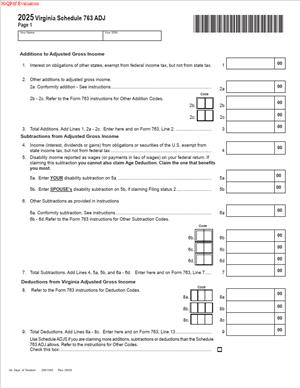
Form 763 ADJ – 2025 Virginia Schedule is a state tax adjustment schedule used with a Virginia income tax return. If you are completing a Virginia nonresident or part-year resident return for 2025, this document helps you calculate specific additions and subtractions to your income.
You use this form when your federal adjusted gross income needs to be changed for Virginia tax purposes. It does not replace your main tax return. Instead, it works alongside it and supports the numbers you report.
If you are filling out your return on your own, this schedule can feel technical. Each line connects to a specific type of income, deduction, or adjustment. Knowing what belongs here can prevent delays or incorrect tax calculations.
Understanding how the Form 763 ADJ – 2025 Virginia Schedule fits into your filing helps you report income accurately. It also helps you explain any differences between your federal and Virginia taxable income.
What is Form 763 ADJ – 2025 Virginia Schedule?
Clear definition
Form 763 ADJ – 2025 Virginia Schedule is a state income tax adjustment schedule issued by the Commonwealth of Virginia, Department of Taxation. It is designed to report Virginia-specific additions and subtractions to federal adjusted gross income.
Virginia begins its tax calculation with your federal adjusted gross income. However, state law does not always treat income and deductions the same way the federal government does. This form captures those differences.
The schedule lists categories of income that Virginia requires you to add back, as well as items you are allowed to subtract. The totals from this form flow into your main Virginia return and affect your final tax amount.
It is not a payment form. It is also not a standalone filing. It supports your Virginia individual income tax return for the 2025 tax year.
Who typically uses this form?
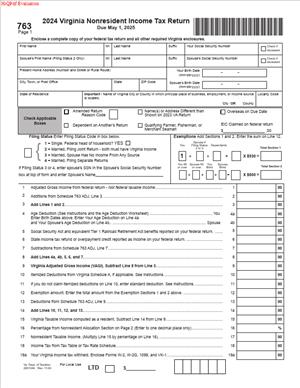
You typically use this schedule if you are filing a Virginia nonresident or part-year resident income tax return. It is commonly attached to Form 763, which is the return for those who did not live in Virginia for the entire year but had Virginia-source income.
Individuals who moved into or out of Virginia during 2025 often need this form. Nonresidents who earned wages, business income, rental income, or other income from Virginia sources may also use it.
Self-employed individuals sometimes complete this schedule if their federal return includes adjustments that Virginia handles differently. Retirees, investors, and business owners may also use it if they have income types that require state-specific treatment.
If your income is simple and fully taxed the same way at the federal and state levels, you may not need to enter much on this form. But if your financial situation includes special credits, deductions, or out-of-state elements, this schedule becomes more important.
Why might you need this form?
You might need this form because Virginia does not always follow federal tax rules. Certain deductions allowed federally may not be allowed by Virginia. In those cases, you report an addition.
On the other hand, Virginia may allow subtractions that reduce your taxable income. These could apply to specific types of retirement income, military benefits, or other categories defined by state law.
Without this schedule, your Virginia taxable income could be calculated incorrectly. That can result in overpaying, underpaying, or receiving notices from the tax department asking for clarification.
Using the correct adjustment schedule also helps explain why your Virginia income is different from your federal income. That transparency can reduce processing delays.
Typical real-life scenarios
- You lived in another state but worked in Virginia for part of the year. Your federal return reports all your income together. Form 763 ADJ – 2025 Virginia Schedule helps separate and adjust what Virginia can tax.
- You moved out of Virginia in mid-2025 and became a resident of another state. Some income earned after your move may not be fully taxable by Virginia. Adjustments reported on this schedule help calculate the correct portion.
- You claimed a federal deduction that Virginia does not recognize. In that case, you may need to add that amount back on this schedule so your Virginia taxable income reflects state rules.
- You received income from a source that Virginia partially excludes from taxation. Reporting that subtraction on this form can reduce your state taxable income and change your final tax due.
When would you use Form 763 ADJ – 2025 Virginia Schedule?
You use this form at the time you prepare your Virginia nonresident or part-year resident income tax return for the 2025 tax year. It is completed before you finalize the total tax calculation on your main return.
If you review your federal adjusted gross income and notice items that Virginia treats differently, this is when the schedule becomes relevant. It is part of the normal filing process, not a separate event.
Nonresidents earning Virginia wages often encounter this form when allocating income between states. Part-year residents use it when determining which income belongs to their Virginia residency period.
Taxpayers with investment income, business income, or specialized deductions may also use this schedule during return preparation. It becomes part of the standard sequence of completing worksheets and transferring totals.
If you receive a request from the Virginia Department of Taxation asking for clarification about adjustments, you may also revisit this schedule. In that situation, it serves as a reference for how your numbers were calculated.
Legal characteristics of Form 763 ADJ – 2025 Virginia Schedule
This schedule is an official state tax document. It becomes part of your income tax filing once submitted with your return. The information you enter is treated as part of your signed tax declaration.
For the form to be effective, it must be completed accurately and attached to the correct return. The totals must match the corresponding lines on your Virginia income tax form. Inconsistent figures can delay processing.
Common problems include entering federal amounts without applying Virginia rules, skipping required additions, or miscalculating totals. Errors often occur when numbers are not transferred correctly from supporting worksheets.
State tax adjustment schedules vary from one state to another. Even if you have completed a similar form elsewhere, Virginia’s categories and rules may differ. Using assumptions from another state can lead to incorrect reporting.
This schedule does not calculate your entire tax liability on its own. It does not authorize refunds or payments independently. It simply adjusts income before the tax rate is applied.
Is it legally binding?
Yes, once you submit it as part of your signed Virginia income tax return, the information on this schedule is legally binding in the same way as the rest of your return. You are declaring that the information is true and complete to the best of your knowledge.
The binding effect comes from your signature on the overall tax return, whether filed electronically or on paper. The schedule is incorporated into that filing.
If the information is incorrect, the Virginia Department of Taxation may adjust your return. This can result in additional tax, interest, or a revised refund amount. In some cases, the department may request documentation to support the adjustments you claimed.
The form itself does not create a contract between private parties. Its legal effect is administrative and tax-related. It documents how you calculated your Virginia-adjusted income for the 2025 tax year.
How to fill out Form 763 ADJ – 2025 Virginia Schedule
Step 1 – Review your federal adjusted gross income
Start with a copy of your completed federal income tax return for 2025. Locate your federal adjusted gross income. This number is the starting point for Virginia adjustments and should match what you report on your Virginia return.
Carefully review the income and adjustment sections of your federal return. Identify any items that Virginia may treat differently, such as certain deductions or income exclusions.
Step 2 – Read each addition category
Move to the additions section of the schedule. Each line represents a type of income or deduction that Virginia requires you to add back to your federal adjusted gross income.
Read each description closely. Compare it to your federal return and supporting documents. If an item applies, enter the appropriate amount on that line.
Do not estimate. Use exact figures from your records. If multiple additions apply, complete each relevant line before calculating the total additions.
Step 3 – Calculate total additions
After entering all applicable additions, add the amounts together. Enter the total in the space provided for total additions.
Check your math carefully. Errors at this stage affect the rest of your tax calculation. Confirm that the total matches the sum of the individual lines.
Transfer this total to the corresponding line on your Virginia income tax return, as instructed by the form.
Step 4 – Review each subtraction category
Next, examine the subtractions section. These lines list categories of income that Virginia allows you to exclude or reduce from your federal adjusted gross income.
Compare each category to your financial records. Common examples may include certain retirement income or other state-specific exclusions. Only enter amounts that clearly match the description on the line.
Enter each qualifying subtraction separately. Keep your calculations organized so you can explain how you arrived at each number if needed.
Step 5 – Calculate total subtractions
Add all subtraction amounts you entered. Write the total in the designated total subtraction line.
Double-check the arithmetic. Then transfer the total subtraction to the proper line on your main Virginia return.
Make sure you are entering additions and subtractions in the correct places. Mixing them up changes your taxable income.
Step 6 – Determine your Virginia adjusted income
Using the totals from additions and subtractions, calculate your Virginia-adjusted income as directed on the form. This usually involves adding total additions to your federal adjusted gross income and then subtracting total subtractions.
Follow the sequence shown on the schedule. Do not skip lines, even if the amount is zero.
Verify that the final adjusted figure matches what you report on your Virginia nonresident or part-year resident return.
Step 7 – Cross-check with your main return
Before finalizing your filing, compare the totals on this schedule with the related lines on your Virginia return. The numbers must align exactly.
Review your entire return for consistency. Ensure names, identification numbers, and tax year information are correct on all documents.
Once you confirm the figures are accurate, include this completed schedule with your Virginia income tax return for submission.
Legal terms you might encounter in Form 763 ADJ – 2025 Virginia Schedule
- Adjusted Gross Income (AGI): This is your total income after certain federal adjustments. On this schedule, your federal AGI is the starting point. Every addition and subtraction you report here changes how Virginia calculates your taxable income.
- Additions: These are amounts you must add back to your federal AGI for Virginia purposes. They often include income that was not taxed federally but is taxable in Virginia. Each additional line requires you to enter a specific amount and sometimes reference supporting documents.
- Subtractions: These are amounts Virginia allows you to subtract from your federal AGI. They reduce your Virginia taxable income. You must enter each subtraction on the correct line and ensure it matches the category described.
- Nonresident Income: Income you earned from Virginia sources while not a full-year Virginia resident. This schedule supports the calculation of income taxable by Virginia. You need to clearly separate Virginia-source income from income earned elsewhere.
- Virginia Source Income: Income that comes from work performed, property located, or business conducted in Virginia. This term matters because only certain income is subject to the Virginia tax for nonresidents and part-year residents. The schedule helps align your reported income with Virginia rules.
- Part-Year Resident: A person who lived in Virginia for only part of the tax year. If this applies to you, you must carefully allocate income between the time you lived in Virginia and the time you did not. Your entries on this schedule must reflect that split.
- Allocation and Apportionment: These terms describe how income is divided between Virginia and other states. Allocation applies to specific types of income. Apportionment usually applies to business income and follows a formula.
- Taxable Income: This is the final income amount Virginia uses to calculate your tax. It results from starting with federal AGI, adding required additions, and subtracting allowed subtractions. This schedule directly affects the final number.
- Supporting Documentation: These are records that back up the figures you enter. Examples include federal schedules, W-2 forms, 1099 forms, or other tax worksheets. You may need to attach copies or keep them available if requested.
- Carryover: An amount from a prior tax year that can be applied to the current year. Some subtractions or adjustments may involve carryover figures. You must confirm the correct amount from your previous return before entering it.
FAQs
Do I always need to complete Form 763 ADJ – 2025 Virginia Schedule?
You complete this form only if you have additions or subtractions that change your Virginia adjusted income. If every line is zero and you have no state-specific adjustments, you generally do not need to include it. Review your federal return and compare it to Virginia rules before deciding.
Where do I find the numbers I need to enter on this document?
Most figures come directly from your federal return, especially your adjusted gross income and certain schedules. You may also need W-2 forms, 1099 forms, and prior-year state returns. Match each amount to the correct line description rather than guessing based on similar wording.
What if my federal return changes after I file this form?
If your federal adjusted gross income or related schedules change, your Virginia numbers may also change. You would need to prepare an amended Virginia return reflecting the corrected figures. Keep copies of both the original and updated federal documents so you can trace what changed.
Do I have to attach proof for every addition or subtraction?
You must attach any schedules or forms specifically required by the instructions. Even when attachments are not required, you should keep documentation that supports each number. If the tax authority reviews your return, they may request those records.
How do I handle income earned both inside and outside Virginia?
You need to separate Virginia-source income from income earned elsewhere. Use your work records, employer statements, or business records to calculate the correct portion. Enter only the amount that qualifies under the line description for Virginia adjustments.
What happens if I leave a line blank instead of entering zero?
Leaving a line blank can create confusion about whether you overlooked it. Enter zero where appropriate, so your math is clear. This helps prevent processing delays or follow-up questions.
Who signs or approves this document?
This schedule is included with your main Virginia return, which you sign. By signing the return, you confirm that the information on all attached schedules, including this one, is accurate. If someone prepares your return for you, they may also need to provide their information.
Will this form change my refund or the amount I owe?
Yes. Because it changes your Virginia adjusted income, it can increase or decrease your taxable income. That directly affects the tax calculation, which then impacts your refund or balance due.
Checklist: Before, During, and After Form 763 ADJ – 2025 Virginia Schedule
Before
- Gather your complete federal tax return, including all schedules.
- Collect W-2, 1099, and any other income statements.
- Review your prior-year Virginia return for carryover amounts.
- Confirm your residency status for the tax year.
- Identify any income earned from Virginia sources.
- Separate documents for additions and subtractions.
- Check for any changes in federal law that affect your income reporting.
During
- Enter your federal adjusted gross income exactly as shown on your federal return.
- Read each additional line carefully before entering an amount.
- Double-check calculations for each addition category.
- Review each subtraction category and confirm eligibility.
- Enter zeros where no adjustment applies.
- Add total additions and total subtractions accurately.
- Verify that your final Virginia adjusted income matches the figure transferred to your main return.
- Recalculate all math before moving on.
After
- Review the completed schedule line by line.
- Confirm that totals match the figures on your main Virginia return.
- Attach any required supporting schedules.
- Make a complete copy of the schedule for your records.
- Store digital and paper copies securely.
- Monitor your filing confirmation or acknowledgment.
- Keep all supporting documents with your annual tax file.
- Be prepared to respond if additional information is requested.
Common mistakes to avoid with Form 763 ADJ – 2025 Virginia Schedule
- Mistake: Entering the wrong federal adjusted gross income because you used a draft return; this happens when you print forms before finalizing your federal filing, and it can lead to mismatched records and correction notices, so do not forget to use the final filed version.
- Mistake: Claiming a subtraction without confirming eligibility; this often occurs when taxpayers assume federal deductions automatically apply to Virginia, which can result in disallowed amounts and added tax, so do not forget to read each subtraction description carefully.
- Mistake: Forgetting to include required additions; this happens when income excluded federally is still taxable in Virginia, and it may reduce your reported income incorrectly, so do not forget to review all addition categories.
- Mistake: Misallocating income between Virginia and another state; this is common for part-year residents and remote workers, and it can cause overpayment or underpayment, so do not forget to calculate Virginia-source income precisely.
- Mistake: Leaving lines blank instead of entering zero; this happens when rushing through the form, and it may delay processing or trigger questions, so do not forget to complete every applicable line.
- Mistake: Failing to transfer the final adjusted income to the main return correctly; this occurs when totals are not double-checked, and it can change your tax due or refund amount, so do not forget to verify the final figure.
- Mistake: Not keeping copies of supporting documents; this often happens after electronic filing, and it can make responding to future inquiries difficult, so do not forget to save both digital and paper records.
- Mistake: Ignoring carryover amounts from prior years; this happens when prior returns are not reviewed, and it can cause you to miss valid adjustments or report incorrect amounts, so do not forget to check last year’s records.
What to do after filling out Form 763 ADJ – 2025 Virginia Schedule
Once you finish the schedule, pause before filing. A short review now can prevent problems later.
Start by confirming that the final Virginia adjusted income on this schedule matches the amount entered on your main Virginia return. The numbers must align exactly. Even a small mismatch can delay processing.
- Step 1: Recalculate all totals manually or with a calculator to confirm accuracy.
- Step 2: Compare each addition and subtraction against your supporting documents.
- Step 3: Ensure all required attachments are included with your return.
- Step 4: Review your residency status and confirm it matches the rest of your return.
- Step 5: Make a full copy of the completed schedule and your entire state return.
- Step 6: Save digital copies in a secure folder with clear file names.
- Step 7: Submit your return using your chosen filing method and confirm it was successfully transmitted or received.
- Step 8: Keep proof of submission or mailing with your tax records.
- Step 9: Monitor your refund status or confirmation of processing.
- Step 10: Store this year’s return with prior-year records for future reference.
After submission, pay attention to any communication you receive. If the tax authority sends a notice asking for clarification, respond promptly and provide copies of the documents that support your entries.
Keep this schedule with your annual tax file for several years. You may need it to verify carryover amounts, residency allocation, or prior adjustments in future filings.
If your federal return is later amended, revisit your Virginia return. Changes at the federal level often require corresponding changes at the state level. Acting quickly helps reduce interest or additional charges.
By treating this schedule as a working document rather than just a worksheet, you create a clear paper trail. That protects you if questions arise and makes next year’s filing easier.
Disclaimer: This guide is provided for informational purposes only and is not intended as legal advice. You should consult a legal professional.