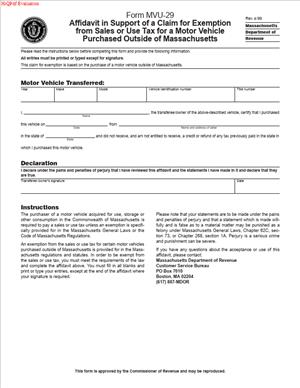
Form MVU-29 – Affidavit in Support of a Claim for Exemption from Sales or Use Tax for a Motor Vehicle Purchased Outside of Massachusetts
Fill out nowJurisdiction: Country: United States | Province or State: Massachusetts
Form MVU-29 – Affidavit in Support of a Claim for Exemption from Sales or Use Tax for a Motor Vehicle Purchased Outside of Massachusetts is a document you use to explain why you believe you do not owe Massachusetts sales or use tax on a vehicle bought in another state. It is a sworn statement that supports your claim for a tax exemption when registering the vehicle in Massachusetts.
If you recently moved to Massachusetts or purchased a car while living elsewhere, this form may become part of your registration process. The state generally collects sales or use tax when a vehicle is registered. This form gives you a structured way to claim that an exemption applies to your situation.
You complete the document as part of a filing tied to your vehicle registration. The information you provide helps determine whether your claim meets the legal requirements for exemption. Accuracy matters because the statement is made under oath.
Understanding what this form does can help you avoid delays. If it is incomplete or inconsistent with other records, your registration or exemption request may be held up. Knowing what to expect makes the completion process more straightforward.
What is Form MVU-29 – Affidavit in Support of a Claim for Exemption from Sales or Use Tax for a Motor Vehicle Purchased Outside of Massachusetts?
Clear definition
Form MVU-29 – Affidavit in Support of a Claim for Exemption from Sales or Use Tax for a Motor Vehicle Purchased Outside of Massachusetts is an affidavit. An affidavit is a written statement of facts that you swear are true.
In this context, the form supports your claim that you qualify for a sales or use tax exemption when registering a motor vehicle in Massachusetts. It focuses on vehicles purchased outside the state and later brought into Massachusetts.
The document collects details about the vehicle, the purchase, your residency, and the circumstances surrounding the transaction. These details are used to assess whether the exemption rules apply to you.
Who typically uses form MVU29?
You typically use this form if you bought a vehicle in another state and are now registering it in Massachusetts. This often happens when you move to Massachusetts and bring your car with you.
It may also apply if you were temporarily living in another state, purchased a vehicle there, and later returned to Massachusetts. In some cases, military personnel, students, or individuals with dual residences encounter this situation.
The person completing the form is usually the vehicle owner listed on the title and registration application. If there are co-owners, the information must align with how the vehicle is titled.
Why might you need MVU29 form?
Massachusetts generally imposes a sales or use tax when a vehicle is registered in the state. If you claim that you qualify for an exemption, you need to provide supporting information.
This form gives the state a formal explanation of why the tax should not apply. It allows you to present facts such as prior residency, length of ownership, or tax paid elsewhere, depending on the type of exemption claimed.
Without this document, your claim for exemption may not be processed. The form becomes part of the overall submission tied to your vehicle registration.
Typical real-life scenarios
- You move from another state to Massachusetts and bring a car you purchased and used while living there. You believe you qualify for an exemption because the vehicle was owned and used outside Massachusetts before your move.
- You purchased a car while temporarily assigned to another state for work. After returning to Massachusetts, you seek to register the vehicle without paying use tax again.
- You were a full-time student in another state and bought a vehicle during that time. When you establish residency in Massachusetts, you claim that the prior ownership and use meet the exemption criteria.
- You received a vehicle as part of a qualifying transfer outside Massachusetts and later brought it into the state. You use the affidavit to explain the transaction and why it falls within an exemption category.
When would you use Form MVU-29 – Affidavit in Support of a Claim for Exemption from Sales or Use Tax for a Motor Vehicle Purchased Outside of Massachusetts?
You would use this form at the time you register a motor vehicle in Massachusetts if you are not paying the standard sales or use tax and are claiming an exemption instead. The form is part of the registration-related filing process.
This situation often arises when you establish Massachusetts residency after living elsewhere. During the registration process, the state reviews whether tax is due. If you state that an exemption applies, the affidavit provides the factual basis for that statement.
It may also be used when the vehicle was purchased and primarily used outside Massachusetts for a period of time before being brought into the state. The timing of the purchase, the period of use, and your residency history can all be relevant.
Dealership purchases within Massachusetts generally involve tax collection at the point of sale. In contrast, when a vehicle is purchased out of state and later registered in Massachusetts, tax questions are addressed during registration. This form is typically connected to that later stage.
If more than one owner is listed, the circumstances of each owner may matter. The information in the affidavit is expected to match the title, bill of sale, and other registration documents submitted at the same time.
Legal characteristics of Form MVU-29 – Affidavit in Support of a Claim for Exemption from Sales or Use Tax for a Motor Vehicle Purchased Outside of Massachusetts
This form is an affidavit, which means it is a sworn statement. You are declaring that the facts you provide are true to the best of your knowledge. The effectiveness of the document depends on complete and accurate information.
For the form to be considered valid, it generally must be filled out in full, signed, and dated. If notarization is required, the signature must be properly witnessed. Missing signatures, incomplete sections, or conflicting information can lead to rejection or delay.
Common problems include mismatched dates between the affidavit and the vehicle title, unclear ownership history, or missing details about where and when the vehicle was used. Inconsistent residency information can also raise questions.
The form supports a claim for exemption, but it does not automatically grant one. The reviewing authority evaluates the information along with other documents in your submission. If the facts do not meet the exemption criteria, tax may still be assessed.
Rules regarding vehicle tax exemptions can vary from state to state. While this document applies to Massachusetts, other states may use different forms or standards. The details required in Massachusetts may not match those used elsewhere.
The affidavit does not transfer ownership, change title information, or replace registration forms. It is limited to supporting a tax exemption claim connected to a vehicle purchased outside the state.
Is it legally binding?
Yes, in the sense that it is a sworn statement. By signing, you are affirming that the information is true. Providing false information in an affidavit can carry legal consequences.
The binding nature relates to your declaration of facts, not to the approval of the exemption. Signing the form does not guarantee that your claim will be accepted. It confirms that you stand behind the accuracy of your statements.
If errors are discovered later, the state may reassess the tax situation. Because the document becomes part of your official filing, it can be referenced in future reviews related to the vehicle or the exemption claim.
How to fill out Form MVU-29 – Affidavit in Support of a Claim for Exemption from Sales or Use Tax for a Motor Vehicle Purchased Outside of Massachusetts
Step 1 – Review the entire form before writing anything
Read through the full document from top to bottom. Identify the information requested about the vehicle, your residency, and the purchase details. This helps you gather all necessary documents before you begin the completion.
Step 2 – Enter your personal and ownership information
Provide your full legal name as it appears on the vehicle title and registration paperwork. Include your current address and any other identifying details requested. Make sure this information matches the rest of your registration filing.
If there are co-owners, include their names exactly as shown on the title. Inconsistent spelling or missing middle initials can create processing issues.
Step 3 – Describe the vehicle accurately
Fill in the vehicle identification number, make, model, year, and other required details. Copy this information directly from the title or manufacturer’s certificate to reduce the risk of errors.
Even a single incorrect digit in the vehicle identification number can delay review. Take time to double-check each entry before moving on.
Step 4 – Provide purchase information
State where and when the vehicle was purchased. Include the name of the seller and the purchase price if the form requests it. The dates you provide should match your bill of sale and title documents.
Be precise about the location. Indicating the correct state and city supports your explanation that the purchase occurred outside Massachusetts.
Step 5 – Explain your residency and use history
Answer the questions about where you lived at the time of purchase and how long the vehicle was used outside of Massachusetts. Provide dates that clearly show the timeline.
If the form asks about when you became a Massachusetts resident, enter the date carefully. This detail is often central to evaluating an exemption claim.
Step 6 – State the basis for your exemption claim
Indicate the specific exemption category that applies to your situation, as reflected on the form. Your explanation should align with the facts you have already provided about ownership, residency, and use.
Keep your statements factual and consistent. Avoid adding unrelated information that does not support the exemption criteria listed on the document.
Step 7 – Review for consistency and completeness
Before signing, compare your answers with your supporting documents. Check that names, dates, and vehicle details match across all paperwork in your submission.
Confirm that no required fields are left blank. An incomplete form can be returned or set aside until corrected.
Step 8 – Sign and date the affidavit
Sign the form exactly as your name appears in the ownership section. Enter the date of signing in the space provided.
If notarization is required, sign in the presence of a notary and ensure the notary completes their portion fully. Once signed, the affidavit becomes part of your official registration filing and supports your claim for exemption from sales or use tax.
Legal terms you might encounter in Form MVU-29 – Affidavit in Support of a Claim for Exemption from Sales or Use Tax for a Motor Vehicle Purchased Outside of Massachusetts
- Affidavit: An affidavit is a written statement made under oath. When you sign this document, you are swearing that the information you provide is true. False statements can lead to penalties, so you must ensure every detail is accurate.
- Exemption: An exemption means you are claiming that you do not owe sales or use tax under specific rules. On this form, you explain why your vehicle purchase qualifies for that exception. The exemption is not automatic; you must clearly state your basis.
- Use Tax: Use tax applies when sales tax was not collected at the time of purchase. If you bought a vehicle outside the state and did not pay equivalent tax, use tax may be assessed. This document supports your claim that the tax should not apply.
- Domicile: Domicile refers to your primary legal residence. The form may require you to explain where you lived at the time of purchase and where the vehicle was principally used. Your domicile helps determine tax responsibility.
- Principal Place of Garaging: This means the main location where the vehicle is kept when not in use. It matters because tax rules often depend on where the vehicle is primarily stored and operated.
- Consideration: Consideration is the total value paid for the vehicle. This includes cash, trade-in value, or other compensation. You must accurately report this amount because it affects whether tax would normally apply.
- Supporting Documentation: These are records you attach to back up your statements. Examples include bills of sale, registration documents, proof of residency, or tax receipts from another state. The agency reviewing your claim relies on these materials.
- Penalty of Perjury: This phrase means you are legally responsible for the truth of your statements. By signing, you confirm that the information is correct to the best of your knowledge. Providing false information can result in fines or other consequences.
- Transfer of Title: This refers to the legal change of ownership from the seller to you. The date of title transfer often appears in the form and must match your purchase documents.
- Tax Paid to Another Jurisdiction: This term refers to sales or use tax you may have already paid in another state. You may need to state the amount and provide proof. This detail helps determine whether an exemption applies.
FAQs
Do I have to complete Form MVU-29 – Affidavit in Support of a Claim for Exemption from Sales or Use Tax for a Motor Vehicle Purchased Outside of Massachusetts if I already paid tax in another state?
You may still need to complete this form if you are claiming that no additional tax is due. Paying tax elsewhere does not automatically remove the obligation to explain your situation. You must provide the amount paid, the state where it was paid, and attach proof such as a receipt or tax statement.
What documents should I attach to support my exemption claim?
Attach documents that match the statements you make. This often includes your bill of sale, title certificate, registration from the prior state, proof of residency at the time of purchase, and proof of tax paid if applicable. Make sure names, dates, and vehicle identification numbers match exactly across all documents.
What if the name on my purchase documents is slightly different from my current legal name?
The names must be consistent. If there is a difference due to marriage, divorce, or another legal change, include documentation showing the name change. Do not assume the reviewing office will overlook small differences. Inconsistent names can delay acceptance of this document.
When is the effective date of my exemption?
The effective date is usually tied to the date you purchased or took possession of the vehicle. You should confirm that the purchase date, title transfer date, and any registration dates align with your explanation. The form records the timeline you rely on to support your claim.
Who is allowed to sign this document?
You must sign if you are the owner claiming the exemption. If the vehicle is owned jointly, each owner may need to sign, depending on how the title is issued. If someone signs on behalf of a business or another person, that individual must have authority and may need to indicate their role.
What happens if I realize I made an error after submitting this form?
If you discover a mistake, act quickly. You may need to submit a corrected statement or additional documentation. Do not ignore the issue, because incorrect information under oath can create complications.
Will submitting this form automatically approve my exemption?
No. This document supports your claim, but the reviewing agency evaluates the information and attachments. If details are missing or inconsistent, you may be contacted for clarification. Approval depends on whether your facts meet the requirements.
Does this form change my vehicle registration or title status?
This form does not by itself change title or registration records. It addresses the tax aspect of your vehicle purchase. However, the information you provide must match your registration and title documents to avoid processing delays.
Checklist: Before, During, and After Form MVU-29 – Affidavit in Support of a Claim for Exemption from Sales or Use Tax for a Motor Vehicle Purchased Outside of Massachusetts
Before
- Gather your bill of sale and confirm the purchase price.
- Locate the vehicle title showing the transfer date.
- Collect proof of residency for the time of purchase.
- Obtain proof of any sales or use tax paid to another state.
- Confirm the vehicle identification number on all documents.
- Review your registration documents for consistency.
- Check that all owners’ names are spelled correctly.
- Make copies of every supporting document.
During
- Read each question carefully before writing an answer.
- Use full legal names exactly as shown on the title.
- Enter the vehicle identification number without errors.
- State the purchase date and location clearly.
- Explain your exemption basis in clear, factual language.
- Double-check that your timeline is consistent.
- Attach all supporting documents referenced.
- Sign and date the affidavit in the correct place.
After
- Make a complete copy of the signed form for your records.
- Keep copies of all attachments submitted.
- Submit the form according to the required filing method.
- Track the date you submitted the documents.
- Watch for confirmation or follow-up requests.
- Respond promptly if additional information is requested.
- Store your records with your vehicle title paperwork.
- Update your personal records to reflect the exemption claim.
Common mistakes to avoid with Form MVU-29 – Affidavit in Support of a Claim for Exemption from Sales or Use Tax for a Motor Vehicle Purchased Outside of Massachusetts
- Mistake: Reporting a purchase price that does not match the bill of sale, often because of rounding or forgetting to include trade-in value, which can trigger review or rejection; do not forget to copy the exact amount shown on your supporting documents.
- Mistake: Leaving sections blank because you think they do not apply, which happens when instructions are skimmed and can delay processing; do not forget to write “N/A” where appropriate instead of leaving empty spaces.
- Mistake: Providing inconsistent dates between the title, registration, and your written explanation, often due to confusion about delivery versus signing dates, which can raise credibility concerns; do not forget to verify all dates before signing.
- Mistake: Forgetting to attach proof of tax paid to another state, which commonly occurs when receipts are misplaced and may result in denial of the exemption; do not forget to include clear, legible copies.
- Mistake: Signing without reviewing the penalty of perjury statement, which happens when people rush and can expose you to legal consequences if the information is inaccurate; do not forget to reread your answers carefully.
- Mistake: Using nicknames or shortened names that do not match official documents, which can cause identity verification issues; do not forget to use your full legal name exactly as it appears on the title.
What to do after filling out Form MVU-29 – Affidavit in Support of a Claim for Exemption from Sales or Use Tax for a Motor Vehicle Purchased Outside of Massachusetts
Once you complete the form, pause before submitting it. A careful final review can prevent delays. Compare every entry to your supporting documents. Make sure the vehicle identification number, purchase price, and dates are identical across all records.
- Step 1: Make a full copy of the signed form and every attachment for your records.
- Step 2: Organize the documents in the same order referenced in the form to make review easier.
- Step 3: Confirm the required submission method, whether in person or with other registration paperwork.
- Step 4: Submit the form together with any related vehicle registration or title documents if required.
- Step 5: Record the date and method of submission for your files.
- Step 6: Monitor for any written notice, receipt, or confirmation that your documents were received.
- Step 7: Respond promptly if you receive a request for clarification or additional documents.
- Step 8: Keep all paperwork in a secure place with your title and tax records.
- Step 9: Update your personal financial records to reflect that you claimed a tax exemption.
- Step 10: Retain the documents long term in case questions arise during future title transfers or audits.
Staying organized protects you. If questions come up later about your vehicle purchase or tax status, you will have a clear paper trail. That preparation can save time and reduce stress.
Disclaimer: This guide is provided for informational purposes only and is not intended as legal advice. You should consult a legal professional.