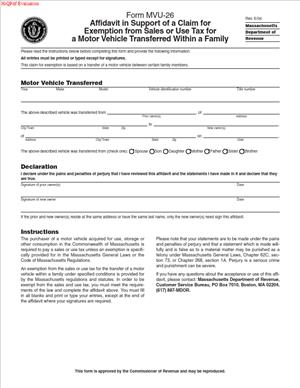
Form MVU-26 – Affidavit in Support of a Claim for Exemption from Sales or Use Tax for a Motor Vehicle Transferred Within a Family
Fill out nowJurisdiction: Country: United States | Province or State: Massachusetts
Form MVU-26 – Affidavit in Support of a Claim for Exemption from Sales or Use Tax for a Motor Vehicle Transferred Within a Family is a document used in Massachusetts to request an exemption from sales or use tax when a vehicle is transferred between certain family members. You complete it when a car, truck, or other qualifying motor vehicle changes ownership within your family and you believe no tax is due.
When you transfer a vehicle in most situations, the state expects sales or use tax to be paid. However, some family transfers may qualify for an exemption. This form is how you formally state that your transfer meets the requirements.
The document works as a sworn statement. You confirm the relationship between the parties and provide details about the vehicle and the transfer. The information you provide supports your claim that the transaction should not be taxed.
If you are about to fill it out, your main goal is simple: clearly show who is transferring the vehicle, who is receiving it, how you are related, and that the transfer qualifies for the exemption. Accuracy matters because this form becomes part of the vehicle registration and tax record.
What is Form MVU-26 – Affidavit in Support of a Claim for Exemption from Sales or Use Tax for a Motor Vehicle Transferred Within a Family?
Clear definition
Form MVU-26 – Affidavit in Support of a Claim for Exemption from Sales or Use Tax for a Motor Vehicle Transferred Within a Family is a written affidavit submitted to support a claim that no sales or use tax is owed on a motor vehicle transferred between qualifying family members in Massachusetts.
An affidavit is a written statement made under oath. By signing this form, you are declaring that the information you provide is true. The document connects the family relationship to the vehicle transfer and explains why tax should not apply.
It is not a bill of sale. It does not transfer ownership by itself. Instead, it supports a tax exemption connected to the transfer.
Who typically uses form MVU26?
You typically use this form if you are receiving a vehicle from a qualifying family member and want to claim that the transfer is exempt from sales or use tax.
The person giving the vehicle may also need to provide information or a signature, depending on how the transfer is structured. Both parties usually have an interest in ensuring the transfer is processed correctly.
Common users include parents transferring a vehicle to a child, spouses transferring a vehicle to one another, or other qualifying family members transferring ownership without a traditional sale.
Why might you need the MVU26 form?
You may need this form when you are registering a vehicle in your name after receiving it from a family member and want to avoid being assessed sales or use tax on the transfer.
Without this document, the transaction may be treated like a standard sale. That could trigger a tax calculation based on the vehicle’s value or purchase price.
The form provides the official explanation for why the tax should not apply. It helps prevent delays in registration and reduces the risk that the transaction will be processed as taxable by default.
Typical real-life scenarios
- A parent gives a used car to a child who has just received a driver’s license. No money changes hands. The child needs to register the car and uses this form to claim that the transfer is exempt from tax because it occurred within a qualifying family relationship.
- One spouse transfers sole ownership of a vehicle to the other spouse as part of a change in financial arrangements. Even if there is no sale price, the state still requires documentation. The affidavit supports the claim that no tax is due because of the marital relationship.
- A vehicle is transferred between siblings as part of settling personal property after a family event. The receiving sibling completes the registration process and submits the affidavit to support the exemption request.
- A grandparent gives a vehicle to a grandchild. The grandchild provides the required details about the relationship and the vehicle, using the form to confirm that the transfer falls within the family exemption rules.
- In each of these examples, the key issue is not just that the transfer is within a family, but that it meets the specific criteria for exemption under Massachusetts tax rules.
When would you use Form MVU-26 – Affidavit in Support of a Claim for Exemption from Sales or Use Tax for a Motor Vehicle Transferred Within a Family?
Use this form when applying to register and title a vehicle in Massachusetts after receiving it from a qualifying family member. Submit the affidavit with the required registration and title documents when transferring ownership into the recipient’s name.
The form is generally used when a vehicle’s legal ownership changes between eligible family members and the recipient must be recorded as the new titled and registered owner. It supports a request to exempt the transaction from Massachusetts motor vehicle sales or use tax.
A family transfer affidavit may also be required when the vehicle is given as a gift rather than sold. Even when no payment is exchanged, the transaction may still be reviewed for tax purposes. The affidavit identifies the parties, describes their family relationship, and confirms that the transfer meets the requirements for the claimed tax exemption.
If the vehicle’s title is being reassigned from one family member to another, submit the exemption request as part of the title transfer process. The affidavit does not transfer ownership by itself; it supports the requested tax treatment while the title and registration documents establish the ownership change.
Family vehicle transfers may arise from household changes, estate planning, divorce, or other personal circumstances. However, not every transfer between relatives qualifies for the same exemption, and certain situations may require different documents. Review the eligible family relationships and supporting-document requirements before filing. Complete the affidavit accurately and submit it with the properly assigned title, registration application, proof of insurance, and any other required records.
Legal characteristics of Form MVU-26 – Affidavit in Support of a Claim for Exemption from Sales or Use Tax for a Motor Vehicle Transferred Within a Family
This form functions as a sworn declaration. Its effectiveness depends on the truthfulness and completeness of the information you provide. You are affirming that the relationship and circumstances meet the exemption requirements.
To be valid, the form must be filled out completely and signed as required. Missing signatures, incomplete vehicle information, or unclear descriptions of the relationship can delay processing or lead to rejection.
Accuracy in vehicle details is critical. The vehicle identification number, make, model, and year must match the title and registration records. Any discrepancy can trigger additional review.
The form does not automatically guarantee approval of the exemption. It supports your claim, but the reviewing authority may evaluate whether the relationship and transfer meet the applicable criteria.
Common issues that cause problems include listing a relationship that does not qualify, leaving sections blank, or providing inconsistent dates between the title transfer and the affidavit. Clerical errors can also create delays.
This document does not replace other required filings. You may still need a properly assigned title, registration application, and any other required documentation for the vehicle transfer. The affidavit only addresses the tax exemption portion.
While many states offer family-based tax exemptions for vehicle transfers, the exact relationships that qualify and the required documentation can differ. This form is specific to Massachusetts and reflects its rules and procedures.
Is it legally binding?
Yes, in the sense that it is a sworn statement. When you sign the affidavit, you are declaring that the information is true to the best of your knowledge. False statements on a sworn document can carry legal consequences.
The form binds you to the accuracy of the facts you provide, such as the nature of the relationship and the details of the transfer. It does not create a contract between family members. Instead, it serves as a declaration made to a government authority.
Its legal effect is limited to the tax exemption claim. It does not determine ownership by itself, change title records on its own, or resolve disputes between family members about the vehicle.
How to fill out Form MVU-26 – Affidavit in Support of a Claim for Exemption from Sales or Use Tax for a Motor Vehicle Transferred Within a Family
Step 1 – Identify the transferor and transferee
Start by entering the full legal name of the person transferring the vehicle and the full legal name of the person receiving it. Use names exactly as they appear on the title and identification documents. Provide addresses and any other requested identifying details clearly and completely.
Step 2 – Provide vehicle information
Enter the vehicle identification number, year, make, and model. Double-check the VIN against the title to avoid errors. Even a single incorrect digit can delay processing or require correction before the transfer can be completed.
Step 3 – State the family relationship
Indicate the exact relationship between the transferor and the transferee. Be specific. For example, identify whether the relationship is parent and child, spouses, siblings, or another qualifying category. The exemption depends on this detail.
Step 4 – Describe the nature of the transfer
Provide the date of the transfer and describe whether the vehicle was given as a gift or transferred without payment. If any consideration was involved, ensure that the description matches the facts of the transaction. Consistency between this form and the title assignment is important.
Step 5 – Review for completeness and consistency
Before signing, read through the entire form carefully. Confirm that names, dates, and vehicle details match the title and any registration paperwork. Make sure no required fields are left blank and that all information is legible.
Step 6 – Sign the affidavit
Sign the form where indicated. Because it is an affidavit, your signature confirms that the information is true. If the form requires additional signatures, such as from the transferor, ensure those are completed as well.
Step 7 – Submit your registration paperwork
Include the completed form with your other required vehicle transfer and registration documents. The affidavit becomes part of the overall submission used to process the ownership change and review the claimed tax exemption.
Legal terms you might encounter in Form MVU-26 – Affidavit in Support of a Claim for Exemption from Sales or Use Tax for a Motor Vehicle Transferred Within a Family
- Affidavit: A written statement made under oath. When you sign this form, you are declaring that the information you provided is true. False statements can lead to penalties, including tax assessments and possible legal consequences.
- Transferor: The person who is giving or transferring the vehicle. This is the current owner listed on the title. The transferor must be identified clearly, including their full legal name.
- Transferee: The person receiving the vehicle. This is the new owner who will register and title the vehicle in their name. The transferee is usually the one claiming the tax exemption.
- Sales Tax: A tax imposed on the sale or transfer of tangible property, including motor vehicles. Normally, when a vehicle changes ownership, tax is due based on the purchase price or value. This form supports your claim that no tax should apply because the transfer qualifies as a family exemption.
- Use Tax: A tax similar to sales tax that applies when sales tax was not collected at the time of transfer. In vehicle transactions, use tax may be assessed during registration. This document is used to show that neither sales nor use tax should be charged due to the family relationship.
- Exemption: A legal exception that removes the requirement to pay tax. In this context, the exemption applies only if the transfer meets specific family relationship criteria and other conditions set by the tax authority.
- Consideration: Something of value exchanged for the transfer, usually money. If money or other compensation is involved, it may affect whether the transfer qualifies for an exemption. You must accurately describe whether the vehicle was a gift or transferred for payment.
- Fair Market Value: The reasonable value of the vehicle in the open market. If the transfer is not a true gift, the tax authority may look at the fair market value to determine tax due. Claiming an exemption does not eliminate review of the vehicle’s value if facts are unclear.
- Immediate Family: A defined group of close relatives who qualify under the exemption rules. The form requires you to state the specific relationship, such as parent, child, or spouse. Only relationships listed as eligible qualify.
- Declaration Under Penalties of Perjury: A statement at the end of the form confirming that all information is true to the best of your knowledge. By signing, you accept legal responsibility for the accuracy of the details provided.
FAQs
Do both the transferor and transferee need to sign this document?
In most situations, the person claiming the exemption signs the affidavit. However, you should review the signature section carefully to confirm whether one or both parties must sign. If a signature line appears for each party, both must sign for the document to be accepted.
What family relationships qualify for the exemption?
You must check the list provided in the form and select the relationship that applies. The exemption is limited to specific immediate family relationships. If your relationship is not listed exactly as required, the exemption may be denied, and tax could be assessed.
What happens if money is exchanged for the vehicle?
If payment was made, you must disclose that amount. The exemption may not apply if the transfer was a sale rather than a gift. Leaving out this information can result in reassessment of tax and possible penalties.
Do I need to attach proof of the family relationship?
You generally are not required to attach documents unless requested, but you must be prepared to provide proof if the tax authority asks. This could include birth certificates, marriage certificates, or adoption records. Make sure the names on those documents match the names listed on this form.
Where do I submit Form MVU-26 – Affidavit in Support of a Claim for Exemption from Sales or Use Tax for a Motor Vehicle Transferred Within a Family?
You typically submit this document along with your vehicle registration and title paperwork at the time you apply to register the vehicle. It becomes part of the registration record. If you fail to submit it with your application, the exemption may not be processed.
What if the names on the title and this document do not match exactly?
You should ensure that the names are consistent across the title, registration application, and this document. Differences in spelling, middle initials, or married names can delay processing. If a legal name change occurred, you may need supporting documentation to clarify the discrepancy.
Can this exemption be claimed if the vehicle still has a lien?
A lien does not automatically disqualify the transfer, but you must ensure the lienholder’s requirements are satisfied. The title cannot usually be transferred without lienholder authorization. The exemption only addresses tax, not lender approval.
What does signing this form legally mean for me?
By signing Form MVU-26 – Affidavit in Support of a Claim for Exemption from Sales or Use Tax for a Motor Vehicle Transferred Within a Family, you are affirming that the transfer qualifies under the family exemption rules. You are declaring that the facts about the relationship and the nature of the transfer are accurate. If the information is incorrect, you may be responsible for unpaid tax, interest, or penalties.
Checklist: Before, During, and After Form MVU-26 – Affidavit in Support of a Claim for Exemption from Sales or Use Tax for a Motor Vehicle Transferred Within a Family
Before
- Confirm that your family relationship qualifies under the exemption rules.
- Gather the current vehicle title showing the transferor’s name.
- Verify the full legal names of both parties as they appear on official IDs.
- Determine whether any payment or other consideration was involved.
- Check for outstanding liens on the vehicle title.
- Review the registration application requirements.
- Ensure you have accurate vehicle details, including VIN and year.
- Prepare any documents that could prove your family relationship if requested.
During
- Enter the transferor’s full legal name exactly as shown on the title.
- Enter the transferee’s full legal name exactly as it will appear on registration.
- Carefully write the vehicle identification number without errors.
- Select or state the correct family relationship.
- Disclose whether the transfer was a gift or involved payment.
- Review every field for completeness before signing.
- Read the declaration under penalties of perjury.
- Sign and date the form in the correct location.
After
- Make a complete copy of the signed form for your records.
- Submit the form with your registration and title documents.
- Confirm that the exemption is reflected in your transaction receipt.
- Keep proof of submission in case of later questions.
- Store the copy with your vehicle title records.
- Monitor for any follow-up correspondence requesting clarification.
- Respond promptly if additional documentation is requested.
- Retain documents related to the transfer for future tax reference.
Common mistakes to avoid with Form MVU-26 – Affidavit in Support of a Claim for Exemption from Sales or Use Tax for a Motor Vehicle Transferred Within a Family
- Mistake: Listing a family relationship that does not meet the defined criteria because you assume all relatives qualify, which can lead to denial of the exemption and assessment of tax; do not forget to confirm the relationship is specifically eligible.
- Mistake: Leaving the consideration section blank because you think gifts do not require explanation, which can delay processing or trigger review; do not forget to clearly state whether the transfer was a gift or involved payment.
- Mistake: Entering an incorrect VIN due to copying errors, which can cause rejection of the filing; do not forget to double-check every character against the title.
- Mistake: Using nicknames or informal names instead of full legal names, which can create mismatches with title records; do not forget to match the exact name shown on official documents.
- Mistake: Forgetting to sign or date the affidavit because you focus on the registration paperwork, which makes the form invalid; do not forget that unsigned affidavits are not accepted.
- Mistake: Submitting the form separately from your registration documents because you think it is processed independently, which can result in tax being charged; do not forget to include it with your complete registration package.
- Mistake: Assuming a lien does not matter and attempting transfer without lender approval, which can block title transfer; do not forget to confirm lienholder requirements.
- Mistake: Failing to keep a copy of the signed affidavit because you rely on the agency’s records, which leaves you without proof if questions arise later; do not forget to store a complete copy with your vehicle documents.
What to do after filling out Form MVU-26 – Affidavit in Support of a Claim for Exemption from Sales or Use Tax for a Motor Vehicle Transferred Within a Family
Once you complete the form, your focus shifts to proper submission and recordkeeping. The exemption only works if the document is processed together with your vehicle title and registration paperwork. Treat this as part of a single transaction, not a separate filing.
- Step 1: Review the completed form one final time for spelling errors, missing signatures, and incorrect vehicle information.
- Step 2: Make at least one clear copy of the signed document for your personal records.
- Step 3: Attach the affidavit to your title transfer and registration application paperwork.
- Step 4: Confirm that all supporting documents are organized in the order requested by the registration office.
- Step 5: Submit the full package through the appropriate filing method, whether in person or through an authorized channel.
- Step 6: Obtain written confirmation or a receipt showing that your paperwork was accepted.
- Step 7: Check that no sales or use tax was charged once the transaction is processed.
- Step 8: Store your copy of the affidavit with the new title once it is issued.
- Step 9: Keep any related family documentation accessible in case the exemption is later reviewed.
- Step 10: Update your personal vehicle records to reflect the transfer date and exemption claim.
You should monitor your mail or official communications after submission. If there is a question about eligibility or documentation, respond promptly and provide clear copies of any requested records. Delays in responding can lead to a temporary assessment of tax.
Finally, maintain your records long-term. Vehicle transfers can be reviewed years later, especially if questions arise about tax treatment. Having a signed copy of the affidavit, proof of the relationship, and confirmation of submission protects you. Good documentation now prevents future disputes.
Disclaimer: This guide is provided for informational purposes only and is not intended as legal advice. You should consult a legal professional.