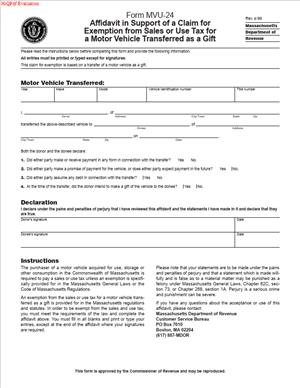
Form MVU-24 – Affidavit in Support of a Claim for Massachusetts Exemption from Sales or Use Tax for a Motor Vehicle Transferred as a Gift
Fill out nowJurisdiction: Country: United States | Province or State: Massachusetts
If you are transferring a vehicle as a gift in Massachusetts, you may come across Form MVU-24 – Affidavit in Support of a Claim for Massachusetts Exemption from Sales or Use Tax for a Motor Vehicle Transferred as a Gift. This document is used to support a claim that no sales or use tax is owed on the transfer.
When a vehicle changes ownership, the state often assesses sales or use tax. However, certain transfers, such as genuine gifts between qualifying parties, may be exempt. This form helps document that the transfer meets the requirements for that exemption.
You typically complete this form at the time of registering the vehicle in the new owner’s name. It becomes part of your overall registration and tax submission process. Without it, the transfer may be treated as a taxable sale.
Understanding what this affidavit does can help you avoid delays. If you are about to fill it out, you need to know what information it requires, what it confirms, and how it fits into the broader vehicle registration process.
What is Form MVU-24 – Affidavit in Support of a Claim for Massachusetts Exemption from Sales or Use Tax for a Motor Vehicle Transferred as a Gift?
Clear definition
Form MVU-24 – Affidavit in Support of a Claim for Massachusetts Exemption from Sales or Use Tax for a Motor Vehicle Transferred as a Gift is a sworn written statement. In it, you declare that a motor vehicle was transferred as a true gift and not as a sale.
An affidavit is a statement made under oath. By signing this form, you confirm that the information is accurate to the best of your knowledge. The form supports a request that the state not apply sales or use tax to the vehicle transfer.
This document does not transfer ownership by itself. Instead, it works alongside the vehicle title and registration paperwork. Its purpose is limited to the tax exemption claim.
Who typically uses MVU24?
This form is commonly used by individuals who receive a vehicle from a family member as a gift. The recipient usually submits it during the registration process.
The person giving the vehicle, often called the donor, may also need to provide information on the form. In many cases, both parties sign to confirm that no money or other consideration was exchanged.
You might use this form if you are a parent transferring a car to a child, a grandparent giving a vehicle to a grandchild, or one spouse transferring a vehicle to another. The key factor is that the transfer is intended as a gift rather than a sale.
Why might you need MVU24 form?
When a vehicle is sold, the state generally imposes sales or use tax based on the purchase price or fair market value. If you claim the vehicle was a gift, the state requires proof or certification of that claim.
This form provides that certification. It explains the relationship between the parties and confirms that no payment was made in exchange for the vehicle.
Without this affidavit, the transfer may be treated as a taxable transaction. That can increase the total cost of registering the vehicle in the new owner’s name.
Filing the form helps clarify the nature of the transfer at the time of submission. It reduces uncertainty about whether the tax applies.
Typical real-life scenarios
- A parent buys a new car and decides to give their older vehicle to their adult child. The child needs to register the car in their own name. Because no money changes hands, the family may use this affidavit to support a tax exemption claim.
- A grandparent no longer drives and gives their vehicle to a grandchild. The grandchild takes ownership and completes the registration process. The affidavit confirms that the transfer was a gift within a qualifying family relationship.
- During a marriage, one spouse may transfer sole ownership of a vehicle to the other. If the transfer is not part of a sale, this form can document that it qualifies as a gift.
- After settling an estate informally, a family member may receive a vehicle from a relative as a gift rather than through a sale. If the transfer meets the exemption requirements, the affidavit may be included in the filing.
When would you use Form MVU-24 – Affidavit in Support of a Claim for Massachusetts Exemption from Sales or Use Tax for a Motor Vehicle Transferred as a Gift?
Use Form MVU-24 when a motor vehicle is transferred as a genuine gift in Massachusetts and the recipient claims an exemption from motor vehicle sales or use tax. The form is generally submitted when the recipient applies to title and register the vehicle in their name.
A gift transfer means ownership is transferred without payment or other consideration. The affidavit identifies the donor, recipient, vehicle, and circumstances of the transfer and supports the claim that the transaction was a gift rather than a sale. A sale price of zero on the title or registration application does not, by itself, establish eligibility for the exemption.
The recipient generally submits MVU-24 with the properly assigned title, Registration and Title Application, proof of insurance, identification, and any other documents required by the Massachusetts Registry of Motor Vehicles. The donor must cooperate in completing the affidavit and provide the required certification concerning the transfer.
The form may be appropriate when a friend, domestic partner, or another person gives a vehicle to the recipient without receiving money, property, services, forgiveness of debt, or another benefit in return. The parties should accurately disclose the circumstances because describing a sale as a gift to avoid tax can result in assessment of the unpaid tax, penalties, interest, or other consequences.
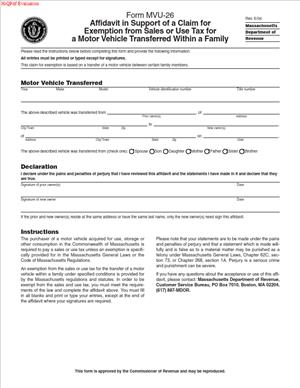
A different form generally applies to qualifying transfers between family members. Massachusetts provides Form MVU-26 specifically for certain intrafamily motor vehicle transfers. Therefore, do not assume MVU-24 is the correct affidavit merely because the donor and recipient are related. Confirm the relationship and select the exemption form that matches the transaction.
MVU-24 may also be inappropriate when the vehicle is transferred through a business, estate, inheritance, divorce, contest, raffle, insurer, or another arrangement covered by a separate exemption category. A transaction involving payment, assumption of an obligation, or an exchange of property may be treated as a sale rather than a gift.
The affidavit supports only the requested tax exemption. It does not transfer title by itself, guarantee approval of the exemption, or replace the remaining registration and title requirements. Both parties should provide complete and accurate information, sign as required, and retain copies of the affidavit and transfer records.
Legal characteristics of Form MVU-24 – Affidavit in Support of a Claim for Massachusetts Exemption from Sales or Use Tax for a Motor Vehicle Transferred as a Gift
This form is an affidavit, which means it is a sworn statement. Its effectiveness depends on complete and accurate information. Names, addresses, vehicle details, and the relationship between the parties must match the accompanying title and registration documents.
For the form to be accepted, it generally needs to be properly signed. Incomplete signatures, missing information, or inconsistencies can lead to delays or rejection of the exemption claim.
Common issues include listing a relationship that does not qualify for the exemption, failing to disclose that money was exchanged, or providing vehicle information that does not match the title. Even small errors in the vehicle identification number can cause processing problems.
This document focuses only on the tax aspect of the transfer. It does not change insurance requirements, registration fees, or title procedures. It also does not override other legal obligations related to the vehicle.
Tax exemption rules can vary by state. A gift exemption in one state does not automatically apply in another. This form is specific to Massachusetts and is used within that state’s tax and registration framework.
Is it legally binding?
Yes, in the sense that it is a sworn statement. When you sign the affidavit, you are declaring that the information is true. Providing false information on a sworn form can have legal consequences.
The binding nature comes from the oath or declaration you make by signing. You are not entering into a contract with the other party through this form. Instead, you are certifying facts to a government agency.
If the information later proves to be incorrect or misleading, the exemption may be denied or reversed. Additional tax, interest, or penalties may apply in some situations.
The form becomes part of the official record of the vehicle transfer. That record can be reviewed if questions arise about the transaction in the future.
How to fill out Form MVU-24 – Affidavit in Support of a Claim for Massachusetts Exemption from Sales or Use Tax for a Motor Vehicle Transferred as a Gift
Step 1 – Identify the donor and recipient
Start by entering the full legal name and address of the person giving the vehicle and the person receiving it. Use names exactly as they appear on the title and identification documents. Make sure the addresses are current and complete.
Step 2 – Provide the vehicle details
Fill in the vehicle information carefully. This usually includes the year, make, model, and vehicle identification number. Copy the details directly from the title to avoid errors. Even one incorrect digit in the VIN can delay processing.
Step 3 – State the nature of the transfer
Indicate that the vehicle was transferred as a gift. Confirm that no money, services, or other items of value were exchanged for the vehicle. The statement should clearly reflect that the transfer was not a sale.
Step 4 – Describe the relationship between the parties
Enter the specific relationship between the donor and the recipient, such as parent and child or spouse to spouse. The relationship must align with the category required for the exemption. Be precise and consistent with other documents.
Step 5 – Review the affidavit statement
Read the sworn declaration carefully before signing. Make sure every detail on the form matches the title and registration paperwork. Check spelling, numbers, and dates. Correct any errors before signing.
Step 6 – Sign and date the form
Both the donor and the recipient typically sign the affidavit. Sign using your legal name and add the date of signing. Do not leave signature lines blank. Once signed, the form becomes a sworn statement.
Step 7 – Submit with registration documents
Include the completed affidavit with your vehicle title and registration paperwork. Keep a copy for your records. The form is processed as part of the overall submission for registering the gifted vehicle in Massachusetts.
Legal terms you might encounter in Form MVU-24 – Affidavit in Support of a Claim for Massachusetts Exemption from Sales or Use Tax for a Motor Vehicle Transferred as a Gift
- Affidavit: A written statement made under oath. When you sign this document, you are swearing that the information is true to the best of your knowledge. False statements can lead to penalties because the form is treated as a sworn declaration.
- Donor: The person giving the vehicle as a gift. This is the current owner listed on the vehicle’s title. The donor must match the name shown on the title and may need to sign related transfer documents.
- Donee: The person receiving the vehicle. This is the new owner who will register and title the vehicle in their name. The donee claims the tax exemption based on the qualifying relationship and gift status.
- Sales or Use Tax: A tax normally due when ownership of a vehicle changes. In a typical sale, the buyer pays this tax based on the purchase price or vehicle value. This form supports a request to waive that tax because the transfer is a qualifying gift.
- Consideration: Anything of value given in exchange for the vehicle. Money, services, or assumption of debt can count as consideration. If any consideration is involved, the transfer may not qualify as a true gift for tax exemption purposes.
- Immediate Family: A defined relationship category that qualifies for the exemption. The form requires you to specify how the donor and donee are related. Only certain relationships qualify, so you must accurately describe the connection.
- Title Transfer: The legal process of changing vehicle ownership. The affidavit supports the title transfer by explaining why no tax should apply. The names on this form must match the names on the title paperwork.
- Vehicle Identification Number (VIN): A unique 17-character number assigned to the vehicle. You must enter it exactly as shown on the title or registration. Even one incorrect character can delay processing.
- Odometer Disclosure: A statement of the vehicle’s mileage at the time of transfer. While often handled on the title or a separate form, it is part of the overall transfer process. Accurate mileage reporting helps prevent fraud.
- Department of Revenue: The state agency that oversees tax matters. This form is submitted in connection with a vehicle transaction to support a claim that no sales or use tax is due. The agency reviews the information to confirm eligibility.
FAQs
Do I need to submit Form MVU-24 – Affidavit in Support of a Claim for Massachusetts Exemption from Sales or Use Tax for a Motor Vehicle Transferred as a Gift if no money changed hands?
Yes. Even if you paid nothing, tax is normally due when a vehicle changes ownership. This form tells the state that the transfer qualifies as a gift and should be exempt. Without it, the transaction may be treated like a taxable sale.
What relationship qualifies as “immediate family” on this document?
You must enter the specific family relationship between the donor and the donee exactly as it applies to you. The exemption applies only to certain close family relationships. If the relationship does not fit within the allowed category, the transfer may not qualify for tax exemption.
Where do I find the correct VIN to enter?
You can find the VIN on the vehicle title, registration, or on the vehicle itself, usually on the dashboard near the windshield. Use the VIN exactly as shown on the title. Double-check every character before signing, because errors can delay the transfer.
What if there is still a loan on the vehicle?
If there is an outstanding loan, the lender may still hold a lien on the title. A transfer cannot be completed until lien requirements are addressed. If the donee agrees to take over payments or refinance, that could be treated as consideration and affect the gift status.
Does the donor have to sign this form?
Yes. Because this is an affidavit about the nature of the transfer, the donor’s statement is central. Make sure the correct party signs in the required place. The signature confirms that the vehicle is being transferred as a gift without consideration.
Can I correct an error after I sign the form?
Minor errors may require you to complete a new form rather than crossing out information. Since this document supports a tax exemption, clarity matters. It is better to start over than submit a form with visible corrections that raise questions.
When does the exemption take effect?
The exemption applies at the time of title and registration processing. The effective date ties to the transfer date you provide on the title documents. Make sure the dates are consistent across all paperwork so the transaction is processed correctly.
What happens if the Department of Revenue does not accept this form?
If the information is incomplete or the relationship does not qualify, the exemption may be denied. In that case, sales or use tax may be assessed. You would need to review the reason for denial and determine whether corrected documentation can be submitted.
Checklist: Before, During, and After Form MVU-24 – Affidavit in Support of a Claim for Massachusetts Exemption from Sales or Use Tax for a Motor Vehicle Transferred as a Gift
Before
- Confirm that the donor and donee qualify as immediate family.
- Review the vehicle title to ensure the donor is the legal owner.
- Check whether there is an active lien on the vehicle.
- Locate the correct VIN and verify it against the title.
- Gather identification for both parties.
- Confirm that no money or other consideration is being exchanged.
- Review related title and registration documents for consistency.
During
- Print or type names exactly as shown on the title.
- Enter the VIN carefully and double-check each character.
- State the correct family relationship clearly.
- Confirm the transfer date matches the title paperwork.
- Read the affidavit statement fully before signing.
- Ensure the donor signs in the correct signature field.
- Avoid cross-outs or handwritten corrections if possible.
After
- Make copies of the completed form for your records.
- Attach the affidavit to the title and registration paperwork.
- Submit all documents together to avoid processing delays.
- Confirm that the exemption is noted during processing.
- Keep proof of submission or receipt.
- Store copies with your vehicle records.
- Check that the new title reflects the donee as the owner.
Common mistakes to avoid with Form MVU-24 – Affidavit in Support of a Claim for Massachusetts Exemption from Sales or Use Tax for a Motor Vehicle Transferred as a Gift
- Mistake: Listing a relationship that does not qualify, which often happens when people assume all relatives count, leading to denial of the exemption and unexpected tax due; do not forget to confirm the relationship category before filing.
- Mistake: Entering an incorrect VIN because of a typo or reading it from memory, which can delay processing or void the exemption request; do not forget to copy it directly from the title.
- Mistake: Failing to disclose existing consideration, such as payment or debt transfer, because it seems informal, which can invalidate the gift claim; do not forget that any value exchanged matters.
- Mistake: Submitting the affidavit without matching title signatures, which happens when paperwork is prepared separately, causing rejection; do not forget to align all names and signatures.
- Mistake: Leaving sections blank, assuming they do not apply, which can result in incomplete processing; do not forget to review every field before signing.
- Mistake: Using correction fluid or heavy cross-outs, which raises questions about accuracy and authenticity; do not forget that a clean, newly completed form is often better.
- Mistake: Ignoring an active lien, assuming a gift overrides financing, which can block the transfer entirely; do not forget to resolve lender issues first.
- Mistake: Forgetting to keep copies, which creates problems if questions arise later about tax status; do not forget to store a full set of documents.
What to do after filling out Form MVU-24 – Affidavit in Support of a Claim for Massachusetts Exemption from Sales or Use Tax for a Motor Vehicle Transferred as a Gift
Once you complete the affidavit, your focus shifts to proper submission and recordkeeping. The form does not stand alone. It supports a larger vehicle title and registration transaction.
- Step 1: Review the completed form one more time for accuracy and legibility.
- Step 2: Make at least two copies of the signed document, one for the donor and one for the donee.
- Step 3: Attach the affidavit to the signed vehicle title and any required registration paperwork.
- Step 4: Confirm that all names, dates, and the VIN match across every document in the packet.
- Step 5: Submit the full set of documents through the appropriate vehicle registration process.
- Step 6: Pay any required registration or title fees, even if the tax is exempt.
- Step 7: Request confirmation that the tax exemption has been applied during processing.
- Step 8: Keep your receipt or proof of submission in a safe place.
- Step 9: Once the new title is issued, verify that the donee is listed as the legal owner and that there are no unexpected tax charges.
- Step 10: Update your personal records, including insurance and internal ownership records, to reflect the completed transfer.
After submission, monitor the transaction until the new title is issued. If you receive any notice questioning the exemption, respond promptly and provide any additional information requested. Keeping organized copies will make that process much easier.
Finally, store the affidavit with your permanent vehicle records. Even after the transfer is complete, you may need proof that the transaction qualified as a gift. Clear documentation protects both the donor and the donee if questions arise later.
Disclaimer: This guide is provided for informational purposes only and is not intended as legal advice. You should consult a legal professional.