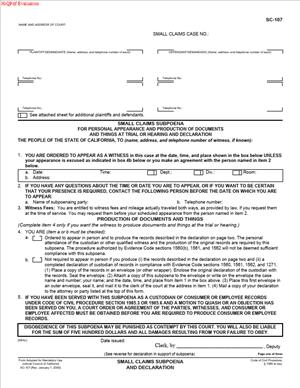
SC-107 – Small Claims Subpoena for Personal Appearance and Production of Documents and Things at Trial or Hearing and Declaration
Fill out nowJurisdiction: Country: United States | Province or State: California
The SC-107 – Small Claims Subpoena for Personal Appearance and Production of Documents and Things at Trial or Hearing and Declaration is a court form used in California small claims cases. It is designed to formally request that a person attend a hearing and, if needed, bring specific documents or items.
You usually encounter this document when you need information that is not in your control. It helps bring witnesses or records into the courtroom so the judge can review them.
This form belongs to the California Small Claims system. It follows specific formatting and content expectations that differ from other civil court subpoenas.
If you are representing yourself, this document can feel intimidating at first. Understanding what it does and how it fits into the process makes it easier to complete with confidence.
The purpose of this guide is to explain how the SC-107 – Small Claims Subpoena for Personal Appearance and Production of Documents and Things at Trial or Hearing and Declaration works, when it is commonly used, and how each section is typically completed.
What is SC-107 – Small Claims Subpoena for Personal Appearance and Production of Documents and Things at Trial or Hearing and Declaration?
Clear definition
The SC-107 – Small Claims Subpoena for Personal Appearance and Production of Documents and Things at Trial or Hearing and Declaration is a court-issued request. It directs a named person to appear at a small claims trial or hearing. It can also require that person to bring specified documents or physical items.
This form combines two functions. One is personal appearance, meaning showing up to testify. The other is production, meaning bringing records or objects described on the form.
It also includes a declaration section. That section is used to confirm that the subpoena was delivered in the manner required by the court.
Who typically uses this form/document?
This document is commonly used by people involved in a small claims case. That includes plaintiffs and defendants who need testimony or records from someone else.
It is often used when the information needed is held by a third party. That person may not be directly involved in the dispute but has relevant knowledge or documents.
Court clerks and judges also interact with this form as part of case administration. The person receiving the subpoena is another key participant, even though they are not a party to the case.
Why you might need this form/document
You might need this form when important evidence is not available without formal court involvement. Some people or organizations will not share records unless they receive a subpoena.
Testimony can also matter. A witness’s direct explanation, given under oath, may clarify events that written statements cannot.
In small claims court, the judge often relies on concise, reliable information. This form helps ensure that information is available at the hearing.
Typical real-life scenarios
- A tenant brings a small claims case about a security deposit. The landlord claims repairs were necessary. A property manager who handled the repairs is asked to appear and bring invoices.
- A customer disputes a charge for vehicle repairs. The repair shop’s former employee, who inspected the vehicle, is requested to testify and bring inspection notes.
- A small business claims unpaid services. The business asks a bank employee to appear with account records showing payment history.
- A neighbor dispute involves property damage. A contractor who gave an estimate is asked to attend and bring photographs and written estimates.
When would you use SC-107 – Small Claims Subpoena for Personal Appearance and Production of Documents and Things at Trial or Hearing and Declaration?
This form is used when a small claims case has already been filed and a hearing date is scheduled. It is tied to a specific trial or court appearance.
It is commonly used when voluntary cooperation has not worked. People sometimes decline informal requests for documents or testimony.
The form may be used to request appearance only, document production only, or both. The choice depends on what information is needed at the hearing.
Typical roles involved include the party requesting the subpoena, the person receiving it, and the court overseeing the case. Each role has different responsibilities connected to the document.
Timing matters in practice. The subpoena is connected to a particular hearing date, so the information requested must be relevant to that proceeding.
Legal characteristics of SC-107 – Small Claims Subpoena for Personal Appearance and Production of Documents and Things at Trial or Hearing and Declaration
This form has legal force when properly completed, issued, and delivered. Its effectiveness depends on accuracy, clarity, and compliance with court procedures.
Common problems include incorrect names, vague document descriptions, or missing hearing details. These issues can lead to confusion or limit the usefulness of the subpoena.
In California, small claims subpoenas follow rules that differ from higher civil courts. Other jurisdictions may use different forms or processes, even if the purpose is similar.
This document does not decide the case. It does not guarantee that the information produced will support one side or the other. It simply brings information before the court.
It also does not replace other evidence. The judge may still weigh credibility and relevance when reviewing testimony or documents produced under the subpoena.
Is it legally binding?
When properly issued and served, this form is legally binding. It creates a formal obligation to appear or produce items as stated.
That obligation exists because the subpoena comes from the authority of the court. The declaration section helps establish that the process was followed.
If the form is incomplete or improperly delivered, its binding effect may be questioned. Accuracy and proper handling are central to its function.
How to fill out SC-107 – Small Claims Subpoena for Personal Appearance and Production of Documents and Things at Trial or Hearing and Declaration
Step 1 – Identify the court
This section names the court handling the small claims case. It usually includes the court’s name and location so the subpoena is clearly tied to the correct case.
Step 2 – Enter case information
You provide the case name and case number exactly as they appear on other court filings. This connects the subpoena to the existing small claims matter.
Step 3 – Name the person being subpoenaed
This step identifies the individual or entity requested to appear or produce items. Clear identification helps avoid confusion about who is expected to respond.
Step 4 – Specify the hearing details
You include the date, time, and place of the trial or hearing. These details tell the recipient when and where their appearance is requested.
Step 5 – Describe documents or things to be produced
If documents or items are requested, they are described here. Descriptions are typically specific enough to identify what is being requested without unnecessary detail.
Step 6 – Indicate appearance requirements
This section clarifies whether the person must appear in person, bring documents, or do both. It ties the request directly to the hearing.
Step 7 – Review any witness fee information
Some versions of the form reference witness fees or mileage. This section explains how that information is recorded on the document.
Step 8 – Complete the declaration of service
The declaration records how and when the subpoena was delivered. It identifies the person who delivered it and the method used.
Step 9 – Sign and date the form
The signature and date confirm that the information provided is complete to the best of the signer’s knowledge. This step finalizes the document for submission or issuance.
Legal terms you might encounter in SC-107 – Small Claims Subpoena for Personal Appearance and Production of Documents and Things at Trial or Hearing and Declaration
- Subpoena: A subpoena is a court-issued order that requires someone to do something specific. In this form, it orders a person to show up at a trial or hearing and, if listed, bring documents or physical items. Ignoring it can lead to court consequences.
- Personal Appearance: This means the person named must appear in person at the date, time, and location listed on the form. It is not optional once properly served. The form records exactly when and where that appearance must happen.
- Production of Documents and Things: This phrase refers to the requirement to bring specific papers or physical items to court. On this form, you must clearly describe what is required so the person knows what to bring. Vague descriptions often cause problems at the hearing.
- Trial or Hearing: This is the court event where the judge hears the case or a specific issue. The form ties the subpoena to a particular date and proceeding. If the date changes, the subpoena may no longer be effective.
- Witness: A witness is the person ordered to appear or produce items. The witness may be a person involved in the dispute or a third party. The name on the form must match the person served.
- Service: Service is the act of officially delivering the subpoena to the witness. The form includes a declaration section to show the court that service was done correctly. Without proper service, the subpoena may not be enforced.
- Declaration: A declaration is a written statement signed under penalty of perjury. On this form, the declaration usually confirms how and when the subpoena was served. Accuracy matters because the judge relies on it.
- Proof of Service: Proof of service is the completed declaration showing the details of service. It becomes part of the court record. Judges often check this before allowing testimony or documents.
- Custodian of Records: This is the person responsible for maintaining documents for a business or organization. If you are seeking records, this title often appears in the name section. Using the correct title helps ensure the right person responds.
FAQs
Who should be listed as the person being subpoenaed on this form?
You must list the exact individual or entity responsible for appearing or producing the documents. If you want records from a business, use the correct person or title that controls those records. The name you enter is the one the server must locate and hand the papers to.
Do I need to describe every document I want, or can I keep it general?
You need to be specific enough that the person knows exactly what to bring. Broad descriptions can confuse the witness and lead to missing documents. The space on the form is where you lock in what will be expected at the hearing.
What happens if the hearing date changes after I complete the form?
If the date or time changes, the information on the subpoena no longer matches the court event. That mismatch can make the subpoena unusable. You usually need a new form that reflects the updated hearing details.
Who is allowed to serve this document?
The server must be someone who is not a party to the case. Their role is to deliver the form and later complete the declaration. The court looks at the declaration to confirm that service was done correctly.
How do I complete the declaration section accurately?
You record the date, time, and method of service, along with the server’s name and signature. These details must match what actually happened. Errors here can cause the judge to disregard the subpoena.
Is SC-107 – Small Claims Subpoena for Personal Appearance and Production of Documents and Things at Trial or Hearing and Declaration filed with the court before the hearing?
This document is usually issued and then served on the witness, with the completed declaration kept for court review. Some courts expect the proof of service to be presented at the hearing. You should know whether the judge will ask to see it.
What if the witness refuses to comply after being served?
The judge will look first at whether this form was filled out and served correctly. If something is missing, enforcement becomes difficult. A properly completed document strengthens your position in court.
Will the information in this document become part of the public court file?
The case number, party names, and declaration details typically become part of the court record. That means accuracy matters. What you write may be reviewed by the judge and the opposing party.
Checklist: Before, During, and After SC-107 – Small Claims Subpoena for Personal Appearance and Production of Documents and Things at Trial or Hearing and Declaration
Before
- Confirm the correct case number and party names from your court paperwork.
- Decide whether you need a person, documents, or both.
- Identify the exact person or title responsible for appearing or producing items.
- Verify the trial or hearing date, time, and location.
- Draft a clear, specific description of documents or things requested.
- Check that you have enough time to serve the subpoena before the hearing.
- Plan who will serve the document and confirm they are eligible.
- Make copies for service and your records.
During
- Fill out the court and case information carefully.
- Write the witness’s name exactly as it should appear.
- Enter the hearing details exactly as scheduled.
- List documents or items in plain, specific language.
- Review the form for blanks or inconsistencies.
- Have the server deliver the document properly.
- Ensure the server completes the declaration section fully.
- Double-check dates and signatures before finalizing.
After
- Make a copy of the completed form with the declaration.
- Store the original in a safe place for the hearing.
- Track whether the witness responds or contacts you.
- Prepare to explain the subpoena to the judge if asked.
- Bring the proof of service to court.
- Update your case notes with service details.
- Be ready to address missing documents or nonappearance.
- Keep copies until the case is fully resolved.
Common mistakes to avoid with SC-107 – Small Claims Subpoena for Personal Appearance and Production of Documents and Things at Trial or Hearing and Declaration
- Mistake: Listing the wrong name or title, which happens when you guess instead of verifying, leading to service on the wrong person, and you must not forget to confirm who controls the testimony or records.
- Mistake: Using vague descriptions of documents, often done to save time, which can result in incomplete production, and you must not forget to be specific.
- Mistake: Entering an incorrect hearing date or time, usually due to relying on memory, which can invalidate the subpoena, and you must not forget to copy details directly from court notices.
- Mistake: Having a party to the case serve the form, often because it seems convenient, which makes service improper, and you must not forget that the server must be neutral.
- Mistake: Skipping the declaration section, often because it seems secondary, which leaves no proof of service, and you must not forget that the judge relies on it.
- Mistake: Failing to make copies, which happens when you rush, causing problems at the hearing, and you must not forget to keep a complete set.
- Mistake: Serving too late, often due to poor planning, which limits compliance, and you must not forget to allow enough time.
- Mistake: Assuming compliance without follow-up, which leads to surprises in court, and you must not forget to prepare for nonappearance.
What to do after filling out SC-107 – Small Claims Subpoena for Personal Appearance and Production of Documents and Things at Trial or Hearing and Declaration
Once the form is complete, your focus shifts to execution and follow-through. A subpoena only works if it is properly served and documented. Treat this as a process, not a single task.
- Step 1: Make at least two copies of the completed form before service.
- Step 2: Give the original and a copy to the person who will serve the subpoena.
- Step 3: Confirm the server understands where and how to deliver it.
- Step 4: Wait for the server to return the form with the declaration completed.
- Step 5: Review the declaration line by line for accuracy and completeness.
- Step 6: Store the original proof of service with your case papers.
- Step 7: Update your case notes with the service date and witness details.
- Step 8: Prepare questions or arguments assuming the witness appears.
- Step 9: Prepare a backup plan if the witness does not appear or bring items.
- Step 10: Bring the subpoena and proof of service to the hearing.
- Step 11: Be ready to explain to the judge what you requested and why.
- Step 12: Keep all records until the case is finished and any judgment issues are resolved.
Disclaimer: This guide is provided for informational purposes only and is not intended as legal advice. You should consult a legal professional.