DV-160 – Request to Keep Minor’s Information Confidential (Domestic Violence Prevention)
Fill out nowJurisdiction: Country: United States | Province or State: California
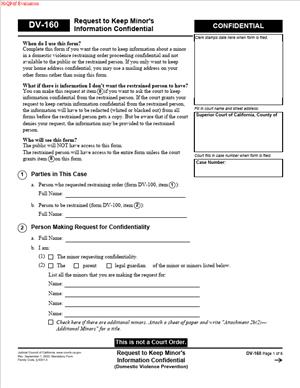
If you are involved in a domestic violence case and have a minor child, protecting that child’s personal information can feel urgent. DV-160 – Request to Keep Minor’s Information Confidential (Domestic Violence Prevention) is designed for that purpose. It asks the court to keep a child’s identifying details out of public court records.
This form is typically used in connection with a domestic violence restraining order case. It focuses on privacy and safety. It does not change custody or visitation orders by itself.
When you file court papers, some information can become part of the public record. That may include names, addresses, and other identifying details. In situations involving domestic violence, sharing this information openly may raise safety concerns.
This document gives you a way to formally ask the court to protect a minor’s information. Understanding how it works helps you complete it clearly and avoid delays.
What is DV-160 – Request to Keep Minor’s Information Confidential (Domestic Violence Prevention)?
Clear definition
DV-160 – Request to Keep Minor’s Information Confidential (Domestic Violence Prevention) is a California court form used in domestic violence prevention cases. It allows a party to ask the court to keep a minor child’s personal information confidential.
The form is submitted as part of a domestic violence case. It tells the court that revealing the child’s information in public court files could create a safety risk. The court then decides whether to grant that request.
Confidential information often includes a child’s home address, school, or other identifying details. The purpose is to limit who can see that information in the court file.
This form does not remove information from all records everywhere. It addresses confidentiality within the court’s case file.
Who typically uses this form?
This form is commonly used by a parent or legal guardian seeking protection in a domestic violence restraining order case. That person may be the one requesting protection for themselves and their child.
It may also be used when a minor is listed as a protected person in the case. If the child’s safety could be affected by public access to court records, the requesting party may file this document.
In some cases, a legal representative completes and files the form on behalf of the parent or guardian. However, self-represented individuals often use it as well.
The person filing the request is usually the same person who filed the main domestic violence paperwork. The form becomes part of the same case file.
Why might you need this form?
You might need this form if you believe that public access to your child’s information could put them at risk. Domestic violence cases can involve threats, stalking, or harassment. Limiting access to personal details can be an added safety measure.
Court records are often accessible to the public unless sealed or made confidential. If your child’s address or school is listed in publicly viewable documents, that could expose their location.
This form gives you a structured way to explain your concern. It creates a formal request for confidentiality instead of relying on informal conversations.
Using the proper document helps the court understand exactly what information you want protected and why.
Typical real-life scenarios
- A parent files for a restraining order after experiencing threats from the other parent. The child lives with the requesting parent at a new, undisclosed address. The parent wants to prevent that address from appearing in public records.
- In another situation, the restrained person has previously tried to locate the child through school records. The requesting party wants to keep the name and location of the child’s school confidential in the court file.
- Sometimes a family has relocated to escape ongoing harassment. Even listing a city or contact details in court documents may create concern. The form can be used to request that this information not be publicly available.
- There are also cases involving extended family conflict or prior stalking behavior. If there is a pattern of tracking or surveillance, keeping a minor’s identifying details confidential may feel necessary for peace of mind.
When would you use DV-160 – Request to Keep Minor’s Information Confidential (Domestic Violence Prevention)?
You would typically use DV-160 – Request to Keep Minor’s Information Confidential (Domestic Violence Prevention) when filing or updating paperwork in a domestic violence restraining order case that involves a minor child.
It is often submitted at the same time as the main request for a restraining order. However, it may also be filed later if concerns about confidentiality arise after the case has started.
If you are including a minor as a protected person and listing details such as their address, school, or other identifying information, this form becomes relevant. It allows you to separate sensitive information from the public portion of the file.
The person requesting protection is usually the petitioner in the domestic violence case. The restrained person is the respondent. The form focuses on protecting the minor’s information from general public access, not from the court or the other party as required by law.
You may also consider this form if you have moved and do not want your new location connected to the court record in a way that can be easily accessed. In cases involving past threats or stalking, timing can be important. Filing early helps ensure sensitive information is handled carefully from the start.
Legal characteristics of DV-160 – Request to Keep Minor’s Information Confidential (Domestic Violence Prevention)
This form is part of a broader court process. Its effectiveness depends on proper completion and court approval. Simply filling it out does not automatically make information confidential.
For the request to be considered, it generally must be filed in the correct case and connected to a domestic violence prevention matter. The court reviews the request and decides whether to grant confidentiality based on the information provided.
Common problems include incomplete sections, unclear explanations, or missing case details. If the form does not clearly identify the child or the reason for confidentiality, the court may require clarification.
Another issue arises when people assume the form blocks all access to information. In reality, confidentiality often applies to public access. Certain parties, such as the court and sometimes the other side in the case, may still receive necessary information through proper procedures.
Confidentiality rules can vary slightly by court procedure, even within the same state. Local filing practices, formatting requirements, and submission methods may differ. The core purpose remains the same, but the administrative steps can vary.
This document does not change custody, visitation, or support arrangements. It does not create a restraining order. It only addresses how a minor’s information is handled in the court record.
Is it legally binding?
The request itself is not automatically binding when you sign and file it. It becomes effective only if the court grants the request and issues an order regarding confidentiality.
Once the court approves the request, the confidentiality protections outlined in the order apply to the case file. Court staff then handle the protected information according to the order.
If the court denies the request, the information may remain part of the standard court record unless other protective measures are in place. The outcome depends on the court’s review of the circumstances.
Because this form is part of an official court proceeding, accuracy matters. The court relies on the statements you provide when deciding whether confidentiality is appropriate.
How to fill out DV-160 – Request to Keep Minor’s Information Confidential (Domestic Violence Prevention)
Step 1 – Identify the case information
Start by entering the court name and location at the top of the form. Use the same court listed on your main domestic violence paperwork.
Fill in the case number exactly as it appears on your other documents. Double-check each digit and letter. An incorrect case number can delay processing.
Provide the names of the parties as they appear in the case. Keep the spelling consistent with prior filings.
Step 2 – Identify the minor whose information you want protected
Enter the full name of the minor child. Make sure the name matches the name used in the main restraining order request.
If there is space to list more than one child, include each minor whose information you are asking the court to keep confidential. Do not assume that listing one child covers others.
Ensure that the child is clearly connected to the domestic violence case. The court needs to understand how the minor relates to the proceeding.
Step 3 – Specify the information to be kept confidential
Indicate what specific information you want protected. This may include the child’s home address, mailing address, school, or other identifying details.
Be precise. If the concern relates to a particular address or location, identify it clearly within the form’s structure. Vague statements can make it harder for the court to act on your request.
Avoid including extra details that are not requested. Provide only the information necessary to explain what needs protection.
Step 4 – Explain the reason for confidentiality
Use the space provided to describe why keeping the information confidential is important for safety. Focus on facts rather than emotional language.
Describe any relevant behavior, such as prior threats, stalking, or attempts to locate the child. Keep your explanation clear and organized.
Connect your explanation to the risk of public disclosure. The court is evaluating whether open access to this information could create harm.
Step 5 – Review for completeness and accuracy
Read the entire form from top to bottom before signing. Check names, dates, and case numbers.
Confirm that every required section is filled in. Missing signatures or blank fields can result in rejection or delay.
Make sure your explanation is legible and easy to follow. If you are handwriting the form, print clearly.
Step 6 – Sign and date the form
Sign your name where indicated. Use the same name format that appears in the rest of your case documents.
Enter the date of signing. The date should reflect when you actually complete the signature.
Your signature confirms that the information you provided is accurate to the best of your knowledge.
Step 7 – File the form with the court
Submit the completed form to the court handling your domestic violence case. It becomes part of that case file.
Follow the court’s standard process for filing documents. This may involve submitting the form in person or through an accepted filing method.
After filing, keep a copy for your records. Store it with your other case documents so you can refer to it if questions arise.
Legal terms you might encounter in DV-160 – Request to Keep Minor’s Information Confidential (Domestic Violence Prevention)
- Minor: A minor is a child under 18 years old. In this form, the minor is the person whose identifying information you want kept out of public court records. You must clearly identify which child the request applies to so the court can protect the correct records.
- Confidential information: This refers to specific details you want hidden from public view. It can include a home address, school name, contact information, or other identifying data. In this document, you must state exactly what information should be kept confidential.
- Protected party: In a domestic violence case, the protected party is the person the court aims to protect. The minor may be listed as a protected party in a restraining order. This status helps explain why confidentiality is necessary.
- Restrained party: The restrained party is the person against whom a restraining order is issued. The court considers whether disclosing a minor’s information could increase the risk from this person. Your explanation should connect the confidentiality request to safety concerns.
- Court record: A court record includes all documents filed in a case. Some parts of the record are public unless sealed or made confidential. This form asks the court to limit public access to specific details about a child.
- Sealed record: A sealed record is not accessible to the public. Only certain authorized individuals can view it. When you request confidentiality, you are asking the court to seal or otherwise restrict access to particular information.
- Case number: This is the unique number assigned to your court case. You must enter it exactly as it appears on other court documents. If the number is wrong or missing, the clerk may not be able to connect your request to the correct file.
- Declaration: A declaration is a written statement made under penalty of perjury. If the form requires you to explain why confidentiality is needed, you are making a declaration. You must tell the truth and be specific.
- Service of process: Service of process is the formal delivery of court documents to another party. In some situations, even if information is kept confidential from the public, certain parties may still receive necessary details through proper legal channels.
- Clerk of the court: The clerk is the court official who receives, files, and maintains case documents. You submit this form to the clerk. The clerk does not decide your request but ensures it becomes part of the court file for a judge to review.
FAQs
Do I have to file DV-160 – Request to Keep Minor’s Information Confidential (Domestic Violence Prevention) at the same time as my restraining order request?
You do not always have to file it on the same day, but it is usually best to do so. If the minor’s identifying details are already included in other documents, filing this document at the same time reduces the risk that sensitive information will appear in the public file. Check your other paperwork and confirm whether the child’s address, school, or contact details are listed. If they are, submit this request as early as possible so the court can address confidentiality before broader access occurs.
What specific information can I ask the court to keep confidential?
You can request protection for details that could identify or locate the minor. This often includes home addresses, mailing addresses, school names, childcare locations, phone numbers, or other contact information. On this form, you must clearly write what information should be restricted. Vague statements such as “all personal information” may not be enough. Be precise so the clerk and judge understand exactly what to protect.
Will the other parent still be able to see the child’s address if I file this document?
Confidentiality from the public does not always mean automatic confidentiality from the other party. The court may limit what appears in public records while still allowing required disclosures through proper legal procedures. You should review whether other filings contain the address and confirm how service will be handled. The judge decides the scope of confidentiality based on safety concerns and legal requirements.
What happens after I file DV-160 – Request to Keep Minor’s Information Confidential (Domestic Violence Prevention)?
After filing, the clerk adds the document to your case file. A judge reviews your request and determines whether to grant confidentiality. You may receive a written order or see a notation in the case record reflecting the decision. Check your case number on all paperwork and confirm that the request appears in the docket so you know it was properly processed.
Do I need to attach additional documents to support my request?
If the form includes space for explanation, use it fully. If there is not enough room, you may attach a separate page as a declaration. Clearly label any attachment with the case number and the minor’s name. Make sure each extra page is signed if required and that it matches the information stated in the main document.
How do I know if the court approved my request?
You will typically receive a filed copy or a separate order indicating the court’s decision. Review the document carefully. Confirm that the minor’s name is spelled correctly and that the case number matches your file. If you are unsure, check the court record or speak with the clerk to verify whether the confidentiality request was granted.
What if I made a mistake on the form after filing?
If you notice an error, act quickly. Compare your filed copy with your original draft to identify what needs correction. You may need to submit an amended document or a corrected request. Make sure the case number, minor’s name, and the specific confidential information are accurate so the court record reflects the correct details.
Does this form automatically remove information that is already public?
This document does not automatically erase information already accessible in prior filings. If sensitive details were previously submitted without protection, you may need to request additional relief from the court. Review the case file to see what information appears in the public record and address each item clearly in your request.
Checklist: Before, During, and After DV-160 – Request to Keep Minor’s Information Confidential (Domestic Violence Prevention)
Before
- Review all existing court documents to see where the minor’s information appears.
- Gather the exact legal name and date of birth of the minor.
- Confirm the correct case number from your restraining order or family law case.
- Identify each specific detail you want kept confidential.
- Prepare a clear explanation of why confidentiality is necessary for safety.
- Check whether you need extra pages for a longer declaration.
- Make a draft copy so you can review it before signing.
- Ensure your contact information is accurate where required.
During
- Print clearly or type your responses to avoid misreading.
- Enter the case number exactly as shown on other filings.
- List the minor’s full legal name without nicknames.
- Specify each piece of information to be kept confidential.
- Use factual, specific language in your explanation.
- Review every field to confirm nothing is left blank if required.
- Sign and date the form where indicated.
- Attach any additional pages and label them properly.
After
- Make at least two copies of the completed form.
- File the original with the court clerk.
- Obtain a stamped copy for your records.
- Check the court docket to confirm the filing appears.
- Monitor for a court order granting or denying the request.
- Store your copy in a safe, organized location.
- Update your records to reflect what information is now protected.
- Follow up promptly if the court requests clarification.
Common mistakes to avoid with DV-160 – Request to Keep Minor’s Information Confidential (Domestic Violence Prevention)
- Mistake: Writing a general request such as “keep everything private,” which happens when you feel overwhelmed, leading to confusion or denial, because the court needs specific items clearly listed, so do not forget to identify each exact piece of information.
- Mistake: Entering the wrong case number, often copied from memory, which can cause the form to be filed in the wrong case or rejected, so do not forget to verify the number directly from an official court document.
- Mistake: Forgetting to sign and date the form, which happens when rushing to file, resulting in processing delays or rejection, so do not forget to check the signature line before submitting.
- Mistake: Misspelling the minor’s legal name, which may create inconsistencies in the court record and weaken the request, so do not forget to match the spelling exactly to prior filings.
- Mistake: Failing to attach additional pages when space runs out, which leads to incomplete explanations and possible denial, so do not forget to clearly label and attach any continuation sheets.
- Mistake: Assuming confidentiality is automatic in domestic violence cases, which can result in sensitive details becoming publicly accessible, so do not forget to file a separate request when protection is needed.
- Mistake: Not checking whether earlier documents already disclosed the information, which may leave gaps in protection, so do not forget to review the entire case file carefully.
- Mistake: Keeping no personal copy after filing, which creates problems if questions arise later, so do not forget to obtain and safely store a stamped copy.
What to do after filling out DV-160 – Request to Keep Minor’s Information Confidential (Domestic Violence Prevention)
Once you complete the form, your next focus is proper filing and follow-up. Accuracy and organization matter just as much after completion as during preparation.
- Step 1: Review the entire document one more time for spelling, case number accuracy, and completeness.
- Step 2: Make at least two copies—one for your records and one for service or backup if needed.
- Step 3: File the original with the court clerk in the same courthouse handling your domestic violence case.
- Step 4: Ask the clerk to stamp your copies as “filed” so you have proof of submission.
- Step 5: Confirm whether a hearing is required or whether the judge will decide based only on the paperwork.
- Step 6: Monitor your mail, online case portal, or court notices for the judge’s decision.
- Step 7: Read any court order carefully to understand exactly what information is protected and from whom.
- Step 8: Update your personal records to reflect what details should no longer be shared publicly.
- Step 9: If the court grants confidentiality, make sure future filings follow the same protection guidelines.
- Step 10: If the request is denied or partially granted, review the order and consider whether additional clarification or documentation is necessary.
Keep all related documents together in a secure place. If you move or change contact information, update the court as required so you continue receiving notices. Staying organized helps ensure the minor’s information remains protected throughout the case.
Disclaimer: This guide is provided for informational purposes only and is not intended as legal advice. You should consult a legal professional.