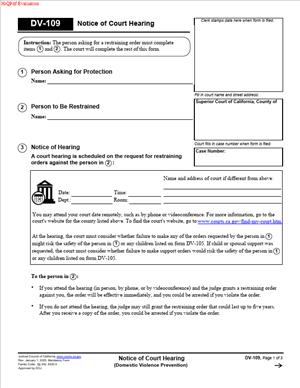
DV-109 – Notice of Court Hearing (Domestic Violence Prevention)
Fill out nowJurisdiction: Country: United States | Province or State: California
The DV-109 – Notice of Court Hearing (Domestic Violence Prevention) is a court document used in California domestic violence cases. It tells the parties when and where a judge will hold a hearing about a restraining order request. If you are asking for protection or responding to a request, this form connects you to the court date that decides what happens next.
When you file for a domestic violence restraining order, the court reviews your paperwork. If the court sets a hearing, it issues this document. It gives you the official details about the hearing and explains what to bring and when to appear.
This form matters because it gives legal notice. It tells the restrained person that a hearing has been scheduled. It also confirms for you, as the requesting party, when to return to court to present your case.
If you are filling out or receiving this form, you are in the middle of a legal process. Understanding what this document does helps you prepare for the next step and avoid missing important deadlines.
What is DV-109 – Notice of Court Hearing (Domestic Violence Prevention)?
Clear definition
DV-109 – Notice of Court Hearing (Domestic Violence Prevention) is an official court notice. It schedules a hearing in a domestic violence restraining order case. The hearing allows a judge to decide whether to issue, change, or deny longer-term protection orders.
The form includes the court’s name and address, the case number, the names of the parties, and the date, time, and department for the hearing. It may also include temporary orders already granted by the court and information about service.
This document does not start the case. It follows a request for a restraining order. It works together with other forms in the same case file.
Who typically uses this form?
The person asking for protection, often called the petitioner or protected person, receives and uses this form after filing a request for a restraining order. It tells you when to return to court.
The person against whom protection is requested, often called the respondent or restrained person, also uses this form. It notifies you of the hearing and gives you the opportunity to respond.
Court staff prepare and issue the form. Law enforcement may become involved if temporary orders are granted and need to be enforced before the hearing.
In some cases, attorneys assist either party. However, many people using this document represent themselves.
Why might you need this form?
You need this form if you have filed paperwork asking the court for protection due to domestic violence. The court cannot issue long-term orders without giving both sides a chance to be heard. This document sets that opportunity.
You may also need this form if you have been served with restraining order papers. It confirms the date when you can present your side to the judge.
Without this notice, there is no official hearing date. Missing the hearing can affect whether temporary orders remain in place or whether longer-term orders are granted.
The form also helps you understand any temporary orders already in effect. These may include stay-away orders, move-out orders, or custody-related provisions that apply until the hearing.
Typical real-life scenarios
- You filed a request for a domestic violence restraining order after an incident involving a spouse or partner. The court reviews your request and issues temporary orders. DV-109 tells you when to return so the judge can decide whether to extend those orders.
- You are served with restraining order paperwork by a process server or law enforcement officer. Included in the packet is the notice of hearing. You now know the date when you can respond and present evidence.
- You share children with the other party. The court sets a hearing to address temporary custody and visitation along with the restraining order request. This document lists the date when those issues will be discussed.
- You asked the court for emergency protection before a weekend or holiday. The judge granted short-term relief and scheduled a follow-up hearing. The notice confirms when the follow-up will take place.
- In some cases, a previously scheduled hearing is continued. A new notice may be issued to reflect the updated date and time. This ensures both sides receive accurate information.
When would you use DV-109 – Notice of Court Hearing (Domestic Violence Prevention)?
You use this form during an active domestic violence restraining order case. It comes into play after a request for protection has been filed and reviewed by the court.
If you are the person seeking protection, you use the document to prepare for your court appearance. It tells you exactly when and where to attend. It may also indicate whether remote appearance options are available.
If you are the person responding to the request, you use it to calculate how much time you have before the hearing. This affects when you must prepare your response and arrange for witnesses or documents.
In cases involving children, property, or shared housing, the hearing scheduled on this form may address several issues at once. The notice becomes the central reference point for all pending matters in that restraining order case.
You might also use this form if the court changes the hearing date. In that situation, the updated notice replaces the earlier schedule and becomes the controlling document for timing.
Legal characteristics of DV-109 – Notice of Court Hearing (Domestic Violence Prevention)
This form is an official court-issued document. Its authority comes from the court, not from either party. Once signed or stamped by the court clerk or judge, it sets a binding hearing date within that case.
For the hearing to move forward, the restrained person must generally receive proper service of the documents. Service means formal delivery of the paperwork according to court rules. If the service is not completed correctly, the hearing may be delayed.
Common problems include incorrect names, missing case numbers, or failure to include all required documents when serving the other party. These issues can lead to continuances or procedural complications.
The form itself does not contain detailed evidence. It does not describe the full allegations or defenses. Instead, it references the underlying request and schedules the time for those issues to be addressed.
Procedures can vary slightly between counties in California. For example, some courts may handle scheduling or remote appearances differently. However, the basic purpose of the notice remains consistent across the state.
This document does not create permanent restraining orders on its own. It provides the structure for the hearing where a judge will decide whether longer-term orders are appropriate.
Is it legally binding?
The scheduling information in the form is legally binding within the case. Once issued, the parties are expected to follow the date and time listed unless the court changes it.
If temporary restraining orders are referenced in the notice, those orders may already be in effect. Their enforceability depends on proper issuance and service.
However, the form itself does not determine guilt or liability. It does not prove that domestic violence occurred. It simply establishes the procedural step for the court to evaluate the evidence.
The outcome of the hearing determines whether long-term orders become legally binding. The notice sets the stage for that decision but does not replace it.
How to fill out DV-109 – Notice of Court Hearing (Domestic Violence Prevention)
Step 1 – Review the caption and court information
At the top of the form, you will see the court’s name, address, and case number. Confirm that the names of the protected person and restrained person are spelled correctly. Check that the case number matches the one assigned when the request was filed. Accuracy here prevents confusion later.
Step 2 – Check the hearing date, time, and department
Locate the section listing the hearing date, time, and courtroom or department. Write this information down in a safe place. Make sure you understand whether the hearing is in person or remote. The date listed controls when you must appear.
Step 3 – Review any temporary orders listed
The form may refer to temporary restraining orders granted by the court. Read this section carefully. It tells you what rules apply until the hearing. These may include stay-away distances, no-contact provisions, or temporary custody arrangements.
Step 4 – Confirm service requirements
Look for instructions about the service. The restrained person must generally receive a copy of the notice and related documents before the hearing. The form may state a deadline for completing the service. Understanding this section helps ensure the court can proceed on the scheduled date.
Step 5 – Verify the clerk’s or judicial signature
Check that the form is signed or stamped by the court clerk or judge. This confirms that the hearing date is officially set. An unsigned or incomplete document may not be valid for notice purposes.
Step 6 – Make and organize copies
Prepare copies of the completed form for your records and for service. Keep one copy in a safe place where you can easily access it before the hearing. Organized paperwork makes it easier to respond to questions in court.
Step 7 – Prepare for the hearing based on the notice
Use the information in the notice to plan your next steps. Mark the hearing date on your calendar. Gather any documents, photographs, messages, or witness information you intend to present. The notice gives you the timeline you need to prepare for the court appearance.
Legal terms you might encounter in DV-109 – Notice of Court Hearing (Domestic Violence Prevention)
- Petitioner: The person asking the court for protection. On this form, the petitioner’s name appears in the case caption at the top. You need to make sure this name matches exactly with the name used on the request for a restraining order and any other related forms.
- Respondent: The person the restraining order is against. This name also appears in the caption. If you are the respondent, this document tells you when and where to appear to respond to the requested orders.
- Case Number: A unique number assigned by the court clerk when the case is filed. It appears near the top of the form. You must use this exact number on every document you file in the same case.
- Hearing Date: The scheduled date when both sides can appear before a judge. This is one of the most important details on the form. Missing this date can result in serious consequences, including orders being made without your input.
- Temporary Restraining Order (TRO): A short-term court order that may already be in effect before the hearing. The DV-109 may reference whether temporary orders were granted, denied, or set to expire on the hearing date. You need to check this section carefully to know what rules currently apply.
- Personal Service: A legal method of delivering court papers directly to the respondent. This form usually states that the respondent must be personally served with the notice and related documents. Service must follow specific rules for the hearing to move forward.
- Proof of Service: A separate document showing that the respondent was properly served. While it is not part of DV-109 itself, this form typically reminds you that proof of service must be completed and filed before the hearing.
- Department or Division: The specific courtroom or branch where the hearing will take place. The form lists the department number or judge assignment. You must go to the correct location on the hearing date.
- Clerk’s Certificate: The clerk’s signature or stamp confirming that the hearing has been scheduled. This shows the notice is officially issued by the court. Without it, the document is not valid as a court notice.
FAQs
What exactly does DV-109 – Notice of Court Hearing (Domestic Violence Prevention) tell me to do?
This document tells you the date, time, and location of your court hearing. It does not ask you to argue your case in writing. Instead, it informs you when you must appear and whether temporary orders are already in place.
You should look at the hearing date section and confirm the department or courtroom listed. If you are the respondent, this is your opportunity to respond to the requested restraining orders in person.
Is this the restraining order itself?
No. This form is only a notice of the hearing. It may reference a temporary restraining order, but it does not create long-term orders by itself.
If a temporary restraining order was issued, that will be shown on a separate document. This notice simply tells you when the judge will decide whether to issue longer-term protection.
What happens if I miss the hearing date listed on this document?
If you are the respondent and you do not attend, the judge may make restraining orders against you without hearing your side. The court will rely on the petitioner’s evidence.
If you are the petitioner and you miss the hearing, the court may dismiss your request. You would then need to start over if you still want protection.
Do I need to file anything after receiving this form?
If you are the petitioner, you must arrange for personal service of this form and all related documents on the respondent. Then you must file a completed proof of service with the court.
If you are the respondent, you may choose to file a written response before the hearing. Even if you do not file a written response, you can still attend the hearing and speak to the judge.
How do I know if temporary orders are already in effect?
Check the section of this document that refers to temporary restraining orders. It will usually state whether they were granted or denied and may list an expiration date.
You should also review any separate temporary restraining order form issued by the court. Follow those terms until the hearing date unless the court changes them.
Can the hearing date on DV-109 – Notice of Court Hearing (Domestic Violence Prevention) be changed?
Yes, but only by court order. Either party can request a continuance, which means asking the court to move the hearing to a later date.
If the hearing is continued, the court will issue a new notice with the updated date. Do not assume the date has changed unless you receive official confirmation from the court.
What should I bring to the hearing listed on this form?
Bring a copy of this document, any temporary restraining order, and all supporting evidence. This may include text messages, emails, photographs, medical records, or witness statements.
Organize your documents so you can quickly show them to the judge. If you are the petitioner, be ready to explain why you need protection. If you are the respondent, be ready to explain your side clearly and calmly.
Does this form become part of the public court record?
Yes. Once filed, this document becomes part of the official court file. The case number, party names, and hearing information are recorded in the court’s system.
You should make sure all names are spelled correctly and match your other filings. Any errors can create confusion in the court record and delay the process.
Checklist: Before, During, and After DV-109 – Notice of Court Hearing (Domestic Violence Prevention)
Before
- Read the entire form and highlight the hearing date, time, and department.
- Confirm the case number matches all other documents in your case.
- Review whether temporary restraining orders were granted or denied.
- Calendar the hearing date and set reminders several days in advance.
- Arrange for proper personal service if you are the petitioner.
- File the completed proof of service before the hearing.
- Gather and organize all supporting evidence.
- Prepare a short outline of what you want to tell the judge.
During
- Arrive early at the correct courthouse and department.
- Bring multiple copies of your documents.
- Check in with the courtroom clerk if required.
- Listen carefully for your case name or number to be called.
- Speak clearly and respectfully to the judge.
- Stick to relevant facts and avoid interrupting.
- Take notes about what the judge orders.
- Ask politely if you do not understand something.
After
- Obtain a filed copy of any orders issued at the hearing.
- Review the terms of any restraining order carefully.
- Note the expiration date of any orders.
- Provide copies of the order to the appropriate parties if required.
- Follow all court-ordered conditions immediately.
- Update your records to reflect any changes in status.
- Calendar any future court dates listed.
- Keep all documents together in a safe place.
Common mistakes to avoid with DV-109 – Notice of Court Hearing (Domestic Violence Prevention)
- Mistake: Ignoring the hearing date because you think the temporary order is the final decision, which happens when people confuse documents, leading to missed court appearances and possible default orders; do not forget that this form schedules the critical hearing.
- Mistake: Failing to complete personal service properly, often due to misunderstanding service rules, which can cause the hearing to be postponed or dismissed; do not forget to file the proof of service on time.
- Mistake: Showing up at the wrong courthouse or department because you relied on memory instead of checking the notice, resulting in delays or missed hearings; do not forget to verify the exact location listed.
- Mistake: Assuming the hearing was rescheduled without written confirmation, which can lead to absence when the judge calls the case; do not forget that only a new official notice changes the date.
- Mistake: Bringing no copies of evidence because you think the judge will already have everything, which may limit what the court reviews; do not forget to organize and duplicate your documents.
- Mistake: Overlooking name or case number errors, often caused by rushing through paperwork, which can create confusion in the court file; do not forget to check spelling and numbers carefully.
- Mistake: Believing you do not need to attend if you filed a written response, which may result in orders being issued without your explanation; do not forget that in-person attendance is still important.
- Mistake: Failing to read the temporary order terms before the hearing, which can lead to accidental violations; do not forget to follow all active orders until the judge changes them.
What to do after filling out DV-109 – Notice of Court Hearing (Domestic Violence Prevention)
Once this notice is issued by the court, your focus shifts from paperwork to preparation and compliance. The hearing date controls your timeline. Everything you do next should be organized around that date.
Start by reviewing the entire case file so you understand how this notice fits with the request for a restraining order and any temporary orders.
- Step 1: Confirm that the hearing date, time, and department are clearly written and match the court’s stamp or clerk’s signature.
- Step 2: Make at least three copies of the notice—one for you, one for service (if you are the petitioner), and one for your records folder.
- Step 3: If you are the petitioner, arrange for personal service on the respondent within the time required and ensure the server completes the proof of service form.
- Step 4: File the completed proof of service with the court clerk before the hearing date and confirm it has been accepted.
- Step 5: Create a hearing folder that includes this notice, the request for a restraining order, any temporary restraining order, proof of service, and your evidence.
- Step 6: Prepare a clear, short statement summarizing the key events and why you are requesting or opposing the order.
- Step 7: Check whether you need to bring witnesses and confirm their availability for the hearing date.
- Step 8: Plan your arrival time and transportation so you can reach the courthouse early and locate the correct department.
- Step 9: After the hearing, obtain filed copies of any orders and review them line by line to understand your obligations.
- Step 10: Update your personal records, including calendars and relevant institutions, to reflect any new restrictions or protections ordered by the court.
Keep all documents related to your case together. Store them in a safe and accessible place. If law enforcement or another authority needs to verify the existence of a hearing or order, you should be able to provide a copy quickly.
Most importantly, treat the hearing date as firm unless you receive written notice from the court changing it. Staying organized and proactive helps you protect your rights and ensures the court has the information it needs to make a fair decision.
Disclaimer: This guide is provided for informational purposes only and is not intended as legal advice. You should consult a legal professional.