DV-115 – Request to Continue Hearing (Temporary Restraining Order) (Domestic Violence Prevention)
Fill out nowJurisdiction: Country: United States | Province or State: California
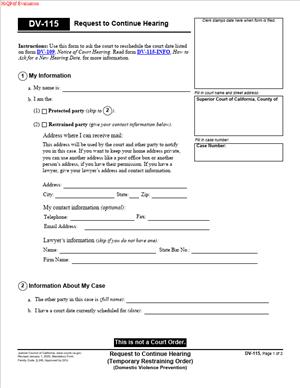
DV-115 – Request to Continue Hearing (Temporary Restraining Order) (Domestic Violence Prevention) is a court form used in domestic violence restraining order cases in California. You use it to ask the court to move, or “continue,” your scheduled hearing to a later date. It does not change the restraining order itself. It asks for more time before the court makes longer-term decisions.
If you are involved in a domestic violence case, you may already have a temporary restraining order in place. A hearing is usually set within a short time so a judge can decide whether to issue longer-term orders. Sometimes you cannot attend on the scheduled date. This form is how you formally tell the court and ask for a new date.
You might be the person who requested protection. You might be the person who is responding to the request. Either side can use this form when there is a valid reason the hearing cannot go forward as planned.
The timing of restraining order hearings is strict. Missing a hearing can affect your rights and your safety. That is why this document matters. It helps you keep the case active while giving you time to prepare or address scheduling conflicts.
This guide explains what the form does, when it is used, and how to complete it clearly. The goal is to help you understand what the court expects before you fill it out.
What is DV-115 – Request to Continue Hearing (Temporary Restraining Order) (Domestic Violence Prevention)?
Clear definition
DV-115 – Request to Continue Hearing (Temporary Restraining Order) (Domestic Violence Prevention) is a written request asking the court to reschedule a domestic violence restraining order hearing. In legal terms, “continue” means to postpone to a later date.
In most domestic violence cases, a temporary restraining order may be issued first. A hearing is then scheduled so a judge can decide whether to issue orders that last longer, often up to several years. This form asks the court to move the hearing date.
The document tells the court who is making the request and why more time is needed. It becomes part of the official case record once filed.
Who typically uses this form?
You may use this form if you are the person who asked for protection and cannot attend the scheduled hearing. For example, you may have a medical issue, travel conflict, or need more time to prepare evidence.
You may also use it if you are the person responding to the restraining order request. If you were served close to the hearing date and need more time to prepare your response, this form allows you to ask for that additional time.
In some situations, both sides may agree that more time is necessary. Even if both parties agree, the court still must approve the new date.
This form is used in domestic violence prevention cases. It is not used for civil harassment or other types of restraining orders, which have different forms.
Why might you need this form?
You might need more time to gather documents, messages, photographs, or witness statements. Preparing for a restraining order hearing often requires organizing detailed information about past events.
You may have been served with the restraining order paperwork shortly before the hearing. That short timeline can make it hard to prepare a clear response.
Unexpected events can also make attendance impossible. Illness, emergencies, work conflicts, or caregiving responsibilities can prevent you from appearing on the original date.
Sometimes safety planning requires extra time. If the temporary order affects housing, child custody, or contact arrangements, you may need time to make practical arrangements before the hearing.
Typical real-life scenarios
- You are the person who requested protection, and you are recovering from an injury related to the incident. Your doctor advises you not to attend court on the scheduled date. You file this form to request a new hearing date.
- You are the respondent and were served only a few days before the hearing. You need time to review the allegations and prepare a written response. You use the form to ask the court for more preparation time.
- You have a work obligation that cannot be changed without serious consequences. The hearing date conflicts with that commitment. You file the request to ask the court to reschedule.
- You and the other party are discussing temporary agreements about children or property. You believe additional time may allow for a more organized presentation at the hearing. You request a continuance so the court can consider a more complete record.
When would you use DV-115 – Request to Continue Hearing (Temporary Restraining Order) (Domestic Violence Prevention)?
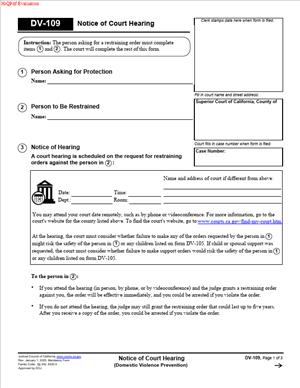
Use DV-115 – Request to Continue Hearing when a hearing has already been scheduled in a California domestic violence restraining order case and either party needs the court to move it to a later date. The current hearing date appears on DV-109, Notice of Court Hearing.
Both the protected party and the restrained party may file DV-115. However, the circumstances supporting each party’s request may differ. The protected party may need additional time to complete personal service of the restraining-order papers. The restrained party may need time to prepare a response, obtain legal assistance, gather evidence, or arrange for witnesses. A first request from the restrained party receives specific treatment under the applicable California law; other requests generally require a showing of good cause.
File the form as soon as you know that a continuance is necessary. Explain clearly why the current hearing date cannot reasonably be kept and provide specific facts, dates, and supporting information. Examples may include late service, illness, hospitalization, an unavoidable scheduling conflict, difficulty obtaining essential evidence, or another circumstance affecting the party’s ability to participate fairly.
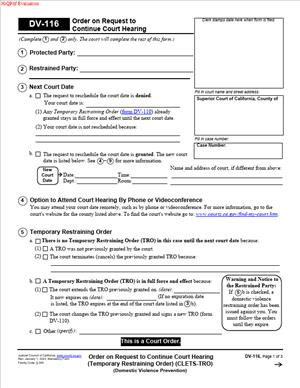
DV-115 is only a request. Filing it does not automatically change the hearing date. The judge decides whether to grant the continuance. The requesting party generally also prepares DV-116, Order on Request to Continue Hearing, for the judge to sign. If the court does not approve the request, the original hearing remains scheduled, and the parties should attend unless the court instructs otherwise.
If DV-110, Temporary Restraining Order, is in effect and the hearing is continued, the temporary orders generally remain effective until the end of the new hearing date unless the judge modifies or terminates them. The signed DV-116 should state the new hearing date and explain what happens to the temporary restraining order.
After the court decides the request, the other party must receive copies of the filed forms and related papers in the manner stated in DV-116. The required method may depend on who requested the continuance, whether the other party has already been personally served, and what the judge ordered. Proof of service should be completed and filed before the new hearing as required.
This form does not ask the court to add, remove, or change the substantive protections in a restraining order. Its primary purpose is to request a new hearing date. Any request to modify the restraining order itself may require different forms or procedures.
Until a signed order confirms the continuance, do not assume that the hearing has been rescheduled. Check with the clerk, obtain a filed copy of DV-116, comply with all service requirements, and attend the original hearing if the request has not been granted.
Legal characteristics of DV-115 – Request to Continue Hearing (Temporary Restraining Order) (Domestic Violence Prevention)
This form is part of the official court record once it is filed. It must be completed clearly and accurately. The court reviews the reasons given and decides whether to grant the request.
For the request to be effective, it generally must be filed with the correct court handling the case. It must include accurate case information, such as the case number and the names of the parties. Missing or incorrect information can delay review.
Service requirements often apply. This means the other party may need to receive a copy of the request. If proper notice is not given, the court may decline to act on the request or may set conditions.
Courts typically look for a reasonable explanation for the postponement. Vague statements or incomplete explanations can create problems. Clear, factual descriptions are more likely to be considered carefully.
Different counties within California may have slightly different local procedures for filing and processing continuance requests. Some may allow electronic submission, while others require paper filing. The core purpose of the form remains the same statewide.
This form does not cancel the hearing by itself. The hearing remains scheduled unless and until the court issues an order changing the date. Filing the document alone does not guarantee a continuance.
It also does not dismiss the restraining order case. The underlying request for protection remains active until the court makes a decision or the case is otherwise resolved.
Is it legally binding?
The form itself is a request. By itself, it is not a court order. It becomes legally meaningful once the judge signs an order granting or denying the continuance.
If the court grants the request and sets a new date, that new date becomes binding. Both parties are expected to follow the updated schedule. Failing to appear on the new date can have consequences similar to missing the original hearing.
If a temporary restraining order is extended as part of the continuance, that extension is legally binding once ordered by the court. The same restrictions remain in effect until the new hearing date.
If the court denies the request, the original hearing date remains in place. The form does not override the existing schedule without judicial approval.
How to fill out DV-115 – Request to Continue Hearing (Temporary Restraining Order) (Domestic Violence Prevention)
Step 1 – Identify the court and case information
At the top of the form, enter the name and address of the court handling your case. Include the case number exactly as it appears on your existing court papers. Write the full legal names of the petitioner and respondent as listed in the case.
Step 2 – Identify who is making the request
Indicate whether you are the person who requested the restraining order or the person responding to it. Make sure your role matches how you are listed in the case. This helps the court understand your position.
Step 3 – State the current hearing date
Write the date, time, and department of the currently scheduled hearing. Copy this information directly from your notice or temporary restraining order paperwork to avoid mistakes.
Step 4 – Explain why you need a continuance
Provide a clear and specific explanation of why you are asking for more time. Describe the circumstances in factual terms. Include relevant dates or events that show why you cannot attend or why you need additional preparation time.
Step 5 – Address temporary orders
If a temporary restraining order is in place, the form may ask whether you are requesting that it remain in effect until the new hearing date. Read this section carefully and complete it based on your situation.
Step 6 – Provide contact information
Fill in your current mailing address and any other required contact details. Make sure the information is accurate so the court can send you notice of its decision.
Step 7 – Sign and date the form
Review the completed document for accuracy. Sign and date it where indicated. Your signature confirms that the information you provided is true to the best of your knowledge.
Step 8 – Prepare for filing and service
Make the required copies of the completed form. File the original with the court handling your case. Follow the applicable process for ensuring the other party receives a copy, so the court can consider your request.
Legal terms you might encounter in DV-115 – Request to Continue Hearing (Temporary Restraining Order) (Domestic Violence Prevention)
- Continuance: A continuance is a request to move a scheduled court hearing to a later date. On this form, you are asking the judge to postpone the current hearing. You must explain why you cannot attend or why you need more time.
- Temporary Restraining Order (TRO): A TRO is a short-term court order meant to protect someone until the hearing. This form may affect how long the TRO stays in place if the hearing is postponed. The judge decides whether to extend the temporary protections.
- Hearing Date: This is the current date set for the court to decide whether to grant longer-term restraining orders. You must clearly list this date so the court knows which hearing you want to continue. If you list the wrong date, your request may not be processed correctly.
- Good Cause: Good cause means a valid and reasonable reason to reschedule the hearing. Examples can include illness, lack of proper notice, needing more time to prepare, or problems with service. You must briefly describe your reason on the form.
- Service: Service is the legal process of delivering court papers to the other party. If the service was not completed properly or on time, that may be a reason to request a continuance. The court will consider whether both sides had fair notice.
- Protected Party: The protected party is the person asking for protection from the court. If you are the protected party and need more time, you use this form to explain why. If you are the restrained person, you may also use it to request more time to prepare your response.
- Restrained Party: The restrained party is the person the temporary order is against. If you are the restrained party, a continuance may give you time to respond, gather evidence, or hire an attorney. The court may decide whether the TRO stays active during the delay.
- Court Order: A court order is a decision signed by a judge. Your request on this form is not automatically approved. It only becomes effective if the judge signs an order granting the continuance.
- Notice: Notice refers to informing the other party about court dates and filings. When you request a new hearing date, the other party must usually be told. Failing to provide notice can delay your case further.
- Extension of Temporary Orders: If the hearing is postponed, the judge may extend the existing temporary restraining orders until the new date. This keeps protections in place while the case is pending. The extension is not automatic unless the judge signs it.
FAQs
What happens after I file DV-115 – Request to Continue Hearing (Temporary Restraining Order) (Domestic Violence Prevention)?
After you file this form, the court reviews your request and decides whether to grant a new hearing date. The judge may approve or deny it without a hearing. You must check for a signed order that confirms the new date and whether temporary orders are extended.
Do I still have to go to court on the original hearing date if I asked for a continuance?
Yes, unless the court signs an order continuing the hearing before that date. Filing this document does not automatically change the schedule. You need written confirmation from the court showing the new hearing date.
Will the temporary restraining order automatically stay in effect?
Not automatically. The judge must specifically extend the temporary orders to the new hearing date. Check the signed order carefully to see if the expiration date was updated.
What if I made a mistake in the hearing date or case number?
You should correct the error as soon as possible. If the mistake is minor and caught before filing, fix it and review the form again. If you already filed it, you may need to submit a corrected version so the court processes the right case.
Do I need to attach proof of my reason for requesting more time?
It depends on your situation. If your reason involves something like a medical issue, scheduling conflict, or lack of service, attaching documents can help the judge understand your request. Make sure any attachments clearly reference the case number and are labeled.
Does the other party have to agree to the continuance?
No. You can request more time even if the other party disagrees. The judge decides whether to grant it based on the information in this form and the case record.
What changes in the public court record when a continuance is granted?
The court record will show a new hearing date and may reflect that temporary orders were extended. It becomes part of the case history. Anyone reviewing the case file will see that the hearing was postponed.
Can I file this form on the same day as the hearing?
You can submit it close to the hearing date, but timing matters. If the judge does not review and sign an order before the hearing, you may still be expected to appear. Filing late increases the risk that your request will not be processed in time.
Checklist: Before, During, and After DV-115 – Request to Continue Hearing (Temporary Restraining Order) (Domestic Violence Prevention)
Before
- Confirm the exact hearing date and time from your notice.
- Verify the case number and court location.
- Decide clearly why you need the continuance.
- Gather any documents that support your reason.
- Check whether temporary orders are set to expire on the hearing date.
- Review all names to ensure they match prior filings.
- Make sure your contact information is current.
During
- Fill in the court name and address exactly as shown on prior documents.
- Enter the correct case number on every page.
- Identify whether you are the protected or restrained party.
- Clearly state the current hearing date you want continued.
- Provide a brief but specific explanation of your reason.
- Indicate whether you are asking to extend temporary orders.
- Sign and date the form where required.
- Make copies for your records and for service if needed.
After
- File the completed form with the court clerk.
- Obtain a stamped copy showing the filing date.
- Check regularly for a signed court order granting or denying the request.
- Note the new hearing date if approved.
- Confirm whether temporary orders were extended.
- Serve the other party with any required documents.
- Keep copies in a safe and organized place.
- Update your calendar with all deadlines and court dates.
Common mistakes to avoid with DV-115 – Request to Continue Hearing (Temporary Restraining Order) (Domestic Violence Prevention)
- Mistake: Assuming the hearing is automatically postponed after filing, which happens because people confuse filing with approval, leading to missed court appearances and possible negative rulings, so do not forget to check for a signed order granting the continuance.
- Mistake: Listing the wrong hearing date or case number due to copying errors, which can cause the clerk to reject or misfile the request, so do not forget to double-check all identifying information before submitting.
- Mistake: Giving a vague reason like “not ready” without details, which may cause the judge to deny the request for lack of good cause, so do not forget to clearly explain your specific situation.
- Mistake: Forgetting to request an extension of temporary orders, often because you focus only on the new date, which could result in protections expiring, so do not forget to address the status of existing orders.
- Mistake: Failing to provide notice to the other party when required, usually due to misunderstanding service rules, which can delay the case further, so do not forget to confirm service requirements.
- Mistake: Waiting until the last minute to file, often because of uncertainty or procrastination, which risks the judge not reviewing the request in time, so do not forget to act as early as possible.
- Mistake: Not keeping a stamped copy for your records, which happens when people rely on memory or online access, creating confusion about what was filed, so do not forget to keep organized copies.
- Mistake: Ignoring the updated expiration date of temporary orders, which can lead to accidental violations or loss of protection, so do not forget to read the signed order carefully.
What to do after filling out DV-115 – Request to Continue Hearing (Temporary Restraining Order) (Domestic Violence Prevention)
Once you complete the form, your next steps are practical and time-sensitive. Stay organized. Keep everything in writing. Confirm every update from the court.
- Step 1: Make at least two copies of the completed form before filing. One copy is for you. The other may be needed for service.
- Step 2: File the original with the court clerk at the courthouse listed on your case documents or through the court’s accepted filing method.
- Step 3: Ask the clerk how you will be notified of the judge’s decision. Some courts provide a stamped order the same day. Others require you to check online or return later.
- Step 4: Carefully review the signed order once it is issued. Look for the new hearing date, time, and department.
- Step 5: Check whether the temporary restraining orders were extended and note the new expiration date, if listed.
- Step 6: Serve the other party with the filed request and the signed order if required. Follow the proper service method for your case.
- Step 7: File any proof of service forms with the court to show that notice was given.
- Step 8: Update your calendar immediately with the new hearing date and any related deadlines.
- Step 9: Keep all documents together in a dedicated folder, including the original TRO, your request, the signed order, and proof of service.
- Step 10: Prepare for the new hearing date by gathering evidence, organizing notes, and reviewing prior filings.
If your request is denied, you must appear at the original hearing date. Do not assume the court will remind you. It is your responsibility to track the status.
If your request is granted, treat the new hearing date as firm. Use the extra time wisely. Gather documents, identify witnesses if applicable, and prepare your statements. The continuance gives you time, not a result.
Stay proactive. Monitor the case status until the hearing is fully resolved.
Disclaimer: This guide is provided for informational purposes only and is not intended as legal advice. You should consult a legal professional.