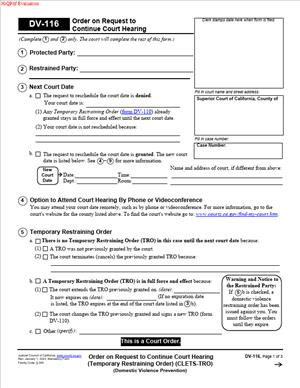
DV-116 – Order on Request to Continue Court Hearing (Temporary Restraining Order) (CLETS-TRO) (Domestic Violence Prevention)
Fill out nowJurisdiction: Country: United States | Province or State: California
If you are involved in a domestic violence restraining order case, the DV-116 – Order on Request to Continue Court Hearing (Temporary Restraining Order) (CLETS-TRO) (Domestic Violence Prevention) is a court order that tells you whether a scheduled hearing has been postponed. It is not a request form. It is the judge’s written decision about a request to move the hearing to a later date.
This document usually appears after someone files a request to continue or reschedule a restraining order hearing. The court reviews that request and then issues this order. The order explains whether the hearing date has changed and whether the temporary restraining order remains in effect.
If you are about to review or receive this form, you are likely preparing for a court hearing related to a domestic violence temporary restraining order. The hearing is where the judge decides whether to issue a longer-term restraining order.
Understanding this document matters because it affects your court date and, in many cases, whether temporary protections stay in place. A missed hearing or confusion about the order can create serious problems for either party.
What is DV-116 – Order on Request to Continue Court Hearing (Temporary Restraining Order) (CLETS-TRO) (Domestic Violence Prevention)?
Clear definition
DV-116 – Order on Request to Continue Court Hearing (Temporary Restraining Order) (CLETS-TRO) (Domestic Violence Prevention) is a California court order used in domestic violence cases. It tells both parties whether the court has granted or denied a request to postpone a scheduled restraining order hearing.
The form states the original hearing date and, if approved, the new hearing date. It may also confirm that the temporary restraining order remains in effect until the new court date.
Because this order relates to a CLETS-TRO, it connects to law enforcement systems. CLETS refers to the California Law Enforcement Telecommunications System. When a temporary restraining order is active, it is often entered into that system for enforcement purposes.
Who typically uses this form?
This form is used in cases where one person has requested a domestic violence restraining order against another. The person asking for protection is often called the protected person or petitioner. The other person is often called the restrained person or respondent.
Either party may request a continuance of the hearing, depending on the situation. For example, the respondent may need more time to prepare a response. The petitioner may need more time to serve papers.
The judge signs this form after reviewing the request. The clerk then files it as part of the official court record. Both parties receive notice of the court’s decision.
Why might you need this form?
You may encounter this form if you or the other party asked the court to reschedule the restraining order hearing. Courts sometimes grant continuances to allow proper notice, gather evidence, or address scheduling conflicts.
If the restrained person was not properly served before the original hearing date, the court may continue the hearing to allow proper service. In many cases, the temporary restraining order remains active during this extended period.
This document is important because it clearly states what happens next. It removes guesswork about whether the hearing is still set for the original date or has been moved.
Typical real-life scenarios
- A petitioner files for a domestic violence restraining order and receives a temporary restraining order from the court. The respondent has not yet been served with the paperwork before the hearing date. The petitioner asks the court to continue the hearing so service can be completed. The judge issues an order continuing the hearing and extending the temporary order.
- In another situation, the respondent is served shortly before the hearing and asks for more time to prepare a response. The court may grant a continuance to allow a fair opportunity to respond. The order then lists a new hearing date and confirms whether the temporary restraining order remains in effect.
- Sometimes, one party has an emergency or scheduling conflict that prevents attendance on the original date. A request is filed explaining the reason. The judge reviews the explanation and decides whether to reschedule the hearing.
- In some cases, the court continues the hearing on its own motion. This can happen if the court calendar is full or if the judge determines that additional information is needed before making a final decision.
When would you use DV-116 – Order on Request to Continue Court Hearing (Temporary Restraining Order) (CLETS-TRO) (Domestic Violence Prevention)?
You use this document when there is already a scheduled hearing for a domestic violence restraining order, and someone has asked to move that hearing to a later date. It only comes into play after a request for continuance has been submitted and reviewed.
This form is relevant in the period between the filing of the restraining order request and the final hearing. During that time, a temporary restraining order may already be in place. The order on continuance clarifies whether that temporary protection stays active until the new hearing date.
Both petitioners and respondents may be directly affected by this order. The petitioner needs to know whether protection continues without interruption. The respondent needs to know the new court date and whether existing restrictions still apply.
You may also use this form as part of the service process. If the hearing is continued, updated paperwork may need to be served to ensure the other party knows the new date and any extended terms.
Legal characteristics of DV-116 – Order on Request to Continue Court Hearing (Temporary Restraining Order) (CLETS-TRO) (Domestic Violence Prevention)
This document is a court order signed by a judge. It becomes effective once it is signed and filed. It carries the authority of the court, not just the request of one party.
For the order to be valid, it must clearly identify the parties, the case number, and the court location. It must state whether the request to continue was granted or denied. If granted, it must list the new hearing date, time, and department.
Common problems arise when the form is incomplete or inconsistent with the case record. Missing case numbers, incorrect names, or unclear hearing dates can create confusion. Inaccurate service of the updated order may also cause enforcement issues.
In California domestic violence cases, temporary restraining orders are often entered into law enforcement databases. If a hearing is continued and the temporary order is extended, the updated information may also need to be reflected in those systems.
This form does not decide whether a permanent restraining order will be issued. It does not make findings about abuse or credibility. It only addresses scheduling and, in many cases, the duration of temporary protections until the new hearing.
Is it legally binding?
Yes, this order is legally binding once signed by the judge and filed with the court. It is an official court directive.
If the order states that the temporary restraining order remains in effect until the new hearing date, those terms continue to apply. The restrained person is still required to follow all listed restrictions, such as stay-away or no-contact provisions.
If the order denies the request to continue, the original hearing date remains in place. Both parties are expected to appear as scheduled unless another court order changes that date.
The binding nature of the document comes from the judge’s authority. It is not a private agreement between parties. Violating an active temporary restraining order may carry legal consequences, separate from the issue of scheduling.
How to fill out DV-116 – Order on Request to Continue Court Hearing (Temporary Restraining Order) (CLETS-TRO) (Domestic Violence Prevention)
Step 1 – Review the case caption
Start at the top of the form. Confirm the court name, address, case number, and names of the protected and restrained persons. These must match the original restraining order paperwork exactly. Errors in names or case numbers can create confusion in the court record.
Step 2 – Identify the original hearing details
Locate the section that lists the originally scheduled hearing date, time, and department. Make sure these details match the notice you previously received. This helps you confirm that the correct hearing is being addressed.
Step 3 – Indicate the court’s decision on the request
The form includes a section showing whether the judge granted or denied the request to continue the hearing. Review this section carefully. If you are preparing the document for court review, ensure the correct box is selected based on the judge’s ruling.
Step 4 – Enter the new hearing date if granted
If the continuance is granted, the form must list the new hearing date, time, and department. Double-check these details for accuracy. An incorrect date can lead to missed court appearances.
Step 5 – Address the temporary restraining order status
The form usually states whether the temporary restraining order remains in effect until the continued hearing date. Review this section closely. It clarifies whether existing protections are extended automatically.
Step 6 – Confirm service requirements
Look for any instructions about serving the updated order. The form may indicate whether the restrained person must be served with the new hearing date and related documents. Make sure the service section is complete and consistent with the court’s direction.
Step 7 – Judge’s signature and date
The order is not effective without the judge’s signature and the date of signing. Verify that the signature line is completed. The clerk will typically file and stamp the form after the judge signs it.
Step 8 – File and distribute copies
After signing, the form is filed with the court clerk. Copies are usually provided to both parties. If the temporary restraining order is extended, updated copies may also be processed for law enforcement entry.
Legal terms you might encounter in DV-116 – Order on Request to Continue Court Hearing (Temporary Restraining Order) (CLETS-TRO) (Domestic Violence Prevention)
- Continuance: A continuance means the court moves your hearing to a later date. On this form, the judge either grants or denies the request to continue. If granted, the new hearing date is listed clearly. You must follow the new schedule exactly as written.
- Temporary Restraining Order (TRO): A TRO is a short-term court order that provides protection until the full court hearing. This document states whether the existing TRO remains in effect and, if so, until what date. It may also show if the protections are modified or extended because of the new hearing date.
- CLETS (California Law Enforcement Telecommunications System): CLETS is the statewide system that allows law enforcement to see active restraining orders. When a TRO is continued, the updated information is transmitted so officers know the order is still enforceable. The CLETS notation on the form confirms that the order is entered into that system.
- Protected Person: This is the individual asking for protection. The form uses the protected person’s full legal name. That name must match prior filings, so there is no confusion about who is covered by the order.
- Restrained Person: This is the individual ordered to follow the restrictions. The court lists the restrained person’s identifying details on the form. Accuracy is critical because law enforcement relies on this information.
- Service: Service means formally delivering court documents to the other party. The order may state what documents must be served and by when. It can also clarify whether personal service is required before the next hearing.
- Hearing Date: This is the scheduled court date when both sides can present their positions. If the hearing is continued, the new date, time, and department are written in a specific section. You must check this section carefully so you appear at the correct time and place.
- Judicial Officer: The judicial officer is the judge who reviews and signs the order. The signature makes the order effective. The date next to the signature often controls when the changes take effect.
- Proof of Service: This is a separate document that shows service was completed correctly. While not part of this order itself, the order may refer to service requirements. Without proper proof of service, the court may not proceed at the next hearing.
- Expiration Date: The expiration date tells you when the temporary protections end. If the hearing is continued, the judge often extends the expiration date to match the new hearing date. Always confirm that the expiration date reflects the updated timeline.
FAQs
Does DV-116 – Order on Request to Continue Court Hearing (Temporary Restraining Order) (CLETS-TRO) (Domestic Violence Prevention) change the terms of my restraining order?
This document does not usually change the substance of the restraining order, such as stay-away distances or no-contact provisions. Its main purpose is to record whether the hearing is postponed and whether the temporary protections remain in effect. You should look at the section that states whether the temporary restraining order is extended and until what date. If any terms are modified, those changes will be written clearly in the body of the order.
When does the continued order take effect?
The order generally takes effect once the judge signs it. Check the signature line for the date of signing. Then review the section that lists the new hearing date and any extended expiration date. If the TRO is extended, it remains enforceable through the new date listed.
What information must match my earlier filings?
The names of the protected person and restrained person must match exactly with prior documents. The case number must also be identical. If even one letter is off, it can create confusion in the court file and in law enforcement databases. Always compare this document with your original petition before relying on it.
Do I need to serve the other party again after the hearing is continued?
Look at the section of this form that addresses service requirements. If the restrained person has not yet been personally served, the order may require service before the new hearing date. If the service was already completed, the order may confirm that no additional service is required. You must follow the specific instructions written in order.
What happens if the request to continue is denied?
If the judge denies the request, the original hearing date remains in place. This document will state that the request is denied and will not list a new hearing date. You must prepare to attend court on the originally scheduled date and time.
How do I know if the temporary restraining order is still enforceable?
Check the section that discusses the status of the temporary restraining order. It will state whether the TRO remains in full force and effect and list a new expiration date if applicable. Because the order is entered into law enforcement systems, officers can confirm its status. Do not assume it continues automatically; verify the written expiration date.
What should I do if the new hearing date conflicts with my schedule?
This document reflects the court’s decision. If a new date is listed and it conflicts with your schedule, you must take action promptly. Review the date, time, and department carefully. If there is a serious conflict, you may need to file another request explaining the reason, but the existing order remains in effect unless changed by the court.
Will the public record show that the hearing was continued?
Yes. This form becomes part of the court file. It shows whether the hearing was continued, the new date, and whether the TRO was extended. Anyone reviewing the court record will see that the timeline changed and can verify the updated hearing information.
Checklist: Before, During, and After DV-116 – Order on Request to Continue Court Hearing (Temporary Restraining Order) (CLETS-TRO) (Domestic Violence Prevention)
Before
- Review the original hearing notice and confirm the current scheduled date.
- Compare the names and case number with your prior filings.
- Check whether the temporary restraining order has an upcoming expiration date.
- Confirm whether the restrained person has already been served.
- Gather copies of any prior orders related to the case.
- Note any safety concerns that may be affected by a delay.
- Verify your current contact information is up to date with the court.
During
- Read the judge’s decision section carefully to see if the request is granted or denied.
- Locate the new hearing date, time, and department if the continuance is granted.
- Confirm whether the temporary restraining order is extended and until what date.
- Check for any new or modified service requirements.
- Ensure the judicial officer’s signature and date are present.
- Make sure the case number appears on every page.
- Ask the clerk for filed copies if you are at the courthouse.
After
- Mark the new hearing date on your calendar immediately.
- Arrange for service if the order requires it.
- Keep a copy of the signed order with you if you are the protected person.
- Provide a copy to local law enforcement if instructed.
- Store copies in a safe but accessible place.
- Prepare for the continued hearing by organizing your evidence.
- Monitor the expiration date of the TRO to ensure continuous protection.
Common mistakes to avoid with DV-116 – Order on Request to Continue Court Hearing (Temporary Restraining Order) (CLETS-TRO) (Domestic Violence Prevention)
- Mistake: Assuming the restraining order automatically continues without checking the new expiration date, which happens when people overlook the extension section, leading to gaps in protection. Do not forget to confirm the exact end date written by the judge.
- Mistake: Ignoring service requirements because you believe the other party already knows about the case, which often results from misunderstanding service rules, causing delays or dismissal, so do not forget to complete and file proper proof of service if required.
- Mistake: Missing the new hearing date after a continuance, which happens when you rely on memory instead of the written order, leading to possible case dismissal or unfavorable rulings, so do not forget to calendar the updated date immediately.
- Mistake: Failing to check that the judge signed the order, which can occur when you receive an unsigned copy, making the order unenforceable, so do not forget to verify the signature and date.
- Mistake: Allowing name or case number errors to go uncorrected, which often happens due to small typographical mistakes, creates confusion in enforcement, so do not forget to review all identifying details carefully.
- Mistake: Not keeping multiple copies of the signed order, which happens when you assume one copy is enough, risking loss or inability to prove the order’s status, so do not forget to make and store extra copies securely.
- Mistake: Believing the continuance changes custody, visitation, or support terms automatically, which stems from misunderstanding the form’s limited purpose, leading to incorrect assumptions about your rights, so do not forget that only written modifications on the order are effective.
- Mistake: Overlooking the CLETS entry status, which occurs when you assume law enforcement will update records without confirmation, possibly delaying enforcement, so do not forget to ensure the order reflects CLETS transmission.
What to do after filling out DV-116 – Order on Request to Continue Court Hearing (Temporary Restraining Order) (CLETS-TRO) (Domestic Violence Prevention)
Once the judge signs the order, your focus shifts to compliance and preparation. This document controls the timing of your case and the status of your temporary protection. Treat it as your updated roadmap.
- Step 1: Obtain at least two certified copies of the signed order from the clerk if available.
- Step 2: Review the entire order line by line to confirm the new hearing date, time, and department.
- Step 3: Verify the expiration date of the temporary restraining order and confirm there is no gap in protection.
- Step 4: If service is required, arrange for personal service promptly and ensure a proof of service form is completed.
- Step 5: File any required proof of service with the court before the new hearing date.
- Step 6: Provide copies to any agencies or individuals listed in the order, if applicable.
- Step 7: Keep one copy with you at all times if you are the protected person.
- Step 8: Update your personal calendar and set reminders several days before the new hearing.
- Step 9: Organize evidence, witness statements, or documents you plan to present at the continued hearing.
- Step 10: Confirm the courthouse location, parking, and arrival time to avoid last-minute delays.
Stay organized. Keep all documents related to your case together in a single folder. If your contact information changes before the new hearing, notify the court promptly so you receive all notices.
Finally, prepare emotionally and practically for the continued hearing. A continuance gives you more time. Use it to strengthen your presentation, clarify your goals, and ensure you understand what the court will decide at the next appearance.
Disclaimer: This guide is provided for informational purposes only and is not intended as legal advice. You should consult a legal professional.