A frozen bank account may be your first warning. You may receive a wage garnishment notice. A collection lawyer may contact you about a case you never knew existed.
If this happens, you may be able to vacate a default judgment in NYC. To “vacate” means to cancel the judgment. The case may then reopen so both sides can be heard.
This result is not automatic. You must ask the court for relief and support your request with facts. The right deadline and evidence depend on why the default happened.
This guide focuses on the General Civil Part of the Civil Court of the City of New York. Consumer-debt cases are common examples. Small Claims and Housing Court may use different forms or procedures. Check the caption and court name on your papers before you begin.
This article provides general legal information, not legal advice. Court procedures and form versions can change. Confirm current instructions with the court that entered the judgment.
What a Default Judgment Means
A default judgment is a court decision entered because one party did not answer or appear. In a debt case, the judgment may say that the defendant owes money. The plaintiff may then use lawful collection tools.
You might learn about the judgment through:
- a copy of the judgment;
- a bank-account restraint;
- deductions from your pay;
- a notice from a marshal;
- a lien or credit report entry; or
- a demand from the plaintiff or its lawyer.
A default judgment is different from a judgment entered after both sides presented their cases. If you participated and lost, a motion to vacate a default may not be the correct procedure.
Do not assume the case is over merely because you did not attend. You can ask to vacate a default judgment in NYC, but you should act as soon as you learn about it. Collection may continue unless the court grants a stay or other relief.
The New York Courts default-judgment guide explains the two most common grounds: an excusable default and improper service. New York law also provides other grounds in limited situations.
First Steps After You Discover the Judgment
Move quickly, but do not file a vague request. Start by finding the case record and building a clear timeline.
A complete record gives the court a sound basis to vacate a default judgment in NYC.

Confirm the court, county, and case number
Look at the judgment, marshal’s notice, restraint notice, or income-execution papers. Copy the names of the parties and the index number exactly.
The case may be in the Civil Court for New York, Kings, Queens, Bronx, or Richmond County. Use the official NYC Civil Court directory to confirm the correct clerk’s office and current hours.
If you cannot identify the case, bring the collection notice and identification to the clerk. Do not start a new case. A request to vacate a default judgment in NYC normally goes to the court that entered that judgment.
Get the complete court file
Ask the clerk for a copy of the file. Include the judgment and the affidavit of service. The affidavit of service states when, where, and how the summons and complaint were allegedly delivered.
Read every page. Compare the service details with your address, appearance, age, work schedule, and household at that time. Also look for a notice of entry. That document may affect the deadline for some motions.
The file helps you decide which rule may let you vacate a default judgment in NYC.
Write a dated timeline
Record these dates:
- when the lawsuit was filed;
- when service allegedly occurred;
- when your answer was due, if known;
- each court date you missed;
- when judgment was entered;
- whether and when the judgment with notice of entry was served;
- when you first learned about the judgment; and
- when collection activity began.
This timeline helps you identify the possible legal grounds. It also shows whether you acted promptly.
Prompt action can be important when asking the court to vacate a default judgment in NYC.
Protect urgent records
Save bank notices, pay statements, envelopes, emails, texts, medical papers, leases, utility bills, travel proof, payment records, and contracts. Download digital records before they disappear.
If collection affects money that may be protected from creditors, keep statements showing the source of each deposit. The New York Courts publish guidance on money that cannot be taken to collect a debt. Ask the court or a lawyer about urgent steps for your situation.
Preserving these records early can support a request to vacate a default judgment in NYC.
Deadlines to Vacate a Default Judgment in NYC
There is no single deadline for every request to vacate a default judgment in NYC. The rule depends on the legal ground. Do not rely on a general statement that you “always have one year.”
Excusable default under CPLR 5015(a)(1)
An excusable default means you had a reasonable reason for failing to answer or appear. You must usually show both:
- a reasonable excuse for the default; and
- a potentially valid defense to the plaintiff’s claim.
CPLR 5015(a)(1) states that a motion on this ground must be made within one year after the moving party is served with a copy of the judgment or order and written notice of its entry. If the moving party entered the judgment, the statute measures one year from entry.
The words “notice of entry” matter. The date the judgment was entered and the date it was served with notice of entry may differ. Get the file and legal help if the dates are unclear.
Even if the one-year clock has not started, waiting is risky. Delay can harm your proof and allow collection to continue. File promptly if you plan to vacate a default judgment in NYC.
Nonpersonal service under CPLR 317
CPLR 317 may apply when the summons was delivered by a method other than personal delivery to you or your designated agent. You must show that you did not personally receive notice in time to defend and that you have a meritorious defense.
The statute allows a request within one year after you learn that the judgment was entered. It also sets an outside limit of five years after entry. Both limits matter.
CPLR 317 is not the same as claiming that service was legally invalid. Service may have followed a permitted method, yet the papers never reached you in time. A lawyer or the Court Help Center can help you identify whether this section fits.
Lack of jurisdiction under CPLR 5015(a)(4)
A court needs personal jurisdiction over a defendant. Proper service of the summons is normally required. If service was legally defective, the judgment may be void for lack of jurisdiction.
CPLR 5015(a)(4) does not state the one-year limit used for excusable default. The New York courts’ guidance says the one-year limit does not apply to a bad-service request. Still, act promptly and explain any delay.
If facts about service are disputed, the judge may order a traverse hearing. This is a hearing about whether service was done correctly. The official traverse-hearing guide tells defendants to obtain the affidavit of service and gather evidence that tests its claims.
If you ask to vacate a default judgment in NYC for bad service, state the exact facts. “I was never served” is only a conclusion. Explain where you lived, who lived with you, and why the server’s description is wrong.
Other grounds and consent
CPLR 5015 also lists newly discovered evidence, fraud or misconduct, and reversal of an earlier judgment on which the current judgment depends. These grounds have different requirements. Get legal advice before relying on them.
Under CPLR 5015(b), the clerk may vacate certain default judgments entered under CPLR 3215 when the parties file a signed stipulation consenting to that relief. A plaintiff does not have to agree. Do not stop preparing your motion while waiting for consent unless the court or your lawyer tells you to do so.
What You Must Prove
The judge needs facts, not labels. Your papers should explain why the default happened and why reopening the case could matter.
What you must prove to vacate a default judgment in NYC depends on the legal ground you select.
Reasonable excuse
A reasonable excuse answers this question: Why did you fail to answer or appear?
Possible facts may include serious illness, an emergency, incarceration, being away, inability to leave work, or incorrect information about whether attendance was required. No example guarantees relief. The judge considers the full situation.
Support the excuse when possible. Use a medical note, travel record, employer statement, court notice, email, or other dated proof. Protect private information that does not need to be filed publicly.
If you knew about the case but ignored it, be honest. False facts can damage your request. A short, accurate explanation is stronger than a dramatic story without proof.
A supported explanation can help the judge assess whether to vacate a default judgment in NYC for excusable default.
Meritorious defense
A meritorious defense means a real defense that could affect the result. It is not enough to say that you cannot afford to pay.
The defense depends on the claim. In a consumer-debt case, possible defenses may concern payment, identity theft, mistaken identity, the amount claimed, ownership of the debt, bankruptcy, or the filing deadline. In a contract case, the dispute may concern performance, defects, cancellation, or the amount due.
State facts that connect to the defense. For example:
I dispute the amount because I paid $1,200 on March 3. Exhibit C is the canceled check, and Exhibit D is the plaintiff’s email confirming receipt.
Do not copy every defense from a form. Use only defenses that honestly fit. The official NYC consumer-debt answer guide explains common defenses, but the facts and current law must support them.
A specific defense is often required when you ask to vacate a default judgment in NYC.
Bad-service facts
For a service challenge, compare the affidavit of service with reliable proof. Helpful evidence may include:
- a lease or deed showing your address;
- utility bills or government mail;
- work or school attendance records;
- travel records;
- a photo showing the building or unit;
- proof that the named recipient did not live there;
- a witness with personal knowledge; or
- records showing that the physical description is inaccurate.
Do not contact the process server to argue. Preserve the record and present your evidence through the proper court process.
How to Vacate a Default Judgment in NYC Civil Court
The usual method is an Order to Show Cause, often shortened to OSC. An OSC asks a judge to set a return date and direct the other side to respond. It can also request temporary relief.
Step 1: Choose and state your legal ground
Identify whether you rely on excusable default, lack of jurisdiction, CPLR 317, or another ground. You may state more than one ground when the facts support them.
Do not force your case into the wrong rule. The deadline and required proof change with the ground used. If you are unsure how to vacate a default judgment in NYC, take the file to the courthouse Help Center or a qualified New York lawyer.
Step 2: Complete the supporting affirmation
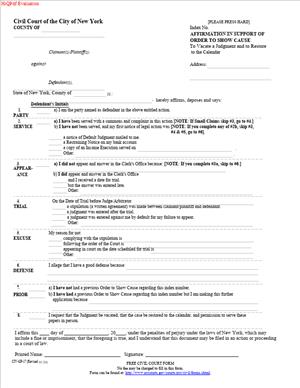
The CIV-GP-17 supporting affirmation helps organize the request. It asks about service, appearances, the reason for the default, the defense, prior applications, and the relief requested.
Use it to present the facts supporting your request to vacate a default judgment in NYC.
Use the caption and index number from the court file. State how and when you first learned of the judgment. Give dates and facts in time order.
New York’s current CIV-GP-17 uses an affirmation under penalties of perjury. Follow the signature instructions on the current form. Do not rely on old instructions that say every affirmation must be notarized.

How to Get a Legal Name Change in the United States: Steps, Costs, and Forms
Step 3: Attach focused evidence
Label exhibits in order. Refer to each exhibit in the affirmation. Useful items may include:
- the judgment and notice of entry;
- the affidavit of service;
- proof of your address;
- proof supporting your excuse;
- contracts, invoices, or statements;
- proof of payment;
- identity-theft records;
- bankruptcy papers;
- the bank restraint or income execution; and
- a proposed answer, when appropriate.
Use copies unless the court asks for originals. Remove sensitive data that court rules require you to redact. Keep an unredacted original available if needed.
Focused exhibits make it easier to evaluate whether to vacate a default judgment in NYC.
Step 4: Ask for a stay when enforcement is urgent
A stay pauses specified enforcement while the court considers the request. Ask for one if wages are being taken, a bank account is frozen, or another immediate harm is occurring.
Explain the harm and attach proof. Identify the enforcement step you want paused. If protected benefits are in the account, show their source without exposing unnecessary account data.
The judge may grant, limit, change, or deny the requested stay. Filing an unsigned OSC does not itself stop collection. Read the signed order to learn whether temporary relief was granted.
A stay and a request to vacate a default judgment in NYC are related but separate forms of relief.
Step 5: Submit the packet to the correct court
Take the OSC, affirmation, and exhibits to the Civil Court that entered the judgment. Ask the clerk about the current submission method, copies, and any fee.
The NYC Civil Court fee page lists court charges and payment methods. A defendant who did not start the case may not owe a first-paper fee, but other fees can depend on the filing. Confirm with the clerk rather than assuming.
If you cannot afford a required fee, ask about a fee waiver. New York Courts provides current fee-waiver guidance.
Step 6: Wait for the judge’s review
The judge may sign the OSC, change it, ask for missing information, or decline to sign it. If signed, the order will state the return date and how service must occur. It may also address a stay.
A signed OSC is not a final decision to vacate a default judgment in NYC. It brings the request before the court. The plaintiff still has a chance to oppose it.
Step 7: Serve exactly as the judge directs
Read every handwritten and printed direction. The order controls who must receive the papers, which papers must be delivered, how delivery must occur, and the deadline.
Serve the signed OSC, supporting affirmation, and exhibits as directed. If the order requires notice to a marshal, employer, bank, or another person, follow that instruction too.
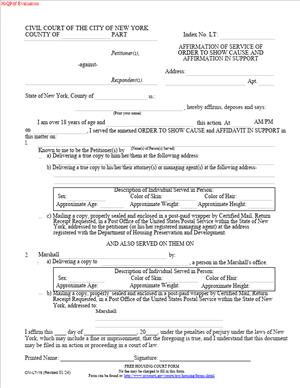
Use CIV-GP-19 when it matches the judge’s directions. File proof of service by the required time and keep a stamped copy.
Correct service is required before the judge can hear your request to vacate a default judgment in NYC.
Step 8: Prepare for the return date
Bring the signed OSC, your affirmation, exhibits, proof of service, and any opposition or reply papers. Bring originals of important records if available.
Prepare a short explanation covering:
- when you learned of the judgment;
- why the default happened;
- the facts supporting your defense;
- any problem with service;
- why you acted promptly; and
- what order you want.
Arrive early and check in. If you do not appear, the request may be denied. The court’s motions and orders-to-show-cause guide explains the hearing process and written opposition.
How to Vacate a Default Judgment in NYC When Service Was Wrong
Bad service deserves its own preparation. The affidavit of service is the starting point, not the final word.
Request the affidavit and a traverse hearing
Ask the clerk for the filed affidavit of service. Read the date, time, address, delivery method, recipient, and physical description.
In your OSC, explain each fact you dispute. Ask for a traverse hearing if needed. At that hearing, the judge decides whether service was proper.
The process server or another witness may testify. You may testify and present records or witnesses. Organize your proof around the statements in the affidavit.
If you seek to vacate a default judgment in NYC under CPLR 5015(a)(4), the jurisdiction issue is central. A successful service challenge may cause dismissal without prejudice. “Without prejudice” means the plaintiff may be allowed to start or continue a proper case, subject to the law and deadlines.
Do not confuse no receipt with invalid service
You may not have seen the papers even though a legally permitted service method was used. That situation may point toward CPLR 317 rather than CPLR 5015(a)(4).
The difference is important. CPLR 317 requires lack of timely actual notice, nonpersonal service, and a meritorious defense. A jurisdiction motion challenges whether service was legally valid at all.
You can state alternative grounds when supported, but avoid inconsistent facts. Legal help is valuable when the service record is complex.
Common Mistakes That Weaken the Request
Avoid these errors when you try to vacate a default judgment in NYC:
- Waiting without explanation. State the date you learned about the judgment and what you did next.
- Using only conclusions. Replace “I was not served” with a detailed address and household facts.
- Explaining hardship but not a defense. Inability to pay is not usually a defense to whether the debt exists.
- Listing defenses that do not fit. Each defense should connect to a fact or record.
- Ignoring the affidavit of service. Obtain it before claiming that service was wrong.
- Forgetting urgent relief. If collection is active, clearly request a stay and support it.
- Serving the unsigned papers. The judge’s signed OSC contains the controlling directions.
- Missing the service deadline. Late or incorrect service may prevent the court from hearing the request.
- Missing the return date. Calendar the date, time, location, and appearance method.
- Assuming vacatur ends the lawsuit. Vacatur usually reopens the case; it does not prove that you win.
What Happens After the Court Decides
The judge may grant the motion, deny it, order a traverse hearing, request more papers, or resolve only part of the request.
The order deciding whether to vacate a default judgment in NYC controls what happens next.
If the judgment is vacated
Get a copy of the signed decision or order. Confirm whether the case was dismissed or restored to the calendar. Ask when an answer is due and what the next court date will be.
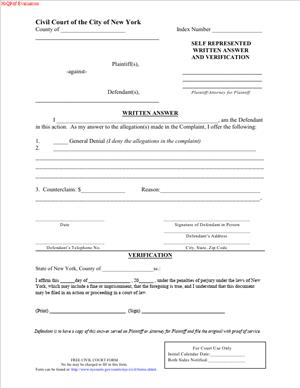
If the case continues, file the answer the court directs. A consumer-debt defendant may need the CIV-GP-58B written answer or another answer suited to the case.
Preserve all evidence. Attend conferences, discovery dates, and trial. Consider settlement only after you understand the terms and their effect.
If money was already collected, ask whether the order addresses restitution. CPLR 5015(d) allows the court to direct restitution when a judgment is set aside. The result depends on the order and facts.
If the request is denied
Read the written decision. It may identify missing facts, a deadline problem, or a legal reason for denial.
Do not repeatedly file the same unsupported papers. Ask the clerk or Help Center about procedural information. Speak with a lawyer promptly about review, renewal, or appeal because new deadlines may apply.
If the parties agree
Put any agreement in writing. Read every term before signing. A settlement may address the judgment, payment, dismissal, credit reporting, costs, or other rights.
Do not rely on an oral promise that collection will stop. File the required stipulation or court papers and obtain proof that the judgment record was changed.
Practical Document Checklist
Before filing, review this checklist:
- complete case caption and index number;
- copy of the judgment;
- copy of any notice of entry;
- affidavit of service from the court file;
- exact date you learned of the judgment;
- legal ground for vacatur;
- facts supporting a reasonable excuse, if required;
- facts supporting a meritorious defense, if required;
- address and service evidence, if relevant;
- proof of active collection and urgent harm;
- completed supporting affirmation;
- clearly labeled exhibits;
- proposed answer, if useful;
- correct contact information for every party; and
- copies for the court, service, and your records.
This checklist cannot decide whether you qualify to vacate a default judgment in NYC. It helps you present a complete and readable request.
Conclusion
To vacate a default judgment in NYC, first obtain the court file and affidavit of service. Then identify the correct legal ground and deadline. Build a dated record that supports your excuse, defense, service challenge, and need for urgent relief.
Use the Order to Show Cause process carefully. File in the court that entered the judgment. After the judge signs, serve the papers exactly as directed and appear on the return date.
If the court grants the request, the case may reopen. Be ready to answer and defend it. RunSensible Forms can help you locate, complete, review, and download relevant forms, but it is not a law firm, court, government agency, or official filing service.
Frequently Asked Questions
How long do I have to vacate a default judgment in NYC?
It depends on the legal ground. CPLR 5015(a)(1) generally gives one year after service of the judgment or order with written notice of entry for excusable default. CPLR 317 has a one-year-from-knowledge limit and a five-year outside limit. CPLR 5015(a)(4) does not state the same one-year limit for lack of jurisdiction. Act promptly and confirm your deadline.
Do I need both an excuse and a defense?
Usually, yes, when you rely on excusable default. Explain a reasonable excuse and a potentially meritorious defense. A jurisdiction challenge based on invalid service follows a different analysis.
Does filing an Order to Show Cause stop a bank restraint or garnishment?
Not by itself. Ask for a stay and explain the urgent harm. Collection pauses only if the judge grants relief that covers the enforcement step. Read the signed OSC carefully.
What if I never received the summons?
Get the affidavit of service from the court file. The facts may support a challenge to service or relief under CPLR 317. These paths have different rules, so compare the service record with your evidence.
What is a traverse hearing?
A traverse hearing decides whether the summons and complaint were served correctly. The judge hears evidence about service. Bring records and witnesses that directly address the filed affidavit of service.
What counts as a meritorious defense?
It is a real defense that could change the result. Examples may include payment, mistaken identity, an incorrect balance, lack of ownership of the debt, bankruptcy, or another defense supported by the facts and law.
Can the plaintiff agree to vacate the judgment?
Yes. CPLR 5015(b) permits the clerk to vacate certain default judgments entered under CPLR 3215 when the parties file a stipulation consenting to vacatur. Make sure the agreement is written and properly filed.
What happens after I vacate a default judgment in NYC?
The case may be restored so you can answer and defend it. Follow the new order, file any required answer, attend every date, and preserve your evidence. Vacating the judgment does not automatically decide the case in your favor.
Resources
- NYC Civil Court — Vacating a Default Judgment: https://www.nycourts.gov/new-york-city-civil-court/nyc-civil-court-vacating-default-judgment
- New York CourtHelp — Vacating a Default Judgment: https://www.nycourts.gov/help/after-case-over/vacating-default-judgment
- New York CPLR 5015 — Relief from Judgment or Order: https://www.nysenate.gov/legislation/laws/CVP/5015
- New York CPLR 317 — Defense After Nonpersonal Service: https://www.nysenate.gov/legislation/laws/CVP/317
- New York CourtHelp — Motions and Orders to Show Cause: https://www.nycourts.gov/help/representing-yourself-court/how-ask-court-something-motions-orders-show-cause
- New York CourtHelp — Preparing for a Traverse Hearing: https://www.nycourts.gov/help/after-case-over/how-prepare-traverse-hearing
- NYC Civil Court — Answering a Consumer-Debt Case: https://www.nycourts.gov/new-york-city-civil-court/answering-debt-collection-case-nyc-civil-court
- NYC Civil Court Directory: https://www.nycourts.gov/new-york-city-civil-court/nyc-civil-court-directory
- NYC Civil Court Fees: https://www.nycourts.gov/new-york-city-civil-court/nyc-civil-court-fees
- New York CourtHelp — Fee Waivers: https://www.nycourts.gov/help/representing-yourself-court/fee-waivers-poo
Disclaimer: The content provided on this blog is for informational purposes only and does not constitute legal, financial, or professional advice.
Contents