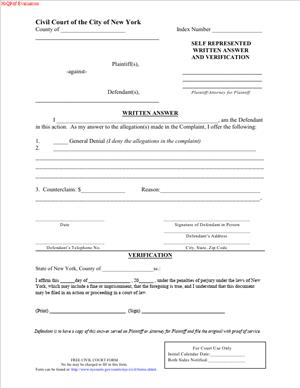
CIV-GP-58E – Self Represented Written Answer and Verification
Fill out nowJurisdiction: Country: United States | Province or State: New York
The CIV-GP-58E – Self Represented Written Answer and Verification is a court filing used when you are responding in writing to a civil case without a lawyer. It is designed for people who represent themselves and need a structured way to answer claims made against them. The document helps you put your response into a format the court recognizes.
This form matters because it is often your first formal chance to be heard in the case. What you write becomes part of the official court record. Judges and court staff rely on this document to understand your position early in the process.
If you are about to fill out this form, you are likely facing deadlines and uncertainty. The form is not about telling your full story. It is about responding clearly and directly to what was filed against you.
CIV-GP-58E – Self Represented Written Answer and Verification also includes a verification section. That part connects your written answers to a statement made under oath. It signals to the court that you are standing behind what you wrote.
Understanding how this document works before you start can save time and reduce avoidable errors. Each section has a specific purpose. Filling it out carefully helps ensure your response is accepted and reviewed.
What is CIV-GP-58E – Self Represented Written Answer and Verification?
Clear definition
CIV-GP-58E – Self Represented Written Answer and Verification is a standardized court form used to respond to a civil complaint or petition. It allows you to admit, deny, or state that you do not have enough information about each claim made against you. The form also includes a verification, which is a written statement confirming the truth of your responses.
This document functions as your formal written answer in the case. It is not a letter and not a narrative explanation. It follows a structured format so the court can easily see how you responded to each part of the complaint.
The form is associated with civil cases handled in the Civil Court of the City of New York. It reflects common procedural expectations used in that court system.
Who typically uses this form/document?
This form is commonly used by individuals who are named as defendants in a civil case and do not have legal representation. These are often everyday people handling the case on their own.
People who use this form may be tenants, consumers, small business owners, or individuals involved in disputes over money or obligations. The form is designed to be accessible to non-lawyers.
Court staff may also refer self-represented parties to this document when a written answer is required. It provides a consistent structure that aligns with court processes.
Why you might need this form/document
You might need this form if you were served with legal papers that require a written response. In many civil cases, the court expects a written answer rather than an oral statement.
The form gives you a way to respond point by point. This helps prevent confusion about which claims you agree with and which you dispute.
Using the CIV-GP-58E – Self Represented Written Answer and Verification can also help demonstrate that you are actively participating in the case. Courts often rely on timely written responses to move cases forward.
Typical real-life scenarios
You receive court papers stating that someone claims you owe money from a past transaction. The papers explain that you must respond in writing within a certain time. This form provides the structure for that response.
You are involved in a dispute related to a service or agreement, and the other party has filed a civil case. You need to tell the court which parts of their statement you disagree with. This document allows you to do that clearly.
You are named in a case where multiple statements are made about your actions. Some statements may be accurate, while others are not. The form lets you address each statement separately.
You are representing yourself and want to avoid submitting an informal response that might be rejected. The standardized format helps ensure your filing is recognizable and usable by the court.
When would you use CIV-GP-58E – Self Represented Written Answer and Verification?
This form is typically used after a civil case has already been started and you have been formally notified. The timing often comes soon after service of the complaint or petition.
You would use this document when the court requires a written answer rather than an appearance-only response. This is common in cases where the claims are detailed and need specific responses.
The form is used by the responding party, often called the defendant. It is not used by the person who started the case. It is also not used to start a new case.
In practical terms, you would use CIV-GP-58E – Self Represented Written Answer and Verification when you need to tell the court your position on the existing claims. It is part of the early stages of the case, before evidence or testimony is presented.
Legal characteristics of CIV-GP-58E – Self Represented Written Answer and Verification
This document has legal significance because it becomes part of the official court file. Its effectiveness generally depends on being completed fully, signed, and submitted according to court requirements.
Courts commonly look for clear responses to each claim. Missing sections, unclear answers, or unsigned verifications often cause delays or rejection. Accuracy and completeness matter because the form reflects your official position.
High-level procedures may differ between courts, even within the same state. Some courts may focus closely on formatting, while others focus on content clarity. These differences can affect how the form is processed.
This form does not present evidence, make legal arguments, or resolve the case. It does not ask the court for relief or make requests. Its role is limited to answering what has already been filed against you.
Is it legally binding?
The written answer itself carries legal weight because it is a formal court filing. What you state in the document is treated as your official response in the case.
The verification section adds another layer. By signing it, you are confirming that your statements are true to the best of your knowledge. Courts generally treat verified statements as sworn statements.
Because of this, inconsistencies between this form and later statements can raise questions. The form does not lock the outcome of the case, but it establishes your initial position in a legally recognized way.
How to fill out CIV-GP-58E – Self Represented Written Answer and Verification
Step 1 – Review the entire form
Start by reading the full document from beginning to end. This helps you understand how many sections there are and what information is requested. Seeing the full structure first reduces the risk of missing a required part.
Step 2 – Identify the case information
Locate the section that asks for case details. This usually includes names of the parties and a case or index number. Copy this information exactly as it appears on the court papers you received.
Step 3 – Confirm your role in the case
Find the part of the form that identifies you as the responding party. Make sure your name is spelled correctly and matches the court documents. This connects your answer to the correct case.
Step 4 – Read each claim carefully
The form is designed to respond to numbered statements or allegations. Read each one slowly. Understanding what is being claimed is necessary before choosing how to respond.
Step 5 – Select a response for each claim
For every claim, indicate whether you admit it, deny it, or do not have enough information to confirm it. Each response should correspond clearly to the specific statement being addressed.
Step 6 – Avoid combining responses
Respond to each claim separately. Do not merge answers or write general statements covering multiple claims. The court expects a clear, one-to-one connection between claims and responses.
Step 7 – Check for additional sections
Some versions of the form include space for additional statements or defenses. Read these sections carefully to understand what type of information they request.
Step 8 – Complete the verification section
Locate the verification near the end of the form. Read it word for word. This section is where you confirm that your answers are true to the best of your knowledge.
Step 9 – Sign and date the form
Sign your name in the space provided and add the date. Unsigned forms are commonly rejected or returned. Make sure the signature matches the name listed earlier.
Step 10 – Review for completeness and clarity
Before submission, read the entire completed form again. Check that every required section is filled in and that your writing is legible. This final review helps catch simple mistakes that can cause delays.
Legal terms you might encounter in CIV-GP-58E – Self Represented Written Answer and Verification
Answer: Your written response to the claims made against you. In this form, the answer is structured so you can address each numbered statement directly. What you write becomes your official position in the case.
Allegation: A statement of fact made by the other side. Allegations appear as numbered paragraphs you must respond to. You are not agreeing just because it is written; you choose how to respond to each one.
Admit: A response that says a specific allegation is true. When you admit, the court treats that point as not disputed. Only admit statements you know are accurate as written.
Deny: A response that says an allegation is not true. Denying keeps that point in dispute. You can deny, even if only part of the statement is incorrect.
Lack of Knowledge or Information: A response used when you do not know whether an allegation is true. This is appropriate when the statement refers to facts outside your knowledge. It avoids guessing and preserves your position.
Verification: A signed statement confirming your answers are true to the best of your knowledge. In this document, verification turns your answers into sworn statements. Courts take verified filings more seriously.
Caption: The heading section that lists the court, parties, and case number. The caption must match the court papers you received. Errors here can cause filing confusion.
Index Number: The court’s tracking number for the case. You copy this exactly as it appears on your summons or complaint. It links your answer to the correct case file.
Service: The act of delivering court papers to the other side. After you complete this form, service rules may apply. Proof of service is often required to show that delivery happened.
FAQs
Do I have to respond to every numbered paragraph in the complaint?
Yes. Each numbered paragraph is a separate allegation, and this form is designed for one response per paragraph. If you skip a number, it can look like you agreed with it or overlooked it.
What if an allegation is partly true and partly wrong?
Choose the response that best fits the statement as written. If the wording makes the statement inaccurate, a denial is appropriate. You are responding to the exact language, not your version of events.
Can I attach extra pages to explain my side?
This document is not meant for long explanations. If there is space for additional statements, use it carefully and keep it brief. Extra pages that do not fit the structure may be ignored or returned.
Who is allowed to sign the verification?
The person named as the responding party signs. If there are multiple respondents, each one typically signs their own verification. The signature confirms personal knowledge and responsibility for the answers.
Does the date next to my signature matter?
Yes. The date shows when you confirmed the answers were true. It should be the actual date you sign, not the date you received the papers or filled out earlier drafts.
What happens to this form once it is filed?
It becomes part of the court record. The judge and court staff can rely on it to understand what is disputed. The other side can also reference it later in the case.
Can I change an answer after filing?
Changes usually require a formal step, not just a new version. Because this document is verified, corrections are not automatic. This is why reviewing carefully before filing matters.
Is CIV-GP-58E – Self Represented Written Answer and Verification public?
Court filings are generally accessible as part of the case record. Information you include may be seen by court staff, the judge, and the other party. Write clearly and stick to the required information.
Checklist: Before, During, and After CIV-GP-58E – Self Represented Written Answer and Verification
Before
- Read the complaint or petition from start to finish
- Confirm the deadline for a written response
- Gather the summons, complaint, and any prior court notices
- Check the spelling of all party names and the case number
- Review each allegation and note your response choice
- Set aside time to complete the form without rushing
- Decide who needs to sign if more than one person is responding
During
- Copy the caption information exactly as shown on court papers
- Respond to every numbered allegation without skipping
- Use one response per allegation and keep it clear
- Write legibly if completing by hand
- Avoid adding explanations where the form does not ask for them
- Read the verification section word for word before signing
- Sign and date using the same name shown in the caption
After
- Make copies for your records before submitting
- Check whether service on the other side is required
- Submit the form using the method allowed by the court
- Confirm the filing was accepted or stamped
- Keep proof of filing and service together
- Update your personal case file with the submission date
- Watch for follow-up notices or court dates
Common mistakes to avoid with CIV-GP-58E – Self Represented Written Answer and Verification
- Mistake: Skipping an allegation because it seems repetitive, which happens when the complaint is long, leads to the court treating it as unanswered, so do not forget to respond to every numbered paragraph.
- Mistake: Admitting a statement without reading it closely, often due to rushing, can lock in facts you did not mean to accept, so do not forget to compare the wording to what you actually know.
- Mistake: Writing a long story instead of selecting a clear response, which happens when you want to explain yourself, can make the answer unclear, so do not forget the form’s limited purpose.
- Mistake: Leaving the verification unsigned, often because it is at the end, results in rejection or delay, so do not forget to sign and date it.
- Mistake: Using a different name or spelling than the caption, which happens with nicknames or abbreviations, causes record mismatches, so do not forget to match the court papers exactly.
- Mistake: Guessing instead of using lack of knowledge, often due to pressure to answer, can create false admissions, so do not forget that uncertainty is an allowed response.
- Mistake: Missing the filing deadline, which happens when focusing only on content, can lead to default consequences, so do not forget to track and act within the time allowed.
- Mistake: Failing to keep copies, often overlooked after submission, makes later disputes harder, so do not forget to save stamped or confirmed versions.
What to do after filling out CIV-GP-58E – Self Represented Written Answer and Verification
Once you complete the form, your focus shifts from drafting to follow-through. This stage matters because it ensures your work actually counts in the case. Small steps here protect the time you spent preparing your responses.
Start by making clean copies. Keep at least one complete copy for yourself. If there are multiple pages, keep them together in the same order. This becomes your reference for everything that follows.
- Step 1: Make copies of the completed and signed form for your records and any required delivery.
- Step 2: Check how the court accepts filings for this type of case, such as in person, by mail, or electronically when available.
- Step 3: Submit the form using an approved method and follow any instructions about envelopes, fees, or cover sheets.
- After submission, look for confirmation. This might be a stamp, receipt, or electronic notice. That confirmation shows the court accepted your filing. Store it with your copy of the form.
- Step 4: If required, arrange service on the other side and complete any proof showing it was delivered.
- Step 5: Place all proof of filing and service in a single folder or file.
- Step 6: Update your personal timeline with the date you filed and served the answer.
Next, prepare for what comes after the answer. Your responses frame what the court sees as disputed. Review your own answers so you remember what you admitted, denied, or stated you did not know.
- Step 7: Watch for court notices, scheduling orders, or requests sent after your answer is filed.
- Step 8: Bring your copy of the answer to any appearance or conference.
- Step 9: If your contact information changes, take steps to update it with the court promptly.
- Finally, keep your case file current. Add notes about any calls, mail, or deadlines. Staying organized reduces stress and helps you respond accurately as the case moves forward.
- Step 10: Re-read your answers before any later filing so your statements stay consistent.
Disclaimer: This guide is provided for informational purposes only and is not intended as legal advice. You should consult a legal professional.