A California small estate transfer allows property to be transferred after a person dies without a full probate case. The process may save time and court work. But “small estate” does not mean one form works for every asset.
California uses different rules for bank accounts, other personal property, low-value real estate, and a primary residence. The date of death changes the value limit. The title on each asset matters too.
This guide helps you sort the estate before choosing a procedure. It explains current amounts for deaths on or after April 1, 2025. It also indicates when formal probate may still be necessary.
Rules, forms, and local filing steps can change. Check the current California court materials before acting. This article gives general information, not legal advice. RunSensible is not a law firm, court, government agency, or official filing service.
California small estate transfer starts with the asset, not the form
Begin with a complete asset list. Do not begin by downloading an affidavit. A correct California small estate transfer depends on what the person owned and how it was titled.
The person who died is called the decedent. A person who has the legal right to receive property may be called a successor. That person could be named in a will or inherit under California law.
For each asset, record:
- the exact owner name.
- account or title type.
- value on the date of death.
- any named beneficiary.
- whether another owner has survivorship rights.
- whether the asset is held in a trust.
- where real property is located; and
- whether a probate case is already open.
An asset with a valid beneficiary may pass directly to that person. Trust property may pass under the trust. Jointly owned property may pass to the surviving owner. These transfers may not need a small-estate procedure.
Use the date-of-death value
California’s limits apply to the value at death. A current balance or later sale price may not answer the right question.
The official DE-300 maximum-values form lists amounts for different dates of death. For a death on or after April 1, 2025, the main amounts are:
- $208,850 for the personal-property affidavit procedure.
- $69,625 for the real-property-of-small-value affidavit.
- $750,000 for a petition concerning the decedent’s California primary residence; and
- $107,900 for a small-estate set-aside for a surviving spouse and minor children.
The numbers apply to different procedures. Do not combine them into one general probate limit.
Understand gross value
Gross value usually means value before subtracting debts. A mortgage does not always reduce the amount used for an eligibility test. California Probate Code also excludes certain property from some calculations.
This is a common source of mistakes. Get help if the estate includes a home, business, unusual title, disputed debt, or several successors.
First check whether property passes outside probate
A California small estate transfer may be unnecessary for an asset that already has a nonprobate path.
Complete this California small estate transfer review before counting assets against a limit.
Common examples include:
- a payable-on-death bank account.
- life insurance with a living named beneficiary.
- a retirement account with a beneficiary.
- property held in a living trust.
- property held in joint tenancy with right of survivorship; and
- some community property passing to a surviving spouse.
Contact the institution or title professional. Ask for its claim requirements. A bank may request a death certificate and beneficiary form. A trustee will use the trust documents. Real estate may require a recorded affidavit or another title document.
Do not assume every beneficiary designation is valid. The named person may have died first. The designation may name the estate. A trust may exist but never received the asset. These facts can change the result.
Make one transfer map
Create four groups:
- property that passes by beneficiary, trust, or survivorship.
- personal property that may fit an affidavit.
- real property that may fit DE-305 or DE-310; and
- property that may require formal probate.
This simple map prevents one asset from being counted or processed twice.
Use a California small estate transfer affidavit for personal property
California Probate Code sections 13100 through 13116 allow a successor to collect certain personal property with an affidavit or declaration. The statewide court website calls this the small estate affidavit procedure.
For a death on or after April 1, 2025, the gross value test is $208,850. The calculation includes the decedent’s California real and personal property, with exclusions described by law. Property included in a qualifying primary-residence petition is also treated under the current rules.
At least 40 days must pass after death. The successor gives the affidavit and required documents to the person or institution holding the property. The affidavit is usually not filed as a new probate case.
What this route can transfer
The procedure is commonly used for:
- bank accounts without a beneficiary.
- stocks or brokerage assets.
- money owed to the decedent.
- refunds.
- tangible personal property; and
- other eligible assets held in the decedent’s name.
Vehicles may use a separate DMV process. Real property needs a different procedure. Ask the asset holder what it requires.
California small estate transfer affidavit checklist
Prepare:
- a certified copy of the death certificate.
- proof of your identity.
- the affidavit or declaration required by the holder.
- the current DE-300 when required.
- a copy of the will, if one affects the right to inherit.
- written consent from other successors when required; and
- proof of the asset and its date-of-death value.
The affidavit is signed under penalty of perjury. Every statement must be accurate. If several successors share the property, they may need to act together or authorize one person.
Do not use the affidavit too early
The 40-day wait is measured from the date of death. Do not ask a bank to ignore it. The affidavit must also state that no probate proceeding is underway, or that the appointed personal representative consents, as the law requires.
If a holder asks for a local form, confirm that it reflects the current $208,850 limit. The Riverside County form, for example, lists the current amount for deaths on or after April 1, 2025.
Use DE-305 for California real property of small value
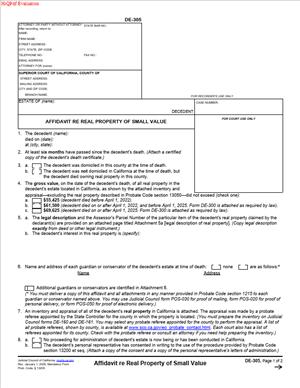
DE-305 is the Affidavit re Real Property of Small Value. It is a court-filed and recorded path for qualifying California real estate.
For a death on or after April 1, 2025, the gross value of all qualifying California real property in the estate must not exceed $69,625. At least six months must pass after death.
This California small estate transfer path is narrow. It is not a general shortcut for a typical California home.
Use this California small estate transfer method only when every DE-305 requirement fits.

Probate Without a Will: The Legal Procedure When Someone Dies Without Estate Planning
What DE-305 requires
The current DE-305 court packet shows key items, including:
- a certified death certificate.
- the property’s exact legal description and parcel number.
- an Inventory and Appraisal using DE-160 and DE-161.
- an appraisal by a California probate referee.
- the current DE-300 maximum-values form.
- a copy of the will, if one exists.
- signatures of all people claiming the property; and
- notarized acknowledgments.
Local courts may require extra cover sheets or declarations. Check the county where the decedent lived or where the property is located.
What happens after filing
The affidavit is filed with the proper Superior Court. After the clerk approves it, obtain a certified copy. Record that certified copy with the county recorder where the property is located.
Title errors are costly. Copy the legal description from the deed or another reliable title document. Do not use only a street address.
Use DE-310 for a qualifying California primary residence
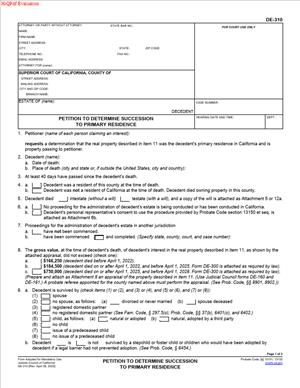
Form DE-310 is the Petition to Determine Succession to Primary Residence. It covers a different California small estate transfer route.
For a death on or after April 1, 2025, the decedent’s California primary residence may qualify if its gross value does not exceed $750,000. The home must have been the decedent’s primary residence. A vacation home, rental property, or commercial property does not become eligible just because its value is below that amount.
At least six months must pass after death before filing. Unlike a personal-property affidavit, this process requires a court petition and order.
California small estate transfer with DE-310
The petitioner files DE-310 in the proper Superior Court. The petition must identify the decedent, the home, its value, and the people entitled to succeed to it.
Expect to gather:
- a certified death certificate.
- the deed and legal description.
- evidence that the property was the primary residence.
- a date-of-death valuation.
- the current DE-300.
- the will, if any.
- names and addresses of heirs and beneficiaries; and
- any county-specific forms.
The court sets a hearing and notice requirements apply. If the court grants the petition, it signs an order that can support the title transfer.
Why the $750,000 limit needs care
The limit concerns gross value, not equity. A $900,000 home with a large mortgage does not fall below $750,000 merely because the loan is high.
The date of death also controls which limit applies. For earlier deaths, older amounts may apply. Use DE-300 and current court guidance rather than a general web summary.
Compare the three simplified routes
The California small estate transfer decision becomes clearer when you ask what is being moved.
Choose the personal-property affidavit when eligible property is mainly accounts, money, or belongings and the statutory test is met. Wait at least 40 days.
Consider DE-305 when all qualifying California real property is within the low-value limit. Wait at least six months. Obtain a probate-referee appraisal and file the affidavit with the court.
Consider DE-310 when the property is the decedent’s qualifying California primary residence and its gross value is within the current limit. Wait at least six months. File a petition and obtain a court order.
These routes are not interchangeable. An estate can sometimes use more than one. For example, a successor might use an affidavit for a bank account and DE-310 for a primary residence. The combined value rules still need careful review.
A California small estate transfer plan should name the procedure used for each asset.
When formal probate may be required
Formal probate may be needed when:
- the estate exceeds the applicable value limits.
- property does not fit a simplified category.
- there is a dispute over the will or heirs.
- a personal representative must sell or manage complex assets.
- creditor issues need formal administration.
- title or ownership is unclear; or
- an institution refuses a claim for a valid legal reason.
Formal probate usually begins with DE-111, Petition for Probate. The court may then issue an order and Letters that give a personal representative authority to act.
Avoid common California small estate transfer mistakes
The procedure may be shorter than probate, but the legal details still matter.
Using today’s value instead of the value at death
Get a supportable date-of-death value. This is especially important for real estate and investments.
Subtracting debts from a gross-value test
Do not assume a mortgage or other debt reduces the gross value. Read the exact eligibility rule.
Counting excluded property the wrong way
California law excludes certain assets from some calculations. It may also treat property in a DE-310 petition differently. Use the current statute and DE-300.
Treating all real estate as a primary residence
The $750,000 route is for the decedent’s qualifying primary residence. Other real estate follows different rules.
Using an old dollar limit
Older forms and articles may show $184,500 or $61,500. For deaths on or after April 1, 2025, the current DE-300 shows $208,850, $69,625, and $750,000 for the three main routes discussed here.
Filing before the waiting period ends
The personal-property affidavit uses a 40-day wait. DE-305 and DE-310 use a six-month wait. Count from the date of death.
Ignoring other successors
One heir cannot silently take property that belongs to several people. Identify everyone with an equal or better right.
Forgetting local forms
California Judicial Council forms are statewide, but counties may add cover sheets or local declarations. Check the court’s probate page.
Assuming a will avoids probate
A will directs distribution. It does not itself retitle a home or release a bank account. The estate still needs an authorized transfer process.
California small estate transfer document checklist
Before contacting a bank or filing with a court, gather:
- certified death certificates.
- the original will and any codicils.
- trust documents, if any.
- beneficiary designations.
- bank and investment statements near the date of death.
- vehicle titles.
- deeds and legal descriptions.
- mortgage statements.
- appraisals or value evidence.
- names and addresses of heirs and beneficiaries.
- a list of known debts.
- the current DE-300.
- the correct affidavit, DE-305, or DE-310; and
- county-specific probate instructions.
Keep a transfer log. Record each asset, holder, procedure, documents sent, and result. This helps prevent duplicate claims.

Review before signing under penalty of perjury
Check names against the death certificate. Check values against source documents. Check each heir’s relationship. Check whether a probate case exists.
Do not sign a California small estate transfer affidavit if a key fact is unknown. Resolve the issue first.
When to get legal help
A simple bank-account claim may be manageable without a lawyer. Advice can be valuable when:
A short review can keep a California small estate transfer from using the wrong value or form.
- real estate is involved.
- the home is close to the value limit.
- the decedent lived outside California.
- property has several owners.
- a trust was not fully funded.
- heirs disagree.
- the will may be invalid.
- the estate has tax or business issues.
- there are large or disputed debts; or
- a bank, recorder, or court rejects the documents.
A probate lawyer can compare the cost of a simplified procedure with formal administration. A title professional can identify deed and recording problems. Court self-help staff can explain forms and process, but they cannot give legal advice.
Conclusion
A California small estate transfer begins with careful sorting. First remove assets that pass by beneficiary, trust, or survivorship. Then separate personal property, low-value real estate, and the decedent’s primary residence.
For deaths on or after April 1, 2025, the main current limits are $208,850, $69,625, and $750,000. Each amount belongs to a different process. Waiting periods, gross-value rules, appraisals, and court filings also differ.
Use current forms and local instructions. Verify values and successor rights before signing. A well-planned California small estate transfer can avoid unnecessary probate while still protecting every person with a legal interest.
Frequently Asked Questions
What is a California small estate transfer?
A California small estate transfer is a simplified way to move eligible property after death without full probate administration. It may use a personal-property affidavit, DE-305 for low-value real property, or DE-310 for a qualifying primary residence.
What is the California small estate limit in 2026?
The answer depends on the procedure and date of death. For deaths on or after April 1, 2025, DE-300 lists $208,850 for the personal-property affidavit, $69,625 for real property of small value, and $750,000 for a qualifying primary residence.
How long must I wait to use a small estate affidavit?
Wait at least 40 days after death for the personal-property affidavit. The DE-305 and DE-310 real-property procedures require at least six months. Check the current law and form.
Does a mortgage reduce the value of a home for DE-310?
The DE-310 limit uses gross value. Do not assume the mortgage lowers that amount. Obtain a supportable date-of-death value and legal advice if eligibility is close.
Can DE-310 transfer a rental house?
DE-310 is for the decedent’s qualifying California primary residence. A rental or vacation property does not qualify as a primary residence merely because its value is below $750,000.
Do I file the personal-property affidavit with the court?
Usually, no. The successor gives the affidavit and supporting papers to the person or institution holding the property. Local forms or a dispute may create extra steps.
Do I need a probate referee for DE-305?
Yes. The current DE-305 requires an Inventory and Appraisal of the California real property. A probate referee appraises the property listed for that procedure.
What if the estate is over the limit?
Check first for assets that pass outside probate and other available procedures. If no simplified route fits, formal probate may be required. DE-111 commonly starts that case.
Resources
- California Courts, “Small estate affidavit to transfer personal property” — https://selfhelp.courts.ca.gov/probate/small-estate
- Judicial Council of California, “DE-300 Maximum Values for Small Estate Set-Aside & Disposition of Estate Without Administration” — https://courts.ca.gov/system/files/file/probate-code-890-adjusted-amounts.pdf
- California Courts, “When formal probate may not be needed” — https://selfhelp.courts.ca.gov/probate/simple-transfer
- California Courts, “Affidavit Re Real Property of Small Value (DE-305)” — https://selfhelp.courts.ca.gov/jcc-form/DE-305
- California Courts, “Petition to Determine Succession to Primary Residence (DE-310)” — https://selfhelp.courts.ca.gov/jcc-form/DE-310
- Riverside Superior Court, “Declaration for Collection or Transfer of Small Estate without Administration” — https://riverside.courts.ca.gov/system/files/local-forms/ri-pr012.pdf?cb=1745879430
- Riverside Superior Court, “Affidavit re Real Property of Small Value packet” — https://riverside.courts.ca.gov/system/files/forms-and-filings/affidavit-re-real-property-small-value.pdf?cb=1767229922
Disclaimer: The content provided on this blog is for informational purposes only and does not constitute legal, financial, or professional advice.
Contents