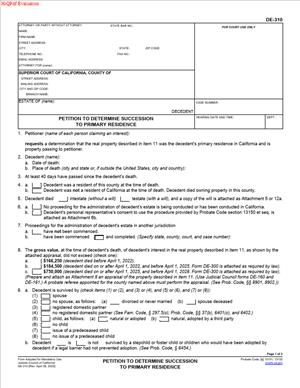
DE-310 – Petition to Determine Succession to Primary Residence
Fill out nowJurisdiction: Country: United States | Province or State: California
The DE-310 – Petition to Determine Succession to Primary Residence is a court form used in California probate proceedings. It asks a judge to decide who succeeds to a deceased person’s primary residence under specific legal rules. If you are preparing to complete this form, you are likely trying to confirm your right to a home after someone has died.
This document is filed with the probate court. It is not a private agreement between family members. It is a formal request for a court order that recognizes a transfer of ownership or confirms who legally inherits the property.
You may be filling out this form because the title to the home is unclear. Even if a will exists, real property often requires a court process to transfer ownership. This form helps create a clear record of who now owns the residence.
The DE-310 – Petition to Determine Succession to Primary Residence matters because real estate cannot usually be sold, refinanced, or transferred without clear legal authority. Lenders, title companies, and buyers typically require proof that the person claiming ownership has a court-recognized right to the property.
If you are self-represented, your goal is usually simple. You want the court to confirm that you are entitled to the decedent’s primary residence under California law. Understanding what the form does and how it works will make the filing process more manageable.
What is DE-310 – Petition to Determine Succession to Primary Residence?
Clear definition
DE-310 – Petition to Determine Succession to Primary Residence is a probate court petition used in California to ask a judge to determine who succeeds to a deceased person’s primary residence. It is part of the probate process and results in a court order if granted.
The form presents basic information about the decedent, the property, and the person or persons claiming succession. It asks the court to confirm that specific legal requirements have been met and to issue an order recognizing the transfer of ownership.
This document does not automatically transfer title. Instead, it begins a court proceeding that may result in an order determining succession. That court order is what can later be recorded with the county recorder to reflect the change in ownership.
Who typically uses this form?
This form is commonly used by surviving spouses, domestic partners, children, or other heirs. It may also be used by a personal representative if a probate estate has been opened.
In many situations, the person completing the form is someone living in the property or expecting to inherit it. Sometimes multiple family members are involved, especially when the residence is being divided among siblings or other relatives.
It is also used when there is no will and succession is determined under California intestate laws. In those cases, the court must identify the legal heirs and confirm how the property passes.
Why might you need this form?
You may need this form if the decedent owned a primary residence in their name alone. Without a joint tenancy, living trust, or other non-probate transfer method, a court order is often necessary to establish new ownership.
You might also need it if there is disagreement about who inherits the home. The petition creates a formal process where interested parties receive notice and have an opportunity to respond.
Another reason to use this form is to clear the title. Even when everyone agrees on who should inherit, public records may still list the deceased person as the owner. A court order helps resolve that issue.
In some cases, the home is the main asset of the estate. Determining succession to the residence may be the central issue in the probate proceeding.
Typical real-life scenarios
- A surviving spouse continues living in the family home after their partner dies. The home was titled only in the deceased spouse’s name. The surviving spouse files this petition to confirm that the property now belongs to them under California law.
- An unmarried parent dies without a will, leaving a house as their primary asset. Their adult children file the petition to determine how the property passes under intestate succession rules.
- Siblings inherit a home from a parent. One sibling wants to sell the property, but the title is still in the parents’ name. The petition is filed so the court can issue an order confirming the siblings as the legal owners.
- A decedent left a will naming a beneficiary of the residence, but probate has not yet clearly established ownership. The beneficiary uses this petition to obtain a court determination regarding succession to the primary residence.
- In another case, a personal representative is managing a probate estate. To finalize the distribution of the home to the correct heir, the representative seeks a court order through this form.
When would you use DE-310 – Petition to Determine Succession to Primary Residence?
You would use DE-310 – Petition to Determine Succession to Primary Residence during a probate proceeding involving real property that served as the decedent’s primary residence. It is typically used when ownership needs to be formally determined by the court.
This form is often used after a person has died and before the property can be transferred, sold, or refinanced. If the residence was not held in joint tenancy or placed in a trust, court involvement is commonly required.
You may encounter this form if you are an heir and want legal recognition of your interest in the home. It can also be part of a broader probate case where other assets are being administered.
The petition may be filed when there is uncertainty about succession. For example, if multiple heirs claim rights to the property, the court must determine who is entitled and in what share.
Sometimes the form is used even when there is no dispute. Title companies and financial institutions often require a court order before recognizing a new owner. In that situation, the filing serves to create official documentation rather than resolve conflict.
If a probate case is already open, this petition can be part of that case. In other situations, it may be filed to address the residence specifically, depending on how the estate is structured.
Legal characteristics of DE-310 – Petition to Determine Succession to Primary Residence
This petition is a formal court filing. It must be completed accurately and submitted to the appropriate California probate court. It becomes part of the public court record.
For the petition to be effective, it generally must identify the decedent, the property, and the legal basis for succession. The property description typically needs to match the legal description recorded in county records. Errors in the legal description are a common source of delay.
Notice requirements are also important. Interested parties, such as heirs or beneficiaries, usually must receive notice of the hearing. Failure to provide proper notice can result in continuances or denial of the petition.
The court will review whether the statutory conditions are met. This may include confirming that the property qualifies as the decedent’s primary residence and determining who is legally entitled to succeed to it.
Common problems include incomplete information, incorrect case numbers, missing attachments, or failure to sign the form properly. Inconsistent information between the petition and other probate documents can also create issues.
California probate procedures govern how this form is handled. While probate laws vary across states, this form is specific to California courts and follows California rules regarding succession and primary residences.
This petition does not transfer property by itself. It requests a judicial determination. The court’s order, once issued, is what establishes the successor’s legal right in the context of the probate proceeding.
It also does not resolve unrelated disputes, such as creditor claims or disagreements about personal property. Its focus is on determining succession to the primary residence.
Is it legally binding?
The petition itself is not legally binding. It is a request. The legally binding effect comes from the court’s order issued after review and, if required, a hearing.
Once the court grants the petition and signs an order determining succession, that order carries legal authority. It can be used to update title records and demonstrate ownership to third parties.
The binding effect generally depends on the proper procedure. If notice requirements are met and the court has jurisdiction, the resulting order typically has legal force within California.
However, if procedural steps are missed or if an interested party later challenges the order on valid grounds, the situation can become more complex. The strength of the order is tied to compliance with probate rules and due process requirements.
How to fill out DE-310 – Petition to Determine Succession to Primary Residence
Step 1 – Identify the Court and Case Information
At the top of the form, fill in the name of the superior court handling the probate matter. Include the county, court address, and branch if required. Enter the case number exactly as it appears on other probate documents. If a case has already been opened, make sure the information matches prior filings.
Step 2 – Provide Information About the Petitioner
Enter your full legal name and contact information in the space designated for the petitioner. If you are representing yourself, indicate that you are self-represented where the form asks for attorney information. Use your complete legal name as it appears on official identification and prior court filings.
Step 3 – Identify the Decedent
Provide the full legal name of the deceased person. Include any known aliases if required by the form. Confirm that the spelling matches the name used on the death certificate and other probate documents. Inconsistent names can cause delays or confusion in court records.
Step 4 – State the Basis for the Petition
The form will ask you to explain your relationship to the decedent and the legal basis for succession. This may involve identifying yourself as a spouse, domestic partner, child, or other heir. Clearly describe your claimed interest in the primary residence.
Be consistent with any will, trust, or intestate succession claim that applies. If there is a will, reference the relevant provision. If there is no will, indicate that succession is determined under California intestate law.
Step 5 – Describe the Primary Residence
Enter the address of the property and its full legal description. The legal description is not the same as the street address. It is usually found in the deed or prior recorded documents. Copy it carefully and completely.
Check that the property is identified as the decedent’s primary residence. The form may require you to confirm this status. Ensure the information matches other records in the probate case.
Step 6 – Identify Other Interested Parties
List any known heirs, beneficiaries, or other individuals who may have an interest in the property. Provide their names and, if requested, their relationship to the decedent. This helps the court determine who must receive notice of the petition.
Accuracy is important. Omitting an interested party can result in procedural issues or objections later in the process.
Step 7 – State the Requested Court Order
The form will include a section where you specify what you are asking the court to do. Clearly indicate that you are requesting an order determining succession to the primary residence and identifying the person or persons entitled to it.
If more than one person is to receive the property, specify how the ownership is to be divided. Use clear language that matches the structure of the estate or inheritance rights being claimed.
Step 8 – Review for Consistency and Completeness
Before signing, read through the entire form. Confirm that names, dates, and property details match other probate filings. Check that all required sections are completed and that no required attachments are missing.
Look for blank spaces that may need an entry such as “not applicable.” Incomplete forms are a common reason for rejection or delay.
Step 9 – Sign and Date the Petition
Sign your name where indicated. Enter the date of signing. If the form requires verification under penalty of perjury, read that statement carefully before signing. Your signature confirms that the information provided is true to the best of your knowledge.
Make sure the signature matches the name listed at the beginning of the petition. If multiple petitioners are involved, each person may need to sign as required by the form.
Step 10 – Prepare for Filing and Hearing
After completing the form, make the necessary copies for filing and service. File the original with the probate court clerk according to the court’s procedures. The court will typically assign a hearing date if one is required.
Keep a filed copy for your records. Track the hearing date and any deadlines related to notice or additional filings. The court’s order, if granted, will follow the hearing and complete the process of determining succession to the primary residence.
Legal terms you might encounter in DE-310 – Petition to Determine Succession to Primary Residence
- Decedent: The person who has died and whose primary residence is the subject of this petition. You must enter the decedent’s full legal name exactly as it appears on the death certificate. Any mismatch can delay review or cause questions about identity.
- Petitioner: You. The person asking the court to determine who succeeds to the primary residence. You must state your relationship to the decedent and explain why you have the right to request this order.
- Primary Residence: The home where the decedent lived at the time of death. This is not just any property they owned. You must describe the property clearly, including the full street address and, if available, the legal description used in property records.
- Succession: The legal transfer of rights in the primary residence after the decedent’s death. In this document, you are asking the court to confirm who now holds title or ownership interest. The court’s order clarifies who legally steps into the decedent’s position regarding the property.
- Intestate: A situation where the decedent did not leave a valid will. If this applies, you must state that no will exists and explain how you qualify to inherit under succession rules. This affects who the court recognizes as a successor.
- Testate: A situation where the decedent left a valid will. If there is a will, you may need to reference it and attach a copy. The will can determine who inherits the primary residence, and the court will review it when deciding your petition.
- Interested Party: Anyone who may have a legal interest in the primary residence. This can include heirs, beneficiaries, creditors, or co-owners. You must identify and provide notice to these individuals so they have an opportunity to respond.
- Probate Estate: The collection of assets subject to court supervision after death. This petition may be used when the primary residence is being addressed outside a full probate process or as part of a simplified procedure. You should clarify whether a probate case is already open.
- Legal Description: A formal property description found in the deed or county records. It is more detailed than the street address and may include lot numbers, tract numbers, or parcel information. You should copy it exactly as written in the recorded deed.
- Court Order: The written decision signed by a judge after reviewing your petition. This order determines who succeeds to the primary residence. You may need a certified copy to update property records or deal with lenders or tax authorities.
FAQs
Do I need to attach a copy of the death certificate?
Yes. You should attach a certified copy of the death certificate because the court relies on it to confirm the decedent’s identity and date of death. Make sure the name on the certificate matches exactly what you list on this form. If there is a spelling difference or a missing middle name, correct it before filing or explain it clearly in your petition.
What if the name on the deed is slightly different from the death certificate?
You must address any name differences directly in your petition. For example, if the deed shows a middle initial and the death certificate does not, state that both names refer to the same person. Consistency is critical because the court order will be used to update public property records, and an unclear identity can delay recording.
Do I have to notify other heirs before filing DE-310 – Petition to Determine Succession to Primary Residence?
You generally must give notice to all interested parties. That includes anyone who may inherit or claim an interest in the home. The court expects you to confirm that notice was given, so keep proof of mailing or service. If you skip someone, the judge may postpone the hearing or require you to re-serve documents.
What information about the property must I include?
You need the full street address and the legal description from the most recent recorded deed. You should also include the assessor’s parcel number if available. Copy the legal description word for word from the deed to avoid errors that could affect the title.
What happens if there is already an open probate case?
You must disclose that information in this document. Provide the case number and the court where it is pending. The judge reviewing DE-310 – Petition to Determine Succession to Primary Residence will consider how your request fits within the existing probate matter.
Is this document enough to transfer the title by itself?
The form itself is not enough. The court must review it and issue a signed order. Once the order is entered, you typically use a certified copy of that order to update the property’s title in the public record.
How do I know if my petition was accepted for filing?
After you submit it, the court clerk reviews it for completeness. If accepted, it will receive a filing stamp and a hearing date, if required. If something is missing, the clerk may reject it and explain what needs correction before it can move forward.
What changes in the public record after the court grants this request?
Once the judge signs the order and you record it, the public record will reflect the new ownership interest in the primary residence. The decedent’s name will no longer appear as the current owner. This update allows you to handle property taxes, insurance, and potential sale or refinancing under the recognized successor’s name.
Checklist: Before, During, and After DE-310 – Petition to Determine Succession to Primary Residence
Before
- Obtain a certified copy of the death certificate.
- Locate the most recent recorded deed for the primary residence.
- Confirm the full legal description and assessor’s parcel number.
- Identify all heirs, beneficiaries, and other interested parties.
- Determine whether a probate case is already open.
- Review any existing will or trust documents.
- Verify that the decedent used the property as their primary residence.
- Prepare a list of all contact information for notice purposes.
During
- Enter the court name and case information accurately.
- Print the decedent’s name exactly as shown on the death certificate.
- State your relationship to the decedent clearly.
- Describe the property using both street address and legal description.
- Disclose whether the decedent died with or without a will.
- List all interested parties and their addresses.
- Attach required supporting documents.
- Review every page for consistency in names and dates.
- Sign and date the petition where required.
After
- Make copies of the completed petition and attachments.
- File the original with the court clerk.
- Pay any required filing fee or request a fee waiver if eligible.
- Serve notice to all identified interested parties.
- Keep proof of service for your records.
- Calendar the hearing date, if one is set.
- Attend the hearing prepared to answer factual questions.
- Obtain a certified copy of the signed court order.
- Record the order with the appropriate county office.
- Update property tax and insurance records to reflect the new owner.
Common mistakes to avoid with DE-310 – Petition to Determine Succession to Primary Residence
- Mistake: Using a nickname or incomplete name for the decedent because it seems informal, which creates identity confusion, may delay court approval, and can cause recording problems; do not forget to match the death certificate and deed exactly.
- Mistake: Leaving out the legal description of the property because the street address feels sufficient, which can make the order too vague to record and lead to rejection; do not forget to copy the full legal description from the deed.
- Mistake: Failing to list all interested parties because you assume they will not object, which can result in postponed hearings or challenges to the order; do not forget to include every person with a potential interest.
- Mistake: Not disclosing an existing probate case due to uncertainty about its relevance, which may create conflicting court actions and delays; do not forget to provide the case number and court details if one exists.
- Mistake: Forgetting to attach the death certificate or other required documents, often due to rushing to file, which leads to rejection by the clerk; do not forget to review attachment requirements before submission.
- Mistake: Signing in the wrong place or failing to date the petition because of unfamiliar formatting, which can invalidate the filing; do not forget to check every signature line carefully.
- Mistake: Recording the order without obtaining a certified copy, which can cause the recording office to refuse it; do not forget to request certified copies from the clerk.
- Mistake: Ignoring minor spelling differences in names or addresses, assuming they do not matter, which can create title defects later; do not forget to correct inconsistencies before the hearing.
What to do after filling out DE-310 – Petition to Determine Succession to Primary Residence
Once you complete the form, pause and review it slowly. Check every name, date, and property detail. Small errors can create long delays.
- Step 1: Make at least two complete copies of the signed petition and all attachments for your records.
- Step 2: Organize your documents in order, with the petition on top and attachments behind it.
- Step 3: File the original with the appropriate court clerk, either in person or through the accepted submission method.
- Step 4: Pay the required filing fee or submit a fee waiver request if you qualify.
- Step 5: Obtain a stamped copy showing the filing date and any assigned case number.
- Step 6: Serve notice of the petition and hearing (if required) on all interested parties and complete proof of service forms.
- Step 7: Prepare for the hearing by bringing copies of the death certificate, deed, and any will referenced in your petition.
- Step 8: Attend the hearing and answer the judge’s questions clearly and factually.
- Step 9: After approval, request one or more certified copies of the signed court order.
- Step 10: Record the certified order with the county office responsible for property records so the change in ownership becomes part of the public record.
- Step 11: Provide a copy of the recorded order to the property tax authority and your insurance company to update their records.
- Step 12: Store your certified and recorded copies in a secure place, along with the deed and death certificate, for future reference.
Taking these steps ensures the transition of the primary residence is recognized not only by the court but also in official property and tax records. This helps you move forward with managing, refinancing, or transferring the home without uncertainty.
Disclaimer: This guide is provided for informational purposes only and is not intended as legal advice. You should consult a legal professional.