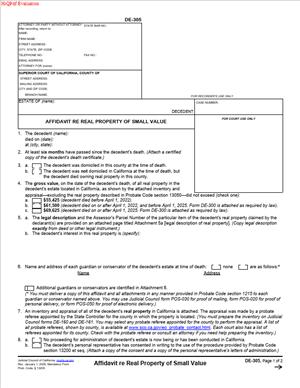
DE-305 – Affidavit Re Real Property of Small Value
Fill out nowJurisdiction: Country: United States | Province or State: California
If you are dealing with a loved one’s property after their death, the DE-305 – Affidavit Re Real Property of Small Value may come up. This form is used in California to transfer certain real estate without going through a full probate case.
The DE-305 – Affidavit Re Real Property of Small Value is designed for situations where the estate is small and meets specific limits. Instead of opening a formal probate proceeding in court, you complete and sign this document under penalty of perjury.
You may be looking at this form because you want to clear the title to a house, land, or other real property. Or you may need to record the change in ownership so the property can be sold or refinanced.
This form matters because it can simplify what is often a stressful process. When used properly, it can save time and reduce court involvement. But it must be completed carefully and filed correctly to work as intended.
What is DE-305 – Affidavit re Real Property of Small Value?
Clear definition
DE-305 – Affidavit Re Real Property of Small Value is a sworn statement used in California probate matters. It allows a person entitled to inherit real property to transfer that property without formal probate, if the estate qualifies as “small” under state law.
In this document, the person signing declares specific facts. These usually include the date of death, the value of the estate, the legal description of the real property, and the signer’s right to inherit.
The affidavit is signed under penalty of perjury. That means the statements in the form must be true to the best of your knowledge. False information can lead to serious legal consequences.
Once completed and properly handled, the document is typically recorded in the county where the real property is located. Recording creates a public record of the transfer.
Who typically uses this form?
This form is commonly used by heirs of a deceased person. An heir is someone who inherits property when there is no will, or when the will leaves property to that person.
It may also be used by beneficiaries named in a will. In that case, the will directs who receives the property, and the affidavit supports the transfer without opening a full probate case.
Sometimes a surviving spouse uses the form to confirm their interest in property that passed to them. Adult children, siblings, or other relatives may also use it, depending on the family situation.
In many cases, the person completing the form is not a lawyer. Self-represented individuals often use it when the estate is modest, and the property meets the small value threshold.
Why might you need this form?
You might need this form if a family member died owning real property in California and the estate qualifies as small. The goal is to transfer title without going through formal probate.
If you want to sell the property, most buyers will require a clear title. The DE-305 – Affidavit Re Real Property of Small Value can help establish that you are now the lawful owner.
You may also need it to refinance the property, add your name to county records, or settle disputes among family members about ownership.
Without proper transfer documents, the property can remain in the deceased person’s name. That can create problems with taxes, insurance, or future transactions.
Typical real-life scenarios
- A parent dies owning a small home in California. The total estate falls under the legal limit for small estates. The adult child, as sole heir, completes the affidavit to transfer the home into their own name.
- A widow inherits her spouse’s share of a rental property. The estate qualifies under the small estate rules. She uses the form to record her full ownership with the county recorder.
- Two siblings inherit vacant land from their father. There is no need for formal probate because the estate meets the value requirements. They complete and sign the affidavit together to establish joint ownership.
- A beneficiary under a simple will is left a small condominium. The estate is otherwise minimal. Instead of opening probate, the beneficiary uses the affidavit to document the transfer of the condo.
When would you use DE-305 – Affidavit Re Real Property of Small Value?
You would use this form after someone has died and owned real property in California. It is used only when the estate qualifies as small under state rules.
Timing matters. In many cases, a specific waiting period must pass after the date of death before you can use the affidavit. This waiting period allows time for creditors or other claims to surface.
You typically use this form when there is no ongoing probate case for the estate. If a formal probate has already been opened, this affidavit is generally not the right tool for transferring the property.
The form is often used by heirs, beneficiaries, or surviving spouses who are entitled to inherit the property. More than one person may sign if multiple heirs share ownership.
You would not use this form for personal property such as bank accounts or vehicles. It is specifically for real property, such as a house, condominium, or land located in California.
It is also not used for large estates that exceed the small estate value limit. In those situations, a formal probate process is usually required.
Legal characteristics of DE-305 – Affidavit Re Real Property of Small Value
This affidavit is a sworn legal document. The person signing declares, under penalty of perjury, that all statements are true. That gives the document legal weight.
For the form to be effective, it must meet specific requirements. The estate must fall within the small estate value limit. The real property must be properly described, usually by its legal description, not just the street address.
The affidavit often needs to include supporting documents. These may include a certified copy of the death certificate and, if there is a will, a copy of the will. Missing attachments can cause the recorder to reject the filing.
Common reasons for rejection include incomplete information, incorrect property descriptions, missing signatures, or failure to notarize the document. Because the form is recorded, formatting and clarity matter.
This document does not resolve disputes among heirs. If there is disagreement about who is entitled to the property, the affidavit alone may not settle the issue.
It also does not eliminate debts secured by the property. Mortgages, liens, and property taxes usually remain attached to the property even after transfer.
Different states have different small estate procedures. The DE-305 – Affidavit Re Real Property of Small Value is specific to California and follows California probate rules.
Is it legally binding?
Yes, the affidavit can be legally binding when properly completed and recorded. By signing, you are making sworn statements that carry legal consequences.
The document becomes effective when it is accepted and recorded in the county where the property is located. Recording creates a public record of the change in ownership.
Its binding effect depends on accuracy and eligibility. If the estate does not meet the small estate requirements, or if the statements are false, the transfer may be challenged.
If all conditions are met and no one contests the transfer, the affidavit can establish ownership without a court order. However, disputes, creditor claims, or errors in the form can limit its effectiveness.
How to fill out DE-305 – Affidavit Re Real Property of Small Value
Step 1 – Review eligibility requirements
Before writing anything, confirm that the estate appears to qualify as a small estate under California law. Check the total value of the estate and confirm that the property is real property located in California. Make sure the required waiting period after death has passed.
Step 2 – Identify the decedent
Enter the full legal name of the person who died. Provide the date and place of death as requested. Attach a certified copy of the death certificate, if the form requires it.
Step 3 – Provide your information as the declarant
List your full name and contact information. Indicate your relationship to the deceased and explain your right to inherit the property, whether as an heir under state law or as a beneficiary under a will.
Step 4 – State the estate value
Declare the total value of the estate that is subject to the small estate limit. Follow the instructions on the form about what to include and exclude. This section confirms that the estate qualifies for this procedure.
Step 5 – Describe the real property
Provide the legal description of the property, not just the street address. The legal description is usually found on the existing deed. Accuracy is critical because the recorder relies on this description to identify the property.
Step 6 – Address other successors
If there are other heirs or beneficiaries entitled to the property, list their names and interests as required. If more than one person is inheriting, the form may need to reflect shared ownership.
Step 7 – Confirm no probate proceeding
State that no formal probate proceeding is pending for the estate, if the form asks for this confirmation. This supports the use of a small estate affidavit instead of a court-supervised case.
Step 8 – Sign under penalty of perjury
Read the completed document carefully. When you are ready, sign the affidavit under penalty of perjury. The signature may need to be notarized before the document can be recorded.
Step 9 – Attach required documents and prepare for recording
Attach any required documents, such as the death certificate and a copy of the will, if applicable. Prepare the full packet for submission to the county recorder in the county where the property is located. Ensure all pages are complete, legible, and properly signed before recording.
Legal terms you might encounter in DE-305 – Affidavit Re Real Property of Small Value
- Decedent: The person who died and owned the real property. In this document, you must enter the decedent’s full legal name exactly as it appears on the death certificate and on the property’s recorded title. Any mismatch can delay recording or cause rejection.
- Affiant (Declarant): The person signing the affidavit. You are the affiant if you are making the sworn statements in this document. You declare, under penalty of perjury, that all facts you state are true and correct.
- Successor in Interest: A person who has the legal right to receive the decedent’s property. This could be a beneficiary named in a will or an heir under inheritance laws if there is no will. The form requires you to confirm your right to receive the specific real property described.
- Heir: Someone entitled to inherit when there is no valid will. The document asks you to state how you qualify as an heir, such as being a spouse, child, or other close relative. You must ensure your relationship is clearly described.
- Beneficiary: A person named in a valid will to receive property. If the decedent left a will, you may need to attach a copy and confirm that the will leaves the property to you. The form distinguishes between inheriting by will and inheriting by law.
- Gross Value of the Estate: The total value of the decedent’s assets in the estate, calculated according to the rules that apply to small estates. This figure determines whether the property qualifies for transfer using this simplified procedure. You must carefully calculate and state this amount.
- Real Property Description: The legal description of the property, not just the street address. The document requires the precise legal description as it appears in the deed. You may need to copy this from a recorded deed to avoid errors.
- Legal Description: A formal property description used in public land records. It may include lot and tract numbers or metes and bounds details. You must enter it exactly as recorded to ensure the transfer is valid.
- Penalty of Perjury: A legal statement that you swear the information is true. When you sign, you are subject to legal consequences if you knowingly provide false information. This makes the document legally enforceable.
- Recording: The process of submitting the signed affidavit to the county recorder where the property is located. Recording updates the public land records to reflect the new ownership. Without recording, the ownership change may not appear in official records.
FAQs
When can I use DE-305 – Affidavit Re Real Property of Small Value?
You can use this form when the decedent’s estate meets the legal limit for a small estate and includes real property that qualifies for simplified transfer. You must confirm the waiting period after death has passed and that no formal probate administration is required. Before filling it out, verify the estate’s total value and confirm that you are legally entitled to inherit the property described.
What information do I need from the death certificate?
You need the decedent’s exact legal name, date of death, and place of death as shown on the certified death certificate. The name must match the title records for the real property. You will also attach a certified copy of the death certificate when recording this document.
How do I calculate the estate’s value for this form?
You total the gross value of the decedent’s qualifying assets as of the date of death. Do not subtract debts when determining eligibility unless the rules specifically allow it. Confirm which assets are included or excluded under the small estate rules before stating the value in this document.
What if there are multiple heirs or beneficiaries?
You must identify all successors who have an interest in the property. If more than one person is entitled to inherit, they may all need to sign or formally assign their interest, depending on how the property will be held. Make sure the document clearly states how the title should vest after transfer.
Do I have to attach the will to this form?
If the decedent left a will that affects the property, you typically attach a copy to support your claim as beneficiary. Ensure the will clearly identifies you and the property or residue you are inheriting. If there is no will, you state that the decedent died intestate and explain your legal relationship.
Does this form transfer the title immediately after I sign it?
Signing alone does not update public records. The transfer becomes effective in the land records once the completed and notarized affidavit, with required attachments, is properly recorded in the county where the property is located. Until recording occurs, the public record may still show the decedent as owner.
What happens if there is an open probate case?
You generally cannot use this simplified procedure if a personal representative has been appointed for the estate. You must confirm that no formal probate proceeding is active or that none is required for the property described. Check court records before signing to avoid filing a conflicting document.
Can I correct an error after recording DE-305 – Affidavit Re Real Property of Small Value?
If you discover an error after recording, you may need to prepare and record a corrective affidavit or other appropriate document. The correction must clearly reference the originally recorded document and explain the change. Minor spelling mistakes may still require formal correction to keep the chain of title clear.
Checklist: Before, During, and After DE-305 – Affidavit Re Real Property of Small Value
Before
- Confirm the estate qualifies as a small estate under the applicable value limit.
- Verify that the required waiting period after the decedent’s death has passed.
- Obtain a certified copy of the death certificate.
- Locate the most recent recorded deed for the property.
- Confirm the exact legal description from the deed.
- Identify all heirs or beneficiaries with potential rights to the property.
- Determine whether a will exists and obtain a copy if applicable.
- Check that no probate case has been opened for the estate.
During
- Enter the decedent’s name exactly as shown on the death certificate and deed.
- Provide your full legal name and contact information as the declarant.
- State your legal basis for inheriting the property.
- Accurately calculate and enter the gross value of the estate.
- Copy the full legal description without abbreviating or altering it.
- Review each statement to confirm it is true and complete.
- Sign the affidavit under penalty of perjury.
- Have your signature notarized if required for recording.
After
- Make multiple copies of the signed and notarized document.
- Attach the certified death certificate and any required supporting documents.
- Submit the original for recording in the county where the property is located.
- Pay any required recording fees.
- Obtain a conformed or recorded copy for your records.
- Verify the recording information, such as instrument number and date.
- Store the recorded copy in a safe place with other estate documents.
- Update your personal records to reflect ownership of the property.
Common mistakes to avoid with DE-305 – Affidavit Re Real Property of Small Value
- Mistake: Using the property’s street address instead of the full legal description, because it seems simpler, which can cause rejection by the recorder and cloud title; do not forget to copy the exact legal description from the recorded deed.
- Mistake: Entering a shortened or misspelled version of the decedent’s name, often due to informal records, which can delay recording or create title issues; do not forget to match the death certificate and deed exactly.
- Mistake: Miscalculating the estate’s gross value by subtracting debts or including excluded assets, which may make the estate ineligible for this process; do not forget to review the valuation rules before stating the amount.
- Mistake: Failing to confirm that no probate proceeding is open, because you assume none exists, which can invalidate the affidavit; do not forget to check court records first.
- Mistake: Not identifying all heirs or beneficiaries, often due to family misunderstandings, which can lead to disputes or legal challenges; do not forget to list and address every person with a possible interest.
- Mistake: Forgetting to attach a certified death certificate, assuming a photocopy is enough, which can result in rejection for recording; do not forget to obtain and attach the certified copy.
- Mistake: Signing without notarization when notarization is required for recording, which can prevent acceptance by the recorder; do not forget to complete the notarial acknowledgment properly.
- Mistake: Recording in the wrong county because you live elsewhere, which delays the ownership update; do not forget to file in the county where the property is physically located.
What to do after filling out DE-305 – Affidavit Re Real Property of Small Value
Once you complete the affidavit, pause before filing. Review every page carefully. Confirm names, dates, and the legal description. Small clerical errors can create long-term title problems.
Make sure all required attachments are ready. This usually includes a certified copy of the death certificate and, if applicable, a copy of the will. Keep originals organized and separate from working copies.
- Step 1: Make at least two complete copies of the signed and notarized affidavit, including all attachments.
- Step 2: Confirm the correct county for recording by verifying where the real property is located.
- Step 3: Prepare the original signed document for submission, ensuring the notary acknowledgment is complete and legible.
- Step 4: Submit the original document to the county recorder’s office, either in person or by another accepted method.
- Step 5: Pay the required recording fees and request a receipt.
- Step 6: Obtain confirmation of recording, including the instrument number and recording date.
- Step 7: Review the recorded copy to confirm that the indexing information, names, and the legal description appear correctly.
- Step 8: Store the recorded copy in a secure place with other important property documents.
- Step 9: Update insurance policies, property tax contact information, and internal records to reflect the new ownership.
- Step 10: Inform any co-owners or relevant family members that the transfer has been completed and provide copies if appropriate.
After recording, the public land records should reflect the change in ownership. This is important if you later sell, refinance, or transfer the property. Keeping clear, organized records now will make future transactions smoother.
You should also monitor future property tax statements to ensure they are issued in the correct name. If you notice discrepancies, contact the appropriate office promptly with your recorded document as proof of ownership.
Finally, maintain a file that includes the death certificate, a copy of the will if applicable, correspondence, and proof of recording. Organized documentation protects you if questions arise years later about how the title transferred.
Disclaimer: This guide is provided for informational purposes only and is not intended as legal advice. You should consult a legal professional.