Starting a Texas LLC in 2026 takes one main state filing, a $300 fee, and a few smart decisions before you file. Texas made the process more attractive this year. The veteran fee waiver is now permanent. The franchise tax no-tax-due threshold rose to $2.65 million. And most new domestic companies no longer file federal beneficial ownership reports. This guide walks you through every step, from choosing a name to your first annual report. It also flags the mistakes that cause the Secretary of State to reject filings.
This article explains general legal information. It is not legal advice for your specific situation.
What Is a Texas LLC?
A Texas LLC is a limited liability company formed under the Texas Business Organizations Code. It is a legal entity that exists separately from its owners, who are called members.
People choose the LLC structure for three main reasons:
-
Liability protection. Members are generally not personally responsible for business debts.
-
Tax flexibility. Profits usually pass through to the members’ personal tax returns. Texas also has no personal state income tax.
-
Simple management. An LLC needs fewer formal records than a corporation.
An LLC becomes official only when the Texas Secretary of State accepts its Certificate of Formation. Until then, the business does not exist as a separate entity.
Key Decisions Before You File
Three choices shape your filing. Make them before you touch any paperwork.
Texas LLC Name Requirements
Your Texas LLC name must follow two core rules from the Business Organizations Code:
-
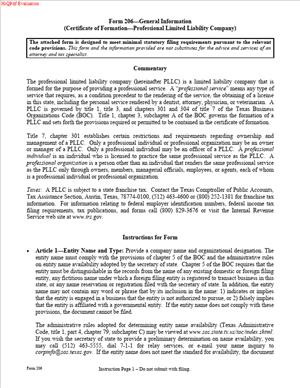
It must contain “limited liability company,” “limited company,” or an abbreviation such as “LLC,” “L.L.C.,” “LC,” or “L.C.”
-
It must be “distinguishable in the records” of the Secretary of State from every existing entity name, registered foreign entity name, and reserved name. Small changes like adding “The” do not make a name distinguishable.
You can ask the Secretary of State for a preliminary name check by phone at (512) 463-5555 or by email. This check is not final. The office makes the real decision only when it reviews your filing. Also remember that name approval does not give you trademark rights. Another business may still have rights to the name through use or registration.

Choose a Registered Agent
Every Texas LLC must name a registered agent. The agent receives lawsuits and official notices for the company. The agent can be a Texas resident or a business entity registered in Texas. Your LLC cannot serve as its own agent.
The registered office must be a physical street address in Texas where the agent is available during business hours. A mailbox service alone does not qualify.
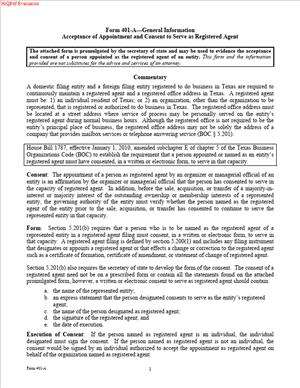
The person or company you name must consent in writing. Use the acceptance of appointment on Form 401-A to record that consent. You keep it with your company records. You do not file it with the state.
Member-Managed or Manager-Managed
Form 205 asks whether your company is member-managed or manager-managed. In a member-managed LLC, the owners run daily operations. In a manager-managed LLC, the members appoint one or more managers to run the business. Pick the structure that matches how you will actually operate, because banks and contract partners rely on it.
How to File Your Texas LLC Step by Step
Here is the full filing path most owners follow in 2026.
Step 1: Search and Reserve Your Name (Optional)
Check name availability first. You can search existing entities through the Secretary of State’s SOSDirect system or the Comptroller’s Taxable Entity Search.
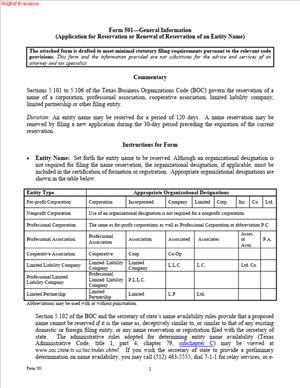
If you are not ready to file yet, you can hold the name. File Form 501, the Application for Reservation of an Entity Name, with a $40 fee. The reservation lasts 120 days and can be renewed. You can prepare the Form 501 name reservation online before you send it in.
Step 2: Prepare the Certificate of Formation (Form 205)
Form 205 is the document that creates your company. It asks for:
-
The exact company name, including the required designator
-
The registered agent’s name and Texas office address
-
The management structure and the names and addresses of initial members or managers
-
The business purpose, which can be a general lawful-purpose statement
-
The organizer’s name, address, and signature
The organizer signs the form. Notarization is not required. Blank or inconsistent fields are a top reason filings get rejected, so match every name and address exactly. You can complete the Texas Certificate of Formation (Form 205) with guided questions before you file.
Step 3: File With the Texas Secretary of State
You can file Form 205 three ways:
-
Online through SOSDirect. This is usually the fastest route. Credit card payments carry a 2.7 percent convenience fee.
-
By mail. Send the form in duplicate with payment to the Secretary of State in Austin.
-
In person. Deliver it to the James Earl Rudder Office Building in Austin.
The standard filing fee is $300. Expedited handling is available for an extra $25 per document. Processing times change with filing volume, so check the Secretary of State’s current posted times. When the state accepts the filing, you receive a file-stamped copy and a certificate. Keep both. Banks and lenders will ask for them.
Step 4: Get a Free EIN From the IRS
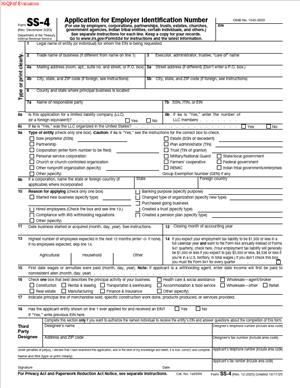
An Employer Identification Number (EIN) is your company’s federal tax ID. You need it to open a bank account, hire employees, and file taxes. Apply online at IRS.gov or use Form SS-4. The IRS never charges for an EIN. Ignore any site that asks for a fee.
Step 5: Sign a Company Agreement
Texas law calls an LLC operating agreement a “company agreement.” You do not file it with the state, but every LLC should have one. It sets out ownership shares, voting rules, profit splits, and what happens when a member leaves. Without one, default state rules decide those questions for you. Single-member companies benefit too, because the agreement helps show the LLC is truly separate from its owner.

Key Forms and Documents for Launching a Business
Step 6: Open a Bank Account and Check Licenses
Open a separate business bank account right away. Mixing personal and business money is the fastest way to weaken your liability protection. Texas has no general statewide business license, but many industries and cities require permits. Check state licensing agencies and your city and county offices before you start selling.
How Much Does a Texas LLC Cost in 2026?
The table below shows the state costs most owners should plan for. Fees can change, so confirm current amounts with the Secretary of State and the Comptroller before filing.
Texas does not charge an annual report fee or a renewal fee for the entity itself. Your yearly duty is the franchise tax filing described below.
Free Texas LLC Formation for Veterans
Texas gives qualifying veterans a real head start, and the benefit became permanent on January 1, 2026, under Senate Bill 938 and House Bill 346. A “new veteran-owned business” pays no Secretary of State filing fees and owes no franchise tax for its first five years. It also skips the Public Information Report during that period.
To qualify, the company must be 100 percent owned by veterans who were honorably discharged. Follow this order:
-
Request a Veteran Verification Letter from the Texas Veterans Commission before you file. You will need your DD-214.
-
Complete Comptroller Form 05-904, Certification of New Veteran-Owned Business.
-
Submit Form 205 together with the letter and Form 05-904 through the SOSUpload system.
Get the verification letter first. Filing before you are verified can cost you the waiver.
Texas LLC Taxes and Annual Filings
Forming the company is the start, not the finish. Every Texas LLC has yearly duties, and missing them has real consequences.
Franchise Tax and the $2.65 Million Threshold
Texas charges a franchise tax on entities formed or doing business in the state. The annual report is due May 15 each year. Your first report is due the May 15 after the year you formed.
For 2026 and 2027 reports, the no-tax-due threshold is $2.65 million in annualized total revenue. If your revenue is at or below that line, you owe no tax. Above it, the rate is 0.375 percent for retail and wholesale businesses and 0.75 percent for most others.
The Public Information Report
Owing no tax does not mean filing nothing. Texas discontinued the separate No Tax Due Report starting with 2024 reports. Instead, every LLC must still file a Public Information Report (Form 05-102) by May 15, even with zero revenue. The report lists your officers, directors, or managers, and an authorized person must sign it. You can prepare the Texas Franchise Tax Public Information Report ahead of the deadline.
Missing the filing triggers a $50 late penalty and can lead to forfeiture. A forfeited company loses its right to do business in Texas, and its owners can lose liability protection for that period.
Federal BOI Reports: What Changed
Many owners still worry about the federal Corporate Transparency Act. In March 2025, FinCEN issued an interim final rule that removed the beneficial ownership reporting requirement for companies formed in the United States. As of mid-2026, a domestic Texas LLC does not file a federal BOI report. Foreign-formed companies registered in a U.S. state still do. Rules can change, so check FinCEN’s site once a year.

Common Texas LLC Mistakes to Avoid
These errors cause most rejections, delays, and later legal headaches:
-
Choosing a name that is not distinguishable. The state rejects the filing and keeps it in line.
-
Skipping the registered agent’s written consent. The appointment is not valid without it.
-
Using a mailbox address as the registered office. The office must be a physical address where the agent can be served.
-
Assuming no revenue means no filings. The Public Information Report is due every year regardless.
-
Paying third parties for an EIN. The IRS issues EINs for free.
-
Mixing personal and business funds. Courts can ignore the LLC and reach personal assets when owners treat company money as their own.
-
Veterans filing before verification. Request the Veteran Verification Letter first, then file through SOSUpload.
Conclusion
A Texas LLC remains one of the most affordable ways in the country to protect a new business, and 2026 made it even friendlier. Plan your name, line up a registered agent with written consent, and file Form 205 with the $300 fee, or free if you qualify as a veteran-owned company. Then get your EIN, sign a company agreement, and mark May 15 on your calendar for the Public Information Report. Handle those steps in order and your Texas LLC will start life in good standing and stay there.
Frequently Asked Questions
How long does it take to form a Texas LLC?
Online filings through SOSDirect are usually processed in a few business days. Mailed filings take longer. Volume changes throughout the year, so check the Secretary of State’s posted processing times. Expedited handling is available for $25 per document.
Can I be my own registered agent?
Yes, if you are a Texas resident with a physical street address in the state and you are available there during business hours. Your LLC cannot name itself as its own agent. Many owners hire a commercial agent to keep their home address off public records.
How much does a Texas LLC cost per year?
Texas charges no annual report or renewal fee. Most small companies owe no franchise tax because of the $2.65 million no-tax-due threshold, but they must still file the free Public Information Report by May 15 each year.
Do I need a company agreement if I am the only member?
Texas does not require one, but you should still have it. A signed company agreement shows banks, courts, and the IRS that the business is separate from you. That separation is the heart of your liability protection.
Is a Texas LLC really free for veterans?
Yes, for companies that are 100 percent owned by honorably discharged veterans. The state waives the $300 formation fee and the first five years of franchise tax, and the benefit is now permanent. You must get a Veteran Verification Letter from the Texas Veterans Commission before filing.
Does an LLC in Texas protect all my personal assets?
It protects members from most business debts and lawsuits, but not from everything. You remain responsible for your own wrongful acts, personal guarantees you sign, and situations where a court finds you ignored the company’s separate existence. Good records and separate finances keep the protection strong.
Resources
-
Form 205 Instructions, Texas Secretary of State — https://www.sos.state.tx.us/corp/instructions/205.shtml
-
Name Filings FAQs, Texas Secretary of State — https://www.sos.state.tx.us/corp/namefilingsfaqs.shtml
-
Franchise Tax, Texas Comptroller of Public Accounts — https://comptroller.texas.gov/taxes/franchise/
-
Franchise Tax PIR and OIR Filing Requirements, Texas Comptroller — https://comptroller.texas.gov/taxes/franchise/pir-oir-filing-req.php
-
Entrepreneurs (Veteran-Owned Business Program), Texas Veterans Commission — https://tvc.texas.gov/entrepreneurs/
-
Texas Business Organizations Code, Section 5.053 — https://law.justia.com/codes/texas/business-organizations-code/title-1/chapter-5/subchapter-b/section-5-053/
-
FinCEN BOI Interim Final Rule News Release — https://www.fincen.gov/news/news-releases/fincen-removes-beneficial-ownership-reporting-requirements-us-companies-and-us
-
Apply for an EIN Online, IRS — https://www.irs.gov/businesses/small-businesses-self-employed/apply-for-an-employer-identification-number-ein-online
Disclaimer: The content provided on this blog is for informational purposes only and does not constitute legal, financial, or professional advice.
Contents