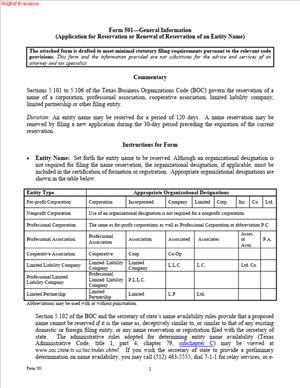
Form 501 – Application for Reservation or Renewal of Reservation of an Entity Name
Fill out nowJurisdiction: Country: United States | Province or State: Texas
Form 501 – Application for Reservation or Renewal of Reservation of an Entity Name is a filing used to temporarily secure a business or entity name. It is part of the early planning stage of forming or maintaining an entity. You use it before the entity exists or while you decide your next step.
This form matters because entity names are shared across a public filing system. If a name is available today, it may not be available tomorrow. This filing creates a short window of exclusivity for that name.
I’m guessing you’re looking at this form because you are preparing paperwork and want to avoid delays. You may also be coordinating with others and need time before the final formation documents are ready. This filing helps manage that timing gap.
The process is administrative, but the details matter. Small errors can cause rejection or a name that does not protect what you expected. Understanding how this document works makes the rest of your filings smoother.
This guide explains what the form does, when people use it, and how to complete it carefully. It is written for people filling it out on their own.
What is Form 501 – Application for Reservation or Renewal of Reservation of an Entity Name?
Clear definition
Form 501 – Application for Reservation or Renewal of Reservation of an Entity Name is a document used to reserve an entity name for a limited period. It places the name on hold within the state’s filing system. During that time, others generally cannot register an entity using the same or a confusingly similar name.
The form can also be used to renew an existing name reservation. Renewal extends the reservation period when allowed. It does not create an entity or authorize business operations.
This filing is separate from formation documents. It stands on its own and expires after a defined period if not renewed or followed by formation.
Who typically uses this form/document?
Individuals planning to form a business entity often use this form. This includes people exploring different entity types or finalizing ownership details.
Groups working together on a new venture also commonly use it. Reserving the name allows discussions to continue without losing the name during planning.
Professionals coordinating filings for others may also submit it. This includes people managing multiple steps in a longer setup process.
Existing entities may use the form when renewing a name reservation tied to a future filing. This happens when plans are delayed or rescheduled.
Why you might need this form/document
You might need this form if you are not ready to file formation documents yet. Reserving the name gives you time without risking someone else taking it.
You may also need it when coordinating filings across states or agencies. A reserved name helps keep records consistent while timing issues are resolved.
Another reason is internal approval. Some organizations require sign-off before final filings, and a reservation bridges that gap.
You might also use it when rebranding or restructuring plans are underway. Holding the name prevents conflicts during transitions.
Typical real-life scenarios
A first-time business owner has chosen a name but is still deciding on an entity structure. The reservation holds the name while those decisions are made.
Two partners agree on a name but are waiting on financing documents. The filing keeps the name available during negotiations.
An existing entity plans to form a related entity later in the year. The name is reserved now to align with future filings.
A professional is managing several entity formations at once. Name reservations help stage the filings in an organized way.
When would you use Form 501 – Application for Reservation or Renewal of Reservation of an Entity Name?
You would use Form 501 – Application for Reservation or Renewal of Reservation of an Entity Name before forming an entity or when extending an existing reservation. It is commonly used early in the planning timeline.
People often use it when a name search shows availability, but other steps are not complete. The form pauses the clock on name availability.
It is also used when formation documents are drafted but not ready for submission. Reserving the name prevents conflicts during review.
Renewal is used when the original reservation period is ending. This may happen if a project takes longer than expected.
Different roles use this filing at different times. Founders, managers, or coordinators may submit it depending on who handles administrative tasks.
Legal characteristics of Form 501 – Application for Reservation or Renewal of Reservation of an Entity Name
This form is effective when it is accepted and recorded by the filing office. Acceptance generally depends on accurate information and name availability at the time of review.
Common issues include incomplete fields, name conflicts, or mismatches between the applicant and reservation details. These issues can delay or prevent acceptance.
Name standards can vary by jurisdiction. What is considered distinguishable or acceptable in one place may differ elsewhere. This affects how names are reviewed.
This form does not create legal rights beyond name reservation. It does not authorize business activity, confer ownership, or replace formation filings.
Is it legally binding?
The form creates an administrative reservation rather than a contract. It binds the filing office to hold the name for the reservation period if accepted.
It does not bind other parties or create obligations beyond the reservation itself. Its effect is limited to name availability within the filing system.
The reservation ends automatically when the period expires or if it is withdrawn. Renewal extends the period when permitted.
How to fill out Form 501 – Application for Reservation or Renewal of Reservation of an Entity Name
Step 1 – Identify the name to be reserved
You begin by entering the exact entity name you want to reserve. The spelling, punctuation, and spacing are reviewed as written. Small differences can affect availability.
Step 2 – Confirm name availability context
The form typically asks for confirmation that the name meets filing standards. This includes distinguishability from existing names. The review is based on the filing system at submission time.
Step 3 – Provide applicant information
You enter the name and contact details of the applicant. This identifies who is requesting the reservation and who receives notices.
Step 4 – Select reservation or renewal
You indicate whether the filing is a new reservation or a renewal. This determines how the filing is processed and the length of the reservation period.
Step 5 – Review duration and timing
The form reflects a specific reservation period. Understanding when it starts and ends helps coordinate later filings without gaps.
Step 6 – Sign and date the form
The form requires a signature from the applicant or authorized person. The signature confirms the accuracy of the information provided.
Step 7 – Prepare the submission
You finalize the form for submission according to the stated method. This step completes the filing process and starts the review.
Legal terms you might encounter in Form 501 – Application for Reservation or Renewal of Reservation of an Entity Name
Entity name: This is the exact legal name you want to reserve. On this form, it must be written exactly as you want it held, including punctuation and spacing. The filing office reviews the name exactly as entered, not based on intent.
Name reservation: A name reservation is a temporary hold placed on an entity name. This document records that hold in the public filing system for a defined period. It does not create an entity or grant permission to operate.
Renewal of reservation: A renewal extends an existing name reservation. On the form, this means you are asking to continue a previously approved reservation rather than starting a new one. You must match the reserved name exactly as originally approved.
Applicant: The applicant is the person or organization requesting the reservation. This is the name that appears as the requester in the public record. Notices about acceptance or rejection are tied to this entry.
Filing office: This is the government office that receives, reviews, and records the form. Acceptance by the filing office is what makes the reservation effective. Submission alone does not secure the name.
Distinguishable name: A distinguishable name is one that is sufficiently different from existing names on record. The form relies on the filing office’s standards to decide this. Minor changes may not be enough to qualify.
Reservation period: This is the length of time the name is held once approved. The form triggers the start of this period upon acceptance. When it ends, the name becomes available again unless renewed or used in a formation filing.
Authorized signer: The authorized signer is the person who signs the form. By signing, they confirm the information is accurate and that they have authority to submit the request. The filing office relies on this representation.
Public record: Information from this form becomes part of the public record once accepted. This includes the reserved name and applicant information. Accuracy matters because corrections require additional filings.
FAQs
What does Form 501 – Application for Reservation or Renewal of Reservation of an Entity Name actually put on record?
This form records a request to hold a specific entity name. Once accepted, the name and the applicant’s information appear in the public filing system. It does not list owners, managers, or business activities.
Where do I see the effective date of the reservation on this document?
The effective date is not something you choose in this document. It is tied to the filing office’s acceptance, not when you sign or submit it. You confirm acceptance through the filing confirmation you receive.
Who should be listed as the applicant if more than one person is involved?
You list one applicant’s name on this document. That name becomes the point of contact in the public record. Internally, you can agree who controls the reservation, but only the listed applicant appears.
Do I need to match the reserved name exactly when I later form the entity?
Yes. The name you later use must match what is reserved, including spacing and punctuation. If it does not match, the reservation may not apply, and the name could be rejected.
Can I change the name after I submit this document?
You cannot edit a submitted filing. If you realize the name is wrong, you would typically need to file a new reservation request. The original filing remains as submitted unless withdrawn.
What happens if someone else tries to file the same name while my reservation is pending?
Until this form is accepted, the name is not protected. If someone else files and is accepted first, their filing controls the name. That is why timing and confirmation matter.
Does this document give me permission to do business under the name?
No. This document only holds the name in the filing system. You still need separate formation or registration documents before operating under the name.
Will the information in this document be visible to the public?
Yes. Once accepted, the reserved name and applicant information become part of the public record. That is why you should double-check spelling and contact details before submitting.
Checklist: Before, During, and After Form 501 – Application for Reservation or Renewal of Reservation of an Entity Name
Before
- Check the name against existing records to reduce conflict risk.
- Decide whether you are filing a new reservation or a renewal.
- Confirm the exact spelling and punctuation you want reserved.
- Decide who will be listed as the applicant.
- Confirm the signer has authority to submit the request.
- Note the expected reservation period for planning purposes.
- Gather contact details for the applicant.
- Set a reminder for the reservation expiration date.
During
- Enter the name exactly as intended, without shortcuts.
- Select the correct option for reservation or renewal.
- Enter applicant information clearly and completely.
- Review the form for consistency before signing.
- Sign and date using the authorized signer’s name.
- Follow the stated submission method carefully.
- Keep a copy of the completed form for your records.
After
- Confirm receipt or acceptance from the filing office.
- Record the acceptance date and reservation expiration date.
- Store the filing confirmation with your planning documents.
- Share reservation details with partners or advisors.
- Align formation timelines with the reservation period.
- Monitor for any notices or issues from the filing office.
- Plan next filings well before the reservation expires.
Common mistakes to avoid with Form 501 – Application for Reservation or Renewal of Reservation of an Entity Name
- Mistake: Entering a name with casual spelling because it looks right, which happens when people rely on memory, leads to reserving the wrong name, so do not forget to copy the name exactly as intended.
- Mistake: Filing a new reservation instead of a renewal because the prior reservation details were not checked, which can cause the original reservation to lapse, so do not forget to confirm the reservation status first.
- Mistake: Listing the wrong applicant because internal roles were unclear, which creates confusion over control of the reservation, so do not forget to agree on the applicant before filing.
- Mistake: Assuming submission equals approval because no confirmation was checked, which can leave the name unprotected, so do not forget to verify acceptance.
- Mistake: Signing without authority because the signer was convenient, which can trigger rejection, so do not forget to confirm the signer authority.
- Mistake: Ignoring punctuation and spacing differences because they seem minor, which can result in a reservation that does not match later filings, so do not forget that details matter.
- Mistake: Letting the reservation expire because no reminder was set, which releases the name back to the public, so do not forget to track the expiration date.
- Mistake: Assuming the reservation allows business activity because the name is held, which can create compliance problems, so do not forget this document only reserves the name.
What to do after filling out Form 501 – Application for Reservation or Renewal of Reservation of an Entity Name
Once you complete the form, your focus should shift to confirmation and follow-through. The value of a name reservation depends on knowing when it is effective and when it ends. Treat this filing as a timing tool, not a final step.
You should keep organized records from the start. A reserved name often connects to later filings, internal planning documents, and communications with others. Clear records prevent mismatches later.
- Step 1: Make a complete copy of the signed form before submission.
- Step 2: Submit the form using the accepted filing method.
- Step 3: Watch for confirmation that the filing office has accepted the document.
- Step 4: Record the acceptance date once you receive confirmation.
- Step 5: Calculate and note the reservation expiration date.
- Step 6: Store the confirmation and copies in a central folder.
- Step 7: Update internal planning documents with the exact reserved name.
- Step 8: Share the reservation details with anyone preparing formation paperwork.
- Step 9: Set calendar reminders well ahead of the expiration date.
- Step 10: Decide whether to proceed with formation or plan a renewal before time runs out.
If your plans change, revisit the reservation early. You may need to file formation documents, renew the reservation, or release it. Acting early gives you more options and fewer surprises.
Disclaimer: This guide is provided for informational purposes only and is not intended as legal advice. You should consult a legal professional.