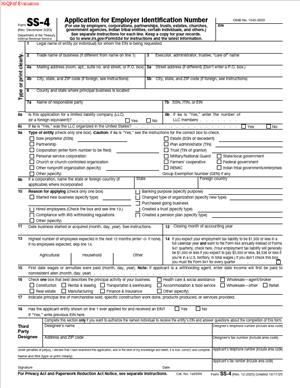
Form SS-4 – Application for Employer Identification Number
Fill out nowJurisdiction: Country: United States | Province or State: Federal
Form SS-4 – Application for Employer Identification Number is the document used to request an Employer Identification Number, often called an EIN. An EIN is a unique nine-digit number assigned to a business or other entity for federal tax purposes. It works like a Social Security number, but for a business.
You complete this form when you need the federal government to recognize your business or entity for tax reporting. The number you receive is used on tax returns, payroll filings, and other official documents. Without it, many business activities cannot move forward.
This form is not limited to large companies. Sole proprietors, partnerships, corporations, limited liability companies, trusts, estates, and nonprofit organizations may all use it. Even a small one-person operation may need an EIN in certain situations.
Understanding this form before you start saves time and avoids rejection. Small errors can delay processing. Knowing what each section means helps you provide clear and consistent information.
What is Form SS-4 – Application for Employer Identification Number?
Clear definition
Form SS-4 – Application for Employer Identification Number is a federal tax form used to request an Employer Identification Number from the Internal Revenue Service. The form collects identifying details about a business or other entity so the government can assign a unique tax ID number.
The document asks for information such as the legal name of the entity, trade name if different, mailing address, and the name and identification number of a responsible party. It also asks about the type of entity and the reason for applying.
Once processed, the EIN becomes the official federal tax identification number for that entity. It remains associated with that entity unless the business structure changes in a way that requires a new number.
Who typically uses this form?
New business owners commonly use this form when starting a company. This includes people forming corporations, partnerships, and limited liability companies. It also includes sole proprietors who need an EIN for tax or hiring purposes.
Nonprofit organizations use the form to obtain an EIN before applying for tax-exempt status. Trusts and estates also use it when they need to report income or manage assets under federal tax rules.
In some cases, individuals use the form when they become the administrator of an estate. Financial institutions and other organizations may request an EIN before opening accounts in the name of a business or trust.
Why might you need this form?
You may need this form if you plan to hire employees. Federal payroll tax reporting requires an EIN. Without it, you cannot properly report wages and employment taxes.
You may also need an EIN to open a business bank account. Many financial institutions require it for accounts held in a business name. It separates your personal and business finances.
Certain tax returns require an EIN even if you do not have employees. Partnerships and corporations generally must use an EIN on their federal tax filings. Some sole proprietors choose to obtain one to avoid using their Social Security number on business documents.
Typical real-life scenarios
- You form a limited liability company with a partner. Before you can open a business account or sign contracts in the company’s name, you need an EIN. You complete the form to establish the company’s federal tax identity.
- You start a small online retail business as a sole proprietor. At first, you operate alone. Later, you decide to hire part-time help. You apply for an EIN so you can report payroll taxes correctly.
- A family member passes away, and you are named executor of the estate. The estate must file its own income tax return. You use the form to obtain an EIN for the estate, separate from your personal number.
- You create a nonprofit organization for community programs. Before applying for tax-exempt status and accepting donations, you need an EIN. The form provides the identification number required for future filings and correspondence.
When would you use Form SS-4 – Application for Employer Identification Number?
You use this form at the beginning of a business or entity’s life cycle. It is often completed soon after formation documents are filed with a state, such as articles of incorporation or organization. The EIN connects your newly formed entity to the federal tax system.
You may also use it when an existing business changes structure. For example, a sole proprietorship that becomes a corporation may need a new EIN. A partnership that incorporates may also require a new number. The need for a new EIN depends on how the entity is reorganized.
Trusts and estates use the form when they first need to report income. This often occurs when assets generate income after a person’s death or when a trust becomes active and begins managing property.
Some businesses apply for an EIN even if they are not yet operating. For example, you may want to secure financing, enter into a lease, or establish vendor relationships. An EIN may be requested as part of those processes.
Foreign entities with U.S. tax reporting obligations also use this form. If a business has U.S.-based employees or is required to file certain federal tax returns, it may need an EIN even if it is formed outside the United States.
Legal characteristics of Form SS-4 – Application for Employer Identification Number
This form is a federal tax document. Its purpose is to request a number, not to create the business itself. The legal existence of a corporation or limited liability company typically comes from state filings, not from this form.
For the form to be effective, the information provided must be accurate and complete. The legal name must match the formation documents if the entity is registered with a state. The responsible party’s identifying number must also be correct.
Common problems include mismatched names, incorrect entity classification, or incomplete sections. If the entity type selected does not align with the details provided, processing may be delayed. Inconsistent addresses or missing signatures can also cause issues.
The form does not grant tax-exempt status. Nonprofit organizations must complete additional steps to obtain recognition as tax-exempt. The EIN simply identifies the organization for tax purposes.
The form also does not replace required state or local registrations. You may still need state tax identification numbers, business licenses, or other permits. The EIN applies at the federal level.
Although the form is federal, some procedural details may vary depending on the type of applicant. For example, entities without a legal residence or principal place of business in the United States may follow different submission procedures. The underlying purpose of the form remains the same.
Is it legally binding?
Form SS-4 – Application for Employer Identification Number is a formal federal filing. When you sign and submit it, you declare that the information is true and correct to the best of your knowledge. That declaration carries legal significance.
Providing false or misleading information can lead to penalties. The responsible party named on the form is the individual who ultimately controls or manages the entity. Listing the correct person is important because that person is linked to the EIN in government records.
The form itself does not create contractual obligations between private parties. It does not function as an agreement between business partners or owners. Its legal effect is limited to requesting and establishing a federal tax identification number.
Once the EIN is assigned, it becomes part of the entity’s official tax record. That number is used in future filings and correspondence. In that sense, the completed and processed form has a lasting administrative impact.
How to fill out Form SS-4 – Application for Employer Identification Number
Step 1 – Provide the legal name of the entity
Enter the full legal name exactly as it appears in your formation documents, if applicable. If you operate under a different trade name, include that in the space provided. Consistency with other official records helps prevent processing delays.
Step 2 – List the responsible party
Identify the individual who ultimately owns or controls the entity. Enter that person’s full name and taxpayer identification number. This person should have authority over the entity’s funds and decisions.
Step 3 – Enter the mailing and physical address
Provide the mailing address where official correspondence should be sent. If the physical location is different, include that as well. Make sure the address is complete and formatted clearly.
Step 4 – Indicate the type of entity
Select the category that best describes your organization, such as sole proprietorship, partnership, corporation, limited liability company, trust, or estate. If additional details are required, complete the related sections. The classification affects how the entity is taxed.
Step 5 – State the reason for applying
Choose the primary reason you are submitting the form. Common reasons include starting a new business, hiring employees, banking purposes, or creating a trust. Select the option that most closely matches your situation.
Step 6 – Provide details about business activity
Describe the principal activity of the business or entity. This may include the type of products sold or services provided. Be concise but specific enough to reflect the main purpose of the organization.
Step 7 – Answer employment and tax questions
Indicate whether you expect to have employees and, if so, estimate the number and type. Provide the date when wages will first be paid, if applicable. These answers determine which federal tax forms you may need to file later.
Step 8 – Review third-party designee information if applicable
If you want another person to receive the EIN or discuss the application on your behalf, complete the third-party designee section. Enter that person’s name and contact information accurately.
Step 9 – Sign and date the form
The responsible party must sign and date the form. By signing, you confirm that the information provided is accurate to the best of your knowledge. Review every section before signing to ensure all entries are complete and consistent.
Step 10 – Submit the form using an accepted method
Send the completed Form SS-4 – Application for Employer Identification Number using one of the approved submission methods available for your situation. After submission, keep a copy of the completed form and any confirmation notice for your records.
Legal terms you might encounter in Form SS-4 – Application for Employer Identification Number
- Employer Identification Number (EIN): A nine-digit number assigned by the Internal Revenue Service to identify your business for tax purposes. This is the main reason you complete this form. Once issued, the EIN becomes the number you use on tax returns, payroll filings, and many official documents.
- Responsible Party: The individual who ultimately owns or controls the entity or exercises effective control over it. This person’s name and taxpayer identification number must be listed on the form. The IRS uses this information to link the business to a real person who has authority over it.
- Legal Name of Entity: The official name of your business as it appears in formation documents or governing records. You must enter this exactly as registered. Any mismatch can delay processing or create confusion when matching your EIN to tax filings.
- Trade Name (Doing Business As): A name your business uses that is different from its legal name. If you operate under a DBA, you list it in the appropriate line. This helps ensure your EIN is connected to all names under which you conduct business.
- Entity Type: The classification of your organization, such as sole proprietorship, corporation, partnership, or limited liability company. You must check the correct box and sometimes provide additional details, like the number of members in an LLC. Your selection affects how the IRS expects you to file taxes.
- Principal Activity: A brief description of what your business actually does. The form asks you to describe your main product or service. This helps the IRS categorize your business activity for statistical and tax administration purposes.
- Date Business Started: The date when your business legally began or when you acquired it. This may be the date of incorporation, formation, or the date you took over an existing business. The IRS uses this date to determine when your filing and reporting obligations begin.
- Closing Month of Accounting Year: The final month of your annual accounting period. Many businesses use December, but you can select a different month if your financial year ends at another time. This affects when your annual returns are due.
- Third-Party Designee: A person you authorize to receive your EIN and discuss your application with the IRS. If you complete this section, you must provide their name and contact details. This does not give them general control over your business, only limited authority related to this application.
- Trust or Estate: A legal arrangement where a trustee manages assets for beneficiaries, or an estate that manages a deceased person’s assets. If you are applying for an EIN for one of these, you must identify it clearly on the form. The EIN will be tied to that specific legal arrangement, not to you personally.
FAQs
Do I need to wait until my business is fully operating before applying?
No. You can apply as soon as your entity legally exists or when you are ready to start operating. On this form, you must enter the date the business started or was acquired. That date anchors your tax timeline, so make sure it reflects when the entity legally came into existence or when ownership changed.
What if I do not have employees yet?
You can still apply. The section about employees asks whether you expect to hire and, if so, when wages will first be paid. If you do not expect to hire anyone, you indicate that clearly. This helps the IRS determine whether you need to file employment tax returns.
Who should be listed as the responsible party?
You must list a real individual who ultimately controls or owns the entity. This cannot be another entity in most cases. Enter that person’s full legal name and taxpayer identification number exactly as shown on their records. Errors here can cause processing delays or future compliance issues.
Can I correct a mistake after submitting this form?
If you notice an error after submission, you may need to contact the IRS to update the information. The type of correction matters. For example, correcting a typo in the legal name is different from changing the entity type. Keep a copy of what you submitted so you can clearly explain what needs to be fixed.
What happens once my EIN is assigned?
You will receive confirmation that includes your new EIN. This number becomes part of your permanent business record. You must use it consistently on tax filings, payroll documents, and financial forms. Do not apply again for a new number unless the IRS specifically requires it due to a structural change.
Do I need to attach formation documents to Form SS-4 – Application for Employer Identification Number?
In most cases, you do not attach formation documents when submitting Form SS-4 – Application for Employer Identification Number. You only complete the requested lines and sign. However, you should have your formation paperwork available because you must enter names, dates, and entity details exactly as they appear in those records.
What if my business name changes after I receive an EIN?
An EIN stays with the entity, even if the name changes. You must notify the IRS of the name change following the appropriate process. Do not submit a new application just because the name has changed. Make sure future tax filings reflect the updated name to keep records aligned.
Can one person have more than one EIN?
Yes. Each separate legal entity generally needs its own EIN. If you operate multiple businesses that are legally distinct, each may require a separate application. On Form SS-4 – Application for Employer Identification Number, you apply for one entity at a time and provide details specific to that entity only.
Checklist: Before, During, and After Form SS-4 – Application for Employer Identification Number
Before
- Confirm your entity is legally formed or that you are authorized to apply.
- Gather formation documents showing the exact legal name and start date.
- Verify the responsible party’s full legal name and taxpayer identification number.
- Decide on your entity classification for tax purposes.
- Determine your accounting year-end month.
- Estimate whether you will hire employees in the next 12 months.
- Prepare a short, clear description of your principal business activity.
During
- Enter the legal name exactly as shown on official formation documents.
- Double-check spelling and spacing for the business name and trade name.
- Provide the correct mailing and physical address.
- Carefully select the correct entity type and complete any related sub-questions.
- Enter the accurate start date or acquisition date.
- Answer employment questions based on realistic expectations.
- Complete the third-party designee section only if you truly want to authorize someone.
- Review every line before signing to confirm consistency.
After
- Save a complete copy of the submitted form for your records.
- Store the EIN confirmation notice in a secure location.
- Use the EIN consistently on all tax and payroll filings.
- Update your internal records and accounting system with the new number.
- Provide the EIN to financial institutions if needed.
- Monitor your mail or online account for any follow-up correspondence.
- Notify relevant agencies if required once the EIN is active.
Common mistakes to avoid with Form SS-4 – Application for Employer Identification Number
- Mistake: Entering a nickname or shortened version of the business name because it feels familiar, which happens when people rely on branding instead of formation documents; this can cause record mismatches and delays, so do not forget to copy the legal name exactly as registered.
- Mistake: Listing the wrong responsible party because you assume it should be a manager or assistant; this often leads to compliance issues later, so do not forget that the responsible party must be the individual who truly controls or owns the entity.
- Mistake: Choosing the wrong entity type due to confusion about tax classification, which can affect how you are expected to file returns; do not forget to confirm your classification before checking the box.
- Mistake: Guessing the business start date without checking formation documents, which can misalign your tax obligations; do not forget to verify the exact legal start or acquisition date.
- Mistake: Applying for multiple EINs for the same entity because you did not receive confirmation quickly, which creates duplicate records; do not forget to wait for processing before submitting another application.
- Mistake: Leaving employment sections blank because you are unsure, which can trigger follow-up inquiries; do not forget to answer every required question, even if the answer is zero.
- Mistake: Authorizing a third-party designee without understanding the limited authority granted, which may cause confusion about who can speak to the IRS; do not forget to complete that section only if you intentionally want representation.
What to do after filling out Form SS-4 – Application for Employer Identification Number
Once you complete the form, your next steps are about confirmation, recordkeeping, and consistent use of the EIN.
- Step 1: Make a complete copy of the signed form for your records before submission.
- Step 2: Submit the form using an accepted method and ensure all required fields are completed.
- Step 3: Monitor for confirmation of your assigned EIN.
- When you receive your EIN, review the confirmation notice carefully. Check the legal name, address, and responsible party information. If anything does not match what you submitted, act quickly to correct it.
- Step 4: Store the confirmation notice in your permanent business records.
- Step 5: Provide the EIN to your bank or financial institution if you are opening or updating accounts.
- Step 6: Update your accounting software or internal systems with the new number.
- Step 7: Use the EIN on all required federal tax filings going forward.
- Step 8: Share the EIN only when necessary and keep it secure to reduce the risk of misuse.
If you later change your business name, address, or responsible party, follow the proper update process rather than submitting a new application. Your EIN is meant to stay with the entity for its lifetime, so treat it as a permanent identifier tied to your official records.
Disclaimer: This guide is provided for informational purposes only and is not intended as legal advice. You should consult a legal professional.