What Divorce Means in California
In California, the legal word for divorce is dissolution. It is the legal process that ends a marriage or domestic partnership.
Legal separation is different. It lets a court decide property, support, and parenting issues, but it does not end the marriage.
A nullity means the marriage was never legally valid, so the court treats it differently from divorce. California also uses no-fault divorce, which means you do not need to prove wrongdoing. The California Courts say you do not need your spouse’s agreement to get divorced, and you can get divorced for any reason.
California Divorce Requirements
- To start a divorce case in California, one spouse must meet the residency rules. The California Courts say that either spouse must have lived in California for the last 6 months and in the current county for the last 3 months.
- California divorce is a no-fault system. That means the usual legal ground is “irreconcilable differences,” which means the marriage cannot be saved. You do not need to show cheating, abuse, or abandonment to file.
- California divorce also has a mandatory waiting period. The California Courts say divorce takes at least 6 months to finish. That period starts after service of the summons and petition, not when you first decide to separate.
Step-by-Step Divorce Process in California
Meet residency rules.
Make sure you or your spouse meets California’s 6-month state rule and 3-month county rule before filing.
Complete required forms.
Most cases begin with FL-100, the Petition, and FL-110, the Summons.
File with the court.
File your forms in the correct county superior court. California Courts say local forms may also be required.
Pay filing fees.
The California Courts list the divorce filing fee at $435–$450
Request a fee waiver if eligible.
If you cannot afford the fee, you may ask for a fee waiver using court forms.
Serve your spouse.
The other spouse must be formally served with the papers. Service starts the response clock.
Exchange financial disclosures.
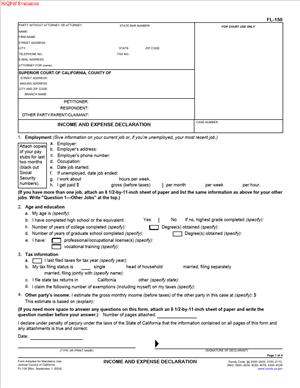
Both spouses must disclose finances in most cases. This helps the court and the parties divide property and decide support.
Negotiate settlement.
Many couples resolve property, support, custody, and debt by agreement. The court can approve settlement paperwork if it is complete and proper.
Court hearing if necessary.
If you cannot agree, a judge may decide disputed issues after hearing and review.
Final judgment.
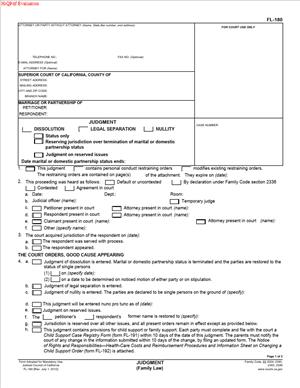
The judge signs the judgment, and the court enters the order ending the marriage.
Waiting period before finality.
Even after judgment, the divorce cannot become final until at least 6 months have passed from service and other legal steps are complete.
California Divorce Forms
How Much Does Divorce Cost in California?
The California Courts say the filing fee for a divorce case is $435–$450. That is the main court fee most people see first.
Other costs can include service fees, mediation, copy costs, mailing, and lawyer fees. The exact amount depends on your case and the services you use. If you qualify, a fee waiver can remove some court fees.
California’s official fee waiver forms are on the Judicial Council website. If you want a lawyer, the cost varies by case complexity, location, and whether the lawyer handles the whole case or only part of it.
How Long Does Divorce Take?
California divorce takes at least 6 months. That rule applies even when both spouses agree.
An uncontested divorce is usually faster in practice because the parties do not fight over issues, but the legal minimum still applies. A contested divorce usually takes longer because the court must resolve disputes.
A default case may move more quickly if one spouse does not respond, but it still must follow the same minimum timeline. Summary dissolution is simpler for eligible couples and uses fewer steps, but the California Courts note that not everyone qualifies.
Property Division
California is a community property state. That means property and debts earned or acquired during marriage are generally divided equally, unless an exception applies.
Separate property is usually property owned before marriage, or property received by gift or inheritance during marriage. Debts can also be community or separate depending on when and how they were incurred.
Retirement accounts can be divided if they include community property interests. The family home may also need to be divided or refinanced if it is community property. Property division can become technical fast, so accurate financial disclosure matters.

Initiating and Responding to Marriage Annulment Proceedings
Child Custody and Child Support
California courts decide custody based on the best interests of the child, which focuses on the child’s health, safety, and welfare. Custody can be legal, physical, or both.
Parents often create a parenting plan that covers schedules, holidays, transportation, and decision-making. If parents cannot agree, the court can make custody orders.
Child support is usually calculated under California’s statewide guideline system. The California Department of Child Support Services says guideline support uses both parents’ income and certain custody factors. Support can be reviewed and changed if facts change and the law allows it.
Spousal Support
Spousal support is also called alimony. California courts may order temporary support while the case is pending and later decide longer-term support in the judgment.
Temporary support often helps one spouse meet basic needs during the case. Longer-term support depends on statutory factors and court discretion. Judicial discretion means that a judge exercises legal judgment within the rules, rather than using a fixed formula for every case.
Can You Get Divorced Without a Lawyer?
Yes. California’s self-help materials say it is possible to complete the process without a lawyer. That is often realistic in simple cases with few assets, no children, or full agreement.
Legal help becomes more important when the case involves children, a house, retirement accounts, business interests, domestic violence, or major debt. California Courts also note that if you have a lot of property or debt, you may want a lawyer, at least for those parts of the case.
Common Mistakes People Make
-
Filing before meeting residency rules.
-
Forgetting to serve the spouse properly.
-
Missing financial disclosures.
-
Using the wrong county or missing local forms.
-
Assuming divorce is final before the 6-month waiting period ends.
-
Leaving out retirement, debts, or other assets from disclosure.
-
Ignoring custody and support forms when children are involved.
Suggested California Divorce Forms
These extra forms may be needed in some cases:
-
FL-140, Declaration of Disclosure.
-
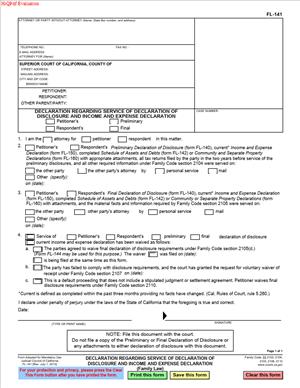
FL-141, Declaration Regarding Service of Declaration of Disclosure.
-
FL-160, Property Declaration.
-
FL-170, Declaration for Default or Uncontested Dissolution.
-
FL-180, Judgment.
-
FL-190, Notice of Entry of Judgment.
-
FL-343, Spousal or Partner Support Attachment.
These forms are commonly used in California family law cases and are available through Judicial Council forms resources.

Conclusion
Getting a Divorce in California is a legal process with clear steps: meet residency rules, file the right forms, serve the papers, exchange financial disclosures, resolve disputes, and finish with a judgment. The process is designed so people can proceed with or without a lawyer, but complex cases often need more help.
If you understand the forms, fees, and timeline, California divorce becomes much easier to manage.
FAQs
How much does divorce cost in California?
The California Courts list the filing fee at $435–$450. Other costs can include service, copies, mediation, and attorney fees. If you qualify, you can ask for a fee waiver.
How long does it take?
California divorce takes at least 6 months. Contested cases usually take longer because the court must resolve disputes.
Can I file without a lawyer?
Yes. California Courts say it is possible to complete the process without a lawyer. A lawyer may be more useful if you have children, property, debt, or safety concerns.
Can I get divorced online?
You can often get help online with forms and court self-help resources. But the court still controls the legal filing process, service rules, and judgment.
Can my spouse refuse it?
No. The California Courts say you do not need your spouse’s agreement to get a divorce. Your spouse can contest issues, but cannot stop the case just by refusing.
What is an uncontested divorce?
An uncontested divorce is one where the spouses agree on the major issues, such as property, support, and parenting. The court can then finalize the case with less conflict.
Can I get divorced for free?
Some people can reduce or remove court fees through a fee waiver. You may still have other costs, such as service or document preparation.
Do I have to go to court?
Not always. If your case is uncontested and the paperwork is complete, you may not need a hearing. If there are disputes, the judge may require court appearances.
What is summary dissolution?
Summary dissolution is a simpler divorce process for couples who meet specific requirements. It is not available to everyone, and the California Courts direct users to a separate process page.
What are California divorce forms?
California divorce forms are the court papers used to start, respond to, and finish a divorce case. Common examples include FL-100, FL-110, FL-105, and FL-180.
Resources
Disclaimer: The content provided on this blog is for informational purposes only and does not constitute legal, financial, or professional advice.
Contents