When the Small Claims Court issues a judgment in your favour, it declares that the defendant owes you a specific sum of money, the return of specific personal property, or both. What the court does not do is transfer those funds. That process, known as post-judgment collection or judgment enforcement, is the creditor’s responsibility, and it requires a distinct set of procedural steps, prescribed forms, and court-issued enforcement instruments.
Post-judgment collection is the legal process used to compel compliance with a court order. Once judgment has been issued, the creditor may be able to use court-authorized enforcement measures to:
- seize and sell the debtor’s personal property
- register the judgment against real property
- require the debtor to attend a financial examination
- recover a specific property the debtor has wrongfully retained
These are formal legal processes backed by court authority. Depending on the enforcement step used, the process may involve the sheriff, bailiff, or another authorized enforcement officer, and failure to comply can have legal consequences.
The specific rules vary considerably by jurisdiction. In Ontario, the governing statute is the Courts of Justice Act, and procedure is set out in Ontario Regulation 258/98, Rules of the Small Claims Court. Common enforcement forms include:
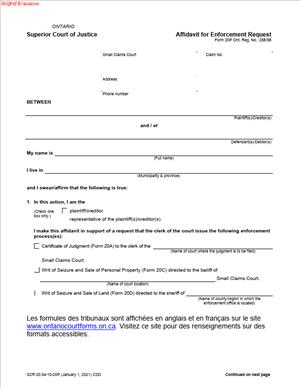
- Form 20P — Affidavit for Enforcement Request
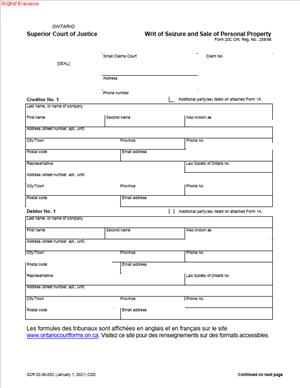
- Form 20C — Writ of Seizure and Sale of Personal Property
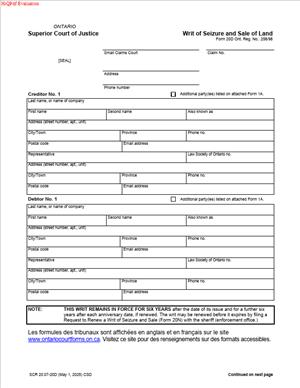
- Form 20D — Writ of Seizure and Sale of Land
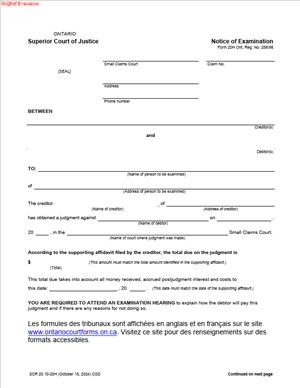
- Form 20H — Notice of Examination
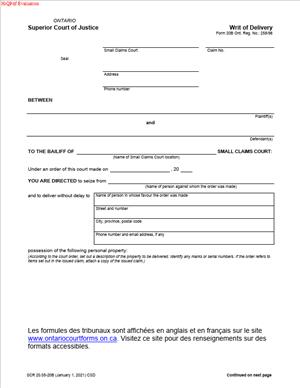
- Form 20B — Writ of Delivery
Selecting the correct enforcement pathway, the right jurisdiction’s forms, and the appropriate sequence of procedural steps is the first critical decision a judgment creditor must make. Using the wrong form, filing with the wrong court office, or skipping a required procedural step can delay or invalidate your enforcement entirely.
Need the correct enforcement forms for your jurisdiction? Find the right law forms online and access structured enforcement templates with RunSensible Forms for Forms 20 series, with guidance designed to reduce filing errors and delays.
What Small Claims Post-Judgment Collection Can Accomplish
Post-judgment enforcement is not one procedure. It is a group of separate legal mechanisms, each designed to reach a different type of asset or compel a different kind of compliance.
That distinction matters. A judgment creditor should not begin with forms. The first step is to identify the enforcement result sought: payment, disclosure, recovery of specific property, or pressure against land. The appropriate instrument follows from that objective.
The Purpose of Enforcement
A judgment establishes legal entitlement. Enforcement is the process used to make that entitlement real.
In practical terms, post-judgment enforcement can do two things:
- turn debtor assets into money to satisfy a judgment
- compel compliance with an order to return specific personal property
Where the judgment is for money, enforcement is aimed at locating assets and converting them into recoverable funds. Where the judgment is for possession of property, enforcement is aimed at physically recovering the item the court ordered returned.

Main Enforcement Tools
- Seize and sell personal property — Form 20C: This writ allows the bailiff to seize and sell the debtor’s non-exempt personal property. The sale proceeds are applied to the judgment debt. It may be used against assets such as vehicles, equipment, inventory, and other movable property.
- Register against land — Form 20D: This writ is filed with the sheriff in the area where the debtor owns land. It creates an encumbrance on the title, which may prevent or complicate a sale or refinancing until the judgment is paid. It does not automatically result in an immediate sale of the property.
- Compel financial disclosure — Form 20H: This notice requires the debtor, and in some cases a corporate officer or director, to attend court and answer questions under oath about income, bank accounts, assets, and debts. Its purpose is to help the creditor identify the most effective enforcement step.
- Recover specific property — Form 20B: This writ is used where the judgment orders the return of specific personal property. It authorizes the bailiff to recover that property and deliver it to the creditor.
Other Legal Effects
Post-judgment enforcement can also have indirect legal and practical consequences. A writ against land may interfere with the debtor’s ability to sell or refinance real property. An examination may expose false or incomplete financial disclosure. Enforcement steps may also reveal asset transfers that support further proceedings under statutes such as the Fraudulent Conveyances Act or the Assignments and Preferences Act. Interest also continues to accrue on an unpaid judgment at the applicable statutory rate.
When enforcement depends on getting the paperwork right, find the correct law forms for your jurisdiction and access structured, fillable templates for Forms 20P, 20C, 20D, 20H, and 20B to help reduce delays and avoid preventable filing errors.
Common Stages of Post-Judgment Enforcement
The enforcement process follows a recognizable sequence, although a creditor may enter at different points depending on what is already known about the debtor’s assets. Each step builds on the one before it. Errors at an early stage can delay or compromise the steps that follow.
Step 1: Confirm the Judgment and Calculate the Outstanding Balance
Before filing any enforcement document, the creditor should confirm that the judgment remains unpaid, calculate the total amount owing, and verify whether any appeal or stay affects enforcement.
This step usually includes:
- confirming the judgment amount
- accounting for any partial payments already made
- calculating post-judgment interest
- obtaining a certified copy of the judgment if needed
This is the foundation for the rest of the process. If the creditor proceeds using the wrong balance, the enforcement documents may be inaccurate and vulnerable to challenge.
Step 2: Complete Form 20P (Affidavit for Enforcement Request)
Form 20P is the gateway document for most Ontario Small Claims Court enforcement steps.
In this sworn affidavit, the creditor sets out the key details of the judgment, including the court file number, the parties’ names, the date of judgment, the amount awarded, and the amount still unpaid. The creditor also identifies the enforcement instrument being requested, such as:
- Form 20C
- Form 20D
- Form 20H
- Form 20B
Because Form 20P is an affidavit, it must be properly sworn or commissioned. Incomplete information, unsigned forms, or incorrect judgment details are common reasons for delay.
Step 3: Select and Prepare the Appropriate Enforcement Instrument
Once Form 20P is complete, the creditor prepares the specific form that matches the chosen enforcement method.
The usual options are straightforward:
- Form 20C if the debtor has non-exempt personal property
- Form 20D if the debtor owns land
- Form 20H if the creditor needs financial information before choosing another remedy
- Form 20B if the judgment orders the return of specific personal property
Each form serves a different purpose. The correct choice depends on the type of judgment and what is known about the debtor’s assets.
Step 4: File with the Court and Pay Required Fees
The creditor then files Form 20P together with the selected enforcement form and pays the required fee.
Depending on the remedy, filing may be made with:
- The Small Claims Court office that issued the judgment
- The court office for the relevant enforcement area
- The sheriff’s office, in the case of land enforcement
The filing location matters. If the document is filed in the wrong office, the enforcement step may not take effect.
Step 5: Serve or Deliver the Enforcement Instrument
Some enforcement steps require formal service or notice to the debtor.
For example, a Notice of Examination must be served in accordance with the rules and within the required time before the examination date. Other writs may be delivered or executed through the bailiff or enforcement office.
At this stage, the creditor should keep clear proof of service or delivery. That record may be required if the debtor fails to attend, refuses to comply, or challenges the enforcement.
Step 6: Attend the Examination or Monitor the Enforcement
Once the document has been filed and, where required, served, the creditor moves to the active enforcement stage.
This may involve:
- Attending the examination and questioning the debtor under oath
- Monitoring the bailiff’s efforts to locate and seize property
- Tracking whether a writ against land creates pressure for payment
- Reassessing the strategy if the first enforcement step is unsuccessful
If enforcement does not produce payment or recovery, the creditor may need to return to an earlier stage, obtain more information, or pursue a different remedy.
Small Claims Enforcement Forms and Documents –
Post-judgment enforcement is carried out through a series of prescribed forms. Each document serves a specific procedural purpose. Some forms begin the enforcement process, some gather financial information, and others authorize enforcement against particular types of property.
The correct document must be used at the correct stage. Using the wrong form, or using the right form at the wrong time, can delay enforcement or make it ineffective.
Form 20P: Affidavit for Enforcement Request
Form 20P starts most Ontario Small Claims Court enforcement steps. It confirms the judgment details, states that all or part of the judgment remains unpaid, and identifies the enforcement remedy being requested. It includes the court file number, the parties’ names, the date of judgment, the amount awarded, and the amount still owing.
Before completing Form 20P, the creditor should:
- Confirm that the judgment remains unpaid
- Calculate the outstanding balance, including post-judgment interest
- Account for any partial payments
- Verify whether any appeal or stay affects enforcement
Because Form 20P is a sworn affidavit, it must be properly commissioned. Errors at this stage can delay the rest of the process.
Form 20H: Notice of Examination
Form 20H is used when the creditor needs information about the debtor’s financial position before choosing another enforcement remedy. It requires the debtor, and in some cases a corporate officer or director, to attend court and answer questions under oath about income, bank accounts, assets, and debts.
This form is often the best starting point where the creditor has a judgment but does not yet know how enforcement should proceed. Once issued, it must be served properly and within the required time. The creditor then attends the examination and uses the information obtained to decide on the next step.

How to Ask the Court to Waive Filing Fees
Form 20C: Writ of Seizure and Sale of Personal Property
Form 20C is used where the debtor has identifiable non-exempt personal property that can be seized and sold. It applies to movable assets such as vehicles, equipment, inventory, and other personal property not protected by exemption law.
This form is generally appropriate where the creditor already knows the debtor has realizable personal property. Where that information is not yet available, Form 20H may be used first.
Form 20D: Writ of Seizure and Sale of Land
Form 20D is used where the debtor owns land. It is filed with the sheriff in the county or district where the land is located and creates an encumbrance on the title. This may prevent or complicate a sale, transfer, or refinancing until the judgment is dealt with.
Its immediate function is to secure the judgment against the property. It does not automatically result in an immediate sale.
Form 20B: Writ of Delivery
Form 20B is used where the judgment orders the return of specific personal property. It authorizes the bailiff to recover the property identified in the judgment and deliver it to the creditor.
This remedy applies only where the court has ordered the return of particular property. It is not used for a money judgment alone.
Filing, Service, and Follow-Through
Once the appropriate form has been selected, the creditor must file it in the correct office and pay any required fee. Depending on the form, that may involve the Small Claims Court office, the sheriff, or the relevant enforcement office.
Where service is required, it must be completed properly and supported by proof of service. The creditor must then carry the process forward by attending the examination, monitoring enforcement efforts, or taking further steps if the first remedy does not produce recovery.
To avoid procedural mistakes, find the right law forms online and download structured enforcement templates for Forms 20P, 20C, 20D, 20H, and 20B, including jurisdiction-specific guidance and supporting checklists.
Enforcement, Compliance, and Ongoing Obligations
Enforcement does not end when a writ is issued or an examination is completed. The creditor must continue to manage the file.
The main ongoing responsibilities are:
- monitoring compliance
- tracking expiry and renewal dates
- watching for changes in the debtor’s financial situation
- keeping a complete enforcement record
Monitor the Effect of the Enforcement Step
Once an enforcement instrument is in place, it can have legal effect right away. A writ against land, for example, may encumber title and interfere with the debtor’s ability to sell or refinance property.
That effect is important, but it is not self-managing. The creditor should continue to monitor the file, especially where priority may matter or where other creditors may also be pursuing the same assets.
Respond to Non-Compliance
If the debtor does not comply with the enforcement process, the creditor may need to take further steps.
This may arise where the debtor:
- fails to attend an examination after proper service
- fails to comply with an order made during the examination process
- gives false or incomplete information
In those circumstances, the creditor may be able to seek further relief from the court, including contempt-related remedies where available.
Track Expiry and Renewal
Enforcement instruments do not remain in force indefinitely. A creditor must know when a writ expires and renew it on time if the judgment remains unpaid.
This is critical because:
- An expired writ no longer protects the creditor in the same way
- Delay can affect enforcement priority
- Refilling may be required if the renewal is missed
Expiry dates should be treated as active file deadlines, not administrative details.
Reassess the Debtor’s Financial Situation
A failed enforcement attempt does not always mean the judgment is uncollectible. A debtor who cannot pay now may later become employed, acquire property, or receive other assets.
For that reason, the creditor should periodically review whether enforcement has become more practical. The judgment may still be enforceable even if early collection efforts were unsuccessful.

Keep a Complete Enforcement File
Good record-keeping is part of enforcement. The creditor should maintain an organized file containing all key documents and enforcement history.
That file should include:
- the certified judgment
- every enforcement form filed
- issued writs or notices
- proof of service
- examination records or orders
- correspondence with the sheriff, bailiff, or enforcement office
This record may be essential if enforcement is challenged, renewed, or brought back before the court.
Common Mistakes and Best Practices
Post-judgment enforcement is procedural. Mistakes are usually not dramatic, but they can delay enforcement, weaken it, or require the creditor to repeat steps. The most effective approach is to understand the common errors and apply consistent file management throughout the process.
Common Mistakes
- Filing in the wrong office: An enforcement document must be filed with the correct court office, sheriff, or enforcement office. Filing in the wrong location may mean the step has no legal effect.
- Using incorrect figures on Form 20P: The amount owing must be calculated accurately, including post-judgment interest and any payments already received. Both understatements and overstatements can create problems.
- Choosing the wrong enforcement tool: A creditor may move too quickly to a writ without first confirming what assets exist. In some cases, a Notice of Examination should come first.
- Defective service: A Notice of Examination and other documents that require service must be served in the proper manner. Poor service can prevent the creditor from relying on the debtor’s non-compliance.
- Failing to keep proof of service: Even proper service can become useless if it cannot be proven. Service records should be prepared and stored immediately.
- Letting writs expire: Enforcement instruments must be monitored for expiry and renewed on time where necessary. Missing a renewal deadline can affect priority and require the creditor to start again.
- Failing to withdraw enforcement after payment: Once the judgment is paid, the creditor should take the necessary steps to clear or withdraw active enforcement measures.
- Not reassessing the debtor’s circumstances: A debtor’s financial position may change over time. A failed enforcement attempt does not always mean the judgment is uncollectible.
- Assuming the bailiff will manage everything: Enforcement officers act within their role, but the creditor still needs to monitor the file, provide useful information, and follow up.
Best Practices
- Confirm the balance before every step: Recalculate the amount owing each time a new enforcement document is prepared, including interest and any payments received.
- Use the form that matches the objective: Choose the remedy based on what is actually needed, whether that is financial disclosure, seizure of personal property, registration against land, or return of specific property.
- Gather asset information early: Use title searches, registry searches, and examinations where needed before deciding how to enforce.
- File in the correct office: Confirm where the document must be issued, filed, or registered before submitting it.
- Serve documents properly: Follow the required service rules carefully and keep complete proof of service.
- Maintain a dedicated enforcement file: Keep the judgment, filed forms, issued writs, affidavits of service, payment records, and correspondence in one organized file.
- Track deadlines actively: Record expiry dates, examination dates, service deadlines, and renewal dates as active file deadlines.
- Stay in contact with enforcement officers: Provide clear, updated asset information and respond promptly when follow-up is needed.
- Review the file periodically: Reassess whether the debtor has acquired new income or assets and whether a different enforcement step is now appropriate.
- Treat enforcement as a process, not a single filing: Effective enforcement usually depends on planning, follow-up, and adjusting strategy as new information becomes available.
To avoid procedural mistakes, find the right law forms online and download structured enforcement templates for Forms 20P, 20C, 20D, 20H, and 20B, with RunSensible Forms’ accurate filing and service.
Final Thoughts
Winning a small claims judgment is not the end of the process. It is the point at which enforcement begins. In Ontario, that enforcement process is carried out through the Form 20 series and the Rules of the Small Claims Court. The creditor’s task is to turn a court order into actual recovery by choosing the correct remedy, preparing the required documents accurately, and following the proper procedural sequence.
The core enforcement forms each serve a distinct function:
- Form 20P starts most enforcement steps and provides the sworn basis for the remedy requested.
- Form 20C targets non-exempt personal property.
- Form 20D is used against land.
- Form 20H compels financial disclosure through examination.
- Form 20B is used where the judgment requires the return of specific personal property.
The process depends on procedural accuracy. Service errors, incorrect calculations, filings in the wrong office, and expired writs can all delay or weaken enforcement. The most effective safeguard is disciplined file management: keep complete records, track deadlines, confirm figures at each stage, and treat enforcement as an active process that may require adjustment over time.
Jurisdiction also matters. This guide is written within the Ontario Small Claims Court framework. Other provinces, territories, and U.S. states use different statutes, forms, and enforcement procedures. A creditor enforcing outside Ontario, or trying to enforce an out-of-province judgment, should confirm the applicable rules before taking any step.
FAQs
What is Form 20P, and when is it required?
Form 20P is the Affidavit for Enforcement Request used in the Ontario Small Claims Court. It is the document that starts most enforcement steps. In it, the judgment creditor confirms the judgment details, states the amount still owing, and identifies the enforcement remedy being requested. A properly completed and sworn Form 20P is generally required before the court will issue a Writ of Seizure and Sale of Personal Property (Form 20C), Writ of Seizure and Sale of Land (Form 20D), Notice of Examination (Form 20H), or Writ of Delivery (Form 20B). Without it, the enforcement process usually cannot move forward.
How do I choose between a Writ of Seizure and Sale of Personal Property and a Writ of Seizure and Sale of Land?
The choice depends on what assets the debtor owns. Form 20C is used when the debtor has non-exempt personal property that may be seized and sold, such as vehicles, equipment, or inventory. Form 20D is used when the debtor owns real property. It is filed with the sheriff in the county or district where the land is located and creates an encumbrance that may affect the debtor’s ability to sell or refinance. A creditor may use both forms if the debtor appears to own both personal property and land. In practice, a title search is usually the clearest way to confirm whether the debtor owns real property.
Can I use Form 20H before attempting any other enforcement steps?
Yes. A Notice of Examination (Form 20H) is often the most useful first step when the creditor does not yet know enough about the debtor’s financial situation. It requires the debtor, or in some cases another appropriate person, to attend and answer questions under oath about income, bank accounts, assets, and debts. The information obtained can then be used to decide whether personal property enforcement, land enforcement, garnishment, or another step is most appropriate. There is no general requirement that another enforcement remedy be attempted first.
How far in advance must a Notice of Examination be served?
In Ontario, a Notice of Examination must be served at least 30 days before the examination date. Ontario’s Small Claims Court guide also states that an Affidavit of Service (Form 8A) should be filed with the court at least 3 days before the examination. The notice must be served by personal service or an authorized alternative to personal service under the rules. That means the creditor should not assume that ordinary mail or email is valid unless the rules or a court order permit it in the circumstances.
What happens if the debtor does not appear for the examination?
If the debtor does not attend after proper service, the creditor may ask the court to take further action. In Ontario, the rules provide for a contempt hearing in connection with failure to attend an examination, and section 30 of the Courts of Justice Act gives the Small Claims Court power to address that non-compliance. The creditor will need clear proof that the notice was properly served and that the debtor had notice of the date, time, and place of the examination. If the service was defective, the court may require the examination to be rescheduled and served again.
How long does a Writ of Seizure and Sale remain in force?
In Ontario, a Writ of Seizure and Sale generally remains in force for six years from the date of issue. Before it expires, it may be renewed for a further period. Ontario’s Small Claims Court guide indicates that renewal is done using Form 20N, Request to Renew a Writ of Seizure and Sale, filed with the appropriate enforcement office. This is important because, if a writ expires, the creditor may lose the benefit of the existing registration and may also lose priority against other creditors who registered earlier or renewed on time.
What property is exempt from seizure under a Writ of Seizure and Sale of Personal Property?
Not all personal property can be seized. In Ontario, the Execution Act and its regulations protect certain categories of property up to prescribed amounts. Current prescribed exemption amounts include household furnishings and appliances up to $17,091, tools and other personal property used to earn income up to prescribed limits, and a motor vehicle up to a prescribed amount where the statutory requirements are met. Because these amounts are set by regulation and may change, they should be checked against the current legislation before enforcement proceeds.
What is a Writ of Delivery, and when does it apply instead of a money writ?
A Writ of Delivery (Form 20B) is used when the judgment orders the return of specific personal property rather than payment of money alone. It authorizes enforcement to recover the identified property and deliver it to the creditor. This remedy is appropriate where the court has ordered the return of a particular item, such as equipment, artwork, or a vehicle, and the debtor has not complied. It is not the correct form for enforcing an ordinary money judgment.
Resources
- Civil Enforcement Act, R.S.A. 2000, c. C-15 — Alberta King’s Printer
https://www.qp.alberta.ca/documents/Acts/c15.pdf - Small Claims Act, R.S.B.C. 1996, c. 430 — BC Laws
https://www.bclaws.gov.bc.ca/civix/document/id/complete/statreg/96430_01 - CLEO (Community Legal Education Ontario) — Steps to Justice: Collecting on a Small Claims Judgment
https://stepstojustice.ca/steps/small-claims-court/collecting-on-a-judgment/
Disclaimer: The content provided on this blog is for informational purposes only and does not constitute legal, financial, or professional advice.
Contents