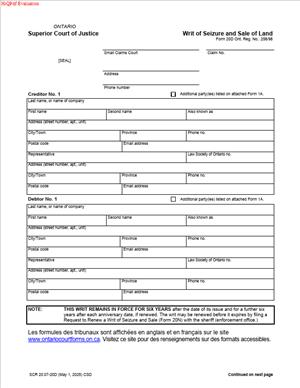
Form 20D – Writ of Seizure and Sale of Land
Fill out nowJurisdiction: Country: Canada | Province or State: Ontario
Updated October 2026 – Form 20D – Writ of Seizure and Sale of Land is an Ontario Small Claims Court enforcement document. It belongs to the Ontario Superior Court of Justice — Rules of the Small Claims Court framework and concerns collecting an unpaid money judgment through the judgment debtor’s interest in land.
The person entitled to payment is the judgment creditor. The person who owes the money is the judgment debtor. Enforcement depends on an enforceable judgment or order, not simply an unpaid invoice.
The writ provides formal authority for land-related enforcement through the sheriff. Preparing it does not arrange a property sale: court issuance, enforcement filing, and any subsequent sale are separate stages.
Accuracy matters. The debtor’s identity, outstanding balance, and enforcement location must be properly established. Even a correctly issued writ does not guarantee recovery. Mortgages, competing claims, ownership arrangements, and enforcement expenses can affect whether money is available.
What is Form 20D – Writ of Seizure and Sale of Land?
Clear definition
Form 20D is a court-issued enforcement instrument directed to the sheriff. It supports enforcement of a money judgment against the debtor’s interest in land. The judgment establishes the obligation to pay; the writ supplies authority for a particular enforcement process.
“Seizure and sale” describes the enforcement power associated with the document. It does not mean that submitting the form immediately transfers ownership or schedules a sale. Further procedures apply before a sale can occur.
The relevant asset is the debtor’s actual legal interest, which may be less than full ownership. Co-ownership, mortgages, and other rights can affect both enforcement and the distribution of proceeds.
Unlike a repayment agreement, the writ does not depend on the debtor accepting new contractual terms. Its authority comes from the court process.
Who typically uses this form?
A judgment creditor with an unpaid Small Claims Court judgment typically uses this form. The creditor may be an individual, sole proprietor, or business. A properly authorized representative may help prepare or handle the paperwork.
The court clerk and sheriff perform different functions. The court handles issuance, while the sheriff handles land-enforcement administration. Completing one stage does not establish that the other has occurred.
A debtor may encounter the writ during enforcement or a property transaction. Co-owners, lenders, and estate representatives may also become involved because of their property interests. Their involvement does not automatically make them personally responsible for the judgment.
Why might you need this form?
You may need Form 20D when a money judgment remains unpaid, and land enforcement is being considered. Winning a case does not necessarily produce voluntary payment.
Land may offer a source of recovery if the debtor owns an interest with realizable value. However, market value is not the same as available equity. Secured debts, ownership shares, expenses, and competing claims can reduce potential recovery.
A filed writ may also require attention during refinancing or a later property sale. That possibility is not a promise of immediate payment.
This process differs from garnishment and enforcement against personal property. Each route has its own requirements and practical limitations.
Typical real-life scenarios
- Unpaid judgment after renovation work: You obtained judgment and believe the debtor owns land. Ownership and available equity still need verification.
- Jointly owned property: Your judgment names one owner. The writ does not make the other owner liable or automatically expose their share to collection.
- Corporate debtor: A corporation operates from a commercial building, but the premises may be leased or owned by a shareholder. Occupation does not establish corporate ownership.
- Partial payments: The debtor has paid part of the judgment. Your calculation must credit those payments and correctly account for interest.
- Heavily mortgaged property: A valuable property may offer little recovery after mortgage debt, prior claims, and enforcement expenses.
When would you use Form 20D – Writ of Seizure and Sale of Land?
You generally use this form after obtaining an enforceable money judgment or order in Small Claims Court. It does not replace starting a claim, proving liability, or obtaining judgment.
Timing depends on more than the judgment date. Payment terms, applicable waiting periods, and enforcement restrictions may affect when action is available. An instalment order requires particular attention: enforcement may depend on its terms and whether a default has occurred.
A stay can restrict enforcement even though the judgment remains in place. An appeal and a stay are not interchangeable. Check the applicable procedure and court orders rather than assuming that a threatened challenge either prevents or permits enforcement.
You may consider land enforcement when credible information indicates that the debtor owns land. A residential, business, or mailing address alone does not prove ownership.
The property’s location also matters. The court file identifies the original proceeding, while the sheriff’s enforcement area relates to the land. A case heard in one Ontario location may involve property elsewhere in the province.
Land enforcement may follow an unsuccessful collection attempt, but that does not establish a universal sequence of remedies. Different methods have different requirements, costs, and limitations.
If you pursue more than one collection method, maintain a single account of the debt. Money received through garnishment or direct payment reduces the balance being pursued through land enforcement. Separate enforcement files do not permit duplicate recovery.
Duration and renewal require continuing attention. Do not assume that a writ remains effective indefinitely. Bankruptcy, a consumer proposal, death, or ownership changes may also affect enforcement.
Before proceeding, assemble the judgment, later orders, payment history, identity records, and available property information. For a debtor reviewing the paperwork, distinguish an issued writ from a filed writ and from notices concerning an actual sale.
Legal characteristics of Form 20D – Writ of Seizure and Sale of Land
The writ’s authority comes from the court process and the enforceable judgment behind it. A completed draft is not an issued writ, and issuance is distinct from filing for enforcement.
The court location, claim number, and party names connect the document to the correct judgment. Identity is especially important where names are similar or business arrangements are involved. A corporation is generally separate from its directors and shareholders; a trading name may not identify a separate legal entity.
You cannot expand the judgment by entering another person’s name. Identity corrections, succession, or changes in entitlement to collect may require a separate procedure.
The amount claimed must have a defensible basis. Judgment principal, awarded costs, interest, and permitted enforcement expenses are different categories. Your time, inconvenience, and collection efforts do not automatically become recoverable charges.
All payments and credits matter, including direct payments and money collected through other enforcement methods. Interest calculations must use the applicable rate, dates, and balance. A contractual rate from the original dispute is not automatically the correct postjudgment rate.
A writ does not displace every mortgage or competing interest. Priority rules determine how claims are recognized and paid. Consequently, a property worth more than the judgment may still offer little recovery after secured debt, co-ownership interests, and expenses.
Nor does the writ give you a private right to enter, occupy, or sell the property. Enforcement must proceed through authorized officials and procedures.
Form 20D belongs to Ontario’s Small Claims Court process. Other courts and provinces may use different documents and requirements. Land outside Ontario may require recognition and local enforcement steps; this form alone is not a complete solution.
Finally, record maintenance continues after filing. Payments, satisfaction, restrictions, and renewal requirements may affect what action remains appropriate and what updates are needed.
Is it legally binding?
A properly issued writ has legal effect as a court enforcement instrument, rather than as a signed contract. Its authority depends on the judgment, official issuance, and compliance with the applicable enforcement process.
Typing names and amounts into the form does not create that authority. A creditor’s signature cannot replace official issuance, and the writ does not establish liability against unnamed relatives, businesses, or co-owners.
Court orders and statutory restrictions can limit enforcement. Errors also have different consequences: an administrative defect may require correction, while identifying the wrong debtor raises a more fundamental problem.
Legal effect is not the same as successful collection. An enforceable writ may produce no payment where the debtor has no realizable interest in land.
How to fill out Form 20D – Writ of Seizure and Sale of Land
Step 1 – Identify the document and court process
Confirm that you have the current official land-enforcement writ for Ontario Small Claims Court. Read its title and instructions, distinguishing your entries from areas reserved for official completion.
Step 2 – Gather the judgment and current court information
Collect the judgment and later orders affecting payment or enforcement. Use the current legal position, not just the original decision. Keep the court location and claim number available.
Step 3 – Review the document’s printed structure
Read the entire form before completing it. Identify the requested court information, party details, amounts, and authentication areas. Follow its labels rather than assuming where particular information belongs.
Step 4 – Enter the court name and location
Copy the court information associated with the proceeding. Do not confuse the court address with your contact address or the sheriff’s enforcement location.
Step 5 – Copy the claim number accurately
Include all letters, prefixes, and separators shown in the court record. Compare the entry directly with the judgment rather than relying on memory.
Step 6 – Identify the parties without changing their roles
Use the names and descriptions requested. Plaintiff and defendant labels do not always identify the creditor and debtor intuitively, particularly where a counterclaim produced the payment order.
Step 7 – Enter the judgment debtor’s legal name
Copy the name from the controlling court record, including corporate endings. Do not substitute a nickname or trading name. Investigate substantive discrepancies instead of silently rewriting the judgment.
Step 8 – Complete the requested address information
Distinguish the debtor’s address from the location of land under consideration. They may differ, and an address alone does not establish ownership.
Step 9 – Identify the relevant sheriff’s enforcement area
Use the intended enforcement location where the form requests the sheriff or territorial area. Do not assume that the originating court’s location supplies the answer.
Step 10 – Record the judgment amount in the appropriate field
Identify the original award and separate principal, costs, and interest in your working calculation. Transfer figures according to the form’s wording, accounting for subsequent adjustments where required.
Step 11 – Reconcile payments and other credits
List payment dates, amounts, and sources. Include direct payments, credits, and funds recovered through other enforcement activity so the calculation reflects the unpaid obligation.
Step 12 – Calculate interest using the applicable basis
Confirm the applicable rate and calculation period. Account for payments affecting the balance and retain a dated worksheet explaining the interest figure.
Step 13 – Distinguish costs from unsupported expenses
Separate awarded costs from later recoverable enforcement expenses. Do not add personal time, travel, correspondence, or inconvenience simply because you incurred them while collecting.
Step 14 – Check how the monetary fields work together
Determine whether each field requests principal, a total, or a separate component. Check the arithmetic after transferring figures to avoid counting interest or costs twice.
Step 15 – Keep property details separate unless requested
Enter only the information each field requests. A street address and legal description serve different purposes. Additional property details may belong in separate enforcement materials.
Step 16 – Complete contact and representative information
Provide reliable contact details where requested. Keep the representative’s information distinct from the creditor’s legal identity and confirm the representative’s authority to act.
Step 17 – Leave official issuance areas for the proper official
Do not complete spaces reserved for the clerk, court seal, or official issuance date. Do not add a debtor-signature requirement absent from the form.
Step 18 – Compare the completed form with your records
Check names, dates, identifiers, and amounts against the judgment and accounting records. Review the whole document for contradictions, not just individual typing errors.
Step 19 – Check the submission package and retain a clear record
Confirm current requirements for supporting materials, copies, and fees. Save the exact submitted version and calculation. Submission for issuance remains distinct from enforcement filing.
Step 20 – Review the issued document before enforcement filing
Verify the returned writ’s official details, debtor information, and amount. Preserve the issued version without editing it, and keep issuance and enforcement-filing confirmations separately identifiable.
Legal terms you might encounter in Form 20D – Writ of Seizure and Sale of Land
- Judgment creditor: The party entitled to payment under the judgment. If the right to collect has changed hands, supporting authority matters; entering a different creditor name does not establish entitlement.
- Judgment debtor: The person or organization legally required to pay. A shared address, family relationship, or business connection does not make another person liable.
- Writ: A formal court document authorizing a specified enforcement process. A draft, an issued writ, and a writ filed for enforcement represent different stages.
- Sheriff: The official or office responsible for specified enforcement functions. Filing with the sheriff does not itself mean that a sale has been scheduled.
- Execution debtor: A term generally referring to the debtor against whom enforcement is directed. Compare identifying information and the underlying judgment when reviewing enforcement records.
- Postjudgment interest: Interest accruing on an unpaid judgment under the applicable judgment and rules. Records should explain the rate, period, and effect of payments.
- Enforcement costs: Expenses associated with pursuing collection. Only amounts recoverable under the applicable process may be added; incurring an expense does not automatically make it recoverable.
- Debtor’s interest in land: The legal interest actually held by the debtor, not necessarily the whole property or its market value.
- Priority: The order in which competing claims may be recognized or paid. Filing a writ does not guarantee payment ahead of every other claimant.
- Satisfaction of judgment: Fulfilment of the judgment obligation, fully or to the extent recorded. Payment and updating or removing an enforcement record are related but separate events.
FAQs
Which date makes Form 20D – Writ of Seizure and Sale of Land effective?
Several dates matter: the judgment date, balance-calculation date, issuance date, and enforcement-filing date. Each records a different event. Your preparation date does not establish issuance or filing.
Leave official date fields for the appropriate official. Use the applicable rules and recorded dates to determine duration or renewal requirements, rather than calculating from when drafting began.
What should you do if the debtor’s name differs from the property record?
Compare the judgment, case heading, and ownership information. A spelling error, former surname, omitted middle name, and different legal entity raise different issues.
Record the discrepancy and confirm what evidence or correction process is required. Do not change the debtor’s name merely to match a property search. A shared address is not sufficient proof that two records identify the same person.
Who can sign this form if someone is helping you collect?
Follow the wording beside each signature field. Authority to prepare a draft does not automatically include authority to sign, represent a party, or complete official issuance areas.
Confirm the helper’s authority and signing capacity. For an organization, also confirm who may give instructions. Representative information should not replace the creditor’s legal identity.
What attachments belong with this document?
Check current requirements for the particular stage. Court issuance and enforcement filing may require different supporting materials, such as prescribed affidavits, judgment information, authority documents, or instructions.
Provide required documents rather than the entire history of the dispute. Check whether attachments must be signed, sworn, identified, or submitted separately, and retain the exact package sent.
Does an upload receipt mean this document has been accepted?
Not necessarily. A receipt may confirm delivery only. Look for the response establishing acceptance, issuance, or enforcement filing, depending on the stage.
A fee receipt also does not prove completion. Read any correction request and check identifying details on returned records. Keep the status marked as pending until the relevant confirmation arrives.
Can you add a property address to make enforcement more specific?
Complete only the property information requested. A street address does not replace the debtor’s legal name and may not uniquely identify a parcel.
Provide legal descriptions, ownership information, or property instructions through the required process. Do not add informal directions to an issued writ. Keep unverified property leads separate from confirmed ownership information.
What happens if you receive a payment after preparing this form?
Record its amount, date, source, and reference. Determine whether the form is still a draft, awaiting issuance, or already issued and filed.
Do not edit an issued document yourself. Confirm how to report the payment and update the balance. Include collections from every method in one account to avoid pursuing an amount already recovered.
What changes in the public record when this document is filed?
Filing may create a searchable enforcement record relevant to a property transaction. It does not transfer ownership, prove that the debtor owns particular land, or confirm a future sale.
Retain the enforcement reference and confirmations of later corrections or withdrawals. Your private ledger does not update external records. Avoid including unnecessary sensitive information in supporting correspondence.
Checklist: Before, During, and After Form 20D – Writ of Seizure and Sale of Land
Before
- Confirm that the judgment is enforceable and review stays, payment terms, and insolvency restrictions.
- Obtain the current official Small Claims Court form.
- Establish who may give instructions and who will manage communications.
- Prepare a dated balance separating principal, payments, interest, and recoverable costs.
- Reconcile money collected through every enforcement method.
- Compare debtor identity records with available ownership information.
- Identify the separate issuance and enforcement offices, requirements, and fees.
- Organize secure storage for orders, calculations, submissions, and correspondence.
During
- Keep working drafts separate from the version being submitted.
- Check that required attachments are complete, readable, and properly identified.
- Match each fee payment to the service requested.
- Use the accepted submission channel, format, and document requirements.
- Provide a reliable return contact and monitor incoming requests.
- Save delivery evidence alongside the exact submission.
- Describe unresolved facts as unverified rather than established.
- Log the date, recipient, purpose, and reference for each submission.
After
- Distinguish delivery acknowledgments from issuance and filing confirmations.
- Check returned documents for errors or unexpected changes.
- Record the enforcement reference alongside the court claim number.
- Calendar applicable review and renewal dates with advance reminders.
- Update the balance whenever payments or recoverable charges arise.
- Confirm further requirements before assuming active enforcement will proceed.
- Coordinate payment discussions with outstanding enforcement instructions.
- Track required closing updates through to written confirmation.
Common mistakes to avoid with Form 20D – Writ of Seizure and Sale of Land
- Treating the defendant as the debtor in every case: A counterclaim may change who owes payment. Read the actual order before identifying the enforcement debtor.
- Equating market value with recovery: Mortgages, shared ownership, prior claims, and expenses can consume apparent equity. Assess the debtor’s realizable interest instead.
- Sending duplicate packages without checking status: Duplicate submissions can produce extra fees and conflicting versions. Follow up on the original submission first.
- Submitting every background record: Unnecessary evidence can obscure required materials and expose sensitive information. Keep unrelated records in your private file.
- Misclassifying pending payments: Promised transfers, uncleared payments, and funds held elsewhere require careful tracking. Verify their status before changing the balance or instructions.
- Assuming filing triggers an immediate sale: Further requests, deposits, notices, and procedures may be needed. Identify who must initiate the next step.
- Editing an issued writ: Informal corrections can make the copy inconsistent with what the court issued. Preserve it and confirm the formal correction process.
- Closing the file immediately after payment: Financial resolution does not automatically remove an enforcement record. Obtain confirmation of any required withdrawal or update.
What to do after filling out Form 20D – Writ of Seizure and Sale of Land
Manage issuance, enforcement filing, and later enforcement action as separate stages. Maintain a short event log so payments, corrections, and new orders are not overlooked while paperwork is being processed.
Step 1: Preserve a clear submission copy.
Save the completed form and required attachments together. Keep editable drafts separately and label the submission by date and purpose. Do not describe it as issued before issuance occurs. For electronic files, open each attachment to confirm that the intended pages are present and readable.
Step 2: Confirm the submission route and handling requirements.
Check the accepted method, required fees, and return arrangements for the particular stage. A channel used earlier in the lawsuit may not handle enforcement documents. Confirm whether originals, issued electronic documents, or specified copies are required before arranging delivery.
Step 3: Submit once and create a tracking entry.
Record the date, destination, method, transaction reference, and precise request. “Submitted for issuance” is more accurate than “enforcement started.” Keep fee receipts separate from delivery evidence. If a representative submits the package, obtain both the submitted documents and acknowledgment.
Step 4: Review the acceptance or correction response.
Identify whether the request was accepted, rejected, or requires more information. Record any deficiency and the requested remedy. Confirm whether corrections require replacement pages or a complete resubmission, and keep the response with the revised package to explain the change.
Step 5: Verify and protect the issued document.
Check identifying information and official completion areas. Preserve the issued version without editing it. If an error appears, retain evidence and ask about correction. Confirm that the format you intend to use for enforcement filing meets the receiving office’s requirements.
Step 6: Complete the separate enforcement filing stage.
Verify the proper enforcement destination and required instructions, documents, and fees. Keep this submission distinct from the issuance request. Obtain confirmation of actual filing, including the filing date and enforcement reference; delivery alone does not establish completion.
Step 7: Establish what further action would be required.
Obtain procedural information about any additional request, ownership information, supporting material, or deposit needed for active enforcement. Do not assume automatic investigation or sale. Keep estimated expenses separate from incurred charges, and confirm which costs may lawfully affect the debtor’s balance.
Step 8: Update your internal account and document register.
Record issuance and filing details, identifying the current writ and superseded drafts. Maintain a separate financial account with receipts, interest worksheets, and supported costs. Cross-reference entries so you can explain the outstanding balance without reconstructing the entire file.
Step 9: Monitor events that could change enforcement.
Track payments, new orders, insolvency notices, revised arrangements, and identity issues. Record which offices or representatives have been informed. Schedule periodic reviews for outstanding queries, renewal requirements, and contact changes, even if the file appears inactive.
Step 10: Complete the closing process and retain the evidence.
Prepare a final account showing how the obligation was resolved, including any settlement terms, pending funds, or refunds. Then complete the required withdrawal or enforcement-record update. Retain confirmation and provide appropriate notice to the other party. The closed file should document both payment resolution and administrative completion.
Disclaimer: This guide is provided for informational purposes only and is not intended as legal advice. You should consult a legal professional.