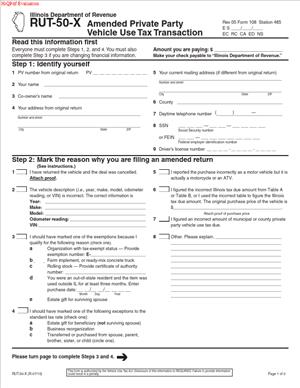
If you bought, received as a gift, or otherwise acquired a motor vehicle from a private party, RUT-50 is the Illinois form that usually controls the tax side of your title transaction. The form is not a general sales-tax return. It is the Private Party Vehicle Use Tax Transaction Return, and it is filed when the vehicle comes from a private party rather than a registered dealer. The Illinois Department of Revenue’s instructions also make clear that some transactions belong on RUT-25 instead, and that timing, local tax, and proof-of-tax-paid issues can change what you owe.
What RUT-50 is and when you use it
RUT-50 applies when a vehicle is purchased or acquired by gift or transfer from a private party. That is the starting rule. If the seller is an unregistered out-of-state dealer, lending institution, leasing company, or retailer, or if you bought a passenger car from an unregistered Illinois lending institution or leasing company, Illinois says to use RUT-25 instead. That distinction matters because buyers often assume every non-dealer vehicle transaction belongs on RUT-50. It does not.
Illinois also makes an operational point that many buyers miss: RUT-25, RUT-25-LSE, and RUT-50 are generally obtained when you title and license the vehicle at the relevant state facility or at a currency exchange, and the Department warns not to duplicate the forms because they carry unique transaction numbers. For firms and document platforms, that means the blog should explain the form accurately, but users still need the official transaction-specific version for filing.
The deadline is short, and late filing is expensive
RUT-50 is due within 30 days from the date you acquired the vehicle if the transaction happened in Illinois, or within 30 days of bringing the vehicle into Illinois if it was acquired outside the state. That deadline is easy to miss in gift, family transfer, and out-of-state move scenarios because buyers often focus on the title and plate process rather than the tax return. Illinois also states that late-filing, late-payment, bad-check, and collection-related penalties may apply if the return is not processable or the tax is not paid on time.
A second nuance matters for movers: if an individual originally acquired the vehicle from a private party and then brings it into Illinois after having titled it in another state for more than three months, Illinois says no Illinois tax is due, but the person still must file Form RUT-50 to show that fact. That is one of the most useful practical rules in the Illinois guidance because it changes filing from “pay and file” to “file and document exemption.”

Before you fill out RUT-50
The official instructions are short, but the return goes faster if you gather the right information first.
You need the purchaser’s name and address exactly as they appear on the Illinois title or registration application. Illinois requires the address to be the actual physical address of the person who will use the vehicle in Illinois, not a P.O. Box. You also need the transaction type, the purchase price or fair market value, supporting documentation if a credit for tax paid elsewhere is claimed, and sufficient information to determine whether any local private-party vehicle use tax applies. If you have a bill of sale or other proof of purchase, Illinois says attaching it may prevent future notices. If you do not have a stated purchase price, such as in a gift or even trade, fair market value is used, and the instructions say you can obtain that value from a licensed dealer.
Another practical item comes from the Illinois vehicle tax FAQs: Form RUT-49, Vehicle Transaction Affidavit, may be used to verify information reported or provide information not reported on RUT-50, and it can also be used in lieu of a bill of sale. That matters in private-party transactions where documentation is thin or informal.
Step-by-step: how to complete RUT-50 correctly
Step 1: Purchaser information
Enter the purchaser’s name and address exactly as they appear on the title or registration application. This sounds routine, but it is where mismatches begin. If the tax form, title application, and supporting documents do not align, the transaction can stall. Illinois explicitly requires the user’s actual Illinois physical address for the vehicle.
Step 2: Transaction description
This step is where many taxpayers either save money or create a notice problem.
Illinois recognizes three major categories here:
- Exemptions: certain charitable, religious, educational, or governmental organizations with an active Illinois exemption number; qualifying farm machinery or equipment; qualifying rolling stock in interstate commerce; and certain former out-of-state residents who used the vehicle outside Illinois for at least three months and meet the specific conditions in the instructions. If an exemption applies, the instructions say to mark the correct box and write $0 on Step 6, Lines 1, 2, and 3.
- Exceptions: for example, certain business reorganizations where beneficial ownership does not change, or transfers or purchases from a spouse, parent, brother, sister, or child, including adopted children. Illinois says step-relations, in-laws, and grandparents/grandchildren do not qualify for this family exception. If an exception applies, the instructions say to mark the correct box and write $15 on Step 6, Line 1.
- Motorcycle or ATV: if the transaction involves a motorcycle, motor-driven cycle, ATV, or motorized pedalcycle, Illinois instructs the filer to write $25 on Step 6, Line 1.
Step 3: Determine the Illinois private party vehicle use tax
The main tax depends on either the vehicle’s age or its purchase price/fair market value, depending on the amount.
If the purchase price or fair market value is less than $15,000, use Table A, which is based on vehicle age. If the purchase price or fair market value is $15,000 or more, use Table B, which is based on value brackets. Trade-in allowances are not allowed on RUT-50.
Do I Need To Pay Taxes on Private Sale Transactions?
Step 4: Figure the final tax
Step 6 of the instructions tells you how to finish the calculation. Line 1 is the Illinois private party vehicle use tax from the exemption, exception, motorcycle/ATV rule, or the main table. Lines 2 and 3 are for additional local private party vehicle use tax if your vehicle registration or titling address is in a local government that imposes such a tax. The instructions direct users to RUT-6 for those rates. Line 5 allows a credit only if proof of tax paid is attached and the tax is separately stated. Line 6 is the amount due, payable to the Illinois Department of Revenue.
5. The tax chart most people need
Alt text: RUT-50 Illinois tax chart showing main private party vehicle use tax rates by vehicle age under $15,000 and by purchase price or fair market value at $15,000 or more.
| RUT-50 rule | Tax due |
| Exception transaction | $15 |
| Motorcycle or ATV | $25 |
| Exemption | $0 |
| Vehicle age 1 year or less (Table A) | $465 |
| Vehicle age 2 years | $365 |
| Vehicle age 3 years | $290 |
| Vehicle age 4 years | $240 |
| Vehicle age 5 years | $190 |
| Vehicle age 6 years | $165 |
| Vehicle age 7 years | $155 |
| Vehicle age 8 years | $140 |
| Vehicle age 9 years | $125 |
| Vehicle age 10 years | $115 |
| Vehicle age 11 years or more | $100 |
| $15,000 to $19,999.99 (Table B) | $850 |
| $20,000 to $24,999.99 | $1,100 |
| $25,000 to $29,999.99 | $1,350 |
| $30,000 to $49,999.99 | $1,600 |
| $50,000 to $99,999.99 | $2,600 |
| $100,000 to $999,999.99 | $5,100 |
| $1,000,000 or more | $10,100 |
These are the main state-level private-party vehicle-use tax amounts in the current Illinois instructions. The taxpayer must still check whether any additional municipal or county tax applies using RUT-6.
Do not miss the local tax layer
RUT-50 is not always the whole answer. Illinois administers local private party vehicle use taxes for certain jurisdictions, and the current RUT-6 reference guide says those taxes are entered on Step 6, Line 2 for municipal tax and Line 3 for county tax. The local tax depends on the address listed on the Illinois title or registration application. Rate changes generally occur on January 1 or July 1, so the current guide matters.
For example, the current RUT-6 guide shows an additional private-party vehicle use tax for the City of Chicago and Cook County. For standard vehicle transactions other than exceptions and motorcycles/ATVs, Chicago charges from $80 to $0 depending on vehicle age, and Cook County charges $225, $175, or $90 depending on vehicle age. Separate local amounts also apply for certain exceptions and for motorcycles or ATVs.
For ordinary users, that means the main RUT-50 tax table is insufficient if the registration address falls within one of those local taxing jurisdictions.

Where to send the form and how to avoid delay
Illinois instructs filers to send Form RUT-50 and attachments, along with the Illinois Secretary of State registration application and fee, to the Office of the Illinois Secretary of State, Vehicle Services Department, Howlett Building, Springfield, Illinois 62756. The instructions also say to keep a copy for your records. That filing path is important because many people assume the form is filed directly with the Department of Revenue. In practice, it moves through the Secretary of State’s titling workflow.
The most common delay points are straightforward:
- using RUT-50 when the transaction actually belongs on RUT-25,
- using a P.O. box instead of the required physical Illinois address,
- failing to attach proof when claiming tax credit,
- leaving family-transfer or out-of-state exemption details undocumented,
- and overlooking local tax under RUT-6.
For legal teams and operations staff, the cleanest process is to build a short intake checklist: seller type, Illinois or out-of-state acquisition, purchase price or FMV, relationship of parties, vehicle type, local registration address, and proof documents.
Frequently Asked Questions
Who must file RUT-50 in Illinois?
Anyone who purchased or acquired a motor vehicle from a private party, by gift or transfer, generally must file RUT-50. If the seller was an unregistered out-of-state dealer, lender, leasing company, or retailer, or certain unregistered Illinois lenders or leasing companies, the correct form may be RUT-25 instead.
When is RUT-50 due?
RUT-50 is due within 30 days after acquiring the vehicle in Illinois, or within 30 days after bringing it into Illinois if it was acquired outside the state. Late-filing and late-payment penalties may apply.
Can I deduct a trade-in on RUT-50?
No. Illinois states that trade-in allowances are not allowed on Form RUT-50.
What if the vehicle was a gift and there is no purchase price?
If there is no stated purchase price, such as a gift or even trade, Illinois says to use fair market value. The instructions say fair market value can be obtained from a licensed dealer.
Does gifting a vehicle in Illinois always mean no tax is due?
No. Some family transfers qualify for the $15 exception, but the relationship rules are specific. Spouses, parents, siblings, and children qualify; in-laws, step-relations, and grandparent/grandchild relationships do not qualify under the listed family exception.
What if I already paid tax elsewhere?
A credit may be allowed, but Illinois allows it only if proof of tax paid is attached and the tax is separately stated.
What if I do not have a bill of sale?
Illinois tax FAQs state that Form RUT-49, Vehicle Transaction Affidavit, can be used to verify reported information or provide missing information, and it can also be used in lieu of a bill of sale with RUT-50.
Resources:
- Illinois Department of Revenue. (2025). RUT-50 instructions for Private Party Vehicle Use Tax Transaction (R-01/25). https://tax.illinois.gov/content/dam/soi/en/web/tax/forms/sales/documents/vehicleusetax/rut-50-instr.pdf
- Illinois Department of Revenue. (n.d.). Private Party Vehicle Use Tax. https://tax.illinois.gov/research/taxinformation/sales/vehicle.html
- Illinois Department of Revenue. (n.d.). RUT-25, RUT-25-LSE, and RUT-50. https://tax.illinois.gov/forms/sales/rut25.html
- Illinois Department of Revenue. (n.d.). Illinois tax requirements for cars, trucks, vans, motorcycles, ATVs, and trailers. https://tax.illinois.gov/individuals/cars.html
- Illinois Department of Revenue. (n.d.). Vehicle tax FAQs. https://tax.illinois.gov/research/taxinformation/sales/vehicle-tax-faqs.html
- Illinois Department of Revenue. (2024). RUT-6, Form RUT-50 Reference Guide (R-03/24). https://tax.illinois.gov/content/dam/soi/en/web/tax/forms/sales/documents/vehicleusetax/rut-6.pdf
Disclaimer: The content provided on this blog is for informational purposes only and does not constitute legal, financial, or professional advice.
Contents