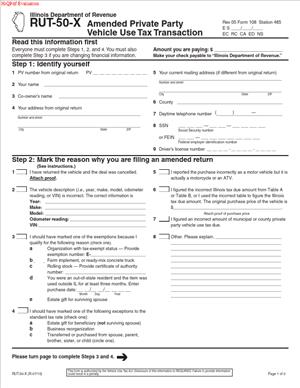
RUT-50-X – Amended Private Party Vehicle Use Tax Transaction
Fill out nowJurisdiction: Country: United States | Province or State: Illinois
The RUT-50-X – Amended Private Party Vehicle Use Tax Transaction is a correction form used in Illinois to update information from a previously filed private party vehicle tax transaction. You use it when something on the original filing was wrong or incomplete. It allows you to fix errors tied to the purchase of a vehicle from another individual.
This form connects to the vehicle use tax you report after buying a car, truck, motorcycle, or similar vehicle from a private seller. If the original submission had incorrect details, this amended document helps align the tax record with the actual transaction.
If you are about to complete the RUT-50-X – Amended Private Party Vehicle Use Tax Transaction, you are likely dealing with a mistake in price, vehicle information, or buyer and seller details. The correction matters because tax amounts are based on the information reported.
Filing an amended form can affect how much tax is owed. It can also affect how your vehicle record appears in state systems. Clear and accurate information helps prevent delays, additional notices, or further corrections.
Understanding how this document works will help you prepare the right details before you start. That makes the completion process smoother and reduces the chance of another amendment.
What is RUT-50-X – Amended Private Party Vehicle Use Tax Transaction?
Clear definition
The RUT-50-X – Amended Private Party Vehicle Use Tax Transaction is an amendment form used to correct a previously submitted private party vehicle use tax filing. It updates information that was reported in error on the original transaction record.
It does not create a new sale. It modifies the tax record linked to an earlier vehicle purchase between private individuals. The purpose is to ensure the tax calculation and transaction details reflect what actually occurred.
This document typically refers back to an earlier submission. It identifies the original transaction and specifies what information is being changed. That may include the purchase price, vehicle identification number, date of sale, or party information.
Who typically uses this form?
You may use this form if you bought a vehicle from a private seller and later discovered an error in the tax filing. Buyers are the most common users because they are usually responsible for reporting and paying vehicle use tax.
In some cases, sellers may assist if the correction involves shared information, such as the date of sale or agreed purchase price. However, the filing responsibility often rests with the purchaser.
You might also use this document if you acted as a family member handling paperwork for someone else. The key factor is that the original private party vehicle use tax filing needs correction.
Why might you need this form?
You may need this form if the purchase price was reported incorrectly. Even a small mistake can affect the tax calculation.
Another reason is an incorrect vehicle identification number. A wrong VIN can cause registration issues or mismatched records.
You might also need it if the date of purchase was entered incorrectly. Tax timing and related records often rely on that date.
Sometimes, the type of vehicle or its description was entered inaccurately. That can affect how the tax is assessed.
In other cases, a clerical error occurred when entering names or addresses. An amendment ensures the official record matches the actual transaction.
Typical real-life scenarios
- You buy a used car from a neighbor. When reviewing your copy of the tax filing, you notice the sale price was entered as $8,500 instead of $5,800. That error changes the tax owed. You would use this form to correct the reported amount.
- You purchase a motorcycle from a private seller. After submitting the original tax form, you realize one digit in the VIN was typed incorrectly. Because the VIN uniquely identifies the vehicle, you file an amendment to correct it.
- You buy a vehicle from a family member at a reduced price. The original filing did not properly reflect the nature of the transaction. An amended submission updates the record so it matches the actual agreement.
- You complete the original filing in a hurry and later see that the date of sale was entered as the wrong month. Since the date ties to the transaction timeline, you file the amended form to fix that detail.
- In another situation, you mistakenly selected the wrong vehicle type. The tax category applied was not accurate. You use the amended document to correct the classification.
When would you use RUT-50-X – Amended Private Party Vehicle Use Tax Transaction?
You would use this form after a private party vehicle purchase has already been reported, and you discover an error. The key point is that an original submission exists and needs correction.
This often happens shortly after filing, when you review your copy and compare it to the bill of sale or title. It can also happen weeks later if you receive a notice that the information does not match state records.
Buyers typically use this amendment when they realize the tax paid does not reflect the true purchase price. If the original tax amount was too high or too low due to incorrect data, an amendment adjusts the reported details.
You may also use it if there is a mismatch between the vehicle record and the title application. For example, the name listed on the tax filing does not match the name on the title documents.
In some situations, you may receive communication indicating that the original filing cannot be processed as submitted. An amended form can address the specific issue identified.
This document is not used for dealer sales. It applies to private party transactions, meaning the vehicle was purchased from an individual rather than a licensed dealer.
Timing matters. Amendments are usually filed after the original transaction has been processed or submitted. You are not starting over. You are correcting what is already on record.
Legal characteristics of RUT-50-X – Amended Private Party Vehicle Use Tax Transaction
The RUT-50-X – Amended Private Party Vehicle Use Tax Transaction functions as an official correction to a tax record. Its effectiveness depends on accurate identification of the original filing and a clear explanation of the changes.
For the amendment to be processed, the information provided must be consistent with supporting documents. These often include the title, bill of sale, or other records showing the actual transaction details.
Common reasons for rejection include incomplete sections, missing identifying information, or discrepancies between the amended form and the original filing. Errors in the VIN or transaction reference details can also delay processing.
Another issue arises when the amended figures do not logically match the transaction documents. For example, reporting a drastically different price without documentation may raise questions.
High-level differences may exist depending on the type of vehicle involved. Passenger vehicles, trucks, and motorcycles can be subject to different tax treatments. The amendment must align with how the vehicle is classified under state rules.
This document does not transfer ownership. It does not replace a title application. It does not serve as a bill of sale. Its function is limited to correcting tax-related information tied to a private party vehicle purchase.
It also does not automatically resolve unrelated registration issues. If other paperwork contains errors, those may require separate correction forms.
Is it legally binding?
Yes, in the sense that it is a formal tax document submitted to a state agency. When you sign and submit it, you are certifying that the information provided is accurate to the best of your knowledge.
The binding nature comes from your declaration that the corrected details reflect the true transaction. False or misleading information on tax documents can carry consequences.
However, the form itself does not create a contract between buyer and seller. The underlying sale agreement remains separate. The amendment only updates the reported tax transaction.
Its legal effect is tied to tax reporting. Once accepted, it adjusts the official record and may affect the amount of tax owed or credited.
How to fill out RUT-50-X – Amended Private Party Vehicle Use Tax Transaction
Step 1 – Identify the original transaction
Begin by locating details from your original private party vehicle use tax filing. You will need information that clearly connects the amendment to the correct transaction. This often includes the original filing reference, the date of submission, and the vehicle’s identification number. Enter these details exactly as they appeared on the original document to avoid confusion.
Step 2 – Provide buyer information
Enter the purchaser’s full legal name and current address as required in the form. Make sure the information matches the name used on the vehicle title and original tax filing, unless you are correcting that specific detail. If the amendment is meant to fix an error in the buyer’s name or address, clearly provide the corrected information in the space designated for changes.
Step 3 – Provide seller information
Fill in the seller’s name and any other identifying details requested. If the seller’s information was incorrect on the original filing, use this section to provide the accurate version. Ensure spelling and formatting are consistent with the bill of sale or title documents.
Step 4 – Enter vehicle details
Carefully input the vehicle’s identification number, year, make, and model. Compare each character of the VIN against the title or vehicle documents. Even one incorrect digit can prevent proper processing. If the amendment is to correct a vehicle detail, clearly indicate the updated information.
Step 5 – Correct the transaction details
State the correct date of sale and the accurate purchase price. If the original filing listed an incorrect amount, enter the revised figure as required and follow the form’s structure for showing previously reported versus corrected amounts. Make sure the numbers reflect the actual agreement between buyer and seller.
Step 6 – Recalculate the tax information
Based on the corrected transaction details, complete the tax calculation section of the form. Use the structure provided to show how the updated information affects the total tax due. If the amendment results in a difference from what was originally paid, ensure the figures are clearly presented in the designated spaces.
Step 7 – Explain the reason for the amendment
Provide a concise explanation of why the amended filing is necessary. State the specific error made in the original submission and describe what has been corrected. Keep the explanation factual and focused on the transaction details.
Step 8 – Review all entries for accuracy
Before signing, read through each section of the completed form. Compare the corrected details with your supporting documents. Confirm that the VIN, names, dates, and amounts are consistent across all paperwork. This step reduces the chance of another correction being needed.
Step 9 – Sign and date the form
Sign and date the RUT-50-X – Amended Private Party Vehicle Use Tax Transaction in the space provided. Your signature confirms that the amended information is accurate to the best of your knowledge. Ensure the date of signing is clearly written and matches the required format on the form.
Legal terms you might encounter in RUT-50-X – Amended Private Party Vehicle Use Tax Transaction
- Amended Return: An amended return corrects information you previously reported. In this document, you are revising details from an earlier vehicle use tax filing. You must clearly identify what was originally reported and what the corrected information should be.
- Original Transaction Date: This is the date the vehicle was actually transferred from the seller to you. It is not the date you discovered the mistake. The form uses this date to determine the correct tax period and rate.
- Purchase Price: The amount you paid for the vehicle. This number directly affects the tax calculation. If you entered the wrong amount on the original filing, you must show the corrected price and explain the reason for the change.
- Taxable Base: The value used to calculate the tax owed. It may be the purchase price or another value required under the rules. When amending, you must ensure the taxable base reflects accurate information.
- Tax Due: The corrected amount of tax you owe after recalculating the transaction. If your amendment increases the tax, you may owe additional payment. If it decreases the tax, you may be eligible for a refund.
- Overpayment: An overpayment happens when you pay more tax than required. The amended filing can request a credit or refund if the correction reduces your tax liability.
- Underpayment: An underpayment occurs when you originally paid less tax than required. The amendment corrects this and may require you to pay the difference.
- Vehicle Identification Number (VIN): A unique 17-character code assigned to your vehicle. The VIN must match your title and registration documents exactly. Even one incorrect character can delay processing.
- Declaration Under Penalties of Perjury: This statement confirms that the information you provide is true and correct. When you sign, you are legally affirming accuracy. False information can lead to penalties.
FAQs
Do I need to attach a copy of my original filing when submitting RUT-50-X – Amended Private Party Vehicle Use Tax Transaction?
You should have your original filing available while completing this document. In many cases, attaching a copy helps the reviewing agency compare the original and corrected information. If you do not attach it, make sure you clearly provide the original transaction date, reported purchase price, and previously paid tax so your amendment can be matched accurately.
What effective date should I use on this form?
Use the original vehicle transfer date, not the date you discovered the error. The amendment corrects the transaction as it occurred. Double-check the date on your title, bill of sale, or original tax filing to avoid inconsistencies.
Who is authorized to sign this document?
The buyer who filed the original return generally signs the amendment. If someone else signs, that person must have proper authority, such as a legal representative or authorized agent. Make sure the name matches the identification on file to prevent rejection.
What if I made more than one mistake on the original filing?
You can correct multiple errors in the same amendment. Clearly identify each incorrect entry and provide the corrected version. Keep your explanation organized so the reviewer can see exactly what changed and why.
Will filing an amended return automatically trigger a penalty?
Not automatically. Penalties depend on the nature of the correction and whether additional tax is owed. If you underreported tax, you may owe the difference and possibly interest. If you overpaid, you can request a refund without penalty.
How do I know if my amended filing has been accepted?
After submission, you should receive confirmation or updated records reflecting the corrected tax amount. Review any correspondence carefully. If you do not receive acknowledgment within a reasonable time, follow up to confirm the amendment was processed.
What happens if the VIN or buyer name does not match the title records?
A mismatch can delay or reject your amendment. The information on this document must align with the title and registration records. Before submitting, compare the VIN and legal name exactly as shown on official documents.
Can I use RUT-50-X – Amended Private Party Vehicle Use Tax Transaction to change ownership details?
No. This document corrects tax reporting errors only. It does not transfer ownership or modify title records. Ownership changes must be handled through the appropriate title or registration process.
Checklist: Before, During, and After RUT-50-X – Amended Private Party Vehicle Use Tax Transaction
Before
- Locate a copy of your original vehicle use tax filing.
- Gather the bill of sale, title, and registration documents.
- Verify the correct purchase price and transaction date.
- Confirm the full legal names of buyer and seller.
- Double-check the complete 17-character VIN.
- Review proof of any payment already made.
- Identify exactly what information needs correction.
- Calculate the corrected tax amount in advance.
During
- Enter the original transaction details exactly as first reported.
- Clearly provide the corrected information in the designated fields.
- Recalculate tax using accurate figures.
- Explain the reason for each correction in plain language.
- Ensure names and VIN match official documents.
- Review all numbers for math errors.
- Confirm that payment information reflects any additional amount due.
- Sign and date the declaration section.
After
- Make a full copy of the completed amendment for your records.
- Attach any required supporting documents.
- Submit the form using the approved filing method.
- Pay any additional tax owed promptly.
- Monitor for confirmation or correspondence.
- Respond quickly to any requests for clarification.
- Keep proof of mailing or submission.
- Store the amendment with your vehicle tax records.
Common mistakes to avoid with RUT-50-X – Amended Private Party Vehicle Use Tax Transaction
- Mistake: Using the date you discovered the error instead of the original transfer date, which happens when people focus on the correction timing; this can cause processing delays or incorrect tax calculations, so do not forget to verify the date on the title.
- Mistake: Entering an incomplete or incorrect VIN because of a typing error; this often leads to rejection since the vehicle cannot be matched, so do not forget to compare every character with the title document.
- Mistake: Failing to explain why you are amending the return, which happens when you assume the correction is obvious; this can result in follow-up requests and delays, so do not forget to provide a clear written explanation.
- Mistake: Recalculating tax incorrectly due to math errors or using the wrong purchase price; this may create another underpayment or overpayment, so do not forget to double-check your calculations.
- Mistake: Forgetting to sign the declaration section because you focus only on the numbers; an unsigned form is not valid, so do not forget to sign and date it.
- Mistake: Not including payment for additional tax owed, often because you expect a separate bill; this can lead to interest or penalties, so do not forget to submit payment if required.
- Mistake: Submitting the amendment without keeping a copy, which happens when you are in a hurry; this makes it difficult to respond to questions later, so do not forget to retain a complete copy.
- Mistake: Assuming the amendment changes ownership records, which causes confusion when title information remains the same; this can delay other transactions, so do not forget that this document corrects the tax only.
What to do after filling out RUT-50-X – Amended Private Party Vehicle Use Tax Transaction
Once you complete the form, pause before sending it. Review every section again with your supporting documents next to you. Small inconsistencies cause the biggest delays.
- Step 1: Make a complete copy of the signed form for your personal records.
- Step 2: Attach copies of supporting documents, such as the bill of sale or title, if required to support the correction.
- Step 3: Confirm the corrected tax calculation one more time using your figures.
- Step 4: Prepare payment for any additional tax due, including applicable interest if required.
- Step 5: Submit the form using the accepted filing method, whether by mail or in person, as permitted.
- Step 6: Keep proof of submission, such as a receipt or mailing confirmation.
- Step 7: Monitor your mail or official account for confirmation that the amendment was processed.
- Step 8: Review any updated tax notice carefully to ensure the correction was applied accurately.
- Step 9: Respond promptly if you receive a request for additional information.
- Step 10: Store all documents together with your vehicle records for future reference.
Keeping organized records protects you if questions arise later. If you sell the vehicle or need proof of corrected tax payment, you will have everything ready. Staying proactive ensures the amendment resolves the issue cleanly and prevents repeat filings.
Disclaimer: This guide is provided for informational purposes only and is not intended as legal advice. You should consult a legal professional.