A leaking ceiling, broken furnace, or pest problem can make a home hard to use. You may have asked your landlord to fix it and heard nothing back. For repairs in Ontario, start by recording the problem and telling your landlord in writing. If the issue continues, you can contact municipal enforcement, apply to the Landlord and Tenant Board (LTB), or do both. Keep paying rent unless the LTB makes an order that changes how you pay it.
This guide covers residential tenancies governed by Ontario’s Residential Tenancies Act. Some living arrangements fall outside that law. If you are unsure whether the LTB can hear your case, check the Board’s guidance or get legal advice. This article is general information, not legal advice.
Who is responsible for repairs in Ontario?
A landlord must keep the rental unit and the residential complex in good repair, fit to live in, and compliant with health, safety, housing, and maintenance standards. For repairs in Ontario, the duty applies even if the tenant knew about a defect when moving in. It also applies if a lease tries to shift the landlord’s legal duty to the tenant. The LTB maintenance brochure gives common examples.
The duty for repairs in Ontario can cover plumbing, heating, wiring, windows, doors, supplied appliances, and shared spaces. A landlord may repair a broken item or replace it with one that works. The replacement does not have to be a better model. A recurring problem can still matter even when a quick patch makes it disappear for a few days.
Repairs in Ontario: normal wear or tenant damage?
A tenant must keep the unit ordinarily clean. A tenant is also responsible for undue damage caused by the tenant, a guest, or another occupant. Normal wear from everyday use is different. A worn carpet or appliance that stops working after ordinary use does not automatically become the tenant’s repair bill.
The cause can matter when repairs in Ontario are disputed. For example, a landlord may say a leak followed misuse of a fixture. The tenant may say a pipe failed. Keep photos, service notes, and messages that show what happened. Avoid guessing at a cause you cannot prove. A professional inspection may help both sides identify the source.

Shared areas and essential services
The duty to make repairs in Ontario also extends to relevant shared areas, such as hallways, laundry rooms, stairs, and parking areas. Pest control may require action across several units, not just one apartment. Tell the landlord where the problem appears and whether it affects common space.
For repairs in Ontario involving utilities, the LTB calls hot and cold water, fuel, electricity, gas, and heat during certain months vital services. Its brochure states that, where the landlord provides heat, the minimum is 20°C from September 1 to June 15; some local standards are higher. A landlord cannot withhold a reasonable supply of a vital service they provide. A utility interruption can have other causes, so report the facts and find out who supplies the service before deciding which process applies.
If there is immediate danger, seek emergency help through the appropriate local service. Do not wait for an LTB hearing to deal with an urgent safety risk.
Tell the landlord clearly and preserve the request
The LTB advises tenants to ask the landlord in writing to fix the problem and keep a copy. Use a method you can later prove was delivered, such as the address or email used for tenancy communications. A call can alert the landlord quickly, but follow it with a dated message.
A useful request for repairs in Ontario states the issue, location, first known date, effect on the home, and access information. For example: “Water has dripped from the bedroom ceiling since September 18. The plaster is wet and the bed has been moved. Please arrange an inspection and repair, and tell me when someone can attend.” Attach clear photos if useful.
Ask for a response that fits the urgency of the problem. Ontario law does not set one universal number of days for every repair. A loss of heat or active leak calls for a faster response than a minor finish defect. Record what the landlord says, any visit, work completed, and whether the defect returns.
Make access possible without giving up privacy
A landlord may need access to inspect and fix the defect. Usually, entry for repairs requires written notice at least 24 hours ahead, with a reason, date, and time between 8 a.m. and 8 p.m. Different rules may apply in emergencies or where the tenant consents to entry. The LTB brochure outlines the ordinary notice rule.
For repairs in Ontario, offer practical times and keep a record of any appointment. If a contractor fails to arrive, note it. If you refuse reasonable access, the refusal may affect what the Board decides about a delay. If you think an entry was unlawful, record that issue separately; a tenant-rights claim may need a different application.
Build evidence before the problem changes
A strong record shows four things: what was wrong, when it happened, when the landlord learned about it, and how it affected you. Evidence for repairs in Ontario can be simple. You do not need to turn your home into a laboratory. Start with dated, readable records.
- Take wide photos showing the room and close photos showing the defect. Keep the original files when possible.
- Write a short log of dates, temperatures or water loss if relevant, calls, visits, promises, and outcomes.
- Save the lease, messages, work orders, inspection reports, and any replies from the landlord.
- Keep receipts for damaged property, supplies, temporary accommodation, or other costs you may claim.
- Record how the issue limited use of the space. Be specific: “The bedroom could not be used for nine nights,” rather than “everything was terrible.”
If you measure room temperature, note the date, time, place, device, and whether windows were open. A photo of a thermometer by itself may not explain conditions. For pests, note sightings, affected rooms, dates of treatments, and whether entry was arranged. For moisture, document leaks and damage, not an unverified diagnosis of the substance.
Build a timeline for repairs in Ontario
For repairs in Ontario, put events in order on one page. For example: September 18, leak noticed; September 18, email sent; September 20, landlord acknowledged; September 24, contractor visited; September 26, leak returned; October 1, municipal inspector attended. Add a link or filename for each supporting item.
The timeline makes gaps visible. It can also show a fair effort by the landlord that did not solve the problem. Tell the whole story. If the landlord completed some work, include it. A later hearing may turn on whether the fix was adequate and how long the problem lasted, not whether anyone ever visited.
For expenses, match each receipt to an event and explain why the cost followed the defect. If an item was already worn, record its condition and age as best you can. Do not assume the Board will award every amount you request.
Rental Rules in Ontario: September 2026 Changes
Contact local property standards enforcement
If the landlord does not fix the issue within a reasonable time after being told, the LTB says you may report it to the local municipality, apply to the Board, or do both. Ask your municipality how it handles property standards or housing complaints. Municipal bylaw standards may apply; where they do not, provincial maintenance standards may apply. Local enforcement processes vary.
For repairs in Ontario, an inspector may visit, identify a violation, and issue a notice or work order with a repair deadline. Ask for a copy of any report or order. Keep the complaint number and dates of follow-up. An inspection record can help show the state of the property, but it does not itself decide your T6 claim or calculate a rent reduction.
Call the relevant local service promptly for an urgent hazard. If there is a fire, gas leak, or immediate threat to life, use emergency services. If heat or water has stopped, notify the landlord right away and ask your municipality or utility provider what immediate assistance is available.
Choose the right LTB path
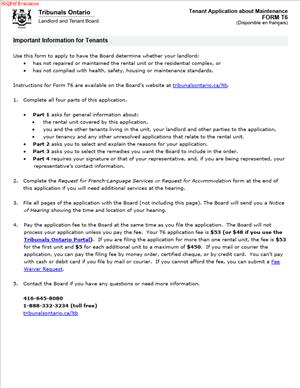
The main LTB form for unresolved repairs in Ontario is Form T6, Tenant Application about Maintenance. The official T6 instructions say a current or former tenant may use it when the landlord did not maintain or repair the unit or complex, or did not meet applicable standards. If the problem has been fixed, file within one year of the date it was fixed.
For repairs in Ontario, a T6 is an application asking the Board to decide a dispute. It is not an order as soon as you file it. The landlord can respond, and the Board considers the evidence. A municipal complaint can run alongside the T6; it is not a required first step in every case.
What can the Board order on a T6?
The T6 lets you ask for one or more remedies. Depending on the evidence and the law, the Board may order the landlord to do work by a date, reduce rent for a period, pay for damaged property or reasonable out-of-pocket expenses, or authorize repair work and payment of its cost. It may stop a rent increase until serious ordered work is completed. It may end the tenancy in the circumstances set by law and the application. The Board can also make another appropriate order.
In a case about repairs in Ontario, a rent abatement means relief from some or all rent for a stated period. It is based on the facts; there is no automatic percentage for a leak, pests, or lack of heat. State the amount you seek, the period involved, and why. For example, explain which room was unusable, for how long, and what your monthly rent was. The Board may award a different remedy or amount.
Be careful when choosing an order to end the tenancy. The official T6 instructions warn that such an order may include a move-out date and enforcement terms. If you want to stay and have the landlord repair the home, say so clearly. A separate rights issue, such as harassment or illegal entry, may call for a T2 application. Check the official instructions for each claim.
Do not stop paying rent on your own
For repairs in Ontario, the LTB expressly warns tenants not to withhold rent because of poor maintenance. A landlord can start a non-payment case if the full rent is not paid when due. That risk exists even when the repair complaint has merit.
If you have filed a T6, you may ask the Board to let you pay some or all rent to the Board while the case is pending. The Board decides whether to allow it. Filing the request alone does not change where rent is due. Wait for the Board’s direction and follow the order exactly.
File the T6 and prepare for the hearing
Read the current official T6 form and instructions before filing. Form versions, fees, and procedures can change. The official instructions call for the completed application and the applicable fee; a fee waiver may be available if you qualify. Check the LTB’s current fee page rather than relying on an old dollar amount in a blog post.
When you file over repairs in Ontario, describe each problem separately. Give its start date, whether it continues, when you first told the landlord, what was done, and what you ask the Board to order. If a date is uncertain, say it is approximate. For a money claim, show your calculation and keep supporting receipts. Check that the correct landlord is named. If more parties must be listed, see the official instructions for a Schedule of Parties.
The Tribunals Ontario Portal accepts T6 applications. The official T6 instructions also describe filing by mail or courier. Save your filed version, payment record, and case number. A form page on RunSensible Forms can help you prepare a document, but the official LTB process controls filing, service, fees, and hearing steps. RunSensible Forms is not the LTB and does not file the case for you.
Share evidence using the current directions
After filing a case about repairs in Ontario, read every notice from the LTB. The notice and current Practice Direction on Evidence tell parties how and when to give materials to the Board and the other party. Uploading to the portal does not necessarily replace every step required to give the other side access. Confirm the instructions for your case.
Label your files by date and subject: “2026-09-18 ceiling leak.jpg” tells more than “IMG_4712.jpg.” Put your timeline first and keep originals. If a witness has firsthand knowledge, ask whether they can attend and explain what they saw. Prepare to explain each requested remedy, not just the defect. Practice a short account of what happened, when notice was given, what followed, and what outcome you seek.
At a hearing about repairs in Ontario, the tenant and landlord can both give evidence and answer questions. An inspection order is useful, but the Board must still decide the legal claim. If you reach an agreement, read its terms before accepting it. Identify the work, deadlines, access, money, and what happens if the work fails.

If the landlord files a rent arrears case
A dispute over repairs in Ontario does not erase rent arrears. For an arrears hearing, Ontario now has a specific rule about raising maintenance issues in that case. If the landlord filed the rent arrears application on or after September 21, 2026, a tenant who wants the LTB to consider other issues at that hearing must pay the landlord at least half the claimed arrears at least seven days before the hearing. The tenant must also give the landlord and LTB a written description of the issues and the evidence within the applicable seven-day period. Payment for this purpose goes directly to the landlord, not to the Board in trust. Keep proof. The LTB’s updated non-payment brochure explains the rule.
This is a rule for raising other issues at a landlord’s arrears hearing. It is separate from filing your own T6. If you receive an N4 notice or a hearing notice, read it promptly and get legal advice on the dates and options. An N4 is a notice, not an eviction order. Do not assume an outstanding repair complaint will pause that process.
Common mistakes and a practical checklist
For repairs in Ontario, the most common mistakes are waiting without a written record, claiming an amount without a calculation, mixing separate issues into one vague story, and stopping rent without an order. Another mistake is treating a quick visit as proof that the repair worked. Check the result, then update your record.
Before filing over repairs in Ontario, ask yourself:
- Can I show what the defect was and when it happened?
- Can I show when and how the landlord was told?
- Have I recorded visits, partial fixes, and recurring problems fairly?
- Have I kept receipts and explained each expense I am claiming?
- Do I know which remedy I want and what facts support it?
- Have I checked the current T6 instructions, fee, form version, and evidence directions?
- Am I still paying rent as required unless the LTB orders a different arrangement?
For example, a tenant with a leaking bedroom ceiling could send photos and a dated request on the first day. If the landlord promises a repair, the tenant records the visit and photographs any continuing leak. A municipal inspection may document a standards problem. A T6 can then describe the leak, lost use of the room, repair requests, work attempted, and a reasoned request for a repair order and rent abatement. The Board decides the result from the full evidence.
Conclusion
When a landlord delays repairs in Ontario, act in a clear order: report the defect, preserve proof, follow up, and consider municipal enforcement or a T6. Keep rent payments current while you seek a remedy. Good records make it easier to explain the problem and ask for a specific order. Check the LTB’s latest forms and directions before filing, especially if a rent arrears hearing is also underway.
Frequently Asked Questions
How long does a landlord have to make repairs in Ontario?
For repairs in Ontario, there is no single deadline that covers every defect. The response should fit the problem and the landlord’s duty to maintain the property. Report an urgent loss of a vital service at once. Save the request and all responses. The Board can consider the nature and length of the delay.
Can I stop paying rent until the repair is done?
No. The LTB warns against withholding rent on your own. You can seek a T6 remedy or ask the Board to allow payment into the Board during a T6 case. Wait for an order before changing how you pay.
Can I file a T6 after moving out?
Yes. The official instructions allow former tenants to apply. If the problem has been fixed, the T6 must be filed within one year after it was fixed. Check the facts and any other applicable limit promptly.
Do I need a city inspection before filing a T6?
No. The LTB says you may contact local government, file a T6, or do both. A municipal report can be helpful evidence, but the Board makes its own decision.
What if my landlord makes one repair but the problem returns?
Record the work date, tell the landlord the problem has returned, and collect new proof. A T6 can explain the full history. Do not say there was no attempt to repair if a contractor attended; explain why the work did not solve the issue.
Can I hire a contractor and deduct the cost from rent?
Do not assume you can make that deduction yourself. The T6 instructions describe remedies through which the Board may approve work or reimbursement and may authorize a deduction. Get advice before taking on a major cost or changing rent payments.
What if the landlord says I caused the damage?
Keep evidence of the item’s earlier condition, ordinary use, and any inspection or service findings. Tenants may be responsible for undue damage, while landlords remain responsible for ordinary wear and the maintenance duties set by law. The Board can assess a dispute about cause.
Does a repair complaint stop an eviction for unpaid rent?
No automatic pause follows from a complaint. If the landlord starts an arrears case, meet the hearing requirements. Special payment and disclosure rules apply when a tenant raises maintenance at a rent arrears hearing for applications filed on or after September 21, 2026.
Resources
- Residential Tenancies Act, 2006 — https://www.ontario.ca/laws/statute/06r17
- LTB: Maintenance and Repairs — https://tribunalsontario.ca/documents/ltb/Brochures/Maintenance%20and%20Repairs.html
- LTB: Form T6 Instructions — https://tribunalsontario.ca/documents/ltb/Tenant%20Applications%20%26%20Instructions/T6_Instructions.html
- LTB: Forms, Filing and Fees — https://tribunalsontario.ca/ltb/forms-filing-and-fees/
- LTB: Tribunals Ontario Portal — https://tribunalsontario.ca/ltb/tribunals-ontario-portal/
- LTB: Law, Rules and Decisions, including Practice Direction on Evidence — https://tribunalsontario.ca/ltb/law-rules-and-decisions/
- LTB: If a Tenant Does Not Pay Rent, updated September 21, 2026 — https://tribunalsontario.ca/documents/ltb/Brochures/If%20a%20Tenant%20Does%20Not%20Pay%20Rent.html
Disclaimer: The content provided on this blog is for informational purposes only and does not constitute legal, financial, or professional advice.
Contents
- Who is responsible for repairs in Ontario?
- Tell the landlord clearly and preserve the request
- Build evidence before the problem changes
- Contact local property standards enforcement
- Choose the right LTB path
- File the T6 and prepare for the hearing
- If the landlord files a rent arrears case
- Common mistakes and a practical checklist
- Conclusion
- Frequently Asked Questions
- Resources