
Several important rental rules in Ontario changed on September 21, 2026. The changes affect unpaid rent notices, personal-use evictions, renovation notices, tenant hearing rights, late rent, and requests to delay an eviction.
The Landlord and Tenant Board also replaced ten forms. Older versions will no longer be accepted after November 30, 2026.
These changes come from amendments to the Residential Tenancies Act, 2006 made through Bill 60 and Bill 97. They add to other changes that took effect on July 1, 2026.
This guide explains the September 21 changes. It is general legal information, not legal advice. A notice or application can have serious effects. Check the current LTB form and instructions before acting.
Rental rules in Ontario: the changes at a glance
The new rental rules in Ontario do not create one single process for every dispute. The date of the notice or application matters. The reason for ending the tenancy also matters.
Table description: Summary of rental rules in Ontario effective September 21, 2026.
| Area | What changed | Who should act |
|---|---|---|
| N4 for unpaid rent | The notice period fell from 14 days to 7 days for notices given on or after September 21, 2026. | Landlords must use the new N4. Tenants should respond quickly. |
| Issues at a rent-arrears hearing | A tenant who wants to raise certain other issues must pay half the arrears claimed at least 7 days before the hearing and still provide a written description of the issues. | Tenants facing a landlord application filed on or after September 21. |
| Persistent late rent | Rent received more than 7 days late at least 3 times in 6 months is now defined as persistent late payment. Other patterns may still qualify. | Both parties should keep clear payment records. |
| N12 for landlord’s own use | A landlord giving at least 120 days’ notice may not need to pay one month’s compensation or offer another acceptable unit. | Applies only to qualifying landlord’s-own-use notices, not purchaser’s-own-use notices. |
| Occupancy after an N12 | The landlord or named person must normally occupy within 60 days of the termination date. Missing that period creates a rebuttable presumption of bad faith in a T5 case. | Landlords should document the move. Former tenants should preserve evidence. |
| N13 renovation return rights | Landlords must provide written timing updates and at least 60 days ‘ notice to return after the unit is ready when the tenant preserved the right to return. | Tenants must give written notice before leaving. Landlords must track notices and updates. |
| T5 filing time after renovations | The deadline is the later of 2 years after move-out or 6 months after the work is completed. | Former tenants considering a right-of-first-refusal claim. |
| Eviction relief | New limits apply when asking the LTB to set aside or delay certain eviction orders. | Parties should present evidence tied to the new legal tests. |
| LTB forms | Ten forms were replaced. Old versions stop being accepted after November 30, 2026. | Anyone preparing an affected notice or application. |
The rest of this article explains each change and the dates that control it.
Non-payment notices now give tenants seven days
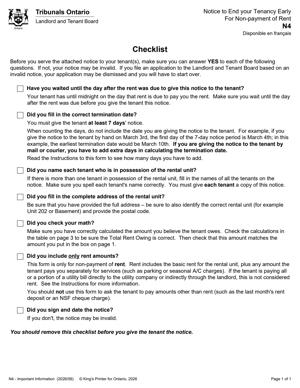
One of the biggest changes to the rental rules in Ontario concerns the N4. A landlord uses the N4 when rent has not been paid in full.
For an N4 given on or after September 21, 2026, the notice period is seven days. It was previously 14 days. This change to the rental rules in Ontario makes the first stage of a non-payment case move faster.
An N4 is a notice. It is not an eviction order. A landlord cannot personally remove a tenant, change the locks, or treat the notice as permission to take back the unit. If the matter is not resolved, the landlord generally must apply to the LTB and obtain an order. Only the sheriff can enforce an eviction order.
What the rental rules in Ontario mean for tenants who receive an N4
Act as soon as the notice arrives. Read the name, address, rent periods, amount claimed, and termination date. A wrong calculation or wrong date can affect the notice, but do not assume an error ends the matter.
Consider these steps:
- Compare the claimed arrears with your lease, receipts, bank records, and rent ledger.
- Save the notice and the envelope or message used to deliver it.
- Ask the landlord for a written breakdown if the amount is unclear.
- Keep proof of every payment.
- Get legal help quickly if you dispute the notice or cannot pay.
Paying all rent owed by the termination date can void an N4. Later payment rules may also affect an L1 application or eviction order. The exact step depends on where the case is in the process.
What landlords should check before serving an N4?
Use the N4 version issued on September 21, 2026. Calculate only lawful rent arrears. Do not include unrelated charges as rent unless the law treats them as rent.
Check the termination date carefully. Service rules can change how time is counted. Keep a copy of the completed notice and proof showing when and how it was served.
The shorter period does not excuse mistakes. A wrong tenant name, rental address, arrears amount, service method, or termination date may delay or defeat an application.
Tenants face a new condition when raising other issues at an arrears hearing
The rental rules in Ontario also changed what some tenants must do before raising other problems at a non-payment hearing.
If a landlord filed the rent-arrears application on or after September 21, 2026, the tenant must pay the landlord half of the arrears claimed at least seven days before the hearing to raise other issues under this process. Examples can include maintenance concerns or alleged breaches of tenant rights.
The payment goes directly to the landlord. It cannot be paid into trust at the LTB. A tenant should obtain and preserve a receipt.
The earlier notice requirement also remains. The tenant must give both the landlord and the LTB a written description of the issues at least seven days before the hearing.
A payment alone is not enough
A tenant who plans to raise another issue should not stop after making the half-arrears payment. The tenant must also meet the written-description requirement. Evidence should be organized and filed under the current LTB rules and Practice Direction on Evidence.
Useful records may include dated photos, repair requests, inspection reports, messages, invoices, medical documents when relevant, and a timeline of events. Evidence rules and disclosure deadlines can change. Check the hearing notice and current LTB directions.
This part of the rental rules in Ontario can be difficult when a tenant disputes the amount claimed or cannot make the payment. A tenant in that position should seek prompt advice from a lawyer, licensed paralegal, community legal clinic, or tenant duty counsel.
Persistent late payment now has a defined pattern
Under the updated rental rules in Ontario, a tenant is considered to have persistently paid rent late when rent is received more than seven days after the due date at least three times within a six-month period.
This does not mean every other late-payment pattern is safe. The LTB says a tenant may still be found to have persistently failed to pay on time in other circumstances.
Under the rental rules in Ontario, a payment is not considered late under this definition when the landlord applied it to another amount the tenant owed, such as older arrears.
Records matter for both sides
Landlords should keep a ledger showing the due date, date received, amount received, and how each payment was applied. Tenants should keep receipts, transfer confirmations, and messages about payment arrangements.
Avoid vague entries such as “late again.” A date-by-date record is more useful. If the parties make a payment plan, put it in writing and state how each payment will be applied.
N12 personal-use notices now have a 120-day compensation option
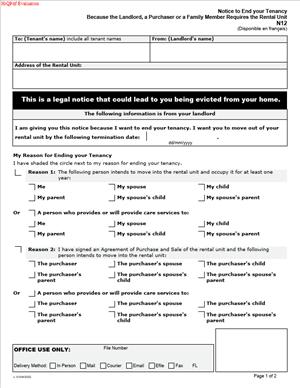
The updated rental rules in Ontario change compensation for some N12 notices. An N12 may be used when the landlord, a listed family member, or a caregiver genuinely needs the unit for residential use. It can also be used in some purchaser-use cases.
For an N12 served on or after September 21, 2026, a landlord who gives at least 120 days’ notice for the landlord’s own use is no longer required to pay the tenant one month’s rent or offer another acceptable unit.
If the notice gives less than 120 days, the existing compensation rule continues to apply. The termination date must still comply with the other rules, including the end of a rental period or fixed term where required.
Purchaser’s own use is different
The 120-day compensation exception does not apply to an N12 served for a purchaser’s own use. Do not assume every N12 follows the same compensation rule.
The reason selected on the form, the person who plans to occupy, the notice date, the termination date, and the tenancy term must all be reviewed together.
Longer notice does not remove the good-faith requirement
The rental rules in Ontario do not allow a landlord to use an N12 as a simple way to end a tenancy merely by giving 120 days. The stated occupant must genuinely intend to live in the unit as required by law.
Tenants do not have to leave only because they received an N12. If the tenant does not move, the landlord must apply to the LTB and prove the case. The LTB decides whether to issue an eviction order.
N12 occupancy must normally begin within 60 days
Another important part of the rental rules in Ontario concerns what happens after a tenant leaves under a landlord’s own-use N12.
The landlord or other named person must normally occupy the rental unit within 60 days after the termination date shown on the N12. If that does not happen, a T5 application creates a presumption that the notice was given in bad faith.
Under the rental rules in Ontario, this presumption is not an automatic final decision. It shifts the starting point. The landlord can present evidence at the T5 hearing to rebut it.
This 60-day presumption does not apply to an N12 served for a purchaser’s use.
Practical records after an N12
Landlords should keep records showing when the named person moved in and began using the unit as a home. Useful evidence may include moving records, utility records, insurance changes, identification updates, and dated correspondence.
Former tenants should keep the N12, proof of their move-out date, rental listings, sale listings, advertisements, messages, and other lawful evidence about later use of the unit.
Do not enter the property, misrepresent yourself, or obtain private information unlawfully. Public listings and records lawfully received may still be useful.
N13 renovation cases now require written updates and return time
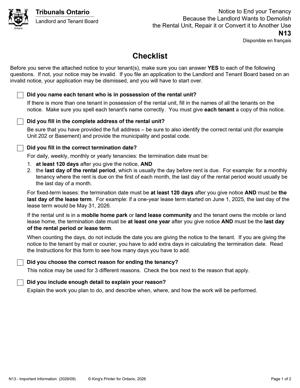
The September changes strengthen the process for a tenant who wants to return after repairs or renovations. These rental rules in Ontario apply where the tenant has a right of first refusal after an N13.
The right of first refusal means the tenant may return to the rental unit after the work is complete. The rent cannot be more than the landlord could have charged if the tenancy had continued without interruption.
The tenant must give the landlord written notice of the intention to return before moving out. Keeping proof of delivery is critical.
Rental rules in Ontario for renovation updates
When a tenant gives the required written notice on or after September 21, 2026, the landlord must provide written information about the renovation schedule. The landlord must:
- give an estimated completion date without delay;
- give a new estimate without delay when that date changes;
- notify the tenant without delay when the unit is ready; and
- give the tenant at least 60 days after the unit is ready to reoccupy it, when the work is completed on or after September 21, 2026.
To follow the rental rules in Ontario, both sides should keep current contact information. A tenant who changes an email or mailing address should notify the landlord in writing. A landlord should preserve each estimate, update, completion notice, and proof of delivery.
A longer T5 deadline may apply
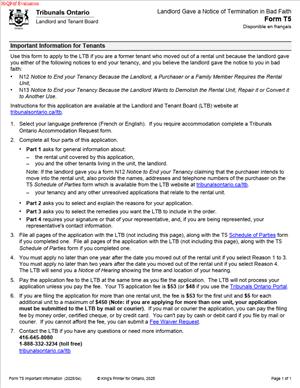
If a landlord fails to provide the required information or the 60-day return period, the law treats that failure as a failure to provide the right of first refusal for the T5 process. The landlord can try to rebut the presumption at the hearing.
The new filing deadline is the later of:
- two years after the former tenant moved out; or
- six months after the repairs or renovations were completed.
“Whichever is later” matters. A long renovation may extend the practical filing window. Former tenants should still act promptly. Evidence becomes harder to find as time passes.
New limits apply to setting aside or delaying eviction orders
The rental rules in Ontario also change some requests for relief from eviction. These rules are procedural and depend on how the order was made.
Setting aside certain orders made without a hearing
The LTB may set aside an eviction order made without a hearing and based on an agreement to end the tenancy or a tenant’s notice only if setting it aside would not be unfair.
When applying that test, the LTB cannot consider changes in the tenant’s circumstances that happened after the agreement was made or after the tenant gave the notice.
These rental rules in Ontario make the circumstances at the time of the agreement or notice especially important. Parties should not sign an agreement to end a tenancy without understanding its effect.
Delaying an eviction order
When a hearing concerns a landlord’s eviction application, the LTB may delay the eviction if the landlord agrees.
If the landlord does not agree, the LTB generally must be satisfied that a delay would not be unfair to the landlord or other tenants in the building and that compelling reasons support the delay.
For N12 and N13 cases, the LTB only needs to be satisfied that the delay would not be unfair to the landlord or other tenants in the residential complex.
Under the rental rules in Ontario, a delay is not automatic. Anyone requesting or opposing one should provide clear evidence about dates, hardship, safety, other occupants, and the effect of delay.

Bill 60 Survival Guide: Dealing with Ontario’s New Eviction Laws
Ten LTB forms were replaced on September 21
Form control is now a central part of the rental rules in Ontario. The LTB replaced these forms:
- N5 — Interfering with Others, Damage or Overcrowding
- N6 — Illegal Acts or Misrepresenting Income in a Rent-Geared-to-Income Unit
- N8 — End of the Term
- N12 — Landlord, Purchaser, or Family Member Requires the Unit
- N13 — Demolition, Repair, or Conversion
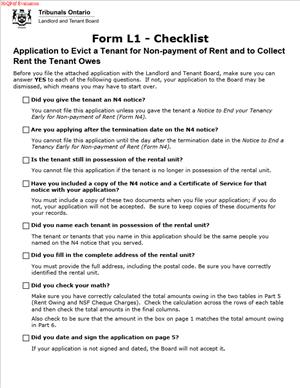
- L1 — Non-payment eviction and rent collection
- L2 — End a tenancy, evict, or collect money
- L9 — Collect rent the tenant owes
- L10 — Collect money a former tenant owes
- T5 — Bad-faith termination
Previous versions will no longer be accepted as of November 30, 2026. The LTB’s wording means users should move to the new forms now instead of waiting for the cutoff.
How to avoid using an outdated form
To follow the rental rules in Ontario, download the form from the current Tribunals Ontario forms page when you are ready to use it. Do not rely on an old file saved to a computer or copied from an earlier case.
Check the form name, revision date, instructions, and required attachments. A form page can help explain the purpose of a document, but the official LTB version and instructions control filing.
RunSensible Forms can help users find and prepare relevant documents. It is not the LTB, a government agency, or a law firm. Users remain responsible for choosing the right form, checking current requirements, and filing correctly.
What tenants should do now?
The new rental rules in Ontario shorten some timelines. A simple document system can reduce risk.
Use this checklist:
- Open and read every notice as soon as it arrives.
- Record the delivery date and method.
- Compare names, addresses, amounts, and dates with your records.
- Keep rent receipts and bank confirmations.
- Respond quickly to an N4 because the notice period is now seven days.
- If you plan to raise other issues at a rent-arrears hearing, review the half-arrears payment and written-description requirements immediately.
- If you receive an N12, identify whether it is for landlord use or purchaser use.
- If you want to return after N13 renovations, give written notice before moving out and keep proof.
- Save every renovation estimate and update.
- Use the current T5 if you believe an N12 or N13 process was handled in bad faith.
- Get legal help early when housing, safety, disability, family needs, or a hearing deadline is involved.
Community legal clinics, Legal Aid Ontario services, licensed paralegals, and lawyers may provide help. Tenant duty counsel may also be available in connection with an LTB hearing.
What landlords and property managers should do now
Landlords should update workflows, templates, and staff instructions to match the rental rules in Ontario now in force.
Use this checklist:
- Remove old copies of the ten replaced forms from shared drives and software templates.
- Use the new N4 and calculate the seven-day period under current service rules.
- Keep a clear rent ledger showing due dates, receipt dates, amounts, and allocation.
- Review N12 cases to distinguish landlord’s own use from purchaser’s own use.
- Do not remove compensation from an N12 unless every part of the 120-day exception applies.
- Track when the named N12 occupant moves in.
- Create an N13 communication log for estimates, changes, completion, and the 60-day return period.
- Preserve proof of delivery for every notice and update.
- Review the revised LTB Rules of Procedure, Practice Direction on Evidence, and interpretation guidelines.
- Ask a lawyer or licensed paralegal to review uncertain cases before service or filing.
The rental rules in Ontario may move some steps faster, but a shorter deadline does not make a weak case stronger. Careful calculations, correct forms, lawful service, and complete evidence remain essential.

Common mistakes under the new rules
The revised rental rules in Ontario create several easy traps.
Treating an N4, N12, or N13 as an eviction order
A notice starts a process. It does not let a landlord physically evict a tenant. The LTB must issue an order, and the sheriff enforces it.
Using the 120-day N12 exception for a purchaser
The no-compensation option described by the LTB applies to a qualifying landlord’s-own-use notice. It does not apply to purchaser’s-own-use notices.
Missing both requirements for a rent-arrears hearing
For covered applications, a tenant who wants to raise another issue must address both the half-arrears payment and the written description due at least seven days before the hearing.
Forgetting written notice before an N13 move
A tenant who wants to return after renovations must preserve that right in writing before leaving. An oral discussion is risky and may not meet the rule.
Assuming three late payments are the only possible pattern
The new definition covers rent received more than seven days late at least three times in six months. The LTB may still find persistent late payment in other circumstances.
Filing an old form near the transition deadline
Old versions stop being accepted on November 30, 2026. Using the current form now avoids a preventable rejection or delay.
Conclusion
The September 21 rental rules in Ontario change both deadlines and evidence requirements. Tenants now have less time to respond to an N4. Some tenants must meet a payment condition before raising other issues at an arrears hearing. Landlords using an N12 may have a 120-day compensation option, but only for qualifying landlord-use cases.
The changes also add clearer timing around occupancy after an N12 and a tenant’s return after N13 renovations. Ten replaced forms and a November 30 transition deadline make current documents essential.
Read every notice, preserve written proof, and check the official LTB page before filing. When the facts or stakes are serious, obtain advice about how the rental rules in Ontario apply to the specific case.
Frequently Asked Questions
When did the new rental rules in Ontario take effect?
The changes covered in this article took effect on September 21, 2026. They are in addition to LTB changes that took effect on July 1, 2026. The date a notice was served, or an application was filed, can decide which rule applies.
Does an Ontario tenant now have only seven days to move after an N4?
No. The N4 gives a seven-day notice period for non-payment notices served on or after September 21, 2026. It is not an eviction order. If the case continues, the landlord generally must apply to the LTB and obtain an order before the sheriff can enforce an eviction.
Does a landlord always avoid N12 compensation by giving 120 days’ notice?
No. The exception applies to qualifying N12 notices for the landlord’s own use. It does not apply to purchaser’s-own-use notices. The notice must also meet the other legal requirements.
What happens if the named person does not move in after an N12?
For a landlord’s-own-use N12, the named person must normally occupy within 60 days after the termination date. If not, a T5 case starts with a presumption of bad faith. The landlord may present evidence to rebut that presumption. The rule does not apply to purchaser-use notices.
How does a tenant protect the right to return after N13 renovations?
The tenant must give the landlord written notice of the intention to return before moving out. Keep proof of delivery and current contact information. The landlord then has duties to provide estimates, changes, a completion notice, and at least 60 days to return when the new rules apply.
How long does a former tenant have to file a T5 after renovations?
The deadline is the later of two dates: two years after the tenant moved out, or six months after the repairs or renovations were completed. Because facts and transition rules can be disputed, a former tenant should not wait unnecessarily.
Can a tenant raise maintenance problems at a rent-arrears hearing?
For a landlord application filed on or after September 21, 2026, the tenant must generally pay the landlord half the claimed arrears at least seven days before the hearing to raise other issues through that process. The tenant must also give the landlord and LTB a written description of those issues at least seven days before the hearing.
Are older LTB forms still accepted?
The LTB says previous versions of the ten forms replaced on September 21 will no longer be accepted as of November 30, 2026. Use the current official form now rather than relying on the transition period.
Resources
- Tribunals Ontario — Legislative Changes at the LTB, Effective September 21, 2026
https://tribunalsontario.ca/2026/09/21/ltb-operational-update-legislative-changes-at-the-landlord-and-tenant-board-effective-september-21-2026/ - Tribunals Ontario — Forms, Filing and Fees
https://tribunalsontario.ca/ltb/forms-filing-and-fees/ - Ontario Residential Tenancies Act, 2006
https://www.ontario.ca/laws/statute/06r17 - Legislative Assembly of Ontario — Bill 60, Fighting Delays, Building Faster Act, 2025
https://www.ola.org/en/legislative-business/bills/parliament-44/session-1/bill-60 - Legislative Assembly of Ontario — Bill 97, Helping Homebuyers, Protecting Tenants Act, 2023
https://www.ola.org/en/legislative-business/bills/parliament-43/session-1/bill-97 - CBC News — Rental rules in Ontario change today. Here’s what tenants and landlords need to know
https://www.cbc.ca/news/canada/toronto/residential-tenancies-act-updates-9.7349885
Disclaimer: The content provided on this blog is for informational purposes only and does not constitute legal, financial, or professional advice.
Contents