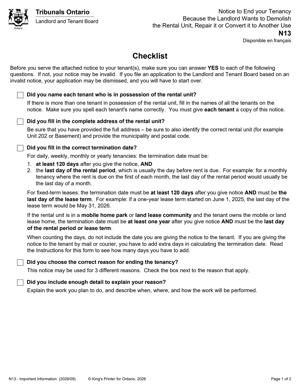
N13 – Notice to End your Tenancy Because the Landlord Wants to Demolish the Rental Unit, Repair it or Convert it to Another Use
Fill out nowJurisdiction: Country: Canada | Province or State: Ontario
The N13 is an Ontario tenancy notice used when a landlord proposes to demolish a rental unit, carry out qualifying repairs or renovations, or convert it to non-residential use.
Whether you are preparing the notice or reviewing one you received, distinguish the proposed project from the legal process for ending a tenancy. The grounds are not interchangeable, and a construction plan does not automatically justify termination.
This form belongs to the Ontario Landlord and Tenant Board (LTB) process. Giving the notice does not itself produce an eviction order or resolve a disagreement about the landlord’s plans.
Before completing it, review the tenancy details, project scope, timing, permits, compensation, and possible return rights. Use the current official form and instructions; this article provides general information, not advice about a particular tenancy.
What is N13 – Notice to End Your Tenancy Because the Landlord Wants to Demolish the Rental Unit, Repair it or Convert it to Another Use?
Clear definition
An N13 is a formal notice stating that a landlord intends to end a residential tenancy for a specified property-related reason. It identifies the rental unit, tenants, proposed termination date, and ground for termination.
The three grounds concern different outcomes:
- Demolition: Removing the rental unit rather than updating its appearance.
- Repairs or renovations: Work requiring a building permit that is sufficiently extensive to require vacant possession.
- Conversion: Changing the premises to a use other than residential accommodation.
Vacant possession means the unit must be empty. For repairs or renovations, the need for an empty unit must relate to the actual work, not simply the landlord’s or contractor’s convenience.
The notice communicates the landlord’s position. It does not independently establish that the work qualifies or that every legal obligation has been met.
Who typically uses this form?
A landlord may use the form when a genuine project falls within one of its grounds. An authorized representative may prepare or sign it, but the representative’s identity and authority remain distinct from the landlord’s.
Property managers may gather tenancy records and project details. Contractors, designers, and municipal staff may supply supporting information, but their involvement does not replace the landlord’s responsibility for the stated reason.
Tenants generally receive and review the notice rather than complete its landlord sections. Their review may focus on the parties, address, proposed work, dates, and applicable protections.
Why might you need this form?
A construction schedule, informal conversation, or building announcement does not serve the same purpose as a formal tenancy notice.
The N13 makes the landlord’s proposed reason and termination date concrete. It also exposes planning gaps: the selected ground may not match the work, the date may conflict with the tenancy, or the explanation may fail to establish why occupancy cannot continue.
For tenants, these details provide a basis for assessing the proposal and responding if the landlord later seeks an eviction order.
Typical real-life scenarios
A landlord plans to remove a small residential building for redevelopment. Demolition may be the relevant ground, while municipal approvals and tenancy obligations remain separate.
Extensive structural repairs require a building permit and an empty apartment during construction. The repair or renovation ground may apply, including compensation and potential return rights.
A residential apartment will become office space. That proposed non-residential use differs from renting the apartment to another tenant.
By contrast, describing kitchen and bathroom upgrades as “major renovations” does not establish that the N13 fits. The scope, permit requirements, and need for vacant possession still matter. In a multi-unit project, those questions must be considered for the affected units rather than assumed building-wide.
When would you use N13 – Notice to End Your Tenancy Because the Landlord Wants to Demolish the Rental Unit, Repair it or Convert it to Another Use?
The N13 is relevant during planning for a qualifying project that affects continued residential occupancy. It is not a general method for recovering possession whenever a landlord wants the property back.
Routine maintenance, painting, or appliance replacement does not automatically justify this notice. For repairs or renovations, noise, dust, inconvenience, and contractor preferences do not independently establish a need to end the tenancy.
For demolition, identify what will happen to the existing rental unit. For conversion, identify its proposed non-residential use. A desire to replace the tenant, increase rent, or stop renting to a particular person is not itself conversion.
Timing must follow tenancy requirements, not merely the construction schedule. The notice generally requires at least 120 days, and the termination date must meet requirements concerning the rental period and any fixed term.
A monthly tenancy does not necessarily follow the calendar month. Rent due on the fifteenth may indicate a different rental cycle from rent due on the first. A termination date generally cannot precede the end of a fixed term.
Delivery also affects timing. The date the landlord signs the form may differ from when it is legally treated as given. Check the current service rules before calculating the termination date.
A genuine project may still have outstanding approvals, but an uncertain concept and a settled intention are different. Plans, approvals, and a realistic schedule can become important in a later proceeding.
Receiving an N13 does not mean the tenant has agreed to leave or that the LTB has accepted the landlord’s explanation. Construction planning, compensation, service, and any application process remain separate steps.
Other tenancy grounds use different processes. Unpaid rent, alleged misconduct, personal occupation, and a sale alone do not describe the project grounds covered by this form.
Legal characteristics of N13 – Notice to End Your Tenancy Because the Landlord Wants to Demolish the Rental Unit, Repair it or Convert it to Another Use
A meaningful notice connects an identifiable tenancy with a recognized ground and an appropriate termination date. Names, address, explanation, selected reason, and signature must work together.
The stated reason must reflect the landlord’s genuine plan. Describing cosmetic improvements as work requiring vacant possession, or selecting demolition while planning to retain and re-rent the unit, can raise substantive concerns.
The explanation should identify the work rather than merely state a conclusion such as “major renovations.” For repairs, distinguish why the work is needed from why the unit must be empty.
Permit requirements and approval status are separate facts. Work may require a permit even though approval is pending. An issued permit does not establish every tenancy requirement, and an N13 does not authorize construction or a change of use.
Dates and service deserve independent review. A short notice period, an unsuitable termination date, or an unrecognized delivery method may create problems even where the project is genuine. Signing proves neither delivery nor receipt.
Compensation may be required. The obligation can depend on the project category, number of residential units, applicable exceptions, and other circumstances. It may involve payment or an acceptable alternative rental unit.
For qualifying repairs or renovations, the anticipated work period and the tenant’s intention to return can affect compensation. Where statutory compensation is required, payment is generally due by the termination date in the notice. Do not defer it indefinitely or assume an unrelated payment satisfies it.
Repair or renovation cases can also involve a tenant’s right to return. The tenant generally needs to give written notice before vacating and comply with related requirements. Demolition and conversion do not create the same return situation.
Returning after qualifying work does not automatically mean accepting any rent the landlord chooses. Rent protections may apply, subject to lawful increases. A proposed new agreement should not be assumed to displace those protections.
Later conduct can also matter. Re-renting without carrying out the stated project may raise good-faith concerns. A genuine later change in circumstances and a misleading original intention are different issues requiring factual assessment.
Ontario’s rules should not be replaced with another province’s notice periods or compensation practices. Municipal requirements may also affect a project without replacing provincial tenancy protections.
The N13 does not resolve unrelated rent, deposit, or maintenance disputes, nor does it release either party from all existing obligations.
Is it legally binding?
An N13 has a formal legal role, but it is not an eviction order. A properly completed and served notice may support a later application; the LTB can still examine the reason, evidence, timing, compensation, and other requirements.
A landlord’s signature records issuance of the notice, not proof that its contents are correct. A tenant’s receipt does not amount to consent, and the tenant’s signature is not ordinarily needed to make it a landlord’s notice.
If the tenant remains and the landlord seeks eviction, a separate process is required. The notice alone does not authorize changing locks, removing belongings, or excluding the tenant.
A negotiated agreement to end a tenancy is different: it records mutual consent rather than the landlord’s asserted grounds.
How to fill out N13 – Notice to End Your Tenancy Because the Landlord Wants to Demolish the Rental Unit, Repair it or Convert it to Another Use
Step 1 – Confirm the document’s purpose
Identify what will physically or functionally change: demolition, qualifying repairs or renovations, or non-residential conversion. If the explanation instead concerns arrears, sale, or personal occupation, review the appropriate process.
Step 2 – Gather the tenancy information
Collect the rental agreement, amendments, tenant names, address, rental cycle, and fixed-term dates. Use current tenancy records rather than relying solely on the construction file.
Step 3 – Enter the tenant names
Identify the tenants rather than using a general label such as “occupants.” A guest or household member is not necessarily a tenant. Resolve spelling differences and documented changes in parties.
Step 4 – Identify the landlord
Enter the landlord’s correct identity. An organization owning the property is distinct from the person managing it. Identify an authorized representative separately where the form provides for that information.
Step 5 – Describe the rental unit precisely
Include the full address and unit designation. Where several tenancies share a street address, the apartment number or other clear description helps prevent confusion about the affected premises.
Step 6 – Match the project to the stated reason
Read each ground carefully. The selected reason must match the proposed work. Adding another reason does not cure uncertainty about what the landlord actually intends.
Step 7 – Explain the proposed work
Describe the project concretely: for example, structural work, major system replacement, or the intended non-residential use. Keep the explanation concise but more informative than “renovations required.”
Step 8 – Clarify why the unit needs to be empty
For repairs or renovations, explain the connection between the work and vacant possession. Extensive removal of essential facilities may be relevant; a contractor’s preference for an empty apartment is not enough by itself.
Step 9 – Distinguish permit requirements from approval status
Use accurate terms: “required,” “applied for,” and “issued” mean different things. Verify any permit details against the actual records and avoid presenting pending approval as complete.
Step 10 – Establish the relevant tenancy dates
Identify the rental period and fixed-term end date before choosing termination. Do not assume monthly rent means a calendar-month tenancy or that a construction start date can control the tenancy timeline.
Step 11 – Review the notice-period calculation
Check the usual 120-day minimum, rental-period requirements, fixed term, and service method. The signing date may not be the date from which the notice period is calculated.
Step 12 – Enter the termination date clearly
Follow the date format printed on the form. Distinguish the termination date from estimated construction milestones, hearing dates, or any later enforcement process.
Step 13 – Account for compensation separately
Review unit count, project type, exceptions, and any acceptable alternative accommodation. Keep records of the amount, purpose, payment date, and method. Payment alone does not establish that the notice is valid.
Step 14 – Recognize any return-related information
For qualifying repairs or renovations, preserve written return requests, forwarding details, and later communications. Do not use the project explanation to assume the tenant has waived return rights.
Step 15 – Complete the signature section
Complete the applicable name, capacity, contact, signature, and date fields. The signer should have authority to act. Keep the signature date distinct from the date of service.
Step 16 – Review the document as a whole
Check that the address, selected reason, explanation, and dates tell a consistent story. Identify continuation pages clearly and review for missing fields, contradictions, unreadable text, or unexplained corrections.
Step 17 – Keep completion, delivery, and filing distinct
Preserve the completed notice and actual delivery details. A later application is a separate submission with its own requirements. Completing or serving the notice does not establish that eviction is authorized.
Legal terms you might encounter in N13 – Notice to End Your Tenancy Because the Landlord Wants to Demolish the Rental Unit, Repair it or Convert it to Another Use
- Termination date: The proposed date for ending the tenancy. It differs from signing, delivery, construction, hearing, and enforcement dates.
- Service: Delivery through a legally recognized method. The method and timing can affect both the notice calculation and proof of delivery.
- Vacant possession: Possession without the tenant continuing to occupy the unit. For repairs, the actual work must justify the need for an empty unit.
- Non-residential use: A function other than residential accommodation. Changing tenants or ownership is not, by itself, non-residential conversion.
- Building permit: Approval for specified construction work. A requirement for a permit, a pending application, and an issued permit are distinct.
- Compensation: A required payment or qualifying alternative arrangement in covered circumstances. Keep it separate from deposits, rent refunds, moving expenses, and negotiated settlements.
- Right of first refusal: In qualifying repair or renovation cases, the tenant’s opportunity to return after completion, subject to applicable requirements. Written notice and updated contact information matter.
- Good faith: Genuine intention to carry out the stated reason. Project records and later conduct can matter beyond the completed form.
- Eviction order: A formal decision authorizing eviction through the legal process. An N13 is not that order.
- Certificate of service: A record of actual delivery details, including the document, date, method, and person who delivered it. It should describe events, not merely the original delivery plan.
FAQs
Which name should you enter if the lease, rent receipts, and ownership records do not match?
Identify what each record establishes. The lease may name an earlier landlord, while later documents show an ownership transfer. A rent receipt may identify a manager collecting payments rather than the landlord.
For tenants, compare the agreement with later documented changes. Do not replace a tenant’s name merely because another household member pays the rent. Resolve discrepancies using supporting records.
Is the date you sign this form its effective date?
There is no single interchangeable date. The signature date records signing, the termination date states the proposed tenancy end, and service has its own timing.
If delivery occurs later than planned, reassess the notice calculation. Tenants should record when and how the notice arrived and retain the envelope or accompanying message without altering the original document.
Who can sign this document if a property manager is handling the tenancy?
Check the capacities recognized by the current form and confirm the manager’s authority. Collecting rent or arranging maintenance does not necessarily establish authority to issue a termination notice.
The signer should use their own name and identify their role accurately. Preserve the management agreement or other authorization. Authority to sign and entitlement to represent someone in an LTB proceeding are separate questions.
Can you attach another page if the explanation of the work does not fit?
Follow the form’s instructions for continuing an answer. Identify the unit and the field being continued, and include the attachment with every complete copy delivered.
The continuation should explain the selected ground, not introduce a conflicting reason. Plans, estimates, and photographs may support a case, but they do not replace a clear explanation. Avoid unnecessary personal information.
What should you record if permit approval is still pending?
Describe the actual status when completing the notice. Verify application numbers and dates against official records. A preliminary discussion, contractor estimate, or application receipt is not an issued permit.
Required approvals can matter at different stages of the process. Preserve later updates separately; do not revise an already delivered copy to imply approval existed earlier.
Where do you record compensation and a tenant’s interest in returning?
Keep separate records. For compensation, record the amount or arrangement, date, recipient, purpose, and transaction evidence.
For returning after qualifying work, preserve the tenant’s written notice, delivery evidence, forwarding address, and contact updates. Reading the form’s information does not itself record payment or exercise a return right. A verbal conversation should not be treated as a substitute for required written notice.
Does completing this form mean it has been filed and accepted?
No. Completion, delivery, and an application are different events. A landlord seeking eviction must use the separate application process.
For any filing, save confirmation of the case, submission date, and documents received. A fee receipt or administrative acceptance does not establish that the notice is valid or that eviction is justified. Read correction requests and hearing information carefully.
Does this document change the public record or prove that you must leave?
The notice does not transfer ownership, amend the property register, or create an eviction order. It communicates the landlord’s proposed reason and date.
If it later enters a proceeding, access to case records depends on applicable access and privacy rules. Do not assume every attachment remains private or becomes publicly searchable. Include necessary identifying information without adding unrelated financial or personal details.
Checklist: Before, During, and After N13 – Notice to End your Tenancy Because the Landlord Wants to Demolish the Rental Unit, Repair it or Convert it to Another Use
Before
- Obtain the current official form and instructions.
- Assemble the agreement, amendments, and current party information.
- Confirm the rental cycle, fixed term, and exact unit description.
- Prepare a project summary separating confirmed plans from tentative ideas.
- Organize permit inquiries, applications, and approvals by status.
- Confirm signing authority and plan delivery.
- Review compensation and potential return rights.
- Assign responsibility for preserving records and tracking deadlines.
During
- Use consistent names and identify the affected unit precisely.
- Match the selected ground to the project explanation.
- Explain why qualifying repair work requires vacant possession.
- Describe permit status accurately.
- Verify timing against the tenancy and intended service method.
- Include clearly identified continuation pages.
- Complete signature and contact fields without backdating.
- Inspect the final copy for missing pages, clipped text, and blanks.
After
- Preserve the exact signed version delivered.
- Record actual service details and retain supporting evidence.
- Track compensation separately from rent accounting.
- Preserve return notices and updated contact information.
- Save any application confirmation and case identifier.
- Monitor correspondence for deadlines and correction requests.
- Keep original records unchanged while updating internal calendars.
- Retain significant project changes and evidence of the eventual outcome.
Common mistakes to avoid with N13 – Notice to End your Tenancy Because the Landlord Wants to Demolish the Rental Unit, Repair it or Convert it to Another Use
- Using one generic renovation explanation for every unit. A building-wide project does not establish why each affected unit must be empty. Connect the explanation to the identified tenancy.
- Treating planned delivery as actual service. Delays or unsuccessful attempts may affect the available termination date. Record what happened and reassess timing where necessary.
- Presenting an application as an issued permit. Verify the approval status and the work covered rather than relying on informal assurances.
- Replacing the landlord’s identity with the manager’s name. Keep the landlord, representative, and signer’s authority distinct.
- Assuming the form settles compensation and return rights. These matters require their own assessment, records, and communications.
- Overwriting a delivered notice with a corrected version. Preserve the historical copy and determine whether a correction requires a fresh procedural step.
- Reading a filing receipt as legal approval. Receipt, administrative processing, and a decision on the merits are different stages.
- Treating termination as permission for self-help eviction. The notice does not authorize lock changes or removal of belongings. An order and lawful enforcement involve separate requirements.
What to do after filling out N13 – Notice to End Your Tenancy Because the Landlord Wants to Demolish the Rental Unit, Repair it or Convert it to Another Use
After drafting, focus on accurate delivery, recordkeeping, and outstanding obligations. Label documents by actual status: “draft,” “signed,” “delivered,” or “included in application.” Intended steps are not completed events.
Step 1: Freeze the completed version.
Save a read-only copy of the signed notice and all continuation pages. Keep editable drafts separately. Check that paper and electronic versions match, and use clear filenames to prevent delivery of the wrong version.
Step 2: Prepare complete copies for the people involved.
Include every continuation page in delivery copies. Give representatives the preserved version rather than a draft.
Tenants should copy all received pages, retain accompanying materials, and note missing pages for clarification rather than assuming their contents.
Step 3: Confirm the delivery arrangements.
Check the current service instructions. A method routinely used for maintenance messages is not necessarily suitable for a formal notice.
Record the actual date, method, document, and person responsible. Preserve factual evidence instead of relying on an unsupported notation that service was “proper.”
Step 4: Create a dated correspondence log.
Track questions, responses, project updates, and arrangements. Record participants, dates, and where original messages are stored.
For significant telephone discussions, make prompt notes distinguishing agreements from proposals or disputed statements. Keep original communications rather than relying exclusively on summaries.
Step 5: Separate the notice from any application process.
If seeking eviction, review the relevant application requirements, supporting documents, deadlines, submission method, and fee. The notice is not a substitute for that application.
Tenants should compare any later application with the notice received, including the parties, address, grounds, and attachments.
Step 6: Verify submission and administrative status.
Save filing confirmations and check which documents were received. A transaction receipt may not establish that an upload was complete.
Respond to correction requests and use accurate status descriptions. Do not mark a matter “approved” simply because it has a case number.
Step 7: Maintain separate financial and return-related records.
Identify compensation by purpose, amount, date, recipient, and payment evidence. Avoid combining it into an unexplained balance with rent or deposits.
Keep written return communications accessible throughout construction, including contact updates. Ensure records remain available if staff or management changes.
Step 8: Preserve changes in the project.
Retain revised plans, approval updates, scheduling changes, and cancellations. Record when changes became known without altering the original notice.
A material change may affect pending communications or procedural steps. Seek case-specific guidance rather than continuing with an outdated project description.
Step 9: Update internal documents without treating proposals as completed events.
Keep proposed termination, actual move-out, and ordered possession dates separate. This reduces the risk of a calendar entry triggering premature action.
Limit access to necessary information. Contractors may need schedules and access arrangements, not the tenant’s financial records or complete legal file.
Step 10: Close the file only after recording the outcome.
Document continued occupancy, any agreement, move-out, decision, completed work, or other outcome. The passing of the termination date does not prove the matter ended.
Keep unresolved compensation or return issues active. The final record should distinguish planned dates, disputed facts, and events that actually occurred.
Disclaimer: This guide is provided for informational purposes only and is not intended as legal advice. You should consult a legal professional.