The Oregon Eviction Process for Landlords starts with the right notice, follows strict service rules, and ends in court if the tenant does not move or cure the issue. Oregon law uses different notice periods for nonpayment, lease violations, and no-cause terminations, so the first step is choosing the correct legal path.
What Oregon law covers
Oregon’s landlord-tenant laws are mostly in ORS Chapter 90. For eviction, the most used statutes are ORS 90.392 for lease violations, ORS 90.394 for nonpayment of rent, and ORS 90.427 for no-cause terminations. After the notice period ends, the landlord uses the court eviction process called a forcible entry and detainer, or FED.
For a blog aimed at both lawyers and general readers, the key point is simple: the notice must match the reason for termination. A landlord who uses the wrong notice length, wrong cure language, or wrong service method can lose time and sometimes the case.
Step 1: Pick the right notice
The notice type depends on why the landlord wants possession. For unpaid rent, Oregon law now gives week-to-week tenants at least 72 hours’ written notice, and all other tenancies at least 10 days’ written notice, with an alternate 13-day option for certain cases. The notice must state the amount due and the date and time to pay.
For lease violations, ORS 90.392 generally requires a notice that gives at least 30 days before termination, and most curable violations must give at least 14 days to fix the problem. A repeat violation in the prior six months can support a non-curable 10-day termination notice in some cases.

For no-cause termination, Oregon generally limits landlords after the first 12 months of occupancy. ORS 90.427 allows no-cause termination in the first year, but after that, a landlord needs a qualifying statutory reason and must follow the longer notice rules and, in some cases, relocation payment requirements.
Common notice types
Step 2: Serve the notice correctly
Service matters as much as the words in the notice. Oregon law on notice delivery is in ORS 90.155, and a landlord must use an approved method such as personal delivery, first-class mail, or attachment plus mail when the statute allows it. A notice can fail if the landlord cannot prove service.
The landlord should keep a clean paper trail. Good practice includes a dated copy of the notice, a service log, photos when posting is allowed, and proof of mailing when mail is used. Courts often care about proof, not just intent.
For nonpayment notices, the rental agreement and the statute can affect when payment is timely and where payment must be made. ORS 90.394 also says the notice must specify the rent amount and the deadline to cure.
Step 3: Wait out the notice period
If the tenant pays, cures, or leaves within the notice window, the eviction may stop. If the tenant does nothing, the landlord can move to court after the deadline expires. The landlord should not self-help, lock out the tenant, or shut off utilities. Those actions can create liability.
For nonpayment, the timing starts from the notice date and service method. Oregon law allows a landlord to use shorter or longer nonpayment notices depending on the tenancy type, so the exact calculation matters. The wrong deadline is a common filing error.
For curable lease violations, the tenant may avoid termination by fixing the problem by the cure date. If the landlord claims a repeat violation, the notice must fit the “prior violation within six months” rule in ORS 90.392.
Step 4: File the FED case
If the tenant does not comply, the landlord files a FED action in circuit court. Oregon’s court-issued landlord instructions explain that FED is the legal process used to recover possession after proper notice and expiration of the cure period.
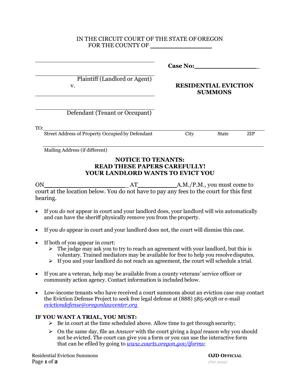
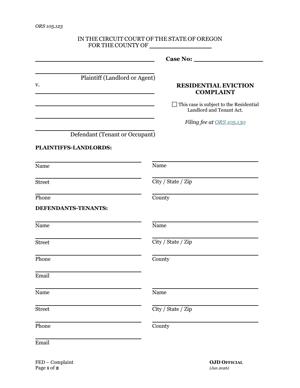
The filing packet usually includes the complaint, summons, copies of the notice, and proof of service. The landlord should also attach the lease, rent ledger, and any documents showing the default or violation. Missing paperwork slows the case and can create dismissal risk.
The FED process moves faster than many civil cases. Once filed, the court sets an early hearing date, and the tenant can contest the case. If the tenant appears and disputes the claims, the case may continue to trial.

A Landlord’s Guide to Legal Tenant Eviction in Canada: 5 Essential Steps
Step 5: Get judgment and writ
If the landlord wins, the court enters judgment for possession and, when allowed, money damages. The landlord then asks for a writ of execution or restitution under the FED process so the sheriff can remove the tenant if needed. Oregon eviction law does not let the landlord do this alone.
If the tenant does not contest, the landlord may still need to prove service, the notice, and the right to terminate. In practice, a strong file is what turns a notice into possession.
If the landlord wants money damages, the case must support them with records. A clean rent ledger and clear notice dates matter because courts look at exact numbers and dates.
Main timelines
Most Oregon eviction problems come from missed deadlines. A rent default case can move quickly, while a no-cause case may take much longer because of statutory notice rules and local ordinance overlays.
Typical path by issue
City rules and local risk
State law is only part of the picture. Portland, Milwaukie, Eugene, and some other cities have added rules for no-cause terminations and relocation assistance. A landlord must check both state law and local law before serving the notice.
Multnomah County practice also reflects strong tenant-protection rules, so landlords in the Portland area should not rely on a generic statewide form without checking the city overlay. Local rules can change the notice length or payment obligations.
For a law firm workflow, this means intake should include the property city, the tenancy start date, and whether the case is nonpayment, violation, or no-cause. Those three facts usually determine the notice path.
Common mistakes
The most common mistake is using the wrong notice for the reason. Another is serving the notice too early, too late, or by the wrong method. A third is forgetting that local city rules may add relocation or timing duties.
A separate mistake is using outdated forms. Some older Oregon nonpayment forms still circulate online, but the landlord should match the current statute, not an old template. The statute controls, not the form title.
Another recurring issue is weak proof. If a landlord cannot show the notice, the service method, and the expiration date, the case can stall even when the underlying breach is real.
Practical checklist
Use this short checklist before filing:
-
Confirm the tenancy type and property location.
-
Pick the correct notice statute.
-
Put the exact rent amount or violation description in writing.
-
Serve the notice using an allowed method.
-
Calendar the cure or termination deadline.
-
Keep proof of service and a full rent ledger.
-
Check city rules for relocation assistance or longer notice.
-
File FED only after the notice period ends.

FAQ
1. What is the Oregon Eviction Process for Landlords in one sentence?
It is a notice-and-court process that starts with the correct written notice, then moves to a FED filing if the tenant does not comply.
2. How much notice do I need for unpaid rent?
For week-to-week tenancies, Oregon law gives at least 72 hours. For other tenancies, the statute gives at least 10 days, with an alternate 13-day option in some cases.
3. Can I evict for a lease violation?
Yes, if the violation fits ORS 90.392 and the notice is written correctly. Many curable violations require at least 14 days to fix the problem.
4. Can I end a month-to-month tenancy without cause?
Sometimes, but Oregon limits no-cause terminations after the first 12 months of occupancy and may require a qualifying statutory reason, longer notice, or relocation payment.
5. Can I just change the locks after giving notice?
No. Oregon requires the court FED process if the tenant does not leave voluntarily. Self-help eviction can create legal liability.
6. Do local city rules matter?
Yes. Portland, Milwaukie, Eugene, and other cities can add notice and relocation rules on top of state law.
7. What should go in the landlord’s file?
Keep the lease, notice, proof of service, rent ledger, photos if relevant, and a deadline calendar. Those records usually decide whether the case is clean and fast.
Resources
-
Residential Eviction Information for Landlords — www.courts.oregon.gov/forms/Documents/FED-Inst-LL.pdf
-
ORS 90.394 – Termination of tenancy for failure to pay rent — oregon.public.law/statutes/ors_90.394
-
ORS 90.392 – Termination of tenancy for cause — oregon.public.law/statutes/ors_90.392
-
ORS 90.427 – Termination of tenancy without tenant cause — oregon.public.law/statutes/ors_90.427
-
Residential Eviction : Self Help – Oregon Judicial Department — www.courts.oregon.gov/courts/coos/help/pages/residential-eviction.aspx
-
No Cause Notices – Oregon Law Help — oregonlawhelp.org/topics/housing/rental-housing/evictions-termination-notices-and-landlord-lockouts/termination-notices/
-
Housing Legal Resources – Multnomah County — multco.us/info/housing-legal-resources
-
Before You Ask a Tenant to Leave: What ORS 90.427(5) Actually Permits — oregonrealtors.org/news/tip-of-the-week/before-you-ask-a-tenant-to-leave-what-ors-90-4275-actually-permits/
Disclaimer: The content provided on this blog is for informational purposes only and does not constitute legal, financial, or professional advice.
Contents