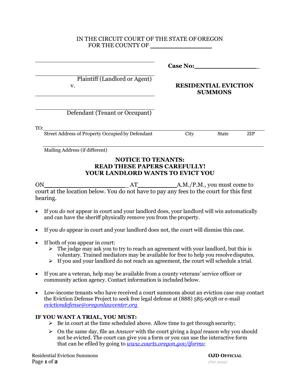
Residential Eviction Summons
Fill out nowJurisdiction: Country: United States | Province or State: Oregon
A Residential Eviction Summons is a court document that officially notifies a tenant that an eviction case has been filed against them. It comes from the Circuit Court of the State of Oregon and sets out key deadlines and court information. If you receive or prepare this document, timing and accuracy matter.
This form is not the eviction itself. It is the formal notice that a lawsuit has started. It tells the tenant when and where to respond. It also explains what can happen if no response is filed.
If you are a landlord, you may encounter this document when starting a residential eviction case. If you are a tenant, you may receive it after a landlord files a complaint with the court. In both situations, the document marks the beginning of the court process.
Understanding this form helps you track deadlines and avoid procedural mistakes. It sets the framework for what happens next in the case.
What is a Residential Eviction Summons?
Clear definition
A Residential Eviction Summons is a court-issued notice that informs a tenant that a landlord has filed an eviction case. It includes the names of the parties, the court where the case is filed, and the deadline to appear or respond. The document is part of the formal court filing.
The summons works together with a complaint. The complaint explains the reasons for the eviction. The summons focuses on notifying the tenant and setting the response process.
This document signals that the dispute has moved from a private disagreement into a court proceeding. From this point forward, court rules apply to both sides.
Who typically uses this form?
Landlords use this form when starting a residential eviction case in the Circuit Court. It is prepared as part of the initial filing package. The court then issues the summons as an official notice.
Tenants receive this document after it has been served on them. Service may occur through personal delivery or another legally recognized method. Once served, the tenant is formally part of the case.
Property managers may also be involved in preparing the filing on behalf of a property owner. In all cases, the named landlord is the party bringing the action, and the named tenant is the party responding.
Why might you need this form?
A landlord may need this form when seeking to recover possession of a rental unit. Common reasons include nonpayment of rent, alleged lease violations, or the end of a tenancy.
The summons is required to move the matter into court. Without proper service of this document, the case may not proceed.
For a tenant, this form becomes relevant when defending against an eviction. The deadlines and court information listed in the summons determine how quickly you must act to participate in the case.
Typical real-life scenarios
- A landlord claims that rent has not been paid for one or more months. After providing any required notices, the landlord files an eviction case with the court. The Residential Eviction Summons is issued and served on the tenant to notify them of the filing.
- A tenant is accused of violating a term of the rental agreement, such as keeping an unauthorized pet. The landlord files a complaint asking the court to order the tenant to move out. The summons tells the tenant when to appear to respond to the allegations.
- A fixed-term lease has ended, and the landlord believes the tenant no longer has the right to stay. The landlord files for eviction. The summons informs the tenant that a court date has been set.
- A tenant believes the eviction is improper, perhaps because rent was paid or repairs were not made. The summons provides the date and location where the tenant can present their side of the dispute in court.
When would you use a Residential Eviction Summons?
You would use a Residential Eviction Summons at the start of a formal eviction case in Oregon’s Circuit Court. It is used after the landlord decides to pursue eviction through the court system rather than resolving the issue privately.
This form comes into play once the complaint is filed. The court issues the summons to ensure the tenant receives official notice of the lawsuit. The landlord cannot rely on informal communication alone when seeking a court order for possession.
In many residential eviction cases, the timeline is shorter than in other civil matters. The summons reflects that by setting a prompt first appearance date or response deadline. Both parties rely on this document to understand the schedule.
Property owners, tenants, and sometimes authorized agents interact with this document during filing, service, and court preparation. It is central to the early stage of the eviction process.
Legal characteristics of Residential Eviction Summons
A Residential Eviction Summons has legal force because it is issued under the authority of the Circuit Court. It must include specific information, such as the court name, case number, and names of the parties. Missing or incorrect information can delay the case.
For the summons to be effective, it must be properly served. Service means delivering the document to the tenant in a legally recognized way. If service does not meet court requirements, the case may be postponed or dismissed.
Accuracy matters. Errors in the tenant’s name, address, or court details can create confusion. In some situations, these mistakes may require correction and re-service.
Eviction procedures often follow specific timelines. The summons reflects those timelines by setting a clear appearance or response date. Courts typically enforce these deadlines strictly.
This document does not itself remove a tenant from the property. It does not grant possession to the landlord. It simply initiates the court phase of the dispute.
Is it legally binding?
Yes, in the sense that it creates formal obligations within a court case. Once properly issued and served, the Residential Eviction Summons requires the tenant to respond or appear by the stated deadline. Ignoring it can lead to further court action.
Its binding nature comes from the court’s authority. Because it is part of an official filing, both parties are expected to follow the procedures outlined.
However, the summons alone does not decide the outcome. It does not prove that the landlord’s claims are correct. The court must review the case and, if necessary, hold a hearing before making a final decision.
How to fill out the Residential Eviction Summons
Step 1 – Identify the Court
At the top of the form, enter the full name of the court where the case is filed, which is the Circuit Court of the State of Oregon. Include the correct county. Make sure the court location matches where the rental property is located or where the case is properly filed.
Step 2 – Enter the Case Caption
Fill in the names of the parties exactly as they appear in the complaint. List the landlord as the plaintiff and the tenant as the defendant. Use full legal names to reduce confusion later in the process.
Step 3 – Add the Case Number
Insert the case number assigned by the court clerk. This number links the summons to the specific eviction case. Double-check that it matches the number on the complaint and other filing documents.
Step 4 – Provide Tenant Information
Enter the tenant’s address, including the rental property address if required. Accuracy is important because this information connects the document to the correct person and location. Mistakes here can affect service and scheduling.
Step 5 – Review the Appearance or Response Details
Carefully complete the section that states when and where the tenant must appear or respond. Confirm the date, time, and courtroom information. This section sets the timeline for the next stage of the case.
Step 6 – Confirm Court Clerk Issuance
Ensure the summons is properly issued by the court clerk. In many cases, the clerk signs, stamps, or otherwise validates the document. A summons that is not officially issued may not be effective.
Step 7 – Prepare for Service
After issuance, arrange for the summons and complaint to be served according to court rules. Record the method and date of service as required. Keep copies of all documents for your records as the case moves forward.
Legal terms you might encounter in Residential Eviction Summons
- Plaintiff: This is the party that started the eviction case. In most residential eviction matters, the plaintiff is the landlord or property manager. In this document, the plaintiff’s name appears in the case caption at the top. You must ensure the name matches exactly what was listed in the complaint.
- Defendant: This is the tenant being sued for possession of the rental property. Your full legal name must be listed exactly as it appears on the complaint and court records. If more than one tenant is named on the lease, each may be listed as a separate defendant.
- Case Caption: The case caption is the heading at the top of the document. It includes the court name, the parties’ names, and sometimes the case number. The caption must match the complaint exactly. Even small spelling differences can cause confusion in the court file.
- Case Number: This is the unique number assigned by the court when the eviction complaint is filed. It connects the summons, complaint, and all other documents in the case. Once assigned, you must include this number on every document filed with the court.
- Return Date or First Appearance Date: This is the date listed in the summons when the tenant must appear in court or respond. It is critical. Missing this date can lead to a default judgment. The date is printed clearly on the summons and controls the timeline for the case.
- Default Judgment: A default judgment happens when the defendant does not appear or respond by the required deadline. If this occurs, the court may grant possession to the landlord without hearing the tenant’s side. The summons warns about this risk directly.
- Service of Process: This refers to the official delivery of the summons and complaint to the defendant. Service must follow specific rules. The court needs proof that the tenant received the documents before it can proceed.
- Proof of Service: This is a written statement confirming how and when the defendant was served. It may be filed separately from the summons. Without proof of service, the court cannot move forward.
- Possession: In eviction cases, possession refers to the legal right to occupy the rental property. The summons informs the tenant that the landlord is seeking possession through the court process.
- Clerk of Court: The clerk is the court official who issues the summons and manages filings. The clerk’s name or signature may appear on the document. The summons is not valid unless properly issued by the clerk.
FAQs
What happens if my name is misspelled on this form?
Check whether the spelling matches the complaint and court record. Minor spelling errors may still identify you correctly, but significant mistakes can cause confusion about who is being sued. If you notice an error, bring it to the court’s attention promptly. The court file should clearly show your correct legal name.
Do I need to file anything before the first appearance date listed?
Look closely at the instructions printed on this document. Some eviction cases require only that you appear in court on the date provided. Others may allow or require a written response. The key is to read the deadline section carefully and confirm what action is expected before that date.
What if I never received the complaint but only saw the summons?
The summons should be served together with the complaint. The complaint explains why the eviction was filed. If you only received part of the paperwork, review the proof of service filed with the court. You can also check the court file to confirm what documents were officially served.
Can I ignore the Residential Eviction Summons if I plan to move out anyway?
No. Even if you plan to leave, the case may still move forward. If you do not appear or respond, the court can enter a default judgment. That judgment becomes part of the court record and may affect your rental history. Review the deadlines and decide how you want the case to be resolved before ignoring any required step.
How do I know if this document was properly issued by the court?
Look for signs that it was issued by the clerk. This may include a signature, stamp, seal, or printed clerk information. The court name should be clearly displayed at the top. If those elements are missing, verify with the court clerk whether the document in your file is officially issued.
What does the appearance date actually require me to do?
The appearance date tells you when to show up in court or otherwise respond. Read the instructions section to confirm whether you must attend in person, appear remotely, or file paperwork. Mark the exact date and time. Being late or absent can lead to a default.
Is the information in this document part of the public record?
Yes. Once filed and issued, the case and this document become part of the court record. That means the parties’ names, the property address, and the case status may be accessible through court records. Confirm that your contact details and identifying information are accurate before the process moves forward.
Can the dates or details on the Residential Eviction Summons be changed after it is issued?
Changes generally require formal correction through the court. If a date is incorrect or the service was defective, the court may require a new summons. Do not alter the document yourself. Any corrections should be reflected in the court record and reissued if necessary.
Checklist: Before, During, and After Residential Eviction Summons
Before
- Confirm the correct court name is listed at the top of the document.
- Verify that the plaintiff and defendant names match the complaint exactly.
- Check that the property address is accurate and complete.
- Make sure a case number has been assigned or space is provided for it.
- Review the appearance date and time carefully.
- Confirm the clerk’s signature, stamp, or issuance details are present.
- Read the instructions about what the defendant must do next.
- Ensure the summons is attached to the complaint before service.
During
- Serve the summons and complaint together according to court rules.
- Use an approved method of service as required by procedure.
- Record the exact date, time, and method of service.
- Provide copies to each named defendant if more than one is listed.
- Complete the proof of service form accurately and fully.
- Double-check that all pages served are complete and legible.
- File the proof of service with the court promptly.
- Keep a stamped copy for your records.
After
- Confirm the court has recorded the proof of service in the case file.
- Track the deadline for the defendant’s appearance or response.
- Prepare any documents needed for the first court date.
- Organize copies of the lease, notices, and payment records.
- Monitor the case status through the court system.
- Update your internal records to reflect the active court case.
- Attend the scheduled court appearance on time.
- Bring copies of all filed documents to court.
Common mistakes to avoid with Residential Eviction Summons
- Mistake: Listing the wrong tenant name because you copied it from memory instead of the lease, which can cause confusion about who is being sued and delay the case; do not forget to match the name exactly to the signed rental agreement and complaint.
- Mistake: Forgetting to include the correct case number after it is assigned, which leads to filing errors and misfiled documents; do not forget to write the full case number on every page you submit.
- Mistake: Serving the summons without attaching the complaint, often due to rushing the process, which can invalidate service; do not forget that both documents must be delivered together.
- Mistake: Missing the appearance date because you misread the time or format, which can result in default judgment; do not forget to calendar the exact date and time immediately.
- Mistake: Failing to file proof of service with the court, which stops the case from moving forward; do not forget to submit the completed proof promptly after service.
- Mistake: Altering the issued document by handwriting corrections, which may make it appear unofficial or invalid; do not forget that any correction should go through proper court procedures.
- Mistake: Assuming moving out automatically ends the case, which can still result in a judgment on record; do not forget to address the court date even if possession is no longer disputed.
- Mistake: Ignoring small errors in the property address, which can raise service or identification issues; do not forget to confirm the address matches the rental agreement and complaint exactly.
What to do after filling out Residential Eviction Summons
Once the summons is properly completed and issued, your focus shifts to process and documentation. Accuracy and timing now matter more than ever.
- Step 1: Make at least two complete copies of the issued summons and the attached complaint.
- Step 2: Confirm the case number appears clearly on every page of every copy.
- Step 3: Arrange for proper service using an approved method that meets court requirements.
- Step 4: Ensure each named defendant receives a full set of documents.
- Step 5: Complete the proof of service immediately after service is made.
- Step 6: File the proof of service with the court and obtain confirmation that it was accepted.
- Step 7: Calendar the appearance or response deadline listed in the summons.
- Step 8: Prepare your supporting documents, such as the lease, payment ledger, and any required notices.
- Step 9: Organize a case file with copies of everything submitted or received.
- Step 10: Monitor the court docket to confirm whether the defendant filed a response.
Keep your records in one secure place. Store both digital and paper copies if possible. If the court schedules mediation or a hearing, review the summons again so you understand what relief was requested and what deadlines apply.
If you are the defendant, use the time before the appearance date to review the complaint carefully. Gather receipts, written communications, and your lease agreement. Decide whether you will appear, file a written response if allowed, or seek additional information from the court clerk.
If you are the plaintiff, be prepared to prove proper service and the basis for eviction. The summons sets the process in motion, but your preparation determines how smoothly the case proceeds.
Above all, treat the deadlines as firm. Court timelines in eviction cases move quickly. Staying organized and proactive helps you avoid unnecessary delays or unfavorable outcomes.
Disclaimer: This guide is provided for informational purposes only and is not intended as legal advice. You should consult a legal professional.