
When people search for new Colorado eviction laws, they usually want to know three things: why an eviction can happen, how long it takes, and what both sides must do next. In 2026, the biggest change is not a brand-new court form. It is the newer for-cause eviction system that Colorado put in place in 2024 and that courts and legal-aid programs were still explaining in 2025. Under that system, many residential landlords cannot simply end a tenancy because they want to. They must have a legal reason, called cause.
Colorado also now has stricter rules on notices, domestic violence protections, and mandatory mediation in some cases. Court materials from 2025 explain that tenants have important rights during the process, including the right to file an answer, raise defenses, and, in some cases, ask for mediation before a case moves forward. The process still moves fast, so both landlords and tenants need to understand the steps before a court date arrives.
What changed in Colorado’s eviction law
The biggest statewide change came from House Bill 24-1098, which became law on April 19, 2024. The Colorado General Assembly says the law generally prohibits a landlord from evicting a residential tenant unless the landlord has cause. It also says cause can include older “traditional” reasons like nonpayment of rent or lease violations, plus certain “no-fault” reasons such as demolition, major repairs, the landlord or a family member moving in, taking the unit off the market to sell it, refusal to sign a reasonable new lease, or a history of nonpayment of rent.
That does not mean every renter in Colorado gets the same protection. The 2025 Colorado Judicial handout says the for-cause law does not apply to some short-term rentals, some owner-occupied properties, some employer-provided housing, some lease-to-own mobile home situations, some new tenants under 12 months, and some “unknown tenants.” That means the first question in any Colorado eviction case is not just “What did the tenant do?” It is also “Does the for-cause law apply to this housing?”
The main legal reasons a landlord can evict
Colorado’s court handout breaks the reasons into two groups: traditional causes and no-fault causes.
Traditional causes include:
- nonpayment of rent,
- material violation of the lease,
- substantial violation of the lease,
- repeat violation after prior notice,
- possession after certain sales or probate events,
- nuisance or disturbance.

No-fault causes include:
- demolition or conversion of the home,
- major repairs or renovations lasting 30 or more days,
- the landlord or a family member moving in,
- selling the property,
- refusal to sign a reasonable new lease,
- a tenant’s history of nonpayment of rent.
This matters because the notice, the chance to fix the problem, and the defenses available can change depending on the reason the landlord uses.
Notice rules: the first step that often decides the case
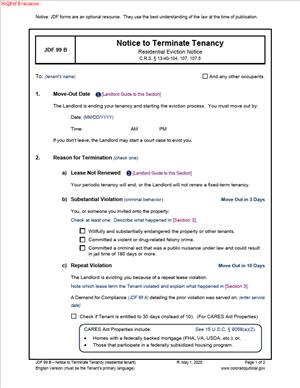
Most Colorado evictions start with a written notice. The notice tells the tenant what the problem is and how long they have to fix it or move out.
For nonpayment of rent, the 2025 Colorado Judicial handout says a standard residential tenant usually gets 10 days to pay or vacate. Some exempt residential situations use 5 days, and some nonresidential or employer-provided housing situations use 3 days.
For a material lease violation, the standard residential notice is also usually 10 days to cure or vacate, with shorter periods in some exempt or employer-provided situations.
For a substantial violation, the rules are stricter. The court handout says there is no chance to cure. The tenant must vacate within 3 days after the notice period applies.
For a repeat minor violation, the landlord may give a notice to terminate. The handout says no new chance to cure is required after the second violation, and the notice period is usually 10 days for standard residential tenancies and 5 days for exempt residential tenancies.
One rule that many people miss is how notice is served. The court handout says the notice must be hand-delivered or posted in a conspicuous place after the landlord tries personal service at least twice on two separate days. The notice period starts the day after posting and cannot end on a Saturday, Sunday, or holiday. It rolls to the next business day.
The eviction timeline in plain language
People often ask, “How long does an eviction take in Colorado?” The honest answer is: it depends. But the basic path is fairly short.
First, the landlord serves the notice. Then the landlord waits through the required notice period. If the tenant fixes the problem, pays, or leaves, the case may end there. If not, the landlord can file a court case, often called a Forcible Entry and Detainer or FED case.
The tenant then gets a summons with a court date. The 2025 court handout says the tenant may file an Answer on or before the court date. It also says the court date on the summons is a deadline to file the Answer. If the tenant files an Answer, the case may be set for trial later rather than being decided that day by default.
If the landlord wins, the judge may enter an Order for Possession. The handout says that after 48 hours, the landlord can ask the court to issue a Writ of Restitution, which allows the sheriff to remove the tenant from the property.
That means the timeline can move quickly after a judgment. But it is not instant. It includes notice time, filing time, the answer deadline, and at least 48 hours before the writ can be requested.
Domestic violence protections are now a major part of the process
Colorado now has stronger housing protections for tenants affected by domestic violence. The 2025 court handout says tenants cannot be evicted for:
- nonpayment of rent related to domestic violence,
- substantial or repeated lease violations caused by abuse,
- nuisance claims tied to domestic violence incidents,
- certain “J” evictions for calling the police during domestic violence events.
The handout also says that if domestic violence causes rent delinquency, the landlord must offer a repayment plan within 3 business days. The plan must be at least $25 per month and can run up to 9 months. The handout states that failure to offer this repayment plan can be an affirmative defense to eviction.
Colorado lawmakers also addressed nuisance claims tied to domestic violence in 2025 legislation. A 2025 bill summary says it should not count as a nuisance or disturbance when a domestic violence victim is accused of causing a disturbance as a direct result of being a victim. That exception applies to victims, not perpetrators.
This is one of the most important updates in current Colorado eviction practice. Landlords must handle these cases carefully. Tenants should raise these facts early and bring documents if they have them.
Mediation can now change the case
Mediation is not just a side option anymore. In some Colorado cases, it is required.
The 2025 court handout says some tenants qualify for mandatory mediation through the Office of Dispute Resolution if they receive SSI, SSDI, or TANF. The handout says any demand must include a statement telling the tenant about mandatory mediation, and once the landlord learns the tenant qualifies, the landlord should schedule mediation. It also says landlords with five or fewer properties are exempt from that mandatory mediation duty.
The handout also lists “landlord failed to offer mandatory mediation” as a possible defense in some eviction cases.
For both sides, mediation matters because it can lead to a payment plan, move-out agreement, or dismissal without a full trial. It can also save legal fees and reduce stress.
Colorado still bans lockouts and utility shutoffs
Some landlords still think they can “speed things up” by changing locks or turning off utilities. Colorado says no.
The 2025 court handout says a landlord cannot simply lock out a tenant or turn off heat, electricity, water, or other utilities. It calls this a constructive eviction and says it violates tenant rights and may create liability for damages.

Rent Reduction, Repairs, and Maintenance: What Tenants Need to Know
This rule is important because it applies even when the landlord believes the tenant is clearly in the wrong. The legal path still must go through the notice and court process.
The 2025 updates many people miss
The same court handout highlights another 2025 change: when a landlord is screening for a new tenant, the landlord can require proof of income, but cannot require income above 200% of the monthly rent. That is not an eviction rule by itself, but it shows that Colorado’s landlord-tenant law is changing in ways that affect the full rental process, not just court filings.
The handout also says some lease terms are not allowed, including:
- eviction “penalties,”
- security deposits above two times the monthly rent,
- one-sided attorney-fee clauses that only favor the landlord.
Those points matter in eviction cases because a bad lease term can become a defense or a side dispute.
One quick chart
Alt text: Colorado Eviction Laws chart showing common notice periods for rent nonpayment, lease violations, repeat violations, and substantial violations.
| Reason for eviction | Standard residential notice | Chance to fix? |
| Nonpayment of rent | 10 days | Yes, usually by paying before judgment |
| Material lease violation | 10 days | Yes, usually cure or vacate |
| Repeat minor violation | 10 days | No new cure after repeat violation |
| Substantial violation | 3 days | No cure period |
What landlords and tenants should do now
For landlords, the safest path is simple: identify the right legal reason, use the right form of notice, follow the notice period exactly, and avoid self-help eviction. Do not guess on whether the for-cause law applies. Check it.
For tenants, the biggest mistake is ignoring the summons. The Colorado Judicial Branch says a tenant may file an Answer on or before the court date, and defenses usually must be raised in that Answer rather than for the first time at trial. That means silence can cost the case.

For lawyers and law-firm staff, the current Colorado eviction system now requires closer intake on:
- whether the property is covered by for-cause protections,
- whether domestic violence rules apply,
- whether mandatory mediation applies,
- whether the notice was served correctly,
- and whether the lease contains prohibited terms.
Frequently Asked Questions
How long does an eviction take in Colorado?
It depends on the reason for the eviction, the notice period, whether the tenant files an Answer, and whether the case goes to trial. The process includes notice, court filing, the answer deadline, and then at least 48 hours after a possession order before a writ can be requested.
Can a Colorado landlord evict without a reason?
Often no. Colorado’s for-cause eviction law usually requires a valid legal reason to evict a residential tenant, though there are exceptions for some types of housing and some tenants.
What is the shortest eviction notice in Colorado?
For a substantial violation, the court handout says the tenant must vacate within 3 days, and there is no chance to cure.
Can a landlord lock out a tenant in Colorado?
No. A landlord cannot simply lock out a tenant or shut off utilities. The Colorado court handout says that it is a wrongful constructive eviction and can lead to liability.
Does a tenant have a chance to pay rent and stop the eviction?
Usually, yes, in a nonpayment case. The court handout says the tenant may pay all amounts due, including rent and late fees, any time before judgment is entered, and that right cannot be waived by lease or agreement.
Who pays legal fees in a Colorado eviction?
It depends on the lease and the court’s ruling. Colorado materials also note that a lease cannot give attorney fees to only one side. Fees must not be one-sided in the lease language.
Resources
- Colorado Judicial Branch / Colorado Legal Services. (2025). Understanding the eviction process (clinic slides handout, June 2025).
https://www.coloradojudicial.gov/sites/default/files/2025-06/250623%20FED%20Clinic%20Slides%20w-o%20WoH_handout.pdf - Colorado General Assembly. (2024). HB24-1098: Cause Required for Eviction of Residential Tenant.
https://leg.colorado.gov/bills/hb24-1098 - Colorado General Assembly. (2025). 2025 bill amending eviction protections for domestic violence victims (bill text summary reflected in 2025 legislative materials).
https://content.leg.colorado.gov/sites/default/files/documents/2025A/bills/2025a_1168_rev.pdf - Colorado Judicial Branch. (2026). Residential Evictions self-help page.
https://www.coloradojudicial.gov/self-help/residential-evictions - Colorado Judicial Branch. (2026). Eviction Answer (JDF 103).
https://www.coloradojudicial.gov/self-help-and-forms/self-help-forms/eviction-answer
Disclaimer: The content provided on this blog is for informational purposes only and does not constitute legal, financial, or professional advice.
Contents