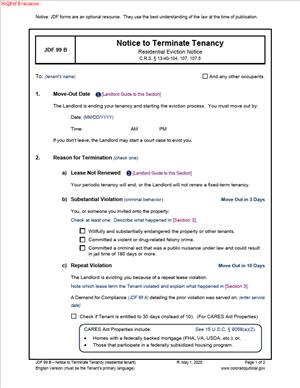
JDF 99 B – Notice to Terminate Tenancy
Fill out nowJurisdiction: Country: United States | Province or State: Colorado
If you are ending a rental arrangement in Colorado, JDF 99 B – Notice to Terminate Tenancy is one of the key forms you may encounter. It is a written notice used to formally inform the other party that a tenancy will end. This document plays an important role in the landlord and tenant process under Colorado law.
JDF 99 B – Notice to Terminate Tenancy is not a casual letter. It is part of the Colorado Landlord and Tenant Law system and is often used before any court filing takes place. It creates a clear record that notice was given and that a timeline to move out has started.
If you are a landlord, you may use this form to notify a tenant that you are ending the tenancy. If you are a tenant, you may receive it and need to understand what it means for your housing situation. In either case, knowing what the document does helps you respond appropriately.
This form matters because many eviction or possession cases depend on proper notice. If the notice is incomplete or incorrect, later court action may be delayed or dismissed. Filling it out carefully helps avoid those problems.
What is JDF 99 B – Notice to Terminate Tenancy?
Clear definition
JDF 99 B – Notice to Terminate Tenancy is a formal written notice used in Colorado to end certain types of rental agreements. It tells the tenant that the landlord is terminating the tenancy and states the date by which the tenant must vacate the property.
This document is typically used for terminating a tenancy without alleging a lease violation. It is often associated with month-to-month tenancies or other periodic rental agreements. The form creates written proof that notice was given.
The notice usually includes the names of the parties, the rental property address, and the date the tenancy will end. It may also include the date the notice is served and how it was delivered.
Who typically uses this form?
Landlords most commonly use this form. It allows them to end a tenancy in a structured and documented way. Property owners, property managers, and authorized agents may complete and serve it.
Tenants may not typically fill out this specific form to end their tenancy, but they may receive it. If you are a tenant, understanding the form helps you know how much time you have and what the next steps might be.
In some situations, a property management company may prepare the form on behalf of the landlord. Even then, the legal effect applies to the landlord-tenant relationship, not the management company itself.
Why might you need this form?
You may need this form when a rental arrangement is continuing from month to month, and you want to bring it to an end. Unlike a fixed-term lease that ends on a set date, a periodic tenancy continues until proper notice is given.
You might also use it when you do not plan to renew a tenancy after its current term converts into a month-to-month arrangement. The form provides written notice that the tenancy will not continue.
In some cases, a landlord may choose to terminate a tenancy for reasons unrelated to misconduct. For example, the owner may plan to move into the property or sell it. The notice communicates the decision formally.
The form is also important if future court action becomes necessary. A court often looks at whether proper notice was given before allowing an eviction case to proceed.
Typical real-life scenarios
- A landlord rents a house on a month-to-month basis. After several years, the landlord decides to sell the property. The landlord uses this notice to inform the tenant that the tenancy will end on a specific date.
- An owner plans to renovate a rental unit and needs it vacant. The current lease has been converted to a periodic tenancy. The owner delivers the notice to terminate so the renovation can begin after the tenant moves out.
- A property manager is reorganizing rental units and chooses not to continue renting to a particular tenant after the lease term. Instead of renewing, the manager provides written notice of termination.
- A landlord prefers not to continue a rental relationship due to ongoing conflicts, even if there has been no clear lease violation. The notice sets a clear end date and documents that the tenancy is being terminated.
- In another situation, a tenant may receive the notice unexpectedly. The tenant then needs to review the document carefully, check the termination date, and prepare to move or seek clarification about the timeline.
When would you use JDF 99 B – Notice to Terminate Tenancy?
You would use this form when ending a tenancy that does not automatically expire on a fixed date. Month-to-month agreements are the most common example. These arrangements continue until either party gives proper written notice.
This form is generally used when the termination is not based on a specific lease violation. If the reason involves nonpayment of rent or another breach, a different type of notice may be required. The type of notice often depends on the reason for ending the tenancy.
Landlords may use this document when they want to regain possession of the property for personal use, sale, or other lawful reasons. The key factor is that the tenancy is being ended through notice, not immediate removal.
Timing is important. Colorado law sets certain notice periods depending on the length of the tenancy and the type of agreement. The number of days required can vary. The notice period typically begins when the notice is properly served.
You might also encounter this form before any eviction case is filed. If the tenant does not move out by the termination date stated in the notice, the landlord may then consider filing a court action for possession. The notice itself does not remove the tenant. It starts the process.
Legal characteristics of JDF 99 B – Notice to Terminate Tenancy
For JDF 99 B – Notice to Terminate Tenancy to be effective, it generally must contain clear and complete information. This includes the correct names of the landlord and tenant, the full address of the rental property, and a definite termination date.
The notice period must align with Colorado’s requirements for the specific tenancy. If the notice gives too little time, it may not be valid. Courts often review whether the required number of days was provided.
Proper service is another key element. The notice must typically be delivered in a way recognized under Colorado law. This may include personal delivery or other accepted methods. If the service cannot be proven, the notice may be challenged.
Common problems include incorrect dates, missing information, or unclear language about when the tenancy ends. An unclear termination date can create confusion and delay. Even small errors can cause complications if the matter proceeds to court.
This form does not, by itself, evict a tenant. It does not authorize law enforcement to remove anyone from the property. It is a notice of termination, not a court order. If the tenant remains after the termination date, a separate legal process may follow.
The form also does not resolve financial issues automatically. It does not decide whether rent is owed, whether a security deposit will be returned, or whether damages exist. Those matters are handled separately.
Colorado’s rules may differ from those of other states. Notice periods, service methods, and tenant protections vary by jurisdiction. What is effective in one state may not meet Colorado requirements.
Is it legally binding?
Yes, JDF 99 B – Notice to Terminate Tenancy can have legal effect when properly completed and served. It becomes part of the official record of the landlord-tenant relationship. If later reviewed by a court, it may serve as evidence that notice was given.
Its binding nature depends on accuracy and compliance with applicable requirements. If the form includes the required information and is delivered correctly, it generally starts the countdown to the termination date.
However, the notice alone does not create an immediate right to possession. It sets a timeline. If the tenant moves out by the date stated, the tenancy ends without further action. If not, the notice may support a later filing for possession.
If the notice contains errors or fails to meet required timelines, its enforceability may be limited. In that case, the party seeking termination may need to issue a new notice that corrects the deficiencies.
How to fill out JDF 99 B – Notice to Terminate Tenancy
Step 1 – Review the Form Header and Court Information
Begin by reviewing the top section of the form. This area may include court-related information, even though the notice is often served before filing any case. Read each field carefully so you understand what information is requested.
If the form includes spaces for a county or court name, ensure you enter the appropriate Colorado county connected to the rental property, if applicable. Accuracy in this section helps maintain consistency if a court filing later occurs.
Step 2 – Enter the Names of the Parties
Write the full legal name of the landlord or property owner as it appears on the rental agreement. If there are multiple owners, include all relevant names as listed in the lease.
Next, enter the full name of each tenant named in the rental agreement. If more than one tenant signed the lease, list each one. Using complete and correct names reduces confusion about who is receiving notice.
Step 3 – Provide the Rental Property Address
Fill in the complete address of the rental property. Include the street number, street name, apartment or unit number if applicable, city, and ZIP code.
This address should match the location described in the rental agreement. The termination notice applies to that specific property, so clarity here is essential.
Step 4 – State the Type of Tenancy
Indicate the nature of the tenancy, such as a month-to-month or other periodic arrangement. The form may include language that identifies the tenancy type.
Make sure the description matches the actual rental arrangement. If the original lease term has ended and converted to month-to-month, reflect that status clearly in the form.
Step 5 – Insert the Termination Date
Enter the specific date on which the tenancy will end. This is one of the most important parts of the document. The date should be clear and written in full to avoid misunderstanding.
Count the required notice period carefully based on the type and length of tenancy. The termination date is typically calculated from the date the notice is served, not the date it is written.
Write the date in a format that cannot be misread. For example, spelling out the month can reduce confusion.
Step 6 – Review Notice Language
Read through the pre-printed language in the body of the form. Confirm that it accurately reflects your intention to terminate the tenancy.
Do not alter standard language unless the form allows modifications. Changes to core wording can affect how the notice is interpreted.
Ensure the statement clearly communicates that the tenant must vacate by the termination date. The wording should be direct and consistent with the purpose of ending the tenancy.
Step 7 – Sign and Date the Form
Sign the form in the designated signature area. Use your legal signature, consistent with how you sign other formal documents.
Enter the date you sign the notice. This date may differ from the termination date. The signing date helps establish when the notice was created.
If you are signing as an agent or property manager, indicate your role if the form provides space for that information.
Step 8 – Complete the Certificate of Service
Locate the section of the form that addresses service. This part documents how and when the notice is delivered to the tenant.
Enter the date of service and the method used, such as personal delivery or another recognized method. Provide the name of the person who delivered the notice if required.
The certificate of service creates a written record of delivery. Fill it out immediately after serving the notice to ensure the information is accurate and complete.
Legal terms you might encounter in JDF 99 B – Notice to Terminate Tenancy
- Tenancy at Will: A tenancy at will is a rental arrangement with no fixed end date. Either party can end it with proper notice. On this form, you may need to indicate whether the tenancy is month-to-month or another type of ongoing arrangement without a written lease term.
- Fixed-Term Lease: This is a rental agreement with a specific start and end date. If you are terminating a fixed-term lease early, the timing and reason matter. The form may require you to confirm the type of lease so the notice period aligns with the agreement.
- Notice Period: The notice period is the amount of time you must give before the tenancy ends. It is calculated from the date the notice is served to the termination date. In this document, you must clearly state the termination date so the notice period is clear and measurable.
- Termination Date: This is the final day the tenant has the right to occupy the property. It must be written clearly and match the required notice period. A vague date like “in 30 days” can create confusion and disputes.
- Service of Notice: Service refers to how the notice is delivered to the other party. The form includes a certificate of service section where you state when and how delivery occurred. Proper service affects whether the notice is valid.
- Certificate of Service: This section confirms that you delivered the notice and explains how you did it. You must complete it accurately. It creates a written record that may be used later if there is a disagreement.
- Premises: The premises are the rental property being terminated. You must provide the full address, including the unit number if applicable. If the address is incomplete, it can create confusion about which property the notice covers.
- Party of Record: This refers to the person or people named in the lease or rental agreement. The names you list on the form must match the lease exactly. If multiple tenants are listed, you generally need to name all of them.
- Holdover Tenant: A holdover tenant is someone who remains in possession after the tenancy has ended. If the termination date passes and the tenant does not leave, further legal steps may be required. This document establishes the date after which continued occupancy may be considered a holdover.
FAQs
How do I calculate the correct termination date on this form?
Start by identifying the type of tenancy. Then count the required notice period from the date you plan to deliver the notice, not from the date you sign it. The termination date must fall after the full notice period has passed. Write the exact calendar date, including month, day, and year, so there is no confusion about when the tenancy ends.
Do the names on JDF 99 B – Notice to Terminate Tenancy have to match the lease exactly?
Yes. The names you enter should match the lease or rental agreement word for word. If the lease lists multiple tenants, include each person. If a name is missing or spelled differently, it may create disputes about whether proper notice was given.
What if I do not know the exact move-in date or lease start date?
Look at the written lease or your rental records. If you cannot find a written agreement, check payment records or prior notices to confirm the tenancy type and start date. The key is that the termination date you choose must comply with the required notice period for that tenancy arrangement.
Can I change the termination date after I have delivered this document?
Once you serve the notice, the termination date is set unless both parties agree in writing to a different date. If you need to change it unilaterally, you may need to issue a new notice with a new date and properly serve it again. Keep copies of both versions for your records.
Who is allowed to sign this form?
The person with legal authority over the property should sign. That may be the property owner or an authorized agent. If you are signing as an agent, make sure your authority is documented in your records so your role is clear if questioned later.
What happens if the other party refuses to accept the notice?
Refusal to physically accept the paper does not necessarily invalidate service. What matters is whether you delivered it in a legally recognized way and completed the certificate of service accurately. Record the date, time, and method used so you can show that delivery occurred.
Do I need to file JDF 99 B – Notice to Terminate Tenancy with the court right away?
This form is typically served on the tenant and not filed immediately. You usually keep it for your records unless further legal action becomes necessary. If a dispute arises, you may later file a copy with the court as part of a case.
What should I keep in my records after serving this document?
Keep a signed copy of the notice and a completed certificate of service. Also, retain proof of how and when it was delivered. These records may be important if the termination is challenged or if additional legal steps are required.
Checklist: Before, During, and After JDF 99 B – Notice to Terminate Tenancy
Before
- Review the lease to confirm the type of tenancy and notice requirements.
- Verify the full legal names of all tenants listed on the agreement.
- Confirm the complete property address, including the unit number.
- Determine the correct notice period and calculate the termination date.
- Decide how you will serve the notice and confirm it meets legal standards.
- Gather prior correspondence or records in case questions arise later.
- Confirm who has the authority to sign on behalf of the owner.
During
- Write the termination date clearly with month, day, and year.
- Double-check that all names are spelled exactly as in the lease.
- Ensure the property address is complete and accurate.
- Review the notice language to confirm it reflects your intent.
- Sign and date the form in the appropriate section.
- Complete the certificate of service immediately after delivery.
- Deliver the notice using the method you selected and record details.
- Make at least two copies before handing over the original.
After
- Store a signed copy in a secure and organized file.
- Keep proof of service with a copy of the notice.
- Mark the termination date on your calendar.
- Monitor rent payments and communications during the notice period.
- Prepare for property inspection or turnover.
- Document any communication related to move-out plans.
- Update your property management records to reflect the pending termination.
- Be prepared to take the next steps if the tenant remains past the termination date.
Common mistakes to avoid with JDF 99 B – Notice to Terminate Tenancy
- Mistake: Using the wrong notice period because you assume all tenancies require the same timeframe; this happens when you do not review the lease carefully, and it can make the notice invalid, so do not forget to confirm the tenancy type and count the days correctly.
- Mistake: Writing an unclear termination date like “30 days from today”; this happens when you rush the form, and it creates disputes about the exact end date, so do not forget to write the full calendar date.
- Mistake: Leaving out one of the tenants named on the lease; this happens when multiple people occupy the unit, and it may mean not everyone received proper notice, so do not forget to match every name to the lease.
- Mistake: Failing to complete the certificate of service; this happens when you focus only on delivery, and without proof of service, your notice can be challenged, so do not forget to fill it out immediately after serving.
- Mistake: Signing without authority; this happens when a manager or relative signs without documented permission, and it can weaken the notice, so do not forget to ensure the signer has clear authority.
- Mistake: Not keeping copies; this happens when you deliver the only signed version, and you may have no proof later, so do not forget to make and store complete copies.
- Mistake: Serving the notice using an improper method; this happens when you choose convenience over compliance, and it can delay the process, so do not forget to verify acceptable delivery methods.
- Mistake: Ignoring communication after service; this happens when you assume the notice ends all interaction, and misunderstandings can escalate, so do not forget to document and respond appropriately during the notice period.
What to do after filling out JDF 99 B – Notice to Terminate Tenancy
After you complete the form, pause and review it one more time. Small errors can cause big delays. Confirm names, dates, and the property address. Make sure your signature and the date of signing are present.
Next, prepare your copies. You should have at least one copy for yourself and one for each tenant named in the notice. If you are working with a co-owner or property manager, provide them with a copy as well.
- Step 1: Make complete copies of the signed notice, including the certificate of service section.
- Step 2: Serve the notice using your chosen method and document the exact date and manner of service.
- Step 3: Immediately complete the certificate of service with accurate details.
After service, organize your records. Place the copy of the notice and proof of service in your tenant file. If you maintain digital records, scan and upload the documents so they are backed up.
- Step 4: Mark the termination date on your calendar and set reminders for one week before and the day of termination.
- Step 5: Communicate in writing about move-out procedures, such as key return and property condition.
- Step 6: Prepare a move-out inspection checklist tailored to the property.
As the termination date approaches, confirm whether the tenant plans to vacate voluntarily. Keep communication professional and documented. Written communication reduces confusion about expectations.
- Step 7: Conduct a move-out inspection on or shortly after the termination date.
- Step 8: Document the condition of the premises with notes and photos.
- Step 9: Update your internal records to reflect the end of the tenancy.
If the tenant remains past the termination date, you may need to consider additional legal steps. Your previously completed notice and certificate of service will become important records at that stage.
- Step 10: Gather all related documents, including the lease, payment records, and the served notice, so you are prepared if further action becomes necessary.
By staying organized and documenting each step, you reduce the risk of disputes and protect your position if the termination is questioned later.
Disclaimer: This guide is provided for informational purposes only and is not intended as legal advice. You should consult a legal professional.