Getting eviction court papers can feel frightening. A California eviction answer gives you a way to respond. It tells the court what you dispute and why the landlord may not have the right to evict you. In most cases, a tenant who is personally served has 10 court days to file a response. Saturdays, Sundays, and court holidays do not count.
This guide explains the process in plain English. It covers the main forms, deadlines, defenses, service, and filing steps. It gives general legal information, not advice for your facts. Local rules can differ, so check with the court named on your papers.
First Confirm That You Received a Lawsuit
A notice from your landlord is not the same as a court case. A landlord may first give you a notice to pay rent, fix a lease issue, or move. The notice may allow only a few days to act. That notice does not start the deadline for a California eviction answer.
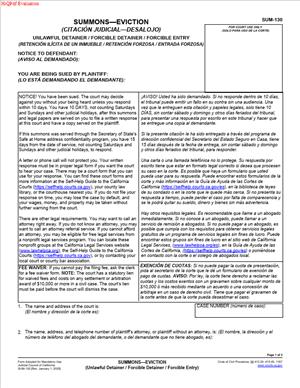
The lawsuit usually starts when someone serves you with two court papers:
- Summons—Eviction (SUM-130). This tells you that a case was filed.
- Complaint—Unlawful Detainer (UD-100). This states the landlord’s claims.
“Unlawful detainer” is the court name for an eviction case. The landlord is the plaintiff. The tenant is the defendant.
Read both papers at once. Check the court name, case number, party names, property address, and date of service. Keep the envelope if papers came by mail. Write down how and when you received them. Those facts control your deadline.
If you received only a landlord notice, the lawsuit may not have started. You may still need to act quickly. A housing lawyer, legal-aid office, or court self-help center can help you identify the paper.
California Eviction Answer Deadlines
California changed the basic response time on January 1, 2025. Under Code of Civil Procedure section 1167, a defendant normally has 10 days after service, excluding Saturdays, Sundays, and judicial holidays. The exact count depends on the service method.
Count the California eviction answer deadline from service
Use the rules below as a starting point. Ask the court to confirm the date if anything is unclear.
- Personal service: If the papers were handed to you, start with the next day. Count 10 court days. Do not count weekends or court holidays.
- Substituted service: If papers were left with another adult at your home or work and then mailed, service is usually complete 10 calendar days after mailing. After that, count 10 court days.
- Posting and mailing: If the court allowed papers to be posted at your home and mailed, use the same general pattern: 10 calendar days after mailing, then 10 court days.
- Safe at Home service: California’s address confidentiality program can add five court days. Section 1167 states that this response period is 15 court days.
The California Courts response guide explains these service methods and includes deadline examples. Your first day is not always the day you found the papers. The server’s proof and mailing date may matter.
Do not wait until the last day. The clerk may reject an incomplete filing. An online filing can also fail. If the deadline is close, contact the clerk or self-help center right away.
What happens if the deadline passed
The landlord may ask the court for a default. A default means the court can decide without hearing your side. This can lead to a judgment for possession and, later, a sheriff’s lockout.
If no default has been entered, the clerk may still accept your California eviction answer. File as soon as possible. If a default already exists, you may need a motion asking the court to set it aside. That process can be technical. Get legal help quickly.
Do not assume that moving out ends the lawsuit. The Complaint may also ask for unpaid rent or other money. A judgment can affect you even after you leave.
Gather the Papers and Facts Before You Write
Start a case folder. Put the Summons and Complaint at the front. Add every landlord notice and proof of how it was delivered. Then gather:
- the lease, renewals, and addenda;
- rent receipts, bank records, and payment messages;
- repair requests and the landlord’s replies;
- dated photos or videos of unsafe conditions;
- inspection reports and code-enforcement notices;
- emails, texts, and letters about the dispute;
- notices about rent increases or local rent rules;
- records of benefits, rental aid, or third-party payment offers; and
- names of people who saw key events.
Build a short timeline. Use one line for each important event. Include the date, what happened, who was involved, and the proof you have.
For example:
- March 2: Texted the manager about no heat. Screenshot saved.
- March 5: City inspector visited. Report saved.
- March 12: Landlord served a notice to pay rent or quit.
- March 18: Offered the full amount listed. Landlord refused by text.
- March 25: Received the Summons and Complaint by personal service.
This timeline can help you complete the California eviction answer and prepare for trial. Facts are stronger when a document, photo, or witness supports them.
How to Complete Form UD-105
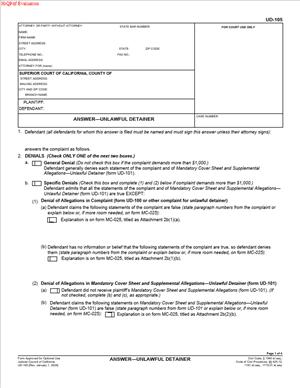
The main response form is UD-105, Answer—Unlawful Detainer. RunSensible Forms can help you locate and prepare the form. Check the current official court version before filing because forms can change.
Copy the case details onto the California eviction answer
Copy the court name, branch address, plaintiff, defendant, and case number exactly from the Complaint. Small spelling differences can cause confusion. List each defendant who is joining the response.
Read every numbered statement in the Complaint. The California eviction answer lets you deny statements that are false or that you cannot confirm. If the Complaint asks for more than $1,000, California Courts says you cannot use the simple general-denial box. You must identify the statements you dispute.
Do not deny a fact that you know is true. Do not admit a fact only because you are unsure. The form has a way to state that you lack enough information.
If you need more room, use an attachment. Label it with the form number and item number. Keep sentences short. Add dates, amounts, and actions.
List each defense with supporting facts
A defense is a legal reason the landlord should not win. Check only defenses that may fit. Then state the facts behind each one. A checked box with no facts may be hard for the judge to understand.
The California Courts eviction-defenses guide explains common defenses and points readers to the law. The examples below are general. A lawyer or self-help center can help you decide what applies.
Common areas include:
- Wrong notice or service. The notice may state the wrong rent, include charges that are not rent, omit required payment details, or use the wrong service method.
- Payment or tender. You may have paid the full amount on time or offered it before the notice expired.
- Landlord accepted later rent. Accepting rent after the notice may affect whether that notice can support the case.
- Serious repair problems. Unsafe conditions and ignored repair requests may support a habitability defense in a nonpayment case.
- Retaliation. The eviction may follow a good-faith repair complaint, code report, or another protected act.
- Discrimination. The landlord may be acting because of a protected trait or a lawful disability request.
- Rent control or just-cause rules. State or local law may require a valid reason, special notice, or relocation help.
- Reasonable accommodation. A disability-related request may affect the landlord’s right to evict.
- Abuse-related protection. Special rules may protect a tenant when the case is based on domestic violence, stalking, sexual assault, human trafficking, or certain other abuse.
- Third-party payment. A landlord may have refused a valid offer from a person or agency that tried to pay rent for you.
Local law matters. A defense in Los Angeles may not exist in a city without the same ordinance. State tenant protections also have exceptions. Confirm the rules for the property address.
Review, sign, and make copies
Read the complete form before signing. Your signature confirms that the information is true. Each tenant who joins the same response should review it. Tenants with different defenses may need separate answers.
Make at least two copies of your signed California eviction answer and every attachment. Keep one set. Another set will be mailed to the landlord or the landlord’s lawyer. The court keeps the original.
Serve the Answer the Right Way
“Serve” means deliver court papers using a method the rules allow. You cannot serve your own response.
Ask an adult who is at least 18 and not part of the case to mail a copy. The server mails it to the lawyer at the top of the Complaint. If no lawyer is listed, the server mails it to the landlord at the listed address.
The server then completes POS-030, Proof of Service by First-Class Mail—Civil. The form records what was mailed, when it was mailed, where it was mailed, and who received it.
California Courts gives this order:
- Choose an adult server who is not a party.
- Have the server mail copies of the Answer and attachments.
- Have the server sign POS-030.
- File the original Answer and signed proof with the court.
The official service instructions warn that the tenant cannot do the mailing. Keep a copy of the signed proof with your California eviction answer file.
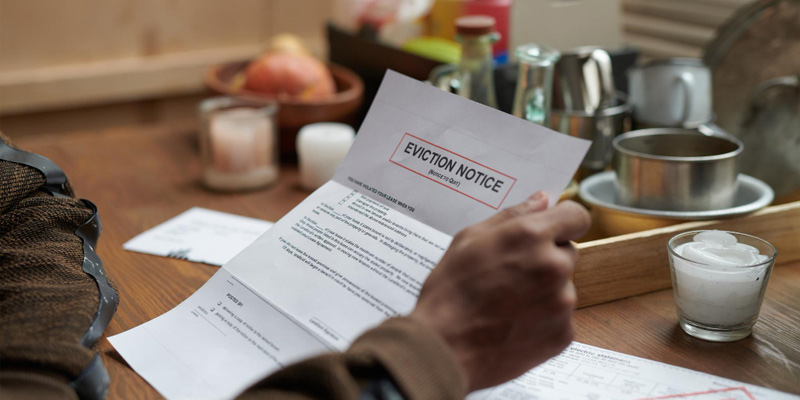
New Colorado Eviction Laws 2026: What Landlords and Tenants Need to Know
File the California Eviction Answer With the Court
File at the court listed on the Complaint. Some courts allow electronic filing. Others accept in-person or mail filings. Because the time is short, confirm the local method before relying on mail.
Bring or submit:
- the original UD-105;
- every labeled attachment;
- the signed POS-030;
- the filing fee or a fee-waiver request; and
- copies for the clerk to stamp, if filing in person.
Filing fees depend on the amount in dispute and local charges. The California Courts filing guide says a tenant who cannot afford the fee may request a waiver. Current thresholds and forms can change, so check the court website or ask the clerk.
Get a filed-stamped copy. It proves when the clerk received your California eviction answer. Save any online confirmation email and receipt too.
Before leaving or logging off, check that the case number appears on every page. Ask when and how you will learn the trial date. Update your address if you move during the case.
Build Evidence for Each Defense
The Answer states your position. Evidence helps prove it. Create one folder for each defense.
For a payment defense, keep receipts, bank records, money-order stubs, and messages about payment. For a repair defense, keep dated photos, written requests, inspection reports, and repair bills. For retaliation, build a timeline showing your protected act and the landlord’s response.
Use original files when possible. Do not edit screenshots in a way that hides context. Save full message threads. Write down the name and contact information of each witness.
Your California eviction answer should match your evidence. If the Answer says you reported a broken heater on April 3, your email should show the same date. Fix honest mistakes quickly. You may need the other side’s agreement or the court’s permission to amend a filed response.
Avoid these common problems:
- waiting until trial week to collect proof;
- bringing only one copy of an important document;
- using photos with no date or location;
- listing a defense with no supporting facts;
- ignoring a local notice or registration rule; and
- missing mail from the court after filing.
What Happens After You File
Filing prevents a default while the case is active. It does not end the case. The landlord may ask the court to set a trial. UD-150 is the Request or Counter-Request to Set Case for Trial in an unlawful detainer case.
Eviction cases move faster than many civil cases. Watch for notices. Calendar every date. The court may require a settlement meeting, local form, exhibit exchange, or other step.
Prepare the California eviction answer issues for trial
Read your response again. Turn each denial and defense into a short issue:
- What did the landlord claim?
- What is your response?
- Which law or defense may apply?
- What proof supports your facts?
- Which witness can explain the event?
Make three sets of your exhibits if local instructions require them: one for you, one for the landlord, and one for the judge. Put them in date order. Add page numbers and a short index.
The California Courts trial guide explains what to expect. Arrive early. Bring the filed California eviction answer, proof of service, notices, lease, timeline, exhibits, and witness information.
Settlement is still possible
The parties can discuss settlement before trial. A settlement might cover payment, a move-out date, repairs, possession, costs, and what happens to the case. Put every term in writing.
UD-115, Stipulation for Entry of Judgment, may be used in some unlawful detainer settlements. It can have serious effects. Do not sign terms you do not understand. Confirm what happens after one missed payment and whether the landlord will dismiss the case.
California Eviction Answer Checklist
Use this final review before filing:
- Confirm you received a Summons and Complaint, not only a landlord notice.
- Record the exact service method and date.
- Calculate the deadline and confirm it with the court if unsure.
- Copy the court, parties, address, and case number exactly.
- Read every Complaint paragraph.
- State denials clearly.
- Check only defenses that may apply.
- Add short facts, dates, and amounts for each defense.
- Attach extra pages with clear form and item labels.
- Sign and date the UD-105.
- Make copies.
- Have an adult nonparty mail the response.
- Have that server sign POS-030.
- File the response and proof before the deadline.
- Pay the fee or submit a fee-waiver request.
- Keep a filed-stamped copy and all receipts.
- Start preparing evidence and witnesses.
- Watch for court notices and the trial date.
A careful California eviction answer protects your chance to be heard. It also creates a clear plan for the next stage.
Conclusion
A California eviction answer is more than one form. It is a short process with a firm deadline. First, identify the lawsuit and service method. Then complete UD-105, state the facts behind each defense, have a nonparty serve the papers, and file everything with the correct court.
The basic period is now 10 court days after personal service. Other service methods can change the count. When time is short, file early and ask for help. RunSensible Forms can help you find, complete, validate, and download relevant forms. It is not a law firm, court, government agency, or official filing service.
Frequently Asked Questions
How long do I have to file a California eviction answer?
Most tenants who receive the Summons and Complaint by personal service have 10 court days. Do not count Saturdays, Sundays, or court holidays. Substituted service, posting and mailing, or Safe at Home service can produce a different deadline.
Which form is the California eviction answer?
The main form is UD-105, Answer—Unlawful Detainer. You may also need an attachment for more facts, POS-030 for service by mail, local forms, and a fee-waiver request if you cannot pay the filing fee.
Can I mail the Answer to my landlord myself?
No. California Courts says an adult who is at least 18 and not a party must mail the papers. That person signs the Proof of Service. You then file the signed proof with the court.
What if I missed the answer deadline?
Act at once. If the landlord has not obtained a default, the clerk may still accept the Answer. If default was entered, you may need to ask the court to set it aside. Get help from legal aid, a lawyer, or the court self-help center.
Do I still need to respond if I moved out?
Possibly. The landlord may still seek rent, damages, fees, or costs. Moving does not automatically close the court case. Read the Complaint and get advice about your risk.
What defenses can I put in the Answer?
Possible defenses may involve a defective notice, payment, refusal of rent, serious repair problems, retaliation, discrimination, rent control, just-cause rules, or disability accommodation. The facts and local law decide what applies.
What happens after I file?
The case can move toward trial, settlement, or another court request. Watch your mail and the online case record. Organize evidence for every denial and defense in your California eviction answer.
Resources
- California Courts — Fill out an Answer form in an eviction case
https://selfhelp.courts.ca.gov/eviction-tenant/respond - California Courts — Serve the Answer form
https://selfhelp.courts.ca.gov/eviction-tenant/respond-serve - California Courts — File an Answer in your eviction case
https://selfhelp.courts.ca.gov/eviction-tenant/respond-file - California Courts — Defenses you can use in an eviction case
https://selfhelp.courts.ca.gov/eviction-tenant/respond-defenses - California Courts — What to expect at an eviction trial
https://selfhelp.courts.ca.gov/eviction-tenant/trial - California Legislature — Code of Civil Procedure section 1167
https://leginfo.legislature.ca.gov/faces/codes_displaySection.xhtml?lawCode=CCP§ionNum=1167
Disclaimer: The content provided on this blog is for informational purposes only and does not constitute legal, financial, or professional advice.
Contents