Introduction
Someone owes you money and will not pay. Maybe a customer ignored your invoice. Maybe a contractor took your deposit and disappeared. The Ontario Small Claims Court exists for exactly these problems. It is a branch of the Superior Court of Justice that handles smaller money disputes quickly and at a lower cost than a regular lawsuit.
The rules changed in a big way. On October 1, 2025, the claim limit rose from $35,000 to $50,000. That means far more disputes now qualify. This guide explains who can sue in the Ontario Small Claims Court, how to fill out Form 7A, what the court charges, and what happens after you file. It reflects the rules and fees in effect as of mid-2026. Fees and procedures can change, so always confirm current amounts before you file.
This article is general legal information, not legal advice. If your case is complex or high value, speak with a lawyer or a licensed paralegal.
What Is the Ontario Small Claims Court?
The Ontario Small Claims Court is a branch of the Ontario Superior Court of Justice that handles civil disputes involving money or personal property worth $50,000 or less, not including interest and court costs. A civil dispute is a private disagreement between individuals, businesses, landlords, tenants, contractors, customers, or other parties. Common claims involve unpaid invoices, property damage, breach of contract, unpaid loans, defective services, or personal property that has not been returned.
The court does not deal with criminal charges, family law matters, or every type of legal dispute. Criminal cases are handled in criminal court, while some disputes may need to be brought before another court or tribunal. Small Claims Court is designed to be more accessible and less formal than higher courts, but the parties must still follow filing deadlines, serve documents correctly, provide evidence, and attend required court proceedings.
Small Claims Court operates through courthouses across Ontario. You do not need a lawyer to start or defend a claim, and many people represent themselves. You may also hire a licensed paralegal or lawyer to prepare documents, negotiate a settlement, or represent you in court. Paralegals are commonly used in Small Claims Court and may cost less than hiring a lawyer.
What You Can Sue For
The court hears two main types of claims:
-
Money owed under an agreement. Examples include unpaid invoices, unpaid loans, bounced cheques, unpaid rent owed by a former commercial tenant, and unpaid wages for some workers.
-
Damages. This means money to make up for a loss. Examples include property damage, a breach of contract, poor workmanship on a renovation, and clothing ruined by a dry cleaner.
You can also ask for the return of personal property worth $50,000 or less, such as equipment a former partner refuses to give back.
What the Court Cannot Handle
Some disputes belong somewhere else. The Ontario Small Claims Court cannot hear:
-
Claims over $50,000, unless you give up the extra amount
-
Divorce, custody, or support cases, which go to family court
-
Most disputes between residential landlords and current tenants, which usually go to the Landlord and Tenant Board
-
Claims against title to land
If you are not sure where your dispute belongs, court staff can tell you what the court handles. They cannot give legal advice.
The New $50,000 Limit Explained
For claims issued on or after October 1, 2025, the limit is $50,000 per plaintiff, excluding interest and costs. Ontario Regulation 42/25 made this change. Before that date, the limit was $35,000.
The limit applies to the amount you claim, not the amount you eventually win. Interest and court costs get added on top, so your total judgment can be higher than $50,000.
What If You Are Owed More Than $50,000?
You have two choices:
-
Sue in the Superior Court of Justice. That court has no upper limit, but the process is slower, more formal, and more expensive.
-
Waive the excess. “Waive” means you give up the amount above $50,000 forever. If someone owes you $56,000, you can claim $50,000 in the Ontario Small Claims Court and abandon the remaining $6,000. Many people accept this trade because the process is faster and cheaper.
Think carefully before waiving a large amount. Once you waive it, you cannot come back for it later.
Before You File: Three Things to Check
A little preparation saves money and stress. Before you start a case in the Ontario Small Claims Court, check these three things first.
The Limitation Period
In Ontario, you generally have two years to sue, starting from the day you discovered the problem. This deadline comes from the Limitations Act, 2002. If you wait longer, the defendant can ask the court to dismiss your case. Some situations have different deadlines, so check yours early.
Whether the Defendant Can Pay
A judgment is only a piece of paper if the defendant has no money, no job, and no assets. Before you spend money on filing fees, ask yourself whether the person or business can actually pay. Suing a company that has closed down rarely produces money.
Whether a Demand Letter Could Work
A demand letter is a written request for payment that warns you will sue if you are not paid by a set date. It is not required, but it often works. It also becomes useful evidence that you tried to resolve the dispute.
How to Start a Claim With Form 7A
Every case in the Ontario Small Claims Court starts with a Plaintiff’s Claim, known as Form 7A. The plaintiff is the person suing. The defendant is the person being sued. You can prepare a Form 7A Plaintiff’s Claim online or download it from the Ontario Court Forms website.
Filling Out Form 7A
Your claim must clearly explain who, what, when, where, and how much. Include:
-
The full, correct legal names of all plaintiffs and defendants. If you name a business, use its exact registered name. Use Form 1A, Additional Parties, if you run out of space.
-
Your address, phone number, and email if you represent yourself
-
The amount you are claiming and any pre-judgment interest rate
-
The reasons for your claim, with dates, places, and details of what happened
-
Copies of supporting documents, such as contracts, invoices, texts, emails, and photos. Attach them to the claim. If a document is lost, explain why it is missing.
Naming defendants correctly matters more than people expect. A judgment against the wrong name can be very hard to enforce.
Where to File
You must file in the right courthouse. File at the court:
-
where the events happened, or
-
where the defendant lives or carries on business, or
-
at the court location nearest to where the defendant lives or does business
The Ontario Small Claims Court sits at courthouses across the province, so most people have a location within reach.
How to File
You can file online, by mail, or in person. Most plaintiffs file online. Since October 14, 2025, Toronto cases must be filed through the Ontario Courts Public Portal, while cases outside Toronto use the Justice Services Online portal. If you file online during business hours, the court usually emails your issued claim the same day.

Proof of Service: How to Prove You Served Court Papers in Ontario
Ontario Small Claims Court Fees
You pay a fee for most steps in a case. The table below shows common fees as of mid-2026. Most individuals are “infrequent claimants,” meaning they file fewer than 10 claims per year at the same court location.
Table: Ontario Small Claims Court filing and enforcement fees.
If you win, the court can order the defendant to repay your filing fees. If you cannot afford the fees, you can ask the court to waive filing fees based on your income and assets.
Serving the Defendant
After the court issues your claim, you must “serve” it. Service means officially delivering the claim to each defendant so they know they are being sued. You cannot skip this step. The Ontario Small Claims Court will not move your case forward without proof of service.
Service Deadline and Methods
You must serve each defendant within six months after the claim is issued. A Plaintiff’s Claim normally requires personal service, which means handing it directly to the defendant. You can serve it yourself, ask a friend, or hire a process server. Different rules apply for serving corporations and other special cases.
Proving Service
For each person served, you must complete Form 8A, an Affidavit of Service. This sworn document tells the court who was served, when, where, and how. Our guide to the affidavit of service explains how to complete it correctly. Mistakes in service are one of the most common reasons cases stall.
What Happens After You File
What happens next depends on the defendant.
If the Defendant Files a Defence
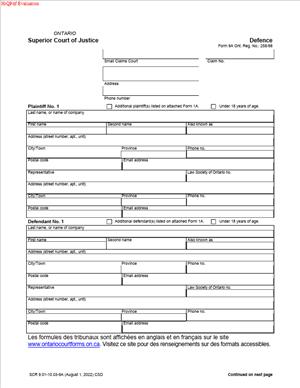
The defendant has 20 days after being served to file a Defence, Form 9A. The Ontario Small Claims Court then schedules a settlement conference, which should happen within 90 days after the first defence is filed. A settlement conference is a private meeting with a judge who helps both sides look for a resolution. Many cases settle here, and settlement is usually faster and cheaper than trial. You can also send the other side a formal Offer to Settle, Form 14A, at any stage. Strong offers can improve the costs the court awards you later.
If the Defendant Ignores the Claim
If 20 days pass with no defence, you can file a Request to Clerk, Form 9B, asking the clerk to note the defendant in default, along with your Affidavit of Service. If your claim is for a fixed amount, like an unpaid invoice, the clerk can sign default judgment. If a judge needs to assess your damages, such as for property damage, you request an assessment instead.
Do not sit on your file. The clerk can dismiss a case for delay if more than two years pass without the required steps being taken.
Going to Trial in the Ontario Small Claims Court
If the case does not settle, either party can pay the fee to set a trial date. Trials here are simpler than in higher courts, but you should still prepare carefully:
-
Gather every relevant document and bring organized copies.
-
List your witnesses early. Use a Summons to Witness, Form 18A, if someone may not attend voluntarily.
-
Practice telling your story in order, with dates.
-
Be respectful, brief, and honest with the judge.
Our article on preparing for a court hearing covers what to expect in the courtroom. At the end, the judge decides who wins and how much. The winner can usually recover court fees and, if represented, a representation fee of up to 15 percent of the amount claimed.
Collecting Your Money After Judgment
Winning is not the end. The court does not collect the money for you. If the debtor does not pay, you must enforce the judgment. Common tools include:
-
Garnishment. Money is taken from the debtor’s wages or bank account.
-
Writ of seizure and sale of personal property. A bailiff can seize certain property.
-
Writ of seizure and sale of land. This can be filed against the debtor’s real estate.
-
Examination hearing. The debtor must answer questions about their finances under oath.
A Certificate of Judgment lets you enforce your judgment at another Ontario Small Claims Court location. For a full walkthrough, read our guide to post-judgment collection.
Common Mistakes to Avoid
These errors cost people real money in the Ontario Small Claims Court every year:
-
Missing the two-year limitation period
-
Naming the defendant incorrectly
-
Filing at the wrong courthouse
-
Forgetting to attach supporting documents to the claim
-
Serving the claim improperly or missing the six-month service deadline
-
Skipping the Affidavit of Service
-
Ignoring settlement conference preparation
-
Assuming the court will collect the judgment for you
Slow down at each step, and use official sources to double-check requirements.
Conclusion
The Ontario Small Claims Court gives everyday people and small businesses a practical way to resolve money disputes up to $50,000. Start by checking your deadline and your defendant’s ability to pay. Then complete Form 7A carefully, file it at the correct courthouse, serve every defendant on time, and prove service with Form 8A. Whether your case ends at a settlement conference or a trial, preparation is what wins. And if you win, be ready to enforce the judgment, because collection is up to you.
Frequently Asked Questions
How much does it cost to file a claim in the Ontario Small Claims Court?
Filing a Plaintiff’s Claim costs $108 for an infrequent claimant as of mid-2026. Other steps carry separate fees, such as $308 to set a trial date. Fee waivers are available for people with low incomes.
What is the monetary limit for the Ontario Small Claims Court?
The limit is $50,000 per plaintiff, excluding interest and costs, for claims issued on or after October 1, 2025. You can waive any amount above the limit to keep your case in this court.
How long do I have to start a claim in the Ontario Small Claims Court?
Ontario’s basic limitation period is two years from the day you discovered your claim. Some claims have different deadlines, so confirm the rule for your situation early.
Can I file my claim online?
Yes. Most Ontario Small Claims Court claims can be filed online. Toronto cases go through the Ontario Courts Public Portal. Cases outside Toronto use the Justice Services Online portal. You can also file by mail or in person.
What happens if the defendant ignores my claim?
After 20 days with no defence, you can ask the clerk to note the defendant in default. You may then get default judgment for a fixed debt, or ask a judge to assess your damages.
Do I need a lawyer or paralegal?
No. Many people represent themselves. For larger or more complicated claims, a licensed paralegal or lawyer can help, and the court may order the loser to pay up to 15 percent of the amount claimed toward representation fees.
What if I win but the defendant still does not pay?
You must enforce the judgment yourself. Options include garnishing wages or bank accounts, seizing property through a bailiff, and examining the debtor about their finances.
Resources
- Suing someone in Small Claims Court, Government of Ontario: https://www.ontario.ca/page/suing-someone-small-claims-court
- Guide to procedures in Small Claims Court, Making a claim, Government of Ontario: https://www.ontario.ca/document/guide-procedures-small-claims-court/making-claim
- File Small Claims Court documents online, Government of Ontario: https://www.ontario.ca/page/file-small-claims-court-documents-online
- Small Claims Court fees, Government of Ontario: https://www.ontario.ca/page/fees-small-claims-court
- O. Reg. 42/25, Small Claims Court Jurisdiction and Appeal Limit, Government of Ontario: https://www.ontario.ca/laws/regulation/r25042
- Small Claims Court, Starting and responding to a case, Ontario Superior Court of Justice: https://www.ontariocourts.ca/scj/areas-of-law/small-claims-court/how-to-start-a-case/
- Form 7A, Plaintiff’s Claim, Ontario Court Services: https://ontariocourtforms.on.ca/en/rules-of-the-small-claims-court-forms/7a/
- Have your court fees waived, Government of Ontario: https://www.ontario.ca/page/have-your-court-fees-waived
- Limitations Act, 2002, Government of Ontario: https://www.ontario.ca/laws/statute/02l24
Disclaimer: The content provided on this blog is for informational purposes only and does not constitute legal, financial, or professional advice.
Contents