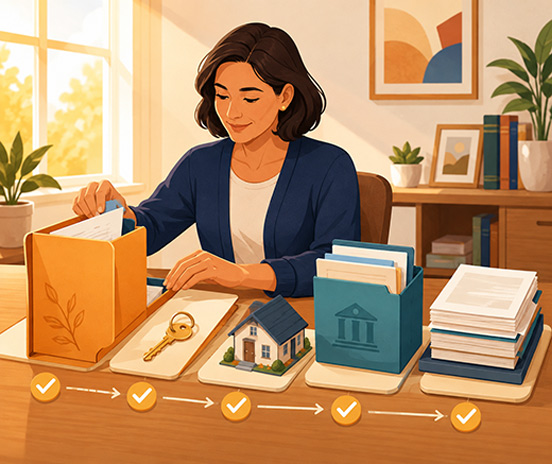
California probate can feel like a pile of unrelated tasks. It is easier to manage when you organize each task. This California probate checklist explains the main stages for a personal representative. A personal representative is the person the court appoints to manage the estate. An executor serves under a will. An administrator usually serves when there is no will.
Use the California probate checklist as a working record. Add local requirements, responsible people, due dates, and proof of completion as the case develops.
This guide gives general information, not legal advice. Every estate is different. County rules, form versions, and deadlines may change. Check the current California Courts instructions and your local court before filing.
First, Confirm That Full Probate Is the Right Process
Do not begin a full court case until you understand what property must pass through probate. Some assets may pass directly to another person. Examples can include property in a living trust, a joint account with survivorship rights, or an account with a named beneficiary.
This first part of the California probate checklist prevents a common problem: using a full court process before checking whether a narrower procedure fits.
California also has simpler procedures for some estates or property. The right path depends on the property, its value, how title was held, and who has the right to receive it. A surviving spouse or registered domestic partner may have a special court procedure. Some smaller real-property transfers may use a different petition or affidavit.
Your first California probate checklist should include these questions:
- Did the person leave an original will or any later change to it?
- Which assets were owned in the person’s name alone?
- Did any account name a payable-on-death beneficiary?
- Was any real property held in joint tenancy or in a trust?
- Is there a surviving spouse or registered domestic partner?
- Could a simplified transfer procedure apply?
- Which California county was the person’s legal home?
Do not guess about eligibility. A wrong process can waste time and filing costs. Review the current California Courts probate guidance. Ask a lawyer for advice when ownership, family rights, or estate value is unclear.
California probate checklist for documents to gather
Create one secure case file. Gather the original will, certified death certificates, property deeds, account statements, tax records, insurance details, debt records, and contact information for heirs and beneficiaries.
Keep original papers separate from working copies. Scan records when safe to do so. Name each digital file with a date and clear description. Good organization at the start supports every later form.
Open the Probate Case With Consistent Information
Formal probate usually begins with a Petition for Probate. The petition asks the Superior Court to open the estate and appoint a personal representative. It may also ask the court to admit a will and grant authority under California’s Independent Administration of Estates Act.
The name of the deceased person must stay consistent across the filing set. So must the county, case caption, proposed representative’s name, and list of heirs and beneficiaries. Compare each entry with the death certificate and will.
The petition is a request. Filing it does not yet give the proposed representative power over estate property. That authority follows a court appointment and issued Letters.
Keep the California probate checklist beside the petition so every name, address, and supporting record can be checked against the same source.

Use this opening-stage California probate checklist:
- Confirm the correct Superior Court and probate division.
- Review the current Petition for Probate and instructions.
- List all heirs and will beneficiaries, even when family members disagree.
- Estimate estate property carefully for the petition and possible bond issue.
- Check local forms and filing rules for the county.
- File the petition and obtain the assigned case number and hearing details.
- Keep a filed-stamped copy of every document.
Check the California probate checklist before filing
Review the entire package line by line. Missing people, inconsistent names, an incomplete attachment, or a wrong case caption may delay review. Do not rely on memory. Compare the filing with source records.
Give Notice and Prepare for the Appointment Hearing
Probate is a court process that can affect heirs, beneficiaries, and creditors. Required people must receive proper notice. Publication may also be required. The type of notice, who serves it, and the timing depend on the petition and governing rules.
The California probate checklist should treat notice as its own workstream, with proof linked to every person and publication step.
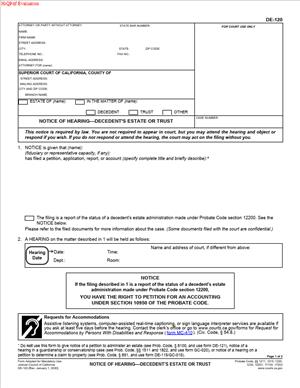
DE-120 is a general Notice of Hearing for a decedent’s estate or trust. DE-121 is the Notice of Petition to Administer Estate. Use the form required for the specific filing. Do not assume one notice can replace another.
Your notice-stage California probate checklist should track:
- Each person entitled to notice
- The person’s verified mailing address
- The form served
- The service method
- The service date
- The required proof of service
- Publication arrangements and proof, when required
- The hearing date, time, department, and appearance method
The person who serves a document may need to be someone other than the petitioner. A proof of service is not a minor extra. It tells the court who received the papers, how they received them, and when service happened.
Before the hearing, review the court’s probate notes or tentative information if the county provides it. Correct allowed defects promptly. Bring or submit any proposed order the court requires. If someone objects, the matter may need more filings or another hearing.
Do Not Act Until the Court Grants Authority
If the judge approves the petition, the court may sign an Order for Probate. The clerk can then issue Letters after all required steps are complete. Letters are the formal proof that the personal representative may act for the estate.
The order and Letters can limit the representative’s powers. A bond may apply. Independent administration authority may be full, limited, or unavailable for a certain act. Read the signed documents instead of assuming what the judge granted.
Add these authority checks to the California probate checklist:
- Obtain filed copies of the signed order and issued Letters.
- Read every limit or condition in the order.
- Confirm whether a bond is active.
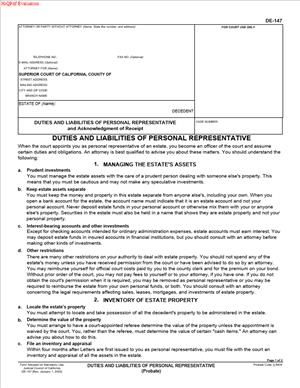
- Review DE-147, Duties and Liabilities of Personal Representative.
- Order certified copies of Letters only as needed.
- Record the exact appointment date.
- Do not mix estate money with personal money.
California probate checklist after Letters issue
Once authority begins, secure estate assets. Change locks where lawful and needed. Protect valuable property. Notify insurers when coverage may be affected. Contact financial institutions with the documents they request. Open an estate account if required for estate funds.
Never use estate funds as your own. Keep receipts for every payment. Record the reason for every transfer. A personal representative has a fiduciary duty, which means a legal duty to act for the estate and its interested people, not for personal gain.
Find, Protect, and List Estate Assets
The representative must identify the estate’s property and debts. Start with the deceased person’s records, mail, tax returns, account statements, deeds, vehicle titles, insurance papers, and business files. Ask institutions what proof of authority they need before releasing information.
Keep a master asset list. For each item, record the owner name, account or property description, title method, date-of-death value source, current location, and next action. Do not place full account numbers in an ordinary spreadsheet or email.
California uses DE-160 and GC-040 for the Inventory and Appraisal. Cash items and noncash items may be handled differently. A probate referee may appraise certain noncash property. Follow the current form and court instructions.
Use this asset-stage California probate checklist:
- Secure homes, vehicles, valuables, and records.
- Redirect important estate mail when allowed.
- Identify bank, investment, retirement, and business interests.
- Review beneficiary and title records before treating an asset as probate property.
- Gather date-of-death statements and property details.
- Separate cash items from property needing appraisal.
- File a supplemental inventory if a new asset is later found.
- Keep insurance and necessary property costs current when authorized.
A filed inventory can become part of the court record. Avoid adding sensitive information that the form does not require. Follow redaction rules.
Handle Debts, Claims, Taxes, and Estate Expenses
Do not pay every bill as soon as it arrives. A claim may need to follow the probate claim process. Some expenses have different treatment or priority. The estate may also have tax filing duties.
DE-172 is the Creditor’s Claim form used by a creditor to state a claim against the estate. The personal representative reviews claims and may allow or reject them through the required process. A rejected claim can start a short period for the creditor to act, so accurate notice matters.
Add a claims log to your California probate checklist. Include the creditor, amount, basis, date received, court filing status, supporting records, response, response date, payment status, and proof of payment. Do not promise payment before confirming authority and priority.
California Small Estate Transfer: 2026 Guide to Affidavits, Homes, and Probate Alternatives
California probate checklist for careful payments
- Keep estate and personal expenses separate.
- Ask for invoices and proof of each claimed debt.
- Match every payment to a receipt or cleared record.
- Record whether a claim was allowed, rejected, or disputed.
- Do not distribute property while unresolved claims or taxes may make that unsafe.
- Track final income, fiduciary, property, and other possible tax work.
- Get qualified tax or legal help when the estate has a business, disputed debt, foreign property, or complex tax issue.
The personal representative is not automatically responsible for the deceased person’s debts. Personal liability can arise, however, when a representative mishandles funds, ignores duties, or distributes property too early.
Keep Records That Can Support an Accounting
Probate records should tell a complete story. Someone reviewing the file should be able to see what the estate owned, what came in, what went out, why each payment was made, and what remains.
Use one ledger for all estate activity. Reconcile it with the estate bank account. Keep invoices, receipts, deposit records, sale papers, tax records, appraisals, and beneficiary communications. Save both the document and proof of the related payment.
A strong records-stage California probate checklist includes:
- A master calendar of hearings and due dates
- A contact list for heirs, beneficiaries, creditors, and professionals
- An asset inventory tied to source records
- A debt and claim log
- A transaction ledger
- Monthly bank reconciliations
- A correspondence log
- Copies of every filed and served document
- Proof of distribution and signed receipts when required
Avoid cash payments. Do not group several unrelated expenses under a vague label. Clear records help the court and beneficiaries understand the administration. They also help the representative answer questions without relying on memory.
Prepare Distribution Only When the Estate Is Ready
Final distribution is not just handing property to beneficiaries. The representative must complete required administration, address allowed debts and taxes, prepare any required report or accounting, and ask the court for approval when required.
At this stage, the California probate checklist should match each proposed transfer to the will, succession rule, and requested court order.
Confirm each beneficiary’s legal name, address, and share. Check the will and court orders. If there is no will, California succession law controls who receives probate property. Do not change shares based on an informal family promise.
Use this distribution-stage California probate checklist:
- Confirm that known estate property has been collected or accounted for.
- Resolve claims, expenses, and needed tax work.
- Update the ledger through the proposed closing date.
- Prepare the required report, accounting, and petition.
- Give required notice of the hearing.
- Review any objection before the hearing.
- Obtain the signed order for final distribution.
- Transfer assets exactly as the order directs.
- Obtain and file receipts when required.
Do not distribute first and seek approval later when prior approval is required. A beneficiary’s request for an early payment does not remove the representative’s duties.
Close the Case and Preserve the Final File
Court approval of final distribution may not end the representative’s role. The representative must carry out the order. After transfers are complete and required receipts are handled, the representative may ask for final discharge.
DE-295 and GC-395 is the Ex Parte Petition for Final Discharge and Order. It asks the court to release the fiduciary after the approved work is complete. A discharge can also address the end of a bond.
The final California probate checklist should confirm:
- Every ordered distribution was completed.
- Required receipts or other proof were filed.
- Final expenses cleared the estate account.
- No hearing, objection, or required filing remains pending.
- The discharge request matches the appointment name and role.
- A filed copy of the discharge order is stored safely.
- Estate records are kept for the period required by law or professional advice.
Do not destroy the file when the order arrives. Questions may come later from a beneficiary, tax agency, financial institution, or bond company.

Common Mistakes That Delay California Probate
Most delays come from missing, inconsistent, or unsupported information. Common problems include:
- Starting full probate without checking for a simpler transfer process
- Filing in the wrong county
- Using names that do not match the death certificate or prior filings
- Leaving out an heir or beneficiary
- Serving the wrong notice or missing proof of service
- Acting before Letters issue
- Mixing estate and personal funds
- Missing an asset or using the wrong valuation date
- Paying or distributing without checking claims and taxes
- Keeping weak records
- Distributing property before the required court order
- Asking for discharge before completing the distribution
Use the California probate checklist as a control document, not as a substitute for current rules. Mark who owns each task, the source of the requirement, the due date, the completion date, and the proof kept in the file.
Conclusion
A California probate checklist turns a long court process into smaller, testable steps. First, confirm the correct procedure. Then open the case, give notice, wait for authority, protect and inventory assets, handle claims, keep complete records, obtain approval, distribute property, and request discharge.
The checklist cannot decide legal questions for you. It can help you spot missing work before a mistake reaches the court. Always use current Judicial Council forms, follow local court rules, and seek professional advice when the estate is contested or complex.
Frequently Asked Questions
What is the first item on a California probate checklist?
Confirm whether the estate needs formal probate. Review title, beneficiary designations, trusts, spousal rights, and possible simplified procedures before filing a petition.
Does filing a Petition for Probate make me the executor?
No. The petition asks for appointment. Authority generally begins after the court appoints the personal representative and the clerk issues Letters, subject to any bond and other requirements.
What records should a personal representative keep?
Keep filed papers, service proof, asset records, statements, appraisals, invoices, receipts, tax documents, correspondence, a claims log, and a full transaction ledger.
Can a personal representative pay beneficiaries before creditors?
That can create risk. The representative must follow California law, court orders, claim rules, and payment priorities. Get legal advice before an early or uncertain distribution.
What if the representative finds another asset after filing the inventory?
The court process may require a supplemental inventory. Use the current form instructions and local rules. Do not silently add the property only to a private list.
How long does California probate take?
Time varies by the estate and county. A San Diego Superior Court informational timeline says a decedent’s estate can take about nine months to one and a half years, while also warning that the estimate does not cover every case. Disputes, property sales, tax issues, missing records, and court delays can extend the process.
When is a California probate estate closed?
Final distribution approval is a major step, but the representative must carry out the order. The case reaches final discharge only after required acts and proof are complete, and the court signs the discharge order.
Resources
- California Courts, Guide to property after someone dies: https://selfhelp.courts.ca.gov/probate
- California Courts, Overview of formal probate: https://selfhelp.courts.ca.gov/probate/formal-probate
- California Courts, Estate representative: https://selfhelp.courts.ca.gov/estate-representative
- Superior Court of California, County of San Diego, PR-195 Probate Timeline: https://www.sdcourt.ca.gov/sites/default/files/sdcourt/generalinformation/forms/probateforms/pr195.pdf
Disclaimer: The content provided on this blog is for informational purposes only and does not constitute legal, financial, or professional advice.
Contents