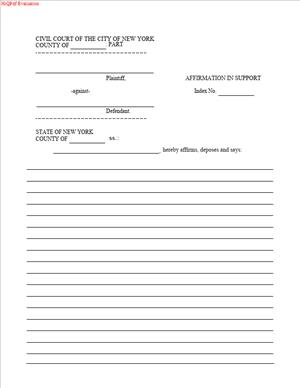
CIV-GP-70 – Affirmation of Service of Subpoena for Records
Fill out nowJurisdiction: Country: United States | Province or State: New York
CIV-GP-70 – Affirmation of Service of Subpoena for Records documents the delivery of a subpoena requesting records. It belongs to the Civil Court of the City of New York. Its purpose is to record service, not to request the records themselves.
Obtaining records can involve several people: the party requesting documents, the person delivering the subpoena, and the records custodian responding. This form concerns the delivery stage. The person who performed service generally completes and signs the affirmation, describing what they delivered, when and where delivery occurred, and who received the papers.
Keep the subpoena, the delivery event, and the proof of service separate. Each serves a different purpose, and organizing the paperwork does not necessarily qualify you to affirm another person’s actions.
What is CIV-GP-70 – Affirmation of Service of Subpoena for Records?
Clear definition
This form is a formal written statement about service of a subpoena for records. Service means delivering legal papers through a legally recognized process. The affirmation records delivery facts for use in the court case.
The subpoena identifies the requested records and communicates the production demand. The affirmation describes delivery of that demand. It does not replace the subpoena, establish whether the records exist, or negotiate the recipient’s response.
The signer formally represents that the account is true. Names, dates, locations, and recipient details connect the statement to a specific delivery and case. The printed declaration explains the seriousness of that representation.
Who typically uses this form?
Self-represented parties may encounter this form when seeking records held by an individual, office, or organization. A process server or another eligible person who delivered the subpoena generally supplies the service account. Eligibility depends on applicable rules, not simply willingness to deliver papers.
If you arranged service but did not perform it, you may provide case information or prepare a draft. You should not present the server’s observations as your own.
The records custodian has a separate role: maintaining records and managing a response. Court personnel may review the affirmation, but the signer remains responsible for its factual contents.
Why might you need this form?
The affirmation provides a record when someone questions when delivery occurred, what was delivered, or who received it. Its timeline may help the court evaluate issues involving a response, objection, or missing records, although the form does not independently determine every deadline.
It also distinguishes multiple subpoenas in one case. Each records holder, delivered version, and service event should remain identifiable. Completing the account while details are fresh reduces reliance on later recollection.
Typical real-life scenarios
In a payment dispute, a third party holds account records. The affirmation documents delivery of the subpoena; the account records remain the separate materials sought.
An organization receives a subpoena through an individual at its office. The service account distinguishes the organization named in the demand from the person accepting papers.
Two record holders receive subpoenas at different locations. Their delivery details should not be combined into one unclear account.
If service notes and a draft show different dates, resolve the discrepancy using reliable information rather than selecting the date most convenient for the case.
When would you use CIV-GP-70 – Affirmation of Service of Subpoena for Records?
You generally use this form after service occurs. Case information may be entered beforehand, but an anticipated delivery date cannot substitute for an actual event.
The form fits the proof-of-service stage in the Civil Court of the City of New York. It is not a general-purpose form for every New York court. Similar document names do not make different courts’ paperwork interchangeable.
The affirmation may be relevant when service is questioned or when organizing papers for a court appearance. Keep it separate from the subpoena and any records received so each stage remains clear.
An unsuccessful attempt is not completed service. An unanswered door or incorrect address cannot accurately be described as delivery. Likewise, an affirmation concerning an original subpoena does not automatically document service of a later revision.
Preparation, signing, and filing are separate actions. Preparing records information; signing formally adopts the statement; filing or submission places it before the appropriate recipient. Completing one action does not necessarily complete the others.
Legal characteristics of CIV-GP-70 – Affirmation of Service of Subpoena for Records
The form’s central function is evidentiary: it provides a formal account of service. Its usefulness depends on truthful information, an appropriate signer, and a clear connection to the case.
Personal knowledge matters. Someone who delivered the papers can describe their actions and observations. Someone who merely arranged delivery may know the plan without knowing what actually happened.
The service event must also be evaluated separately from the document describing it. Accurate paperwork cannot make an unacceptable delivery method valid. Conversely, an unclear affirmation can make an actual delivery harder to prove.
Recipient identity is especially important when an organization holds the records. The named organization, the individual accepting papers, and that individual’s authority are distinct matters. A reported job title should not become an unsupported statement of legal authority.
Missing signatures, incomplete dates, inconsistent names, and unclear addresses can prompt questions or challenges. Internal contradictions may undermine confidence in the account even when the document looks professionally prepared.
Affirmations and affidavits are related but different. Affidavits commonly involve an oath before an authorized official; affirmations may use a prescribed written declaration. Follow the document’s current signature requirements rather than assuming notarization is always required or never required.
The affirmation does not resolve separate questions about subpoena authorization, timing, fees, protected records, or permissible service methods. Nor does it establish that produced records are authentic, complete, admissible, or favorable to your position.
Is it legally binding?
A signed affirmation is a serious factual representation. Knowingly false statements may carry legal consequences under the applicable declaration and law.
A court may rely on the affirmation, but the account is not automatically conclusive. Other evidence may contradict it, and the court may request clarification.
The signer’s responsibility concerns the truth of the service account. The recipient’s production obligations generally arise from the subpoena and governing process, not from the affirmation alone. Signing or filing also does not guarantee that service will be accepted as legally sufficient.
How to fill out CIV-GP-70 – Affirmation of Service of Subpoena for Records
Step 1 – Confirm the document and court
Check the title and confirm that the form belongs to the Civil Court of the City of New York. Read the entire document, including its declaration and instructions, before entering information.
Step 2 – Gather the underlying paperwork
Have the delivered subpoena and contemporaneous service notes available. The subpoena identifies the demand; the notes describe delivery. Using both helps prevent planned details from being mistaken for actual observations.
Step 3 – Match the case caption
Copy the court and party information from existing case papers. Preserve party positions and spelling. A third-party records holder does not become a party merely because it received a subpoena.
Step 4 – Enter the case number accurately
Use the case or index number requested, including relevant letters and year information. Check it against court papers rather than relying on an unrelated reference number from correspondence.
Step 5 – Identify the person making the affirmation
Enter the requested information about the server who will affirm the account. Read any preprinted statements about qualifications carefully: signing adopts those factual assertions as well as the handwritten or typed entries.
Step 6 – Identify the subpoena that was delivered
Describe the actual document served. Distinguish it from later revisions, and identify accompanying materials only if they were delivered during the event being documented.
Step 7 – Record the actual delivery date and time
Use the completed delivery date, not the scheduled date or signing date. Clearly distinguish morning from afternoon where requested. Do not present an uncertain estimate as an exact observation.
Step 8 – Enter the place of service
Record where delivery actually occurred. Include requested details such as a suite or floor when known. Do not substitute a mailing address or the location underlying the lawsuit.
Step 9 – Distinguish the recipient from the records holder
Identify the person accepting papers and their connection to the named recipient where requested. Distinguish personal recognition from a name or title supplied by the recipient.
Step 10 – Describe the delivery without adding conclusions
Use concrete facts about handing over or otherwise delivering papers. Supply requested identifying descriptions from actual observations. Avoid unsupported conclusions that every legal requirement was satisfied.
Step 11 – Check conditional entries carefully
Complete conditional statements only when they apply. Report additional acts, payments, or accompanying materials accurately where requested. A blank on the form does not establish that an event occurred.
Step 12 – Review the completed account for consistency
Compare names, dates, times, locations, and document descriptions against the subpoena and notes. Resolve discrepancies through reliable facts. Do not manufacture missing information, and ensure every entry remains readable.
Step 13 – Read the declaration and complete the signing section
The server should review the complete account and declaration before signing. Use the actual signing date and follow applicable signature or witnessing requirements. Preserve a complete, legible signed copy.
Legal terms you might encounter in CIV-GP-70 – Affirmation of Service of Subpoena for Records
- Affirmation: A formal written statement declared true under the document’s prescribed declaration. Here, it records service facts for which the signer takes responsibility.
- Service: Delivery of legal papers through a legally recognized method. Describing delivery and determining its legal sufficiency remain separate questions.
- Subpoena for records: A legal demand for specified documents or information. This affirmation concerns its delivery, not whether production occurred.
- Person making the affirmation: The individual adopting the service account as true. Preparing or coordinating paperwork does not establish firsthand knowledge of delivery.
- Recipient: The person who actually receives the papers. That individual may differ from the organization or custodian named in the subpoena.
- Records custodian: A person responsible for maintaining or controlling records. The custodian may handle production without having accepted the subpoena personally.
- Case caption: The court and party information identifying the proceeding. It should match existing case papers.
- Index number: The court-assigned identifier distinguishing the case from other matters, including those involving similar names.
- Personal knowledge: Knowledge obtained through direct observation or participation, rather than solely through another person’s later account.
- Proof of service: Documentation showing how and when papers were delivered. It may support service without conclusively resolving every challenge.
FAQs
Does this form have an effective date separate from the delivery date?
The form records an event rather than establishing an agreement’s effective date. Keep the service date, requested delivery time, and signing date distinct. They may legitimately differ.
The subpoena’s production or appearance date is separate. Completing or filing the affirmation does not, by itself, create a new response deadline or extend an existing one.
Who should sign if I prepared the paperwork but someone else delivered it?
The person who performed the service described generally signs, provided they satisfy applicable qualifications and can affirm the facts.
If you typed the document, give the server the complete account and declaration to review. Do not sign for them or substitute your signature merely because you manage the case paperwork.
What should I do if the recipient’s name differs from the name on the subpoena?
Determine what each name represents. An organization may be named in the subpoena while an employee physically accepts it. Preserve both identities where requested.
Check apparent spelling errors against reliable materials. A different business, person, or location may be a substantive service issue. Do not rewrite the account to make the event appear to match the intended delivery.
Do I need to attach the subpoena or the records being requested?
Check the requirements for the particular submission. Retain the exact subpoena delivered, including accompanying schedules, so the affirmation can be connected to that demand.
Requested records are separate from proof of delivery. Do not automatically attach sensitive medical, financial, or employment documents. Include only the supporting materials required or appropriate under applicable instructions.
Does the clerk’s acceptance mean the service was legally valid?
No. Acceptance generally establishes receipt or entry into the filing system, not compliance with every requirement concerning method, timing, recipient, or server qualifications.
Confirm that the document appears in the correct case and is readable. A filing receipt cannot correct an inaccurate account or supply a delivery step that never occurred.
Can I correct a mistake after this form has been signed or filed?
Identify the error by comparing the signed document with reliable service records. A typographical error differs from naming the wrong recipient or stating an incorrect delivery date.
Do not silently alter a signed copy. Confirm the appropriate correction or replacement procedure, preserve the earlier version, and have the signer review and adopt any corrected account through the required process.
What if I cannot confirm the delivery time or the recipient’s exact title?
Review contemporaneous notes, logs, and other reliable records. Distinguish observations from estimates and later-supplied information.
If uncertainty remains, check how the instructions permit unavailable information to be addressed before signing. Do not invent a time or title to fill a blank. An assumed title may wrongly suggest authority to accept service.
What changes in the public record when this document is filed?
The affirmation may become part of the court file and, subject to access restrictions, available for others to review. Check privacy and redaction requirements without removing required information improperly.
Filing does not automatically make the requested records public, establish their contents, or prove compliance. Proof of service and receipt of records remain separate events.
Checklist: Before, During, and After CIV-GP-70 – Affirmation of Service of Subpoena for Records
Before
- Confirm the court, case, and current form instructions.
- Locate the exact subpoena and accompanying materials delivered.
- Separate firsthand notes from later reports.
- Identify multiple attempts or subpoenas that could cause confusion.
- Resolve uncertain facts where possible.
- Check signature, submission, attachment, and privacy requirements.
During
- Distinguish the actual recipient from the named records holder.
- Keep delivery, signing, production, and filing dates separate.
- Describe facts without unsupported legal conclusions.
- Complete conditional entries only when applicable.
- Connect additional pages to the correct affirmation.
- Let the signer review every entry and the declaration.
After
- Save the complete signed document and original service notes.
- Confirm whether and when submission is required.
- Retain transmission receipts and acceptance or rejection notices.
- Verify the correct case and readable pages.
- Track production independently of filing.
- Preserve version history and protect sensitive materials.
Common mistakes to avoid with CIV-GP-70 – Affirmation of Service of Subpoena for Records
- Treating planned delivery as completed service. Advance preparation can leave anticipated details in the final document. Verify what actually occurred before signing.
- Having the case organizer sign for the server. Coordinating, paying for, or typing the paperwork does not establish personal knowledge of delivery.
- Combining different attempts. Similar notes can lead to mismatched dates, recipients, or locations. Connect every entry to the specific event and subpoena.
- Assuming recipient authority. A receptionist’s location or reported title does not automatically establish authority to accept service. Preserve the basis for each description.
- Confusing transmission with acceptance. Upload or mailing confirmation may show only that papers were sent. Check the court’s response and case entry.
- Attaching unnecessary records. Extra documents may expose sensitive information and obscure the service issue. Verify attachment requirements.
- Silently editing a signed document. Preserve the original and follow the appropriate correction process so the signer’s adopted account remains identifiable.
- Assuming filing completes the request. Production, objections, and incomplete responses may still require attention. Track them separately from service.
What to do after filling out CIV-GP-70 – Affirmation of Service of Subpoena for Records
After completion, preserve a usable record of what was signed, where it went, and what remains outstanding. The affirmation documents delivery; it does not replace the subpoena or resolve production issues.
Step 1: Preserve the finalized copy.
Save every page, including the signature. Check scans for missing or cropped information, and securely retain any paper original.
Step 2: Build a clearly identified service packet.
Group your retained affirmation, delivered subpoena, and supporting notes. Label the recipient and event clearly. Internal records need not all accompany a court submission.
Step 3: Confirm whether submission is needed now.
Check when proof of service must be presented or filed. Do not assume every completed affirmation requires immediate filing.
Step 4: Confirm the permitted submission method.
Verify whether electronic submission, mail, in-person delivery, or another authorized method applies. Check format and signature requirements before sending.
Step 5: Assemble only the required filing materials.
Review attachments, page order, and duplicates. Remove unrelated correspondence, private notes, or sensitive records included accidentally.
Step 6: Retain evidence of transmission.
Save acknowledgments, receipts, and available tracking information. Record when and how you submitted the packet without equating transmission with acceptance.
Step 7: Verify acceptance or identify the problem.
Check the court’s response or case entry. Confirm the intended version was received. Preserve rejection notices and address stated problems before resubmitting.
Step 8: Update your internal case record.
Record service, signing, submission, and acceptance separately. Identify superseded drafts without destroying important history. “Affirmation filed” is more accurate than “service approved.”
Step 9: Monitor production independently.
Calendar the subpoena’s response date and record incoming documents, partial responses, and objections. Filing proof of service does not establish complete production.
Step 10: Keep the record ready for later use.
Store the packet where it can be retrieved if delivery is disputed. Preserve notes and correspondence, and restrict access to sensitive materials.
If a later problem arises, identify whether it concerns the affirmation, filing, service itself, or production. These are different issues; changing a correct document will not necessarily resolve an unrelated problem.
Disclaimer: This guide is provided for informational purposes only and is not intended as legal advice. You should consult a legal professional.