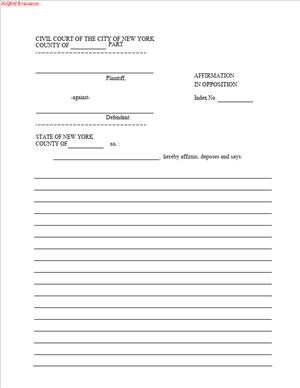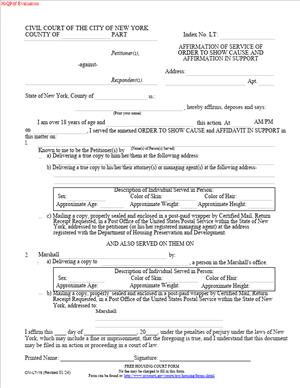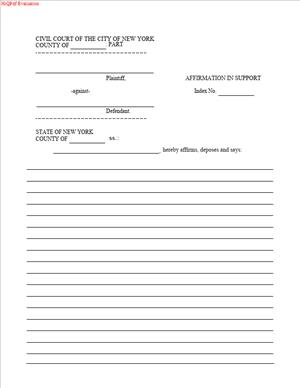
CIV-GP-23-I – Affirmation in Support of an Order to Show Cause to Punish for Contempt
Fill out nowJurisdiction: Country: United States | Province or State: New York
What is a CIV-GP-23-I – Affirmation in Support of an Order to Show Cause to Punish for Contempt?
This affirmation is a sworn factual statement supporting a request that a judge require the other party to explain why they should not be held in contempt for violating a prior court order. It provides the court with a concise narrative of the original directive, how the respondent knew about it, the specific acts or omissions that breached it, and the resulting harm. It also requests defined remedies to secure compliance or compensate losses. This form belongs to the Civil Court of the City of New York.
Functionally, the affirmation is the motion’s backbone. It is not itself a ruling; rather, it convinces the judge to sign an order to show cause, set a return date, and, where appropriate, grant temporary relief. Because the judge will likely read it first, clarity, organization, and credible proof are essential. The strongest affirmations read as short, chronological stories anchored to labeled exhibits that confirm each key point.
Use this form when there is a clear written order, judgment, or stipulation, and the other side, despite notice, has failed or refused to comply. Typical users include self-represented litigants, attorneys, landlords, tenants, small business owners, and judgment creditors.
Common settings
- Access or turnover orders that continue to be ignored.
- Repair directives with missed deadlines.
- Ongoing violations of restraining orders.
- Ignored subpoenas or discovery orders.
- Payment obligations not honored.
- Breach of a “so-ordered” settlement.
An effective affirmation
- Identifies the exact order, date, and violated terms (quoting key language).
- Shows the respondent’s notice (service, appearance, stipulation, transcript).
- Details a factual timeline with exhibits (emails, photos, logs, receipts).
- Explains concrete harm and how it stems from the violation.
- Requests specific coercive and compensatory relief, plus a prompt return date and practical service.
Accuracy matters. Distinguish personal knowledge from information drawn from business records and attach the records that support your statements. False or careless assertions harm credibility and risk sanctions.
When Would You Use a CIV-GP-23-I – Affirmation in Support of an Order to Show Cause to Punish for Contempt?
Use this affirmation when urgent court action is needed because a clear court order is being ignored, and delay may cause further harm. The order to show cause process can help obtain a faster hearing date, set specific service directions, and request temporary measures to preserve the situation until the court decides the issue.
This form may be appropriate where an access order is not being followed. For example, if the court ordered a party to allow entry for repairs, inspection, or turnover of property, but access is still being refused, the affirmation should identify the exact access term in the order. It should also attach the order, proof that the other party had notice, and a record of each refused appointment, including dates, times, messages, logs, or other supporting details.
It may also be used when ordered repairs or maintenance have not been completed. If a landlord, tenant, contractor, or other party was directed to complete specific work by a deadline and the work remains undone, the affirmation should attach the order, correspondence, photographs of the unchanged conditions, and any inspection reports. The goal is to show both what was required and how the respondent failed to comply.
Restraining orders may also require this type of application. If the restrained party continues prohibited conduct, such as contacting witnesses, using protected marks, transferring funds, entering premises, or violating a no-contact term, the affirmation should quote the relevant restraint and attach dated evidence of each breach. Proof that the restrained party knew about the order is especially important.
The affirmation may also be used when subpoenas, discovery orders, or production directions are ignored. In that situation, attach the subpoena or order, proof of service, follow-up reminders, and a concise explanation of what remains missing and why it matters. This helps the court understand the importance of the non-compliance and the need for prompt relief.
Settlement breaches may also support an order to show cause. If a stipulation or so-ordered agreement required payments, document returns, discontinuance, access, or other steps that were not completed, the affirmation should attach the agreement or order, proof of notice, payment records, correspondence, and reminders. The more clearly the record shows the missed obligation, the stronger the request will be.
The central issue is willfulness. You must show that the respondent knew what the order required and chose not to comply. A single clear failure may be enough, but repeated violations, ignored reminders, and missed opportunities to comply make the showing stronger. Include reasonable steps you took before returning to court, such as offering multiple access dates, sending follow-up emails, or proposing alternative methods for production.
This route should be used carefully if the original order is vague. Contempt or enforcement relief usually requires a definite directive. If the order is unclear, it may be better to seek clarification or modification first. If you proceed despite possible ambiguity, explain why the directive was clear in context, such as prior written acknowledgments, the parties’ conduct, or the way both sides previously understood the order.
An order to show cause is most effective when the harm is time-sensitive. This may include safety risks, ongoing business disruption, interference with legal rights, loss of access, or deadlines where delayed compliance would make the relief ineffective. In those cases, the affirmation should request a short return date, practical service methods, and narrowly tailored temporary directions that protect the status quo until the hearing.
Legal Characteristics of the CIV-GP-23-I – Affirmation in Support of an Order to Show Cause to Punish for Contempt
The affirmation is a sworn factual submission within your motion record. It asks the court to exercise its contempt powers; it does not itself impose sanctions. Judges use it to decide whether to sign the order to show cause and, after a hearing, whether contempt remedies are warranted.
Key elements that affect enforceability
- Clarity of directive: The underlying order must be definite enough that the respondent could understand what to do or not do. Vague orders are hard to enforce.
- Notice: Show how the respondent knew of the order—presence in court, signed stipulation, or service. Connect the proof of notice to the order with exhibits.
- Noncompliance: Provide specific, dated facts showing failure to obey. Avoid conclusory labels; show who, what, when, where, and how.
- Harm or affront: Civil contempt aims to compel obedience and compensate for losses. Explain concrete injury to you or the court’s authority and quantify losses where possible.
Your statements are under penalty of perjury. Identify facts known personally and those drawn from regularly kept business records; attach the relevant pages and explain the basis for your knowledge.
If the judge signs the order to show cause, it will set a return date and detailed service directions, ensuring due process. If standard service is impracticable, explain why and propose realistic alternatives (e.g., email to counsel plus certified mail), noting prior failed attempts.
Remedies typically fall into two categories
- Coercive relief: Deadlines, conditional fines, or, in serious cases, confinement until compliance. Effective orders include purge conditions—specific steps that end the sanction once completed.
- Compensatory relief: Reimbursement for losses attributable to the violation, such as reasonable attorney’s fees, service costs, and documented damages caused by delay or obstruction.
Be specific. “Comply with the order” is weaker than “By [date], provide access on two business days’ notice between 9 a.m. and 5 p.m., with keys available on-site.” Courts may tailor relief to feasibility and fairness.
The hearing is focused and limited: (1) the existence of a clear order, (2) notice, (3) noncompliance, and (4) appropriate remedy. Organize your affirmation and exhibits around these points.
How to Fill Out a CIV-GP-23-I – Affirmation in Support of an Order to Show Cause to Punish for Contempt
1) Caption the case
- Use: “Civil Court of the City of New York,” and the correct county.
- List parties as they appear in the case, in the same order.
- Include docket/index number and part (if known).
- Title: “Affirmation in Support of an Order to Show Cause to Punish for Contempt.”
- Match spellings and capitalization from prior filings.
2) Identify yourself and your role
- State your full name, role (petitioner/plaintiff or respondent/defendant, or counsel), and relationship to the facts (party, owner, agent, officer, or attorney).
- If counsel, provide firm name, address, phone, email, and any attorney number.
- Briefly describe how you know the facts—personal involvement or oversight of routinely kept records.
3) State that you are swearing to the facts
- Begin with a short statement that you affirm the facts under penalty of perjury based on personal knowledge and records maintained in the ordinary course of business.
- Distinguish what you observed from what is established by the attached records.
4) Describe the order that was violated
- Identify the judge, date, and precise terms at issue.
- Quote the exact language breached; avoid paraphrase when precision matters.
- Attach the order as Exhibit A; include any incorporated stipulations or modifications.
5) Prove the other side knew about the order
- Explain notice: service, presence in court, or signed stipulation.
- Attach proof—affidavits of service, transcript excerpts, acknowledgments—as Exhibit B.
- If counsel accepted service or appeared, identify them and attach confirming pages.
6) Detail the noncompliance
- Provide a clear, dated timeline. Present events chronologically and link each to an exhibit.
- Describe specific acts or omissions without conclusory labels.
- Attach supporting proof (emails, letters, texts, photos, logs, receipts) as Exhibit C and subparts (C1, C2, etc.).
- Include reasonable attempts to resolve (proposed dates, follow-up messages, alternatives offered).
7) Explain the harm
- Describe concrete impacts: safety risks, lost revenue, operational disruption, litigation prejudice.
- Quantify losses where possible; attach invoices, receipts, or time records, and show how they relate to the violation.
- If harm is ongoing, explain compounding effects and why expedited relief is needed.
8) Ask for specific relief
- Request a contempt finding based on a clear order, notice, and documented noncompliance.
- Coercive relief: precise steps and deadlines; specify windows, locations, and contact methods.
- Compensatory relief: reasonable attorney’s fees and enforcement costs; if pro se, identify out-of-pocket expenses.
- If seeking fines or confinement, tie to narrow purge conditions that track the original directive.
- Request any just and proper relief and, in the proposed order, narrowly tailored interim measures to prevent further harm.
9) Address service and scheduling
- In the proposed order to show cause, request a return date, and propose service methods likely to give actual notice (personal service, certified mail, email to counsel).
- Provide current addresses, emails, and phone numbers.
- If personal service is impracticable, explain why and propose effective alternatives; summarize prior failed attempts.
10) List and label exhibits
- Label exhibits A, B, C, etc., and reference each where discussed.
- Add a short exhibit list at the end (e.g., “Exhibit C: Email chain re access attempts”).
- Ensure legibility and redact confidential data where appropriate.
11) Add the verification block
- Attorneys: include an affirmation under penalty of perjury with date and location; state admission where applicable.
- Self-represented parties: sign before a notary if required; ensure the notary block is complete.
12) Sign and date
- Sign above printed name; include date and city/county.
- Provide mailing address, phone, and email.
- If counsel, include firm name and attorney number.
13) Attach the proposed order to show cause
- Draft a separate proposed OSC mirroring your requested relief.
- Leave spaces for return date, time, courtroom; include your service proposals and deadlines.
- If interim protection is requested, keep directives narrow and consistent with the underlying order.
14) File and serve
- File the affirmation, proposed OSC, and exhibits with the clerk; follow local format and fee requirements.
- After the OSC is signed, serve as directed, on time, and document service.
- File proof of service promptly and bring originals or clean copies to court.
Legal Terms You Might Encounter in CIV-GP-23-I – Affirmation in Support of an Order to Show Cause to Punish for Contempt
- Affirmation: A sworn factual narrative signed under penalty of perjury; an affidavit is notarized.
- Order to show cause: A judge’s scheduling order requiring the respondent to appear and explain why contempt should not be found; may include temporary relief.
- Contempt: Court power addressing disobedience of a clear order; civil contempt compels compliance or compensates harm.
- Willful noncompliance: Knowing and deliberate failure to follow a definite directive.
- Notice: Prove the respondent knew about the order (presence, service, signed stipulation).
- Service: Delivery of legal papers; proof of service confirms compliance with the court’s directions.
- Stipulation: Party agreement adopted by the court; violating a “so-ordered” stipulation can support contempt.
- Return date: The hearing date set in the OSC; service must be completed beforehand.
- Relief: The specific outcome requested—coercive steps to comply and compensatory reimbursement.
- Purge conditions: Defined actions the respondent can take to purge contempt and end sanctions.
FAQs – CIV-GP-23-I – Affirmation in Support of an Order to Show Cause to Punish for Contempt
Do you need a lawyer to file this affirmation?
No. Many litigants file pro se. If the sanctions sought are significant or the facts complex, consider consulting counsel to review your draft for clarity, proof, and appropriate relief.
Do you use this form if the original order is vague?
Contempt requires a definite directive. If ambiguity exists, seek clarification or modification first. If you proceed, explain why the directive is clear in context and attach proof showing both sides treated it as definite.
Do you have to warn the other side before seeking contempt?
Not necessarily, but documented reminders and opportunities to comply help show willfulness and reasonableness. Include dates, content, and responses with delivery confirmations.
Do you need personal knowledge for every fact?
No. Identify what you know firsthand and what is established by regularly kept records. Attach relevant excerpts and, if needed, supporting affidavits from those with direct knowledge.
Do you include new claims or only the violation?
Focus on the violated order and resulting harm. Include additional disputes only if they directly prove notice, willfulness, or damages tied to the violation.
Do you have to quantify your losses?
If you seek compensatory relief, yes—provide dates, invoices, receipts, and a simple calculation. If seeking only coercive relief, still detail concrete consequences that justify urgency.
Do you still proceed if the other side complies right before the hearing?
You can. Late compliance may resolve coercive issues, but the court may still award fees or costs caused by the noncompliance. Update the court on what remains outstanding.
Do you need to notarize this document?
Attorneys typically use affirmations under penalty of perjury; self-represented parties may need notarized affidavits depending on local practice. Confirm the correct signature format for acceptance.
Checklist: Before, During, and After the CIV-GP-23-I – Affirmation in Support of an Order to Show Cause to Punish for Contempt
Before signing: Gather
- The exact prior order or stipulation (with date, judge, and precise language).
- Proof of notice (service, appearance, transcript, signed stipulation).
- A dated timeline of violations and attempted resolutions.
- Exhibits showing noncompliance and harm (messages, photos, logs, invoices).
- A draft relief plan with deadlines and purge conditions linked to the order.
- Current addresses and practical service methods; reasons for alternate service if needed.
- A proposed OSC aligned with your relief and service deadlines.
During signing: Verify
- Caption accuracy (court, county, parties, docket), and title.
- Identity paragraph (role, knowledge basis, contact details).
- Accuracy of quoted language and exhibit references.
- Clear showing of notice, noncompliance, harm, and requested relief.
- Signature block format, date, and location; notary if required.
After signing: Execute
- File the affirmation, proposed OSC, and exhibits per local requirements.
- Obtain the signed OSC with return date and service instructions.
- Serve exactly as directed and by the deadline; secure proofs of service.
- Calendar all dates; prepare a hearing outline keyed to the four core elements.
- Maintain a complete, organized file of all papers and proofs.
Common Mistakes to Avoid – CIV-GP-23-I – Affirmation in Support of an Order to Show Cause to Punish for Contempt
- Missing exact order language: Courts may deem directives too vague without verbatim quotes and attached orders.
- Conclusory allegations: Claims of “refusal” without dated proof often fail; attach emails, texts, photos, logs, and receipts.
- Skipping notice/service proof: Without evidence of notice or proper service, relief may be denied or adjourned.
- Vague relief requests: Open-ended directives are hard to enforce; propose specific steps, deadlines, and purge conditions.
- Overreaching on sanctions: Excessively punitive requests can harm credibility; tailor remedies to secure compliance and compensate documented harm.
What to Do After Filling Out the Form CIV-GP-23-I – Affirmation in Support of an Order to Show Cause to Punish for Contempt
- Finalize your packet: The affirmation, labeled exhibits A, B, and C, a brief exhibit list, and a proposed OSC mirroring the requested relief, with space for the return date and service directions.
- File promptly and track: Submit to the clerk, obtain the signed OSC, note any interim directives, and calendar return and service deadlines.
- Serve precisely as directed: Follow the OSC’s method and timing, use a reliable server, and preserve proofs of service. Document failed attempts, if any.
- Prepare for the hearing: Bring originals or clean copies of exhibits, a concise timeline, proof of service, and an updated status on compliance and damages. Focus the argument on clarity, notice, noncompliance, and remedy.
- Monitor compliance: If compliance occurs before the hearing, inform the court and narrow issues; if seeking fees, bring documentation connecting costs to the violation.
- Supplement if needed: For new violations or key evidence, file a short supplemental affirmation with exhibits in time for review, clearly labeled and dated.
Disclaimer: This guide is provided for informational purposes only and is not intended as legal advice. You should consult a legal professional.