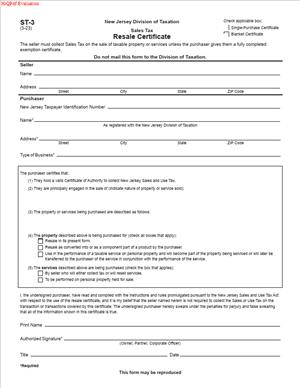
Form ST-3 – Sales Tax Resale Certificate
Fill out nowJurisdiction: Country: United States | Province or State: New Jersey
If you are buying goods to resell in New Jersey, you may come across the ST-3 – Sales Tax Resale Certificate. This document allows you to purchase certain items without paying sales tax at the time of purchase.
The ST-3 – Sales Tax Resale Certificate is commonly used by retailers, wholesalers, and other businesses that resell tangible goods. Instead of paying tax upfront, you collect sales tax from your customers when you sell the item.
If you are filling out this form, you are likely setting up a relationship with a supplier. The supplier needs written proof that your purchase qualifies as a resale. This certificate provides that proof.
Understanding how the form works helps you avoid delays, rejected certificates, or unexpected tax charges. When completed correctly, it supports your tax reporting and keeps your purchasing process smooth.
What is ST-3 – Sales Tax Resale Certificate?
Clear definition
The ST-3 – Sales Tax Resale Certificate is a New Jersey tax document that a registered seller gives to a supplier. It certifies that the items being purchased are for resale in the regular course of business.
In simple terms, it tells the seller, “I am not the final consumer of these goods.” Because the goods will be resold, sales tax is not collected at the time of that transaction.
This form applies to tangible personal property and certain taxable services that will be resold. It does not apply to items you use in your own business operations.
Who typically uses this form?
Retail store owners often use this form when purchasing inventory from wholesalers. Online sellers with a New Jersey tax registration may also provide it to suppliers.
Wholesalers and distributors may use it when buying products in bulk that they plan to resell to retailers. Manufacturers sometimes use it when buying components that will become part of products for sale.
Newly formed businesses commonly complete this certificate when opening vendor accounts. Established businesses may submit it when working with a new supplier who requests resale documentation.
Why might you need this form?
Suppliers are responsible for collecting sales tax unless they receive a valid resale certificate. Without this form on file, a seller may charge you sales tax even if the goods are for resale.
Providing the certificate helps prevent paying tax twice. You avoid paying tax when purchasing inventory, and you instead collect tax from the end customer when you sell the product at retail.
It also supports accurate tax reporting. Your purchases for resale are separated from taxable business expenses, which may be treated differently for tax purposes.
Typical real-life scenarios
- You open a clothing boutique in New Jersey and purchase inventory from a regional wholesaler. The wholesaler asks for a completed resale certificate before shipping your first order. You provide the certificate, so the purchase is not taxed.
- You operate an online electronics store and buy products from a distributor located in another state. The distributor requests proof of your New Jersey sales tax registration. You submit the certificate to confirm the items are for resale.
- You run a convenience store and restock beverages and packaged snacks weekly. Your supplier keeps your resale certificate on file so each new invoice reflects a tax-exempt purchase for resale.
- You own a small hardware store and begin carrying a new brand of tools. The new vendor requires a resale certificate before extending wholesale pricing and tax-exempt sales. You complete the form as part of setting up the account.
When would you use ST-3 – Sales Tax Resale Certificate?
You use this form when purchasing goods that you intend to resell in the ordinary course of your business. The key factor is your intent at the time of purchase. The items must be for resale, not for business use.
This often happens when establishing a new supplier relationship. Many vendors will not process a wholesale order without a resale certificate on file.
You may also use it when expanding into new product lines. If you add a new category of goods for resale, your supplier may request an updated or additional certificate reflecting your registration details.
Businesses that operate both retail and service divisions sometimes use this form selectively. For example, a company might buy products tax-free for resale but pay sales tax on tools and equipment used internally.
Seasonal businesses also rely on this document. Before peak sales periods, they may increase inventory purchases and provide updated certificates to ensure transactions are processed correctly.
If you change your business structure, legal name, or tax registration number, a supplier may ask for a new certificate. In that case, you would complete a fresh form reflecting your current registration information.
Legal characteristics of ST-3 – Sales Tax Resale Certificate
This certificate functions as a written representation by the purchaser. You are stating that the goods listed or described are being purchased for resale. Sellers rely on this statement to justify not collecting sales tax.
For the document to be effective, it generally must include accurate identifying information. This typically includes your business name, address, and New Jersey tax registration number. Incomplete or incorrect information can lead to rejection.
The seller must accept the certificate in good faith. If the information appears inconsistent or invalid on its face, a seller may question or refuse it. A missing signature or unclear description of the property being purchased can also create problems.
The form is usually kept on file by the seller rather than submitted directly with each transaction. It supports the seller’s records in case of a tax review or audit.
Rules and interpretations can vary by state. While many states use resale certificates, each jurisdiction has its own format and requirements. This form is specific to New Jersey and reflects that state’s tax structure.
It is important to understand what this document does not do. It does not eliminate sales tax entirely. It shifts the responsibility to collect tax to you when you resell the item to the final customer. It also does not cover items you consume, use, or convert for your own operations.
Is it legally binding?
Yes, in a practical sense, it carries legal significance. When you sign the certificate, you are making a formal statement about how the purchased goods will be used.
Sellers rely on your signed representation to support their tax treatment of the sale. If the goods are later used for a non-resale purpose, tax consequences may arise under general tax rules.
The binding nature comes from the fact that it is a signed declaration connected to tax reporting. Accuracy matters because the information can be reviewed in connection with tax compliance.
How to fill out ST-3 – Sales Tax Resale Certificate
Step 1 – Enter your business name and address
Write your full legal business name as it appears on your tax registration. Include your complete business address. This identifies you as the purchaser claiming the resale exemption.
Step 2 – Provide your New Jersey tax registration number
Enter your valid New Jersey tax registration or identification number in the space provided. This number shows that you are registered to collect and remit sales tax in the state.
Step 3 – Identify the seller
Fill in the name and address of the supplier or vendor to whom you are giving the certificate. This links the document to a specific seller who will keep it in their records.
Step 4 – Describe the type of property being purchased
Indicate the general nature of the goods you will be purchasing for resale. The description does not need to list every item, but it should clearly reflect the category of merchandise involved.
Step 5 – Confirm that the purchase is for resale
Review the certification language on the form. By completing this section, you are confirming that the items are being purchased for resale in the regular course of your business.
Step 6 – Sign and date the certificate
Sign your name as the owner, partner, corporate officer, or authorized representative. Add the date of signing. Your signature finalizes the declaration and allows the seller to rely on the document for tax purposes.
Legal terms you might encounter in ST-3 – Sales Tax Resale Certificate
- Resale: This refers to purchasing goods with the intent to sell them again in the regular course of your business. On this form, you are confirming that the items you buy are not for your own use but for resale to customers. The resale purpose is the core reason the seller does not charge you sales tax at the time of purchase.
- Tax Registration Number: This is the number issued to you by the state after you register to collect and remit sales tax. You must enter this number accurately on the certificate. It links your business to state tax records and shows that you are authorized to collect sales tax from your customers.
- Seller: The seller is the business from which you are purchasing goods. In this document, you identify the seller by name and address. The seller keeps the completed certificate in its records as proof for not charging you sales tax.
- Purchaser: You are the purchaser when you complete this form. Your legal business name and business address must be listed exactly as they appear in your tax registration. This confirms who is claiming the resale exemption.
- Tangible Personal Property: This term generally refers to physical goods that can be seen and touched, such as inventory, merchandise, or equipment. The form typically applies to purchases of tangible personal property intended for resale. Services or items used in your business operations usually do not qualify.
- Exemption Certificate: This document functions as an exemption certificate. It allows the seller to treat your purchase as exempt from sales tax. By issuing it, you are formally claiming that the transaction meets the legal requirements for resale.
- Good Faith Acceptance: Sellers rely on your certificate in good faith. This means they accept it as valid based on the information you provide. If the information is incorrect or misleading, the responsibility can shift back to you.
- Authorized Signatory: The person signing must have authority to act on behalf of the business. This could be an owner, officer, partner, or other authorized representative. By signing, that person confirms the truth of the statements made on the form.
- Liability: Liability refers to your legal responsibility if the certificate is misused. If you claim a resale exemption for items that are not actually resold, you may owe unpaid sales tax, plus possible penalties or interest.
- Blanket Certificate: In some cases, a resale certificate can cover multiple purchases over time from the same seller. When used this way, it remains on file and applies to future qualifying transactions, rather than a single purchase.
FAQs
Do I need to give a new ST-3 – Sales Tax Resale Certificate for every purchase?
Not always. If you regularly buy qualifying items from the same seller, you can usually provide this document once as a blanket certificate. The seller keeps it on file and applies it to future resale purchases. If your business information changes, you should give the seller an updated version.
What tax registration number should I enter on this form?
You must enter the sales tax registration number issued to your business by the state tax authority. Do not use a federal employer identification number unless it is specifically required. Double-check that the number matches your registration certificate to avoid rejection.
What happens if my business name on the certificate does not exactly match my registration?
The name you enter should match your official tax registration records. If it does not match, the seller may question its validity and refuse to accept it. Inconsistent names can also create issues if the transaction is reviewed later.
Can I use this document to buy office supplies tax-free?
No, not if the office supplies are for your own business use. This document only covers items you will resell to customers. If you use the items instead of reselling them, you may owe the tax that was not collected at purchase.
Who is allowed to sign this form?
An owner, partner, corporate officer, or another person with authority to bind the business should sign. The signer is confirming that the purchases qualify for resale. Make sure the signer prints their name and title clearly so the seller can see their authority.
Do I send this form to the state tax agency?
In most cases, you give the completed form directly to the seller, not to the state. The seller keeps it in their records as support for not charging sales tax. You should also keep a copy for your own files.
What if I accidentally use this form for items I later decide to keep?
If you remove items from resale inventory for your own use, you may need to report and pay sales tax on those items. Keep clear inventory records so you can identify when this happens. Failing to do so can create tax liability during an audit.
How long should I keep a copy of this certificate?
Keep a copy for as long as you are purchasing from that seller and for several years afterward. Retain it with your tax and accounting records. If questions arise about past transactions, you will need to show when and how you claimed the resale exemption.
Checklist: Before, During, and After ST-3 – Sales Tax Resale Certificate
Before
- Confirm that your business is properly registered to collect sales tax.
- Locate your official tax registration number.
- Verify your legal business name and address as registered.
- Confirm that the items you plan to purchase are truly for resale.
- Check whether the seller requires a blanket certificate or one per transaction.
- Identify who in your business has the authority to sign.
- Review your inventory system to track resale items separately from business-use items.
During
- Enter your legal business name exactly as registered.
- Fill in your complete and accurate business address.
- Provide the correct tax registration number.
- Clearly identify the seller’s name and address.
- Describe the type of property you are purchasing for resale.
- Read the certification statement carefully before signing.
- Have the authorized person sign and date the form.
- Print the signer’s name and title clearly.
After
- Provide the completed certificate to the seller.
- Request confirmation that the seller has accepted it.
- Keep a copy in your tax records.
- Note the date you issued the certificate for future reference.
- Monitor purchases to ensure they match the resale purpose stated.
- Update the seller if your business name, address, or registration number changes.
- Review your records periodically to confirm continued compliance.
Common mistakes to avoid with ST-3 – Sales Tax Resale Certificate
- Mistake: Using the certificate for items you plan to use in your own business because it seems easier at checkout, which happens when inventory and supplies are not clearly separated, leading to unpaid tax assessments and penalties—do not forget to confirm the resale purpose before issuing the form.
- Mistake: Entering the wrong tax registration number due to copying errors or using an outdated document, which can cause the seller to reject the certificate or question its validity—do not forget to verify the number against your official registration.
- Mistake: Listing a trade name instead of the full legal business name because that is what appears on storefront signage, which may create mismatches in tax records and audit issues—do not forget to use the registered legal name.
- Mistake: Forgetting to sign and date the certificate because you assume typed information is enough, which can make the document invalid and unusable for the seller—do not forget that an authorized signature is required.
- Mistake: Failing to update the seller after a change in address or ownership, often overlooked during business transitions, which can leave outdated information on file—do not forget to issue a new certificate when key details change.
- Mistake: Assuming one certificate covers all sellers automatically, which happens when you misunderstand blanket use, resulting in sellers charging tax or lacking documentation—do not forget that each seller must have its own copy.
- Mistake: Not keeping a copy for your own records because you rely on the seller to store it, which creates problems if transactions are later questioned—do not forget to maintain organized internal records.
What to do after filling out ST-3 – Sales Tax Resale Certificate
Once you complete the form, your job is not done. You need to handle delivery, documentation, and internal controls carefully. This protects you and supports the seller’s records.
- Step 1: Make a clear copy of the signed certificate for your records before you hand it over.
- Step 2: Deliver the certificate to the seller using their preferred method, such as in person or through secure electronic delivery if accepted.
- Step 3: Ask the seller to confirm that the certificate is complete and acceptable.
- Step 4: Verify on your next invoice that sales tax was not charged on qualifying resale items.
- Step 5: Store your copy in your tax compliance or accounting files, organized by seller name.
- Step 6: Enter a note in your accounting system showing the date you provided the certificate and to whom.
- Step 7: Monitor your purchases to ensure you only claim the exemption for resale inventory.
- Step 8: Reconcile inventory records regularly to confirm that items purchased tax-free were actually resold.
- Step 9: If you withdraw items from inventory for business or personal use, record and report the required tax.
- Step 10: Update and reissue the certificate if your business name, address, entity type, or registration number changes.
Keep your documentation consistent with your tax filings. If your business grows or changes structure, review all resale certificates you have on file with vendors. Organized records reduce risk and make future reviews or audits much easier to manage.
Disclaimer: This guide is provided for informational purposes only and is not intended as legal advice. You should consult a legal professional.