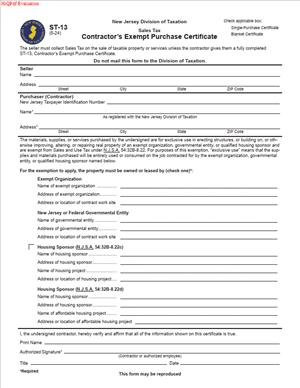
ST-13 – Contractor’s Exempt Purchase Certificate
Fill out nowJurisdiction: Country: United States | Province or State: New Jersey
The ST-13 – Contractor’s Exempt Purchase Certificate is a tax document used in New Jersey by certain contractors to make exempt purchases of materials and supplies. If you are filling it out, you are likely working on a project connected to a tax‑exempt organization or entity.
This form allows a contractor to buy qualifying materials without paying New Jersey sales tax at the time of purchase. Instead of paying tax upfront, you certify that the items are for use in a project that qualifies for exemption.
The ST-13 – Contractor’s Exempt Purchase Certificate matters because it shifts how sales tax is handled. If completed correctly, it can reduce project costs. If completed incorrectly, it can create tax liability for you or the seller.
You are not simply filling out a purchase slip. You are making a written certification. That certification carries responsibility. Understanding what the form does and does not cover helps you avoid delays, rejected transactions, or later tax assessments.
What is ST-13 – Contractor’s Exempt Purchase Certificate?
Clear definition
The ST-13 – Contractor’s Exempt Purchase Certificate is a New Jersey tax form used by contractors to certify that certain purchases are exempt from sales tax because they will be used in a qualifying exempt project.
In practical terms, it is a document you give to a supplier. By signing it, you state that the materials or supplies you are buying will be incorporated into a project for an organization or entity that is exempt from New Jersey sales tax, such as certain nonprofit, religious, or government entities.
The form does not automatically make all your purchases tax‑free. It applies only to specific purchases connected to a qualifying project. Each certificate is tied to defined work and conditions.
Who typically uses this form?
This form is most commonly used by construction contractors. That includes general contractors, subcontractors, and builders working on capital improvement projects for exempt organizations.
You might use this form if you are improving real property owned by a qualifying nonprofit organization. It may also apply if you are performing work for a governmental entity that is eligible for exemption.
Suppliers and vendors also rely on this form. When you present a completed certificate, they use it to document why they did not collect sales tax on the transaction.
If you are self‑employed or operate a small contracting business, you may be personally responsible for signing and maintaining copies of this document.
Why might you need this form?
You may need the ST-13 – Contractor’s Exempt Purchase Certificate to avoid paying sales tax on materials that will become part of an exempt project. Without it, suppliers typically charge sales tax at the time of sale.
For large projects, sales tax on materials can represent a high cost. Using the correct certificate at the time of purchase can change how those costs are calculated and billed.
You may also need this form because the exempt organization you are working for expects it. Many nonprofits and public entities structure contracts around the assumption that eligible purchases will be made tax‑exempt.
Finally, you may need it to document compliance. If your purchases are reviewed later, the certificate serves as written proof that the exemption was claimed for a specific reason.
Typical real-life scenarios
- You are hired to renovate a building owned by a nonprofit religious organization. The project includes installing new drywall, flooring, and electrical wiring. Because the property owner qualifies for exemption, you use this form to purchase the building materials without paying sales tax.
- You are a subcontractor performing plumbing work on a public school expansion. The general contractor informs you that the project qualifies for exempt purchasing. You complete the certificate and provide it to your plumbing supply vendor for materials that will be permanently installed.
- You are building an addition to a hospital that meets the exemption criteria under New Jersey tax rules. The materials you buy for framing, insulation, and roofing are incorporated into the structure. You use the certificate when purchasing those items from your supplier.
- You are completing a capital improvement for a qualifying charitable organization. The organization provides documentation of its exempt status. You then use the form when buying qualifying materials directly connected to that improvement.
- In each of these scenarios, the key point is that the materials are used in a project tied to an exempt entity and are incorporated into real property.
When would you use ST-13 – Contractor’s Exempt Purchase Certificate?
You use this form at the time you purchase materials or supplies that qualify for exemption under a specific project. It is typically provided to the seller before or at the point of sale.
This is common in construction and renovation projects involving real property. The form is often used when materials will be permanently affixed to land or buildings owned by a qualifying exempt organization.
General contractors may use it when purchasing bulk materials for the overall project. Subcontractors may use it for their specific portion of the work, as long as the project itself qualifies.
Timing matters. The certificate is generally presented before the transaction is finalized. If tax has already been charged and paid, the process may differ from presenting the exemption at the point of sale.
You would not use this form for personal purchases or for projects that do not involve an exempt organization. It is also not typically used for tools or equipment that remain your business property rather than becoming part of the real estate.
Legal characteristics of ST-13 – Contractor’s Exempt Purchase Certificate
The ST-13 – Contractor’s Exempt Purchase Certificate is a written certification made under penalty of law. By signing it, you declare that the information provided is accurate and that the purchase qualifies for exemption.
For the form to be effective, it must be completed fully and accurately. This usually includes identifying information about the contractor, the exempt organization, and the nature of the project. Missing details can lead a seller to reject the certificate.
The certificate is transaction‑based. It is generally connected to specific purchases and a defined project. Using it broadly outside the scope of that project can create problems.
Common issues that lead to rejection or scrutiny include incomplete fields, incorrect identification numbers, mismatched project descriptions, or using the certificate for items that do not qualify. Sellers may refuse to accept a certificate if it appears inconsistent or unclear.
In New Jersey, tax exemption rules are interpreted within the state’s tax framework. While other states may have similar contractor exemption certificates, the requirements and terminology can differ. A form valid in one state is not automatically valid in another.
The document does not transfer all tax responsibility to the seller. If the certificate is invalid or misused, liability for unpaid tax may fall on the contractor who signed it.
The form does not create a contract between you and the exempt organization. It also does not confirm that the organization is exempt; it relies on that status already existing and being applicable to the project.
Is it legally binding?
Yes, in the sense that it is a signed certification made to support a tax exemption claim. When you sign it, you are making a formal representation about the nature of the purchase and the project.
Because it is signed and dated, it can be used as evidence in a tax review or audit. If the information is inaccurate, it may be treated as a false statement.
It becomes legally meaningful once it is relied upon by a seller to not collect sales tax. The seller keeps it as documentation supporting the exempt sale.
However, it is not a negotiated agreement like a construction contract. Its binding nature comes from tax law and your certification, not from mutual promises between parties.
How to fill out ST-13 – Contractor’s Exempt Purchase Certificate
Step 1 – Enter contractor information
Begin by providing your full legal name or business name as it appears in your registration records. Include your business address and any required identification numbers requested on the form.
Make sure the information matches your official records. Inconsistent names or numbers can cause delays or rejection by the seller.
Step 2 – Provide exempt organization details
Fill in the name and address of the exempt organization for whom the work is being performed. This identifies the entity whose status supports the exemption.
You may also need to include an exemption identification number or other reference information connected to that organization. Enter it exactly as provided to you.
Step 3 – Describe the project
State the nature of the project clearly. Indicate that the materials are for a capital improvement or other qualifying work on real property owned by the exempt organization.
Be specific enough that the seller can see the connection between the purchase and the project. A brief but accurate description helps avoid confusion.
Step 4 – Identify the type of property or materials
Indicate that the items being purchased will be incorporated into real property. The form typically distinguishes between materials that become part of the structure and items that remain personal property.
Confirm that the purchases covered by the certificate meet the conditions described. Do not include tools, machinery, or equipment that you will keep for future jobs unless the form allows it.
Step 5 – Review the certification statement
Read the certification language carefully before signing. This section explains what you are declaring about the purchase and the project.
Ensure that the information you entered supports the statements in this section. The certification ties all previous entries together.
Step 6 – Sign and date the form
Sign your name where indicated. Use your legal signature and include your title if you are signing on behalf of a business entity.
Enter the date of signing. The date helps establish when the certification was made and supports the timing of the exempt purchase.
Step 7 – Provide the certificate to the seller
Give the completed ST-13 – Contractor’s Exempt Purchase Certificate to the supplier at or before the time of purchase. The seller retains the document as support for not collecting sales tax.
Keep a copy for your records. Maintaining organized copies linked to specific projects can help you track which purchases were made under each certificate.
Legal terms you might encounter in ST-13 – Contractor’s Exempt Purchase Certificate
- Exempt Organization: This is the nonprofit or qualifying entity for whom you are performing the work. In this document, you must list the full legal name of the organization exactly as it appears on its exemption approval. If the name does not match state records, the seller may reject the certificate.
- Exemption Number: This is the identification number issued to the exempt organization by the tax authority. You will enter this number to show that the organization has a valid tax-exempt status. If the number is missing or incorrect, the seller has no proof that the purchase qualifies.
- Contractor: You are the contractor if you are buying materials for a project on behalf of the exempt organization. The form requires your business name, address, and tax identification number. You are the one certifying that the purchase meets the exemption rules.
- Tangible Personal Property: This refers to physical items you can touch and move, such as building materials, fixtures, or equipment. The form applies to qualifying purchases of tangible personal property used in the exempt project. Services alone do not usually qualify unless specifically covered.
- Improvement to Real Property: This means work that permanently becomes part of a building or structure. The project description section should clearly show that the materials will be incorporated into real property owned or used by the exempt organization.
- Certification Statement: This is the legal declaration you sign at the bottom of the document. By signing, you confirm that the information is true and that the materials will be used only for the stated exempt purpose. False statements can lead to tax assessments and penalties.
- Seller: The seller is the supplier providing the materials. You give the completed certificate to the seller so they can document why they did not charge sales tax. The seller keeps the certificate in their records.
- Sales and Use Tax: This is the tax that would normally apply to purchases of materials. The certificate allows the seller not to collect this tax when the purchase qualifies. If the purchase later turns out to be taxable, you may become responsible for the unpaid tax.
- Good Faith Acceptance: This means the seller must reasonably believe that the certificate is valid and properly completed. If information is incomplete or suspicious, the seller may refuse to accept it. Clear and accurate entries protect both you and the seller.
FAQs
What information do I need in front of me before I start filling out this form?
You should have the exempt organization’s full legal name, exemption number, and address exactly as shown on its approval letter. You also need your business name, address, and tax identification number. Have details about the specific project, including the location and a clear description of the work. Finally, confirm what materials you are buying so your description matches the actual purchase invoice.
Do I attach proof of the organization’s tax-exempt status?
In many cases, the seller will ask for a copy of the organization’s exemption certificate or approval letter to keep with this document. While the form itself captures the exemption number, sellers often want written proof for their files. If you do not provide it when requested, the seller may charge sales tax until documentation is received.
Who is allowed to sign this document?
You must be authorized to act on behalf of your contracting business. That usually means you are the owner, officer, or a person with authority to make tax-related certifications. Your signature confirms that the materials are for the exempt project only, so do not delegate signing to someone without proper authority.
Does this form get filed with the state?
You generally do not send this document to the tax authority. Instead, you give it directly to the seller at the time of purchase. The seller keeps it in their records to justify not collecting sales tax. You should also keep a copy in your own project file.
What if I make a mistake after I give the certificate to the supplier?
If you notice an error, correct it immediately by preparing a new, accurate document and giving it to the seller. Tell the seller clearly that the new version replaces the earlier one. Keep copies of both versions with notes explaining the correction in case questions arise later.
Can I use the ST-13 – Contractor’s Exempt Purchase Certificate for all my purchases on the project?
You may use this document only for qualifying materials that will be incorporated into the specific exempt project described. It does not cover tools, office supplies, or materials for other jobs. Each seller may require a separate certificate, and some may ask for a new one if the project details change.
What date should I enter on the form?
Enter the date you sign the document. Make sure that the date is on or before the purchase date shown on the invoice. If the certificate is dated after the purchase, the seller may refuse to apply the exemption and may charge tax.
What happens if the information does not exactly match the organization’s records?
If the name, exemption number, or address does not match official records, the seller may reject the certificate. In that case, you may have to pay sales tax upfront and resolve the discrepancy later. Always compare your entries with the organization’s approval documents before signing the ST-13 – Contractor’s Exempt Purchase Certificate.
Checklist: Before, During, and After ST-13 – Contractor’s Exempt Purchase Certificate
Before
- Confirm the organization has a valid tax-exempt status and obtain its exemption number.
- Verify the exact legal name and address of the exempt organization.
- Review your contract to confirm the project qualifies as an improvement to real property.
- Identify the specific materials you plan to purchase.
- Gather your business details, including legal name and tax identification number.
- Ask the seller whether they require a copy of the exemption approval letter.
- Check the project location and ensure it matches your contract documents.
During
- Enter all names exactly as they appear on official documents.
- Write a clear and specific project description, including location.
- List only qualifying tangible personal property.
- Double-check the exemption number for accuracy.
- Read the certification statement carefully before signing.
- Sign and date the form on or before the purchase date.
- Make a copy of the completed document before handing it to the seller.
After
- Confirm the seller accepted the certificate and did not charge sales tax.
- Review your invoice to ensure tax was not applied in error.
- Store a copy of the signed certificate in your project file.
- Keep copies of related purchase invoices with the certificate.
- Monitor purchases to ensure the certificate is used only for this project.
- Update your accounting records to reflect tax-exempt purchases.
- Retain records for the period required by tax recordkeeping rules.
Common mistakes to avoid with ST-13 – Contractor’s Exempt Purchase Certificate
- Mistake: Using the certificate for tools or supplies not incorporated into the project, which happens when contractors assume all job-related purchases qualify; this can trigger tax assessments and penalties, so do not forget to limit it to qualifying materials only.
- Mistake: Entering the wrong exemption number because you copied it from memory or an old document; this may cause the seller to reject the form or the state to question the exemption, so do not forget to verify it against the official approval letter.
- Mistake: Leaving sections blank due to rushing through the form; incomplete certificates may be invalid and lead to sales tax being charged, so do not forget to review every line before signing.
- Mistake: Dating the form after the purchase invoice date, often because paperwork is handled late; this can result in the exemption being denied, so do not forget to sign and date it at or before the time of purchase.
- Mistake: Providing a vague project description, such as “construction work,” which creates doubt about eligibility; this may cause rejection or audit issues, so do not forget to clearly describe the specific project and location.
- Mistake: Failing to keep a copy for your records because you assume the seller’s copy is enough; this can leave you without proof during an audit, so do not forget to retain a complete, signed copy with related invoices.
- Mistake: Allowing an unauthorized employee to sign the form for convenience; this can invalidate the certification and shift tax liability to you, so do not forget that only someone with proper authority should sign.
What to do after filling out ST-13 – Contractor’s Exempt Purchase Certificate
Once you complete the form, your job is not finished. You need to make sure the exemption is properly applied and documented. Careful follow-up protects you if questions arise later.
- Step 1: Make at least one clear copy of the signed document for your own records before giving it to the seller.
- Step 2: Provide the original to the supplier at or before the time of purchase so they can apply the exemption correctly.
- Step 3: Confirm with the seller that they accept the certificate and that sales tax will not be charged on the qualifying items.
- Step 4: Review the invoice immediately after purchase to ensure no sales tax was added in error.
- Step 5: If tax appears on the invoice, address it with the seller right away and provide clarification or a corrected certificate if needed.
- Step 6: File the signed copy together with the related contract, exemption approval documentation, and purchase invoices in your project records.
- Step 7: Record the tax-exempt purchase accurately in your accounting system so your books reflect that no sales tax was paid.
- Step 8: Limit future use of that certificate to the same project and exempt organization described in the document.
- Step 9: Monitor the project to ensure the purchased materials are actually incorporated into the exempt job as stated.
- Step 10: Keep all related records organized and accessible in case of a future review or audit.
Good recordkeeping is your protection. If a tax authority later questions the exemption, you will need to show the signed certificate, the exempt organization’s approval details, and invoices that match the described project. Clear documentation reduces stress and helps resolve issues quickly.
Disclaimer: This guide is provided for informational purposes only and is not intended as legal advice. You should consult a legal professional.