JC 89 – Order Transferring Petition to Consent Calendar (Delinquency Proceedings)
Fill out nowJurisdiction: Country: United States | Province or State: Michigan
The JC 89 – Order Transferring Petition to Consent Calendar (Delinquency Proceedings) is a court document used in Michigan juvenile cases. It relates to delinquency proceedings in the Family Division of the circuit court. This form reflects a judge’s decision to move a case from the regular court process to the consent calendar.
If you are a parent, guardian, or young person involved in a juvenile case, you may see this form after a court hearing. It is not something you usually complete on your own. Instead, it records a court order that changes how the case will move forward.
The consent calendar is different from a traditional adjudication process. Instead of proceeding toward a trial-like hearing, the case may be handled in a more informal and rehabilitative way. The goal is often supervision and services rather than a formal finding of responsibility.
Understanding this form helps you know what stage your case is in and what the court has decided. When you read the JC 89 – Order Transferring Petition to Consent Calendar (Delinquency Proceedings), you are looking at an official record of that decision.
What is JC 89 – Order Transferring Petition to Consent Calendar (Delinquency Proceedings)?
Clear definition
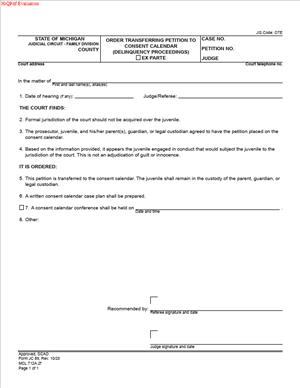
The JC 89 – Order Transferring Petition to Consent Calendar (Delinquency Proceedings) is a court order issued by a judge in a juvenile delinquency case. It states that the petition will be transferred to the consent calendar rather than continue on the standard delinquency track.
In delinquency proceedings, a petition is a formal document alleging that a minor violated the law. Normally, the case could proceed to an adjudication, which is similar to a trial. When the court transfers the petition to the consent calendar, it changes the direction of the case.
The form documents that the transfer was considered and approved by the court. It identifies the juvenile, the case number, and the parties involved. It also confirms that the matter will now be handled under consent calendar procedures.
Who typically uses this form?
This form is used by the Michigan Judicial Circuit – Family Division. It is signed by a judge or referee and entered into the court record.
You may encounter it if you are the juvenile named in the petition. Parents or legal guardians also commonly receive copies. Attorneys, probation officers, and prosecutors may refer to it when tracking the status of the case.
Although court staff prepares the document, the people most affected by it are the juvenile and their family. It shapes what happens next in the proceedings.
Why might you need this form?
You may need this form to understand the current status of a delinquency case. It confirms that the court has decided to use the consent calendar instead of continuing with formal adjudication.
It also matters for compliance. Once a case is on the consent calendar, specific terms and conditions may apply. These can include supervision, counseling, school attendance requirements, or community service.
The form may also be important for recordkeeping. If questions arise later about how the case was handled, this order shows when and how the transfer occurred.
Typical real-life scenarios
- A teenager is accused of shoplifting for the first time. After reviewing the situation, the court determines that formal adjudication may not be necessary. The judge transfers the case to the consent calendar, and the JC 89 form records that decision.
- A minor is charged with vandalism at school. The family agrees to cooperate with supervision and counseling. Instead of proceeding toward a contested hearing, the court moves the case to the consent calendar and issues this order.
- A youth admits responsibility early in the process. The court decides that structured supervision is more appropriate than a full adjudication. The transfer order reflects this shift in approach.
- In another case, the prosecutor and defense agree that a rehabilitative plan would better serve the juvenile. The court reviews the agreement and issues the order transferring the petition to the consent calendar, documenting the new path forward.
When would you use JC 89 – Order Transferring Petition to Consent Calendar (Delinquency Proceedings)?
Use this order when a juvenile delinquency petition has been received by the Michigan Family Division and the court decides that the matter should proceed on the consent calendar instead of the formal calendar. The transfer may occur at any time after the court receives a petition, citation, or appearance ticket, but it must occur before disposition.
Contrary to the original description, the court does not need to have formally acquired jurisdiction over the juvenile before making the transfer. The purpose of the consent calendar is to allow the case to proceed informally when the court determines that formal jurisdiction should not be acquired and that protective and supportive intervention would serve the interests of the juvenile and the public.
The case cannot be placed on the consent calendar unless the prosecutor, the juvenile, and the juvenile’s parent, guardian, or legal custodian agree. The court must also consider the results of the required risk and mental-health screening tools and determine that consent-calendar treatment is appropriate. Victim-notification and participation requirements may apply when the alleged conduct falls under Michigan’s Crime Victim’s Rights Act.
The order states that the court is transferring the petition to the consent calendar. It may also confirm that the juvenile remains in the custody of the parent, guardian, or legal custodian and schedule a consent-calendar conference. Placement on the consent calendar is not an adjudication of guilt or innocence, even though the court must find that the available information indicates conduct that could bring the juvenile within its jurisdiction.
After the transfer, the court conducts a conference with the juvenile, the juvenile’s lawyer if any, and the parent, guardian, or legal custodian. The prosecutor and victim may also participate. The court then prepares a written consent-calendar case plan, which may address counselling, education, community-based services, behavioural requirements, restitution, or other appropriate corrective measures.
The case plan is not itself a court order, and the court does not enter an order of disposition while the matter remains on the consent calendar. However, failing to follow the plan may result in the case being returned to the formal calendar. If the juvenile completes the plan successfully, the court closes the case and handles the records according to the applicable nonpublic-record and retention rules.
Parents and juveniles should review the transfer order and case plan carefully. Consent-calendar proceedings affect important procedural rights and can have significant consequences. The juvenile should understand the process, the requirements of the plan, and what may happen if the plan is not completed.
The order remains part of the official case record and may later establish when and why the matter was transferred. Consent-calendar records are maintained as nonpublic records, subject to the access rules established by Michigan law.
Legal characteristics of JC 89 – Order Transferring Petition to Consent Calendar (Delinquency Proceedings)
This document is a formal court order. It becomes effective once it is signed by a judge or authorized judicial officer and entered into the court record.
For the order to be valid, the court must have proper jurisdiction over the juvenile and the subject matter. The case must already be a delinquency proceeding in the Family Division. The transfer must occur within the structure allowed by Michigan juvenile procedures.
Problems can arise if the order is incomplete. Missing case numbers, incorrect names, or a lack of a judicial signature may delay processing or create confusion. Clerical errors can also affect how the case is tracked in court systems.
Another common issue is misunderstanding what the transfer means. The order does not dismiss the petition. It does not erase the allegations. Instead, it changes the procedural path of the case.
High-level differences may exist between jurisdictions. In Michigan, the Family Division handles juvenile delinquency matters. In other states, similar transfers may use different terminology or follow different rules. The structure of a consent calendar can vary depending on local court practices.
This form does not determine guilt or innocence. It does not impose a final disposition by itself. Instead, it moves the case into a framework where conditions and supervision may be applied without a formal adjudication.
Is it legally binding?
Yes, this is a legally binding court order once signed and entered. It changes how the delinquency petition will proceed within the court system.
Because it is an order of the court, the parties are expected to follow it. If the case is placed on the consent calendar, any related conditions or supervision requirements may carry legal weight.
However, the binding nature of the order relates to the procedural transfer. It does not create a criminal conviction. Juvenile delinquency proceedings are handled differently from adult criminal cases, and the consent calendar is typically designed to emphasize accountability and rehabilitation.
If the terms associated with the consent calendar are not followed, the court may revisit the case. In that situation, the petition could potentially return to the regular delinquency track. The order itself remains part of the official record.
How to fill out JC 89 – Order Transferring Petition to Consent Calendar (Delinquency Proceedings)
Although this form is generally prepared by the court, understanding each section helps you read it accurately. Below is a step-by-step explanation of how the document is structured and completed.
Step 1 – Court Information and Case Caption
At the top of the form, the court name, division, and location are listed. This confirms that the case is in the Michigan Judicial Circuit – Family Division. The case number appears here as well. This number matches the delinquency petition and is used to track the case.
The caption section also identifies the juvenile by name. It may include other identifying information required by the court’s format. Accuracy in this section ensures the order is connected to the correct file.
Step 2 – Identification of the Petition
The form references the delinquency petition that is being transferred. This may include the date the petition was filed or a brief description of the allegations. This section ties the transfer directly to the specific charges in question.
The language typically states that the petition is being transferred to the consent calendar. This confirms that the court is not dismissing the matter but changing how it will proceed.
Step 3 – Findings or Basis for Transfer
In this section, the court may indicate that it has considered relevant factors. These can include the nature of the offense, the juvenile’s history, and the interests of rehabilitation. The form may use standardized wording to reflect these considerations.
This portion shows that the transfer is not automatic. It is based on a decision made during the court process. Even if the wording is brief, it reflects judicial review.
Step 4 – Order of Transfer
This is the core of the document. The judge formally orders that the petition be placed on the consent calendar. The wording makes clear that the case will now proceed under that structure.
This section may also reference supervision by the court or probation department. It signals that further proceedings will follow consent calendar procedures rather than adjudication.
Step 5 – Judicial Signature and Date
At the bottom of the form, the judge or referee signs and dates the order. The signature is what makes the order official and enforceable.
The date is important because it marks when the transfer takes effect. From that point forward, the case is considered part of the consent calendar unless changed by a later order.
Legal terms you might encounter in JC 89 – Order Transferring Petition to Consent Calendar (Delinquency Proceedings)
- Delinquency Petition: This is the formal written request asking the court to decide whether a minor committed a violation of the law. In this form, the petition is the case being moved from the regular delinquency track to the consent calendar. The petition remains active, but the way it is handled changes.
- Consent Calendar: A specialized court track that focuses on supervision, services, and agreements rather than a full adjudication. When your case is placed on the consent calendar, it means the court is allowing the matter to proceed with conditions and oversight instead of moving directly toward trial. The form documents the judge’s decision to make that transfer.
- Adjudication: A court process where a judge decides whether the allegations in the petition are proven. Transferring a case to the consent calendar typically pauses or avoids adjudication, as long as the youth follows the court’s conditions. The order reflects that the case will not proceed to adjudication at this stage.
- Minor or Juvenile: The young person who is the subject of the delinquency petition. The form identifies the minor by name and case number. Accuracy here matters because the order applies only to that specific individual and case.
- Parent, Guardian, or Legal Custodian: The adult legally responsible for the minor. The consent calendar often requires cooperation from this person. The court may consider whether the parent or guardian agrees to the transfer before issuing the order.
- Prosecuting Attorney: The government lawyer who filed or is handling the delinquency petition. In many cases, the prosecutor must agree to the transfer to the consent calendar. The order may reflect that the prosecutor was notified or consented.
- Probation or Court Services: The department that supervises minors placed on the consent calendar. After transfer, probation officers often monitor compliance with conditions such as school attendance, counseling, or community service. The order triggers their involvement.
- Conditions of Supervision: Specific requirements the minor must follow while on the consent calendar. These may include counseling, restitution, curfews, or educational programs. Although the detailed conditions may appear in a separate document, this order allows those conditions to be imposed.
- Jurisdiction: The court’s legal authority over the minor and the case. By transferring the petition to the consent calendar, the court continues to exercise jurisdiction but under a different procedural path. The order confirms that the court retains control of the case.
- Disposition: The outcome or final decision in a delinquency case. Placement on the consent calendar is not a final disposition. Instead, it is a supervised opportunity that may lead to dismissal if successfully completed.
FAQs
Does this order mean the case is dismissed?
No. This document does not dismiss the petition. It moves the case to the consent calendar, where the minor must follow specific conditions. If those conditions are successfully completed, the court may later dismiss the petition, but that happens through a separate action or order.
Who has to agree before the judge signs this form?
Typically, the prosecutor and the minor, often through their attorney, must agree to the transfer. The parent or guardian may also need to consent. Before the judge signs, you should confirm that all required parties have indicated agreement on the record or in writing, because the court will not enter the order without proper consent.
What information must match the court record exactly?
The case number, the minor’s full legal name, and the court’s name must match the official court record. Even a small spelling error can cause filing delays or confusion about which case is being transferred. Double-check the caption at the top of the form against prior court documents before submission.
When does the transfer to the consent calendar become effective?
The transfer becomes effective on the date the judge signs the order. Look at the signature line and the date entered by the court. That date controls when supervision under the consent calendar begins and when any deadlines tied to compliance start running.
Do I need to attach any other documents to this form?
Usually, this document stands alone as a court order. However, the court file may also include a written agreement or recommendation supporting the transfer. Check whether the court requires a separate consent agreement or recommendation from probation to be filed at the same time, so the judge has a complete record.
Will the JC 89 – Order Transferring Petition to Consent Calendar (Delinquency Proceedings) change what appears in the public record?
It changes the procedural status of the case but does not erase the petition. The docket will reflect that the matter was transferred to the consent calendar. The original petition remains part of the court record unless later dismissed by separate court action.
What happens if the minor does not follow the consent calendar conditions?
If conditions are violated, the court can remove the case from the consent calendar and return it to the regular delinquency track. That means the petition may proceed toward adjudication. You should carefully review all supervision terms because noncompliance can reactivate formal proceedings.
How do I confirm that the court accepted and entered the order?
After the judge signs this form, the clerk enters it into the court’s case management system. You can confirm entry by reviewing the case docket or requesting a stamped copy showing the filing date. Make sure the signed version, not a draft, appears in the official record.
Checklist: Before, During, and After JC 89 – Order Transferring Petition to Consent Calendar (Delinquency Proceedings)
Before
- Review the delinquency petition to understand the allegations being transferred.
- Confirm that all parties required to consent have agreed to the transfer.
- Verify the correct case number and spelling of the minor’s full legal name.
- Check whether a separate consent agreement or probation recommendation is needed.
- Ensure contact information for the parent or guardian is current in the court file.
- Speak with probation or court services about proposed supervision terms.
- Prepare copies of any related documents that support the transfer.
- Confirm the scheduled court date for presentation of the order, if applicable.
During
- Present the completed order to the judge for review and signature.
- Confirm that the caption and case number match the court’s official record.
- Listen carefully while the judge states findings on the record.
- Make sure the date of the judge’s signature is clearly written.
- Verify that any referenced agreements are identified in the court file.
- Ask the clerk how and when the signed order will be entered.
- Request a stamped or certified copy if needed for records.
- Clarify the start date of supervision and reporting requirements.
After
- Obtain a copy of the signed and entered order for your records.
- Calendar all deadlines and supervision appointments.
- Review all consent calendar conditions with the minor and parent or guardian.
- Provide a copy of the order to probation or court services if required.
- Monitor compliance with counseling, school, or restitution requirements.
- Keep written proof of completed programs or payments.
- Track progress toward successful completion of the consent calendar.
- Follow up with the court about dismissal or next steps after completion.
Common mistakes to avoid with JC 89 – Order Transferring Petition to Consent Calendar (Delinquency Proceedings)
- Mistake: Submitting the order with the wrong case number because you copied it from memory, which can cause filing rejection or misfiling in another case, so do not forget to verify the number directly from the official court document.
- Mistake: Assuming verbal agreement is enough and failing to document consent, which may lead the judge to refuse to sign the order, so do not forget to ensure all required parties’ consent is clearly reflected.
- Mistake: Leaving the minor’s name incomplete or misspelled, often due to rushed preparation, which can create confusion in the court record, so do not forget to match the spelling exactly as it appears in prior filings.
- Mistake: Not checking the effective date after the judge signs, which can cause missed supervision deadlines, so do not forget to confirm and record the signature date.
- Mistake: Treating the transfer as a dismissal and ignoring supervision conditions, which can result in the case returning to the delinquency calendar, so do not forget that compliance is required.
- Mistake: Failing to obtain a filed copy for your records, which makes it harder to prove the transfer occurred, so do not forget to request and safely store a stamped copy.
- Mistake: Overlooking required attachments or related agreements, often due to a misunderstanding of court procedures, which can delay entry of the order, so do not forget to confirm whether additional documents must be filed together.
What to do after filling out JC 89 – Order Transferring Petition to Consent Calendar (Delinquency Proceedings)
Once the form is completed and ready for signature, your focus shifts to filing, confirmation, and compliance. This order changes the procedural path of the case, so careful follow-through matters.
- Step 1: Review the completed form line by line for accuracy, including the case caption, names, and any referenced documents.
- Step 2: Make at least two copies of the unsigned form—one for your records and one for service or internal tracking.
- Step 3: Submit the form to the court for the judge’s signature, following the court’s required method, whether in person or through the clerk’s office.
- Step 4: After the judge signs, confirm that the clerk has entered the signed order into the official case record.
- Step 5: Request a stamped or certified copy that clearly shows the judge’s signature and the entry date.
- Step 6: Provide a copy to probation or court services if supervision will begin immediately.
- Step 7: Review every supervision condition with the minor and the parent or guardian so everyone understands expectations.
- Step 8: Create a written schedule of all reporting dates, program enrollments, payment deadlines, and review hearings.
- Step 9: Keep organized records of attendance certificates, receipts, and progress reports to demonstrate compliance.
- Step 10: Monitor the case docket for any follow-up hearings or status conferences related to the consent calendar.
- Step 11: When all conditions are completed, confirm with probation or the court what documentation must be filed to show successful completion.
- Step 12: Check whether a separate order of dismissal or closing entry is issued, and obtain a copy for your records.
Staying organized after the transfer is just as important as completing the form correctly. The order opens the door to a structured opportunity. Your careful follow-up helps ensure the case moves toward a positive resolution.
Disclaimer: This guide is provided for informational purposes only and is not intended as legal advice. You should consult a legal professional.