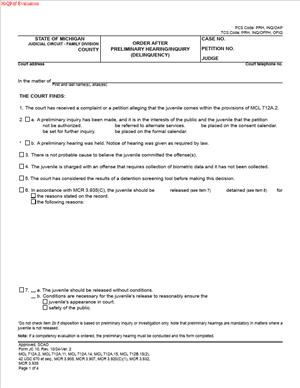
JC 10 – Order after Preliminary Hearing or Inquiry (Delinquency)
Fill out nowJurisdiction: Country: United States | Province or State: Michigan
If you are looking at the JC 10 – Order after Preliminary Hearing or Inquiry (Delinquency), you are likely involved in a juvenile court case in Michigan. This document records what the judge decided after an early court hearing in a delinquency matter.
In plain terms, this form is the court’s written order. It follows a preliminary hearing or preliminary inquiry and sets out what happens next in the case. It may address whether the case moves forward, whether the juvenile remains in custody, and what conditions apply.
For you, this document matters because it controls the next stage of the court process. It reflects decisions that can affect custody status, court dates, and legal rights.
If you are a parent, guardian, or the juvenile named in the case, understanding this form helps you track what the court has ordered. If you are filling it out for the court or reviewing it after a hearing, you need to know exactly what each section means.
What is JC 10 – Order after Preliminary Hearing or Inquiry (Delinquency)?
Clear definition
JC 10 – Order after Preliminary Hearing or Inquiry (Delinquency) is a Michigan court form used in juvenile delinquency cases. It documents the judge’s decisions made at a preliminary hearing or preliminary inquiry.
A preliminary hearing or inquiry is an early stage in the case. The court reviews the allegations, considers whether there is enough basis to proceed, and addresses temporary custody and placement. This form turns those decisions into an official written order.
The document becomes part of the court record. It shows what findings were made and what directions were given to the parties, the juvenile, and any supervising agency.
Who typically uses this form?
This form is used in Michigan family division courts that handle juvenile delinquency matters. Court staff often prepare the document based on the judge’s rulings.
Judges sign the completed form to make it effective. Attorneys for the juvenile or the state may review it for accuracy. Parents or guardians usually receive a copy for their records.
In some situations, a self-represented party may review the form closely to understand the outcome of the hearing. The form is not usually drafted by families themselves, but it directly affects them.
Why might you need this form?
You may need this form to confirm what the court decided at the preliminary stage. It tells you whether the petition moves forward or is dismissed.
It may also state whether the juvenile will remain in detention, be released to a parent, or be placed under supervision. Those details affect daily life immediately.
The form can include conditions, such as school attendance, curfew, or no-contact provisions. Knowing these conditions helps you understand the expectations set by the court.
If you are preparing for the next court date, this document gives you the framework for what comes next. It shows the legal status of the case after the preliminary review.
Typical real-life scenarios
- A juvenile is accused of shoplifting. At the preliminary hearing, the court reviews the petition and decides there is enough information to continue the case. The JC 10 – Order after Preliminary Hearing or Inquiry (Delinquency) reflects that decision and schedules the next step.
- A teenager is taken into custody after an alleged assault. At the preliminary inquiry, the judge considers whether the youth should remain in detention. The order states whether the juvenile stays in custody or is released to a parent with conditions.
- In another case, the court finds that the allegations are not supported at the early stage. The order documents that the petition is dismissed, ending the matter at that point.
- A youth appears in court with a parent and an attorney. The judge sets specific conditions of release, such as attending school daily and avoiding contact with a named individual. The form lists those conditions so everyone knows what rules apply.
When would you use JC 10 – Order after Preliminary Hearing or Inquiry (Delinquency)?
This form is used immediately after a preliminary hearing or inquiry in a Michigan juvenile delinquency case. That hearing usually takes place shortly after a petition is filed or the juvenile is taken into custody.
The court uses the form to record its findings. If you are reviewing the case file, you would look at this document to understand the court’s early rulings.
Attorneys may use the completed order to prepare for the next phase of the case. It helps them confirm what issues were addressed and what remains unresolved.
Parents and guardians often refer to the order to understand custody status and any court-imposed conditions. The form becomes a reference point until another order changes those terms.
Court staff rely on it to update internal records. Agencies involved in supervision or detention may also rely on it to carry out the court’s instructions.
Legal characteristics of JC 10 – Order after Preliminary Hearing or Inquiry (Delinquency)
This document is a court order. It reflects a judge’s findings and directives made on the record during a hearing. Once signed, it carries the authority of the court.
For the order to be effective, it generally must identify the juvenile, the case number, and the court. It must clearly state the decisions made. A judge’s signature and the date are typically required for validity.
Problems can arise if information is incomplete or inconsistent with what was said in court. Errors in names, case numbers, or custody status can create confusion. Inaccurate details may require correction through the court.
The form addresses decisions at the preliminary stage only. It does not determine final responsibility or impose a final disposition. Those decisions usually come later in the process if the case continues.
Procedures and terminology can vary slightly between courts, but the basic function remains the same across Michigan. The order documents early findings and sets the case on its next path.
Is it legally binding?
Yes, once signed by a judge, the order is legally binding. It represents an official directive of the court.
The binding effect applies to the parties named in the case. If the order sets conditions of release, those conditions are enforceable. If it schedules further proceedings, the parties are expected to appear as directed.
However, it is limited to the matters addressed at the preliminary stage. It does not resolve the entire delinquency case unless it specifically dismisses the petition. Future hearings may change custody, conditions, or other terms through new orders.
How to fill out JC 10 – Order after Preliminary Hearing or Inquiry (Delinquency)
Step 1 – Enter the court and case information
At the top of the form, fill in the name of the court, including the county and division handling the juvenile matter. Enter the case number exactly as it appears on other court documents. Identify the juvenile by full legal name and include any required identifying details. Accuracy here ensures the order is placed in the correct file.
Step 2 – Identify the type of hearing held
Indicate whether the proceeding was a preliminary hearing or a preliminary inquiry. This section clarifies what stage of the process the court addressed. Make sure the date of the hearing is listed clearly, as the timing is part of the official record.
Step 3 – Record the court’s findings
Document the judge’s findings regarding the petition. This may include whether there is sufficient basis to proceed. Write the findings in clear, complete terms that reflect what the judge stated on the record. Avoid adding information that was not part of the ruling.
Step 4 – State custody or placement decisions
Complete the section that addresses whether the juvenile is detained, released, or placed under supervision. If the court ordered release to a parent or guardian, include that information. If detention continues, reflect that decision exactly as stated.
Step 5 – List any conditions of release or supervision
If the court imposed specific conditions, enter them clearly in the space provided. Conditions may relate to school attendance, curfew, contact restrictions, or other behavioral requirements. Use precise language so there is no confusion about what is expected.
Step 6 – Include scheduling information for next proceedings
If the judge set a date for the next hearing, record the date, time, and location. This section guides the parties on what happens next. Confirm that the information matches the court’s announced schedule.
Step 7 – Review for completeness and accuracy
Before the form is finalized, check all names, dates, and selections. Ensure that each marked box and written section reflects the judge’s actual rulings. Correcting errors at this stage helps avoid later disputes or delays.
Step 8 – Obtain the judge’s signature and date
Present the completed document for the judge’s signature. The order becomes effective once signed and dated. After signature, it is filed with the court and entered into the official record.
Legal terms you might encounter in JC 10 – Order after Preliminary Hearing or Inquiry (Delinquency)
- Preliminary Hearing: This is an early court proceeding where a judge reviews the allegations against a minor. On this form, it confirms that the court has determined whether there is enough evidence to move the case forward. The order reflects what the judge decided at that stage.
- Preliminary Inquiry: A less formal review conducted by the court before a petition proceeds. The form may indicate that the inquiry was completed and whether the case will continue or be dismissed. It documents the court’s initial assessment of the matter.
- Probable Cause: This means the judge found sufficient evidence to believe the juvenile committed the alleged offense. If probable cause is found, the case typically advances to the next phase. The form records whether this finding was made.
- Petition: The formal written document that lists the allegations against the juvenile. The order references the petition when confirming what charges or counts were reviewed. Make sure the petition details match what appears in the order.
- Detention: Temporary custody of the juvenile, often in a secure or non-secure facility, while the case continues. The order will state whether the juvenile remains detained or is released. This section affects immediate living arrangements.
- Release Conditions: Specific rules the juvenile must follow if released from custody. These may include attending school, obeying a curfew, or avoiding certain individuals. The order lists these conditions clearly, and they are legally enforceable.
- Custody Placement: The decision about where the juvenile will live during the case. This may be with a parent, guardian, relative, or another approved placement. The form documents the court’s placement decision.
- Next Hearing Date: The scheduled date for the next court appearance. The order usually includes this information. You must carefully record and follow this date.
- Waiver of Hearing: In some cases, a party may give up the right to a formal preliminary hearing. If that happens, the order will note that the hearing was waived. This changes how the case moves forward.
- Court Jurisdiction: The authority of the court to hear and decide the case. The order confirms that the court has jurisdiction over the juvenile and the alleged offense. Without jurisdiction, the court cannot proceed.
FAQs
What information should I double-check before the judge signs this document?
Confirm the juvenile’s full legal name, date of birth, and case number exactly match the petition and court file. Check that the listed charges are accurate and that the judge’s findings reflect what was stated in court. Verify the next hearing date and any custody or release conditions. Small clerical errors can create confusion later.
Does this form take effect immediately after the hearing?
In most situations, yes. The order becomes effective once the judge signs it. If it includes detention or release conditions, those rules apply right away. Look for the judge’s signature and the date on the document to confirm when it became active.
What if the custody decision written on the form is different from what I understood in court?
Review your notes from the hearing and compare them with the written order. If something seems inconsistent, raise the issue promptly through proper court channels. The written order controls what happens next, so you must ensure it accurately reflects the judge’s ruling.
Do I need to attach anything to JC 10 – Order after Preliminary Hearing or Inquiry (Delinquency)?
This document is typically completed and issued by the court, not filed by you with attachments. However, if the judge referenced specific reports or recommendations during the hearing, those documents may already be part of the court file. Make sure the order accurately references any findings connected to those materials.
How do I know if the court officially accepted and entered this order?
Once signed by the judge, the clerk records it in the court file. You can confirm entry by checking the case docket or requesting a copy stamped or marked as filed. If you receive a copy directly from the courtroom, verify that it includes the signature and date.
Can the conditions listed in this document be changed later?
Yes, conditions can sometimes be modified at a later hearing. Until that happens, you must follow the terms exactly as written. If circumstances change, the proper way to address it is through a formal request to the court, not by ignoring the existing order.
What happens if someone does not follow the release conditions stated in the order?
Failure to follow conditions can lead to additional court action. The judge may revise placement, impose stricter supervision, or order detention. Carefully review each condition so you understand what compliance requires in practical terms.
Will this order appear in the public court record?
This document becomes part of the official juvenile case file. Access to juvenile records is often restricted, but the order is still an official court record. Keep a copy for your own records and understand that it documents the court’s findings at this stage.
Checklist: Before, During, and After JC 10 – Order after Preliminary Hearing or Inquiry (Delinquency)
Before
- Review the petition and confirm the listed allegations.
- Verify the juvenile’s full legal name and date of birth.
- Confirm the correct case number.
- Gather notes from the preliminary hearing or inquiry.
- Check any recommendations discussed in court.
- Prepare to confirm custody status and placement details.
- Write down questions about release conditions.
- Bring identification if you plan to request copies.
During
- Listen carefully as the judge states findings.
- Confirm whether probable cause was found.
- Note whether detention continues or release is granted.
- Write down all release conditions exactly as stated.
- Record the next court date and time.
- Watch for any corrections made on the record.
- Ensure the judge signs and dates the order.
- Ask how to obtain a certified or file-stamped copy.
After
- Obtain a copy of the signed order.
- Review every section for accuracy.
- Calendar the next hearing date.
- Share the conditions with the juvenile and caregivers.
- Keep the document in a secure file.
- Monitor compliance with all listed conditions.
- Update any school or supervision arrangements if required.
- Track deadlines related to upcoming hearings.
Common mistakes to avoid with JC 10 – Order after Preliminary Hearing or Inquiry (Delinquency)
- Mistake: Assuming the written order matches what you remember from court, which happens because hearings move quickly; this can lead to missed conditions or incorrect dates, so do not forget to read every line before relying on it.
- Mistake: Ignoring minor spelling errors in the juvenile’s name or case number, often caused by clerical oversight; this can create record mismatches later, so do not forget to request corrections promptly.
- Mistake: Overlooking release conditions such as curfews or no-contact rules, which happens when focusing only on custody status; violations can result in detention, so do not forget to review each condition carefully.
- Mistake: Failing to calendar the next hearing date, often due to assuming you will receive a reminder; missing court can cause serious consequences, so do not forget to enter the date immediately.
- Mistake: Not confirming that the judge signed and dated the order, which can occur if you leave the courtroom quickly; an unsigned document may not be enforceable, so do not forget to check for a valid signature.
- Mistake: Misunderstanding who is responsible for supervising compliance, which happens when roles are not clearly discussed; confusion can lead to unintentional violations, so do not forget to clarify supervision duties.
- Mistake: Storing the only copy in an unsecured place, often because the matter feels temporary; losing the document can make it hard to prove terms later, so do not forget to keep copies in a safe location.
What to do after filling out JC 10 – Order after Preliminary Hearing or Inquiry (Delinquency)
Once the order is completed and signed, your focus shifts to implementation and recordkeeping. This document controls what happens next in the case. Treat it as an active instruction sheet, not just paperwork.
Start by reviewing the entire order calmly. Pay attention to custody status, supervision terms, and scheduling information. Make sure you understand what is required immediately.
- Step 1: Obtain at least two copies of the signed order, including one for your records and one for the juvenile’s primary caregiver.
- Step 2: Confirm that the copy you receive includes the judge’s signature and the date of entry.
- Step 3: Review all listed conditions line by line and translate them into practical actions, such as setting curfews or arranging transportation.
- Step 4: Enter the next court date into your calendar and set reminders several days in advance.
- Step 5: Inform any necessary parties, such as a supervising adult, of their responsibilities under the order.
- Step 6: Organize the document in a dedicated case folder, either physical or digital, labeled with the case number.
- Step 7: Monitor compliance with every condition and keep simple written notes if supervision is required.
- Step 8: Prepare in advance for the next hearing by tracking whether conditions are being followed.
- Step 9: If circumstances change, document those changes and prepare to address them at the next court appearance.
- Step 10: Bring your copy of the order to all future court hearings so you can reference it if questions arise.
Staying organized reduces stress. Clear records help you respond confidently if the court asks about compliance. The more proactive you are now, the smoother the next stage of the case will be.
Disclaimer: This guide is provided for informational purposes only and is not intended as legal advice. You should consult a legal professional.