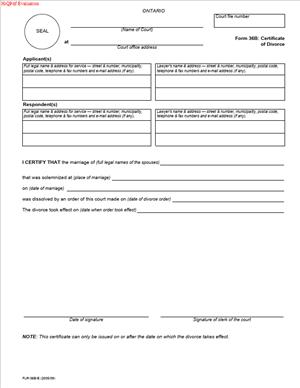
Form 36B – Certificate of Divorce
Fill out nowJurisdiction: Country: Canada | Province or State: Ontario
If your divorce has already been granted by the court, Form 36B – Certificate of Divorce is the document that confirms it. This form is not what starts your divorce. It is what proves your divorce is legally finalized.
You may need Form 36B – Certificate of Divorce when you want official proof that your marriage has ended. Many people request it after receiving a divorce order, especially when they need to update personal records or remarry.
This document is issued by the court. It reflects that a divorce order has taken effect and that the required waiting period has passed. It is a formal court certificate, not a private agreement between spouses.
If you are representing yourself, it helps to understand what this form does, how it fits into the court process, and what information must be accurate before it is issued.
What is Form 36B – Certificate of Divorce?
Clear definition
Form 36B – Certificate of Divorce is an official court certificate issued after a divorce order becomes final. It confirms that a marriage has been legally dissolved under Ontario’s family law system.
The form includes basic details such as the names of the former spouses, the court file number, and the date the divorce took effect. It serves as formal confirmation that the divorce is complete.
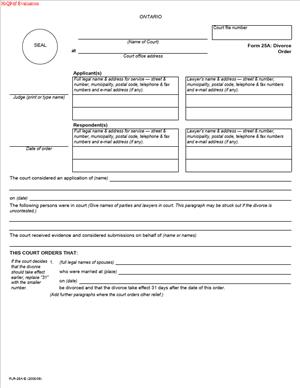
This document is separate from the divorce order itself. The divorce order states that the court has granted the divorce. The certificate confirms that the divorce is now legally effective.
Who typically uses this form?
People who have already gone through the court process for divorce are the ones who use this form. This includes individuals who filed for divorce on their own and those whose divorce was handled with legal assistance.
You might request this certificate if you were the applicant or the respondent in the case. Either former spouse can usually request a copy once the divorce is final.
Court staff prepare and issue the certificate. You do not draft the legal wording of the certificate yourself, but you may need to complete a request or provide identifying information to obtain it.
Why might you need this form?
You may need this certificate to prove your marital status has changed. Many institutions require official proof before updating their records.
For example, if you plan to remarry, you will typically need to show proof that your previous marriage has legally ended. A divorce order alone may not always be accepted. The certificate is often the document requested.
You may also need it when changing your name on identification, updating financial accounts, adjusting insurance policies, or handling estate matters.
This form provides clear evidence that the divorce is no longer pending and that the legal relationship of marriage has been dissolved.
Typical real-life scenarios
- You finalized your divorce several months ago and are now planning to remarry. When applying for a marriage licence, you are asked to provide official proof of your divorce. The certificate serves that purpose.
- You are updating your legal name on government identification. The agency requests proof that your divorce is final. You provide the certificate to support your request.
- You are dividing pensions or adjusting beneficiary designations. An institution asks for confirmation that your marriage has legally ended before processing changes.
- You are dealing with cross-border matters, such as immigration or property issues in another country. An official certificate from the court may be required to confirm your current marital status.
When would you use Form 36B – Certificate of Divorce?
Use this form after the court has granted a divorce order and the required waiting period has passed. In Ontario, a divorce order usually becomes final 31 days after it is made, unless an appeal is filed during that period.
Once the waiting period has passed and no appeal has been started, the divorce takes effect automatically. The Certificate of Divorce can then be issued as official proof that the divorce is final.
You may request the certificate shortly after the divorce becomes final, or you may request it years later. There is no strict deadline for asking for a Certificate of Divorce. However, you may need it when a specific situation arises, such as remarrying, updating government records, changing identification, dealing with pension or benefit issues, or proving marital status for legal or administrative purposes.
Either former spouse may request the certificate. It is not limited to the person who started the divorce case. Once the divorce is final, both parties have the same ability to obtain proof of the divorce from the court.
This form applies specifically to divorces granted by the Ontario Superior Court of Justice under the Family Law Rules. If your divorce was granted in another province, territory, or country, a different process may apply. In that case, you may need to request proof from the court or authority that granted the divorce.
Legal characteristics of Form 36B – Certificate of Divorce
This certificate is an official court document. It is issued under the authority of the Ontario Superior Court of Justice. It carries the court seal or official endorsement that confirms its authenticity.
For the certificate to be valid, the divorce order must already be in effect. If the 31-day waiting period has not passed, or if an appeal has been filed, the certificate cannot be properly issued.
Accuracy is critical. The names of the spouses must match the court record. The court file number must be correct. Errors in spelling, dates, or identifying details can cause delays or require corrections before issuance.
The certificate confirms only that the marriage has ended. It does not set out terms about child support, decision-making responsibility, parenting time, or property division. Those issues are addressed in separate court orders or agreements.
If court fees are required for issuing the certificate, they must be paid before it is released. Failure to complete the request properly may result in processing delays.
In some cases, people confuse the divorce order with the certificate. The order grants the divorce. The certificate confirms it is final. Both are court documents, but they serve different purposes.
Is it legally binding?
The certificate itself does not create new legal obligations. It confirms a legal status that already exists. The binding decision is the divorce order made by the judge.
Once the divorce order becomes effective, the marriage is legally dissolved. The certificate reflects that fact. It is evidence of a change in legal status, not a new ruling.
Institutions rely on this certificate as official proof. Because it is issued by the court, it is widely accepted as authoritative confirmation that the divorce is final.
However, the certificate does not change or override other court orders. If there are separate orders about support or parenting, those remain in effect according to their terms.
How to fill out Form 36B – Certificate of Divorce
Step 1 – Confirm that your divorce is final
Before requesting or completing any portion related to the certificate, confirm that the divorce order has taken effect. In Ontario, this usually happens 31 days after the order is made, provided no appeal has been filed.
Check the date on your divorce order. Count the required waiting period carefully. If you apply too early, the certificate cannot be issued.
Step 2 – Gather your court information
Locate your court file number. This number appears on your divorce order and other court documents. You will need it to ensure the certificate matches the correct case.
Also, confirm the full legal names of both former spouses as they appear on the court record. Use the exact spelling shown in the divorce proceedings.
Have the date the divorce order was made available. This helps court staff verify that the waiting period has passed.
Step 3 – Complete the request details accurately
If you are required to submit a request form or provide written information, fill in all required sections clearly. Enter the court file number, the names of both parties, and the location of the court where the divorce was granted.
Ensure that the information matches the court record exactly. Even small differences in spelling or formatting can cause confusion.
Write legibly if completing the form by hand. If submitting electronically, double-check for typing errors before finalizing.
Step 4 – Pay any required court fee
There is typically a fee to obtain a Certificate of Divorce. Confirm the current amount with the court office handling your file.
Prepare payment in the accepted form. An incomplete payment can delay processing. Keep proof of payment for your records.
If you are requesting multiple copies, confirm the total fee in advance.
Step 5 – Submit your request to the correct court office
Submit your request to the same court location where your divorce was granted. This is usually listed on your divorce order.
Provide all required information at the time of submission. Incomplete requests may be returned or held until additional details are provided.
If submitting in person, bring identification if required. If submitting by mail, ensure all documents and payment are included.
Step 6 – Review the issued certificate carefully
Once you receive Form 36B – Certificate of Divorce, review it immediately. Confirm that the names, court file number, and effective date of divorce are correct.
If you notice an error, contact the court office promptly to ask about the correction process. Do not use a certificate with incorrect information for official purposes.
Store the certificate in a secure place. You may need it again in the future for legal or administrative matters.
Legal terms you might encounter in Form 36B – Certificate of Divorce
- Divorce Order: This is the official court order that ends your marriage. The certificate is based on this order. You will need the court file number and the date the divorce order was made when requesting this document.
- Effective Date of Divorce: This is the date your divorce legally took effect, not the date of your court hearing. In Ontario family law proceedings, a divorce usually becomes final 31 days after the divorce order is made, unless there is an appeal. The certificate confirms this exact date.
- Court File Number: This is the unique number assigned to your family court case. It appears on all court documents related to your divorce. You must provide this number so the court can locate your file.
- Applicant: This is the person who started the divorce case. The applicant’s name appears on the original divorce documents and must match the court record exactly.
- Respondent: This is the person who responded to the divorce case. Like the applicant, the respondent’s name must be written exactly as it appears in the court file.
- Court Seal: The seal is the official stamp placed on the certificate by the court. It confirms that the document is authentic and issued by the court. Without the seal, the document is not considered an official court-issued certificate.
- Registrar or Clerk: This is the court official who processes and issues the certificate. The registrar reviews the court file to confirm that the divorce is final before preparing the certificate.
- Appeal Period: This is the time allowed for either party to challenge the divorce order. The certificate will not be issued until this period has passed and no appeal has been filed.
- Certified Copy: This is a copy of a court document that has been stamped and confirmed as a true copy of the original. A certificate of divorce is different from a certified copy of the divorce order, although both may be requested from the court.
FAQs
How do I know if I can apply for Form 36B – Certificate of Divorce?
You can apply once your divorce order has taken effect. Check the date the divorce order was made and confirm that the appeal period has passed. The divorce usually becomes final 31 days after the order date, unless an appeal was filed. If you are unsure, review your divorce order or contact the court office to confirm the effective date before submitting this form.
What information do I need to provide on this document?
You need the court file number, the full legal names of both spouses exactly as written in the court record, and the date of the divorce order. If any detail does not match the court file, the court may not process your request. Double-check spelling, middle names, and hyphenated names against your original court documents.
Is this document the same as my divorce order?
No. Your divorce order is the decision issued by the judge that grants the divorce. This document is proof that the divorce has become final and shows the effective date. Many government offices and foreign authorities ask specifically for the certificate, not just the order.
Can I request this certificate if I was not the applicant in the divorce case?
Yes. Either former spouse can request this document, as long as the divorce has been finalized. You must provide accurate case details so the court can locate the file. The court does not require both parties to sign the request.
What happens if I enter the wrong court file number?
If the file number does not match an existing case, the court will not be able to locate your record. This can delay processing or result in your request being returned. Always copy the number directly from your divorce order or other official court documents to avoid errors.
Will this document show details about support or custody?
No. It only confirms that a divorce was granted and states the effective date. It does not list terms about child support, spousal support, parenting arrangements, or property division. For those details, you would need a copy of the relevant court orders.
How long does it take to receive the certificate after I apply?
Processing times vary depending on the court’s workload and how you submit your request. If your file is complete and the divorce is final, the court will issue the certificate once it verifies the information. Delays often happen when names or dates do not match the court record.
What should I check once I receive Form 36B – Certificate of Divorce?
Review the spelling of both names, the court file number, and the effective date of divorce. Make sure the court seal is present. If any detail is incorrect, contact the court office promptly to have it corrected before using the document for official purposes.
Checklist: Before, During, and After Form 36B – Certificate of Divorce
Before
- Confirm that your divorce order has been granted.
- Count 31 days from the date of the divorce order to ensure the appeal period has passed.
- Locate your court file number on previous court documents.
- Verify the exact spelling of both spouses’ legal names in the court record.
- Check the date the divorce order was made.
- Prepare payment for the required court fee.
- Decide how you will submit your request (in person, by mail, or as permitted by the court).
During
- Write the court file number exactly as shown on your documents.
- Enter both spouses’ names exactly as they appear in the court record.
- Provide the correct date of the divorce order.
- Review every field for spelling and number errors.
- Confirm that your contact information is current and legible.
- Attach the payment in the accepted form.
- Make a copy of your completed request for your records.
After
- Wait for confirmation or processing from the court.
- Monitor your mail or chosen delivery method for the certificate.
- Check that the court seal appears on the certificate.
- Review names and dates for accuracy.
- Store the original certificate in a secure place.
- Make certified copies if you need to submit the document to multiple agencies.
- Update your personal records to reflect your divorced status if required.
Common mistakes to avoid with Form 36B – Certificate of Divorce
- Mistake: Applying before the divorce is final because you assume the hearing date is the final date, which leads to rejection or delay; do not forget to confirm that the full appeal period has passed.
- Mistake: Misspelling a spouse’s legal name because you rely on memory, which can cause processing delays; do not forget to copy names exactly as shown in the court record.
- Mistake: Entering the wrong court file number due to mixing it up with another document number, which prevents the court from locating your file; do not forget to verify the number directly from your divorce order.
- Mistake: Assuming the certificate includes custody or support terms, which can result in submitting the wrong document to an agency; do not forget that this certificate only confirms the divorce and its effective date.
- Mistake: Forgetting to include the required fee, often because you overlook payment instructions, which can stop your request from being processed; do not forget to confirm the current fee and accepted payment methods.
- Mistake: Failing to check the issued certificate for errors, which can create problems when remarrying or updating records; do not forget to review names, dates, and the court seal immediately upon receipt.
What to do after filling out Form 36B – Certificate of Divorce
Once you complete your request, pause and review it carefully. Small mistakes cause most delays. Check names, numbers, and dates against your original court documents.
- Step 1: Make at least one clear copy of your completed request for your personal records.
- Step 2: Confirm the correct court location where your divorce was granted.
- Step 3: Submit your request using the accepted method for that court, such as in person or by mail.
- Step 4: Include the required fee in the proper format.
- Step 5: If mailing, use a secure method and keep proof of delivery.
- Step 6: Wait for the court to process your request and issue the certificate.
- Step 7: Review the issued certificate immediately for accuracy, including the spelling of names and the effective date.
- Step 8: Store the original certificate in a safe place, such as a secure home file or safety deposit box.
- Step 9: Provide certified copies to government agencies or other institutions if required, rather than giving away your original.
- Step 10: Update your personal records where necessary, such as marital status information on official documents.
Keep your certificate accessible but protected. You may need it years later for remarriage, estate matters, or administrative updates. Having accurate records now saves time and stress in the future.
Disclaimer: This guide is provided for informational purposes only and is not intended as legal advice. You should consult a legal professional.