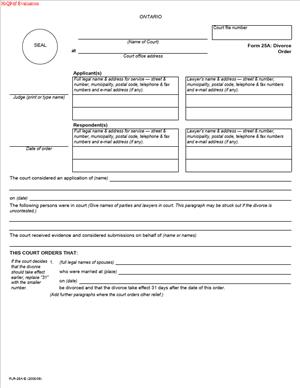
Form 25A – Divorce Order
Fill out nowJurisdiction: Country: Canada | Province or State: Ontario
Form 25A – Divorce Order is the court document that officially ends a marriage in Ontario. It is issued by the court after a judge grants a divorce. This form confirms that the divorce has been approved and sets out the effective date.
If you are representing yourself, this is one of the final documents in your divorce process. It reflects the judge’s decision and becomes part of the official court record. You may prepare it for the court’s review and signing.
This document matters because it legally changes your marital status. Until a divorce order takes effect, you are still legally married. Many financial, personal, and legal decisions depend on that status.
You may need this order to remarry, update government records, change your name in certain contexts, or deal with estate matters. It is not just paperwork. It is the formal confirmation that your marriage has legally ended.
Understanding how Form 25A – Divorce Order works will help you complete it accurately and avoid delays at the final stage of your case.
What is Form 25A – Divorce Order?
Clear definition
Form 25A – Divorce Order is the official court order that grants a divorce under Ontario’s family law process. It sets out the names of the parties, the court file number, and the date the divorce becomes effective.
It is not the same as an application for divorce. It comes after the court has reviewed your materials and decided to grant the divorce. The form reflects that decision in a formal, enforceable format.
The document is part of the Ontario Superior Court of Justice’s family law forms. It follows a standard layout so court staff and judges can quickly confirm the required details.
Who typically uses this form?
This form is used by married spouses who have applied for a divorce through the court. It may be used in both simple and joint divorce cases.
In a simple divorce, one spouse applies, and the other does not respond or contest the divorce. In a joint divorce, both spouses apply together. In either case, the court issues a divorce order once the legal requirements are met.
Self-represented individuals often prepare this document themselves as part of the final steps in the process. Lawyers also complete and submit it for their clients in represented cases.
Why might you need this form?
You need this form to formally end your marriage in the eyes of the law. Without a signed divorce order, you remain legally married, even if you have been separated for years.
This document confirms the exact date the divorce takes effect. That date is important for remarriage and for calculating certain legal timelines.
The divorce order also serves as proof of divorce. You may need it when dealing with pension administrators, insurance providers, or government agencies.
It provides clarity and closure. It shows that the court has reviewed your case and granted the divorce according to legal requirements.
Typical real-life scenarios
- You and your spouse have lived apart for at least one year. You file for an uncontested divorce. After the waiting period and required documents are submitted, the court prepares to issue a divorce order.
- You and your spouse apply together in a joint divorce. You agree on all related issues, such as parenting and support. Once the judge reviews the file and is satisfied, a divorce order is issued.
- Your spouse does not respond to your divorce application. You proceed by filing the required additional materials. The court reviews your evidence and grants the divorce. Form 25A – Divorce Order reflects that decision.
- You previously obtained a separation agreement dealing with property and support. Now you want to legally end the marriage. After filing for divorce and meeting the requirements, the court issues the divorce order to finalize your marital status.
When would you use Form 25A – Divorce Order?
You use this form at the final stage of a divorce case. It comes after the application has been filed, served, and processed, and after any waiting or response periods have passed.
In many uncontested cases, once all required materials are in the court file, the matter is reviewed by a judge without a court appearance. If the judge is satisfied that the legal grounds for divorce are met, the divorce is granted and recorded in this order.
In joint applications, both spouses submit the required documents together. The divorce order is then prepared to reflect the joint request and the court’s approval.
This form is not used to start a divorce. It is used to record that the divorce has been granted. It may be prepared by one of the spouses and submitted for the judge’s signature, depending on how the case proceeds.
If there were additional claims in the case, such as parenting time, decision-making responsibility, child support, or spousal support, those may be addressed in other orders. The divorce order focuses specifically on ending the marriage, although it may reference related relief if granted at the same time.
Legal characteristics of Form 25A – Divorce Order
Form 25A – Divorce Order becomes effective only after it is signed by a judge and entered by the court. The order includes the date it takes effect. In Ontario, a divorce typically becomes final 31 days after the order is made, unless there is an appeal.
The form must accurately reflect the information in the court file. This includes the full legal names of both spouses, the court file number, and the correct court location. Errors in these details can cause delays or require corrections.
The order must show that the court has jurisdiction. This usually involves confirming that at least one spouse has lived in Ontario for the required period before applying for divorce. If this information is missing or unclear in the record, the court may not grant the order.
Common problems include incomplete information, mismatched names, incorrect dates, or missing prior steps in the process. If required documents, such as proof of service or affidavits, are not in the file, the judge may refuse to grant the divorce until the file is complete.
This form does not divide property by itself. It does not automatically change child support or spousal support terms unless those matters are included in the court’s decision. It also does not replace a certificate of divorce, which is a separate document that can be requested after the divorce takes effect.
Although divorce laws are federal, court procedures are managed at the provincial level. The structure and numbering of this form are specific to Ontario’s family court system. Other provinces use similar but not identical documents.
Is it legally binding?
Yes, once signed and entered by the court, the divorce order is legally binding. It formally ends the marriage as of the effective date stated in the order.
Before it is signed by a judge, the document is only a draft. It has no legal effect until the court approves it. After the effective date passes, both parties are legally divorced.
The binding nature of the order relates to marital status. It confirms that the legal relationship of marriage has ended. If the order also includes additional terms granted by the court at the same time, those terms are also enforceable according to their wording.
If either party believes there is an error or wishes to challenge the decision, there are legal processes that may apply within certain time limits. Outside of those processes, the divorce order stands as the final decision on the marriage itself.
How to fill out Form 25A – Divorce Order
Step 1 – Complete the court information section
At the top of the form, enter the name of the court and the court file number exactly as shown on your other court documents. Include the full names of both spouses, written the same way they appear in the application for divorce. Consistency is important to avoid confusion in the court record.
Step 2 – Identify the parties correctly
Indicate who the applicant is and who the respondent is, or confirm that the case is a joint application if that applies. Use full legal names, not nicknames. The names must match the ones used throughout the case.
Step 3 – Confirm the type of divorce decision
The form includes wording that reflects the judge’s decision to grant a divorce. Ensure that the language aligns with the type of application filed, whether simple or joint. Do not change the standard wording unless directed through the court process.
Step 4 – Insert the date the order is made
Leave space for the date the judge signs the order, unless you are instructed to include a specific date. The effective date of the divorce is calculated from the date the order is made, not from the date you separated.
Step 5 – Review for accuracy and completeness
Read the entire document carefully before submitting it. Check spelling of names, the court file number, and all identifying details. Confirm that the information matches the rest of your court materials. An accurate and complete form helps prevent delays at this final stage of your divorce process.
Legal terms you might encounter in Form 25A – Divorce Order
- Divorce Order: This is the official court document that confirms your marriage is legally dissolved. In Form 25A – Divorce Order, the judge signs this order after reviewing your application and confirming that all legal requirements have been met. It is not the same as a divorce certificate. It is the court’s formal decision.
- Effective Date: This is the date your divorce legally takes effect. It is usually 31 days after the date the order is made, unless the court orders otherwise. You must check this date carefully because you cannot remarry until after the divorce becomes effective.
- Court File Number: This is the unique number assigned to your case when you started your divorce proceeding. It appears at the top of the document and connects this order to your specific court file. If this number is wrong, the order may not match your case record.
- Applicant: The person who started the divorce case. This name must appear exactly as it does in the court file and on prior documents. Any spelling difference can cause delays or confusion in court records.
- Respondent: The other spouse in the divorce case. Even in a joint divorce, both names must be correctly listed. The court uses these names to ensure the order applies to the correct individuals.
- Order Date: This is the date the judge signs the divorce order. It is not necessarily the same as the date you filed documents. The effective date of divorce is calculated from this order date.
- Registrar: A court official who processes and issues court documents. The registrar may sign or issue the divorce order after the judge approves it. You may deal with the registrar when submitting documents for review or when requesting certified copies.
- Corollary Relief: This refers to additional issues such as child support, spousal support, decision-making responsibility, or parenting time. In some cases, the divorce order may address only the divorce itself, while other issues are dealt with in separate orders.
- Certificate of Divorce: This is a separate document you can request after the divorce becomes effective. It confirms the divorce is final and is often required if you plan to remarry. It is not automatically issued with the divorce order.
- Affidavit for Divorce: This is a sworn statement you previously filed confirming details such as the separation date and absence of reconciliation. The judge relies on this affidavit before signing the divorce order.
FAQs
When does my divorce become final?
Your divorce becomes final on the effective date written in the order. This is usually 31 days after the judge signs the Divorce Order. You must look at both the order date and the effective date section to confirm when your marital status legally changes.
Is the Form 25A – Divorce Order the same as a divorce certificate?
No. This document is the judge’s formal order granting the divorce. A divorce certificate is a separate document you can request after the effective date has passed. If you plan to remarry, you will usually need the certificate, not just this form.
What happens if my name is spelled incorrectly on this document?
If your name does not match your court file or identification, it can create problems later. For example, it may affect your ability to obtain a divorce certificate or update your identification. You should review every letter of each name before the order is finalized and raise any errors promptly.
Do both spouses have to sign this form?
No. The judge signs the divorce order. You and your spouse do not sign the final order itself. However, you may have signed earlier documents in the process, such as an application or affidavit.
Can I remarry as soon as the judge signs the order?
No. You must wait until the effective date stated in the order. The law provides a waiting period, typically 31 days, before the divorce becomes legally effective. Remarrying before that date would not be legally valid.
What if I disagree with something written in this document?
You need to identify exactly what part concerns you. Check whether the issue relates to the divorce itself or to corollary relief such as support or parenting. If you believe there is an error in the Form 25A – Divorce Order, you must act quickly before the order becomes effective.
Will this document change my name automatically?
No. The order legally ends the marriage, but it does not automatically change your name on identification. If you want to resume using a previous surname, you must update your name separately with government agencies and institutions.
How do I know the court has officially issued this document?
You will receive a signed and dated copy showing the judge’s signature and the court seal or issuance stamp. The presence of the court’s official markings confirms it has been entered into the court record.
Checklist: Before, During, and After Form 25A – Divorce Order
Before
- Confirm your court file number matches all previous documents.
- Review the spelling of both spouses’ full legal names.
- Ensure your affidavit for divorce has been properly filed.
- Check that all required waiting periods have passed.
- Verify that any required service steps were completed.
- Confirm there are no outstanding claims that affect the divorce.
- Review prior endorsements or court directions.
- Prepare clean copies of all supporting documents.
During
- Enter the court location exactly as shown on your file.
- Insert the correct order date section for the judge to complete.
- Double-check the names of the applicant and respondent.
- Confirm that the divorce section reflects the correct relief granted.
- Ensure no blank spaces are left where information is required.
- Review the document line by line before submission.
- Make sure attachments, if any, are clearly labeled.
- Keep a copy of the unsigned draft for your records.
After
- Obtain a copy showing the judge’s signature.
- Confirm the effective date of divorce.
- Calendar the date when the divorce becomes final.
- Store the order in a secure place.
- Request a certificate of divorce after the effective date if needed.
- Update your marital status with relevant agencies.
- Provide a copy to financial institutions if required.
- Keep digital and paper backups of the document.
Common mistakes to avoid with Form 25A – Divorce Order
- Mistake: Entering a wrong court file number because you copied it from memory; this happens when people rush, and it can cause filing rejection or misfiling, so do not forget to copy the number directly from an official court document.
- Mistake: Misspelling a party’s legal name because you rely on informal versions; this is common when spouses use nicknames, and it can delay issuance or create record inconsistencies, so do not forget to match the exact spelling used in earlier court filings.
- Mistake: Assuming the divorce is final on the signing date; this misunderstanding happens because people confuse the order date with the effective date, and it can lead to invalid remarriage plans, so do not forget to check the 31-day waiting period.
- Mistake: Leaving blank sections in the form because you think the court will complete them; this occurs when self-represented parties are unsure who fills what, and it may result in the document being returned, so do not forget to complete all required fields clearly.
- Mistake: Failing to review prior court endorsements before preparing the order; this happens when parties overlook earlier directions, and it can result in inconsistencies with the judge’s decision, so do not forget to align the order with the court’s prior rulings.
- Mistake: Not keeping a copy of the signed order because you expect easy access later; this is common when relying on court records alone, and it can cause stress if you need proof urgently, so do not forget to secure both paper and digital copies.
What to do after filling out Form 25A – Divorce Order
Once you have completed the form, slow down and review it carefully. Small errors at this stage can delay the finalization of your divorce. Read each line out loud. Confirm dates, spelling, and numbers. Make sure everything matches your existing court record.
Next, prepare your copies. Courts usually require the original plus additional copies. Keep at least one copy for yourself. If you filed jointly, ensure the other party also receives a copy for their records.
- Step 1: Make at least two clear copies of the completed form.
- Step 2: Submit the document to the court for review and signing, following the accepted filing method for your case.
- Step 3: Confirm with the court clerk or registrar that your document has been received and is complete.
- Step 4: Wait for the judge to review and sign the order.
- Step 5: Obtain a copy showing the judge’s signature and court seal.
- Step 6: Check the order date and calculate the effective date (usually 31 days later).
- Step 7: Mark the effective date on your calendar.
- Step 8: After the effective date, request a certificate of divorce if you need formal proof for remarriage or other legal purposes.
- Step 9: Update your marital status with government agencies, banks, and insurance providers.
- Step 10: Store the signed order and certificate in a secure, accessible place.
You should also review any related court orders dealing with support or parenting. The divorce order ends the marriage, but it does not cancel other legal obligations. Make sure you understand what continues after the divorce becomes effective.
Finally, organize your records. Create a dedicated folder for your divorce documents. Include your application, affidavits, endorsements, the signed order, and any certificate issued later. Having everything in one place will save time if you need to refer to it in the future.
Disclaimer: This guide is provided for informational purposes only and is not intended as legal advice. You should consult a legal professional.