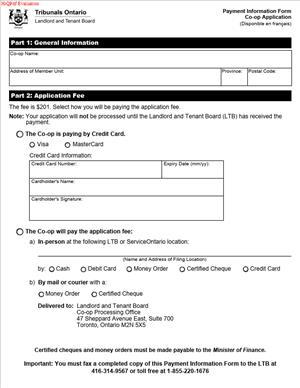
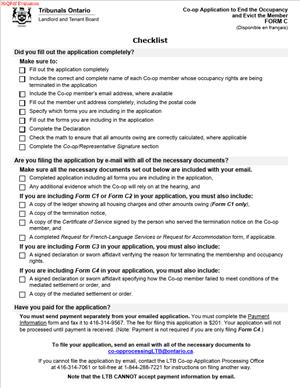
Payment Information Form Co-op Application
Fill out nowJurisdiction: Country: Canada | Province or State: Ontario
The Payment Information Form Co-op Application is used in the residential housing context in Ontario. It is connected to matters handled by the Landlord and Tenant Board. If you are involved in a co-operative housing dispute, this form helps organize key financial details about your situation.
You are likely looking at this document because you need to provide clear information about payments. That may include rent, housing charges, arrears, or other amounts connected to a co-op unit. The form creates a structured way to present those details.
For self-represented people, financial sections can feel overwhelming. This form is designed to make the numbers clear. It gives the Board and the other party a consistent format to review payment history and outstanding amounts.
Understanding what the Payment Information Form Co-op Application does will help you avoid errors. When you know why each section exists, you can complete it with confidence and reduce delays in your matter.
What is the Payment Information Form Co-op Application?
Clear definition
The Payment Information Form Co-op Application is a supporting document used in co-operative housing proceedings before the Landlord and Tenant Board in Ontario. It sets out detailed payment information related to a member’s housing charges.
In simple terms, it is a financial summary. It outlines what amounts were charged, what amounts were paid, and what balance is claimed as owing. It may also include dates and payment methods.
This form does not start a case on its own. Instead, it supports a co-op application already filed with the Board. Its purpose is to provide a clear breakdown of payment history so the decision-maker can understand the financial dispute.
Who typically uses this form?
Housing co-operatives often use this form when they claim a member owes housing charges. It helps them present an organized record of the alleged arrears.
Co-op members may also review or complete this form if they are responding to a claim. They may compare their own records against the amounts listed.
Property managers or co-op administrators may prepare the financial information. In smaller co-ops, a board member might complete it.
If you are representing yourself, you may be reading this form carefully to confirm the numbers. Even if you did not prepare it, you need to understand what it shows and how it affects your case.
Why might you need this form?
You might need the Payment Information Form Co-op Application if there is a dispute about unpaid housing charges. The Board requires clear financial details to decide whether money is owed.
The form may also be required when a co-op seeks to terminate a membership due to non-payment. Financial accuracy is central in these cases.
If payments were made but not properly recorded, this document becomes especially important. It gives you a place to clarify what was paid and when.
The form also helps prevent confusion. Instead of relying on general statements about “arrears,” it requires specific dates and amounts.
Typical real-life scenarios
- A co-op member falls behind on monthly housing charges after losing a job. The co-op files an application claiming several months of unpaid charges. The Payment Information Form Co-op Application sets out each missed payment and calculates the total arrears.
- A member makes partial payments over several months. The co-op applies those payments in a particular order, and the balance remains disputed. The form shows how each payment was applied and what balance is still claimed.
- A disagreement arises about additional charges, such as parking or utilities. The member believes these amounts were already included in previous payments. The form lists each charge separately so the Board can see what is included in the total.
- A member receives a notice claiming arrears but believes the amount is incorrect. When the application is filed, the form outlines the payment history. The member compares it against personal records to identify differences.
When would you use the Payment Information Form Co-op Application?
This form is used when a co-operative housing dispute involves money. Most often, it appears in cases about non-payment of housing charges.
You may see it after a co-op has served a notice to terminate membership for arrears. If the matter proceeds to the Landlord and Tenant Board, a financial breakdown becomes necessary.
It can also be relevant if there is disagreement about the amount owed, even when some payments were made. The Board needs a clear calculation to make a decision.
Typically, a co-op representative completes and submits the form as part of the application package. However, a member may rely on it to prepare a response or to challenge specific entries.
If you are attending a hearing, the information in this form often forms the basis of financial discussion. The accuracy of dates, amounts, and totals can directly affect the outcome.
Legal characteristics of Payment Information Form Co-op Application
The Payment Information Form Co-op Application is procedural in nature. It supports a formal application before the Landlord and Tenant Board. Its role is to present financial facts in a structured format.
For the form to be effective, the information must be clear and complete. Dates of charges, amounts due, payments received, and the resulting balance are usually required. Incomplete sections or unclear calculations may cause delays or questions at the hearing.
Common problems include mathematical errors, missing payment dates, or inconsistencies between the form and attached ledgers. Even small discrepancies can create confusion. The Board may ask for clarification if the numbers do not add up.
In Ontario, co-operative housing disputes follow specific legislative rules that differ from standard rental tenancies in some respects. While the overall process is similar, co-op membership and occupancy rights have unique features. The financial information still plays a central role when arrears are alleged.
This form does not itself terminate a membership. It does not automatically create a debt. It simply presents information for the Board to review. The decision about whether money is owed is made after considering all evidence.
Is it legally binding?
The Payment Information Form Co-op Application is not a contract between the parties. It is a formal statement of financial information submitted in a legal proceeding.
When signed and submitted as part of a Board application, it becomes part of the official record. The person who completes it is expected to provide accurate information. False or misleading entries can affect credibility during the hearing.
The form becomes significant because the Board may rely on it when making an order. If the Board issues an order for payment based on the amounts set out and proven, that order can be enforceable.
On its own, the form does not create legal obligations. Its impact depends on how it is used within the proceeding and what the Board ultimately decides.
How to fill out the Payment Information Form Co-op Application
Step 1 – Review the related application
Start by identifying the main co-op application connected to this form. Read it carefully so you understand what is being claimed. Confirm the time period involved and the total amount alleged as owing.
Step 2 – Gather complete payment records
Collect all relevant financial records before entering any numbers. This may include account ledgers, receipts, bank statements, and notices. Make sure the records cover the full period listed in the application.
Step 3 – Enter member and unit details
Fill in the identifying information exactly as it appears in the co-op’s records. This usually includes the member’s name, the address of the unit, and any file or reference numbers. Accuracy here ensures the form is matched to the correct case.
Step 4 – List housing charges by date
Record each housing charge for the relevant period. Enter the date the charge was due and the amount charged. Keep the entries in chronological order so the payment history is easy to follow.
Step 5 – Record payments received
For each payment, enter the date received and the amount paid. If partial payments were made, list each one separately. Do not combine multiple payments into a single entry unless the form clearly allows it.
Step 6 – Calculate the running balance
After listing charges and payments, calculate the balance for each period if required. Double-check your arithmetic. Ensure the final total matches the amount claimed in the main application.
Step 7 – Include additional lawful charges if applicable
If there are other amounts being claimed, such as administrative or service-related charges, enter them in the designated section. Clearly separate these from regular housing charges so the totals are transparent.
Step 8 – Review for consistency and completeness
Read through the entire form once completed. Confirm that dates, amounts, and totals are consistent with your records. Make sure no required sections are left blank and that the information aligns with the related application.
Legal terms you might encounter in the Payment Information Form Co-op Application
- Member: This is the person who holds the membership in the housing co-operative and occupies the unit. In this document, the member’s full legal name must match the name used in the co-op’s records and any related application. If the name does not match exactly, it can delay review or cause confusion about who the payment history refers to.
- Housing Charge: This is the regular monthly amount the member must pay to occupy the unit. It may include base housing costs and other approved charges. On this form, you list housing charges by month or billing period to show what was owed.
- Arrears: Arrears are unpaid housing charges that remain outstanding after the due date. The form usually requires you to calculate total arrears as of a specific date. You must clearly state that date so the balance makes sense.
- Subsidy: Some members receive financial assistance that reduces the amount they must personally pay. The form may ask you to separate the full housing charge from the member’s portion after subsidy. Be precise so it is clear what amount the member was responsible for.
- Payment Allocation: This refers to how a payment was applied. For example, a payment may be applied to the oldest arrears first or to the current month. The form should reflect how payments were actually credited in the co-op’s records.
- Ledger: A ledger is the detailed account record that shows charges, payments, credits, and balances over time. You may need to rely on the member’s ledger to complete this form accurately. The numbers you enter should match the ledger totals.
- Effective Date: This is the date up to which the payment information is calculated. It is critical because balances change over time. The effective date tells the Board or decision-maker exactly what period your numbers cover.
- Additional Charges: These are lawful charges added to the member’s account, such as parking, utilities, or other approved fees. If you include additional charges, you must show when they were added and why. Do not combine them with housing charges without explanation.
- Credit: A credit is an amount applied to reduce what is owed. It may come from an overpayment, an adjustment, or a subsidy reconciliation. Credits must be clearly recorded so the running balance is accurate.
FAQs
Do I need to complete a Payment Information Form Co-op Application if I already provided a ledger?
Yes, if the Board or the co-op requires this form, you should complete it even if you have a ledger. This document organizes the information in a standardized way. It helps the decision-maker quickly see the total charges, payments, and balance as of a specific date.
What date should I use as the “balance as of” date?
Use the exact date requested in the related application or notice. If no date is specified, use the date you are finalizing the numbers. Make sure every charge and payment listed falls on or before that date, and clearly state it so the balance can be verified.
Do I include payments made after I filed the related application?
Only include payments up to the effective date shown on this form. If payments were made after that date, you may need to update the document or provide an additional statement. Do not mix post-date payments into earlier calculations without clearly adjusting the balance date.
How detailed do the monthly entries need to be?
List each billing period separately with the housing charge due for that period. Then list each payment with the actual date received and amount. Avoid lump sums unless they truly represent one charge or one payment on a single date.
What if the member disputes the amount shown?
You still complete this form using the co-op’s official records. Make sure your numbers match the ledger and supporting documents. If there is a dispute, the form provides a clear breakdown that can be reviewed and compared to other evidence.
Do I need to attach supporting documents?
Often, yes. You may need to attach a copy of the ledger, subsidy calculations, or notices showing changes in housing charges. Check the instructions that accompany this form to confirm what must be included so your filing is complete.
Who is allowed to sign this document?
An authorized representative of the co-op should sign. That may be a property manager, staff member, or board member with authority to confirm the account details. The signature confirms that the information in this document is accurate to the best of their knowledge.
What happens after I submit this form?
The Board will review the information as part of the application process. The amounts listed may be used to determine arrears or other remedies. Make sure you keep a copy because you may need to refer to it at a hearing or meeting.
Checklist: Before, During, and After Payment Information Form Co-op Application
Before
- Review the related application to confirm why this form is required.
- Identify the correct member name and unit number from official records.
- Obtain the complete ledger covering the relevant time period.
- Confirm the effective date you will use for the balance calculation.
- Gather records of any subsidy adjustments or rent changes.
- Verify that all payments have been entered into the accounting system.
- Check for any credits or reversals that affect the balance.
- Make sure you understand how payments were allocated on the account.
During
- Enter the member’s name exactly as it appears in the co-op records.
- List each housing charge by billing period with the correct amount.
- Record each payment with the actual date received and amount.
- Show how payments were applied if required.
- Include additional lawful charges separately and clearly.
- Calculate the running balance after each entry, if the form requires it.
- Double-check all arithmetic for accuracy.
- Clearly state the balance as of the effective date.
- Sign and date the form where required.
After
- Make a complete copy of the signed form for your records.
- Attach any required supporting documents.
- Submit the form using the method required for the related application.
- Confirm that the submission was received, if possible.
- Store the original in the member’s file.
- Update internal tracking notes to reflect that the form was filed.
- Monitor for any payments received after the effective date.
- Bring a copy to any hearing or meeting where it may be discussed.
Common mistakes to avoid with the Payment Information Form Co-op Application
- Mistake: Using an incorrect effective date because you assume it is the filing date, which can lead to an inaccurate arrears amount and confusion about the balance, so do not forget to confirm the exact date required.
- Mistake: Combining several months of housing charges into one total, which often happens to save time but makes it hard to verify calculations and may weaken your evidence, so do not forget to list each period separately.
- Mistake: Leaving out small credits or adjustments because they seem minor, which can distort the final balance and affect credibility, so do not forget to include every transaction shown on the ledger.
- Mistake: Recording payment dates incorrectly from memory instead of the ledger, which can change how payments are applied and alter arrears totals, so do not forget to rely only on documented records.
- Mistake: Failing to match the member’s legal name to official records, which can cause administrative delays or questions about identity, so do not forget to verify spelling and order of names.
- Mistake: Submitting the form without a signature from an authorized person, which may result in rejection or requests for correction, so do not forget to confirm signing authority before filing.
- Mistake: Ignoring post-effective-date payments when preparing for a hearing, which can make your information outdated and incomplete, so do not forget to track and disclose later payments separately if needed.
- Mistake: Forgetting to attach required supporting documents because you assume the ledger is already on file, which can delay processing, so do not forget to review attachment requirements carefully.
What to do after filling out the Payment Information Form Co-op Application
Once you complete the form, pause before sending it anywhere. Review it as if you were the decision-maker seeing the account for the first time. Ask yourself if the timeline makes sense and whether the balance is easy to follow.
- Step 1: Recalculate the total arrears from the first listed charge to the effective date to confirm the math is correct.
- Step 2: Compare every figure on the form to the official ledger to ensure they match exactly.
- Step 3: Confirm that the effective date is clearly written and consistent throughout the document.
- Step 4: Make at least one complete copy of the signed form for your internal records.
- Step 5: Assemble all required attachments, such as the ledger or notices of housing charge changes.
- Step 6: Submit the form using the required filing method for the related proceeding, whether by mail, online system, or in person, as permitted.
- Step 7: Keep proof of submission, such as a confirmation page, receipt, or delivery tracking number.
- Step 8: Update the member’s file to note the date the form was completed and submitted.
- Step 9: Monitor the account for new payments and keep a separate record of any amounts received after the effective date.
- Step 10: Bring a copy of the completed form and supporting documents to any hearing, mediation, or meeting where the account may be discussed.
Stay organized after filing. Payment information can change quickly. If additional payments are made or errors are discovered, prepare an updated summary so you are ready to explain the current balance clearly. Clear records make the process smoother and help you present accurate information when it matters most.
Disclaimer: This guide is provided for informational purposes only and is not intended as legal advice. You should consult a legal professional.