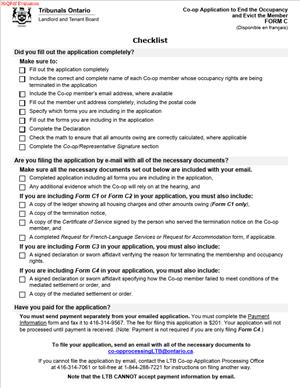
Form C – Co-op Application to End the Occupancy and Evict the Member
Fill out nowJurisdiction: Country: Canada | Province or State: Ontario
Form C – Co-op Application to End the Occupancy and Evict the Member is a formal application used by a housing co-operative to ask for an order ending a member’s right to occupy a unit and evicting that member. It is part of the process handled by the Landlord and Tenant Board in Ontario.
If you are filling out this form, you are likely acting on behalf of a co‑operative. You may be a board member, property manager, or authorized representative. You are preparing a formal filing that asks the Board to review a dispute and make a decision.
This document is not a notice. It is not a warning letter. It is an application that starts a legal process. Once submitted, it leads to a hearing where the Board decides whether to grant the order requested.
Because this filing can affect someone’s housing, accuracy matters. The information you include must match the co‑op’s records and any prior notices. Small mistakes can delay the process or lead to the dismissal of the application.
Understanding what the form does and how it fits into the larger process helps you complete it correctly the first time.
What is Form C – Co-op Application to End the Occupancy and Evict the Member?
Clear definition
Form C – Co-op Application to End the Occupancy and Evict the Member is a written request to the Landlord and Tenant Board asking for an order that ends a co‑op member’s occupancy rights and permits eviction from the unit. It sets out the legal grounds relied on and the facts supporting those grounds.
The form captures key details about the co‑operative, the member, the unit, and the reasons for seeking eviction. It also outlines any related issues, such as unpaid housing charges or breaches of the co‑op’s by‑laws or occupancy agreement.
Once filed, the application triggers a formal process. The Board schedules a hearing and gives both parties an opportunity to present evidence and arguments.
Who typically uses this form?
This form is typically used by non‑profit housing co‑operatives. The applicant is the co‑op as a legal entity, not an individual board member in a personal capacity.
A board member, staff member, or legal representative often completes and signs the form on behalf of the co‑op. The person signing must have authority to act for the organization.
The respondent is the member whose occupancy the co‑op seeks to end. In some cases, other occupants may also be named if their rights are tied to the member’s occupancy.
Why might you need this form?
You may need this form when a co‑op believes a member has seriously breached their occupancy agreement, the co‑op’s by‑laws, or other governing rules. The form allows the co‑op to ask the Board to enforce its rights through an eviction order.
Common reasons include persistent non‑payment of housing charges, serious interference with other members, damage to the unit, or conduct that threatens safety. In some situations, the issue may relate to eligibility for membership or subsidy requirements.
The form is used after internal co‑op processes have taken place. Many co‑ops have procedures for meetings, notices, and decisions before applying to the Board. The application presents the outcome of those internal steps for external review.
Typical real-life scenarios
- A member falls behind on monthly housing charges for several months. The co‑op sends notices and holds meetings, but the arrears continue to grow. The board votes to end the member’s occupancy and files this application to obtain an eviction order.
- A member repeatedly breaches noise rules and engages in conduct that disrupts other residents. Complaints are documented. The co‑op follows its by‑law process and decides to terminate occupancy. The form is used to request confirmation and enforcement through the Board.
- A member no longer meets the eligibility requirements set out in the co‑op’s rules, such as income‑based criteria tied to a housing charge subsidy. After internal review and notice, the co‑op applies to end the occupancy.
- There is significant damage to a unit that goes beyond normal wear and tear. The co‑op alleges the damage results from the member’s actions or neglect. After providing notice and an opportunity to address the issue, the co‑op seeks an order ending occupancy and evicting the member.
When would you use Form C – Co-op Application to End the Occupancy and Evict the Member?
You use this form when a co‑operative has already made a decision, through its internal governance process, to terminate a member’s occupancy rights and needs the Landlord and Tenant Board to issue an enforceable order.
The timing usually follows a series of steps. These often include a written notice to the member, an opportunity to respond, and a board decision. The application reflects that those steps have been completed.
The form is not used for minor disputes or informal warnings. It is used when the co‑op is seeking a formal eviction order. That order, if granted, can be enforced through legal channels.
In practice, the co‑op acts as the applicant. The member is the respondent. The Board acts as the decision‑maker. At the hearing, each side may present documents, testimony, and arguments.
You would not use this form simply to collect money, unless the request for money is tied to ending occupancy. The focus of the form is the termination of the right to occupy and eviction from the unit.
Legal Characteristics of Form C – Co-op Application to End the Occupancy and Evict the Member
This form is part of a statutory dispute resolution process. It must be completed fully and accurately to be accepted for filing. The Board relies on the information provided to identify the parties, the property, and the legal grounds.
For the application to move forward, the required sections must be filled in. Filing fees are typically required. The co‑op must also follow service rules so the member receives proper notice of the hearing.
Common problems include incorrect names, wrong unit numbers, missing dates, or failure to attach required details. Inconsistent information between the form and prior notices can also cause delays or dismissal.
The form does not, by itself, end occupancy. Filing it does not automatically remove a member from the unit. Only a Board order can authorize eviction. Until that order is made and enforced, the member remains in possession.
While housing co‑ops operate differently from private landlords, the eviction process through the Board shares some structural similarities. However, co‑ops often have additional internal decision‑making requirements before filing. Those internal steps are separate from the Board’s review.
Is it legally binding?
Form C – Co-op Application to End the Occupancy and Evict the Member is legally significant once filed because it starts a formal legal proceeding. It creates an official case before the Board.
However, the form itself is not a binding order. It is a request for one. The legally binding document is the Board’s written order issued after a hearing or resolution process.
If the Board grants the application, its order can require the member to vacate the unit by a specified date. That order can be enforced according to applicable procedures. If the Board dismisses the application, the co‑op does not obtain eviction rights based on that filing.
The binding effect depends on proper completion, valid service, and a final decision from the Board.
How to fill out Form C – Co-op Application to End the Occupancy and Evict the Member
Step 1 – Identify the co‑operative as the applicant
Enter the full legal name of the housing co‑operative exactly as it appears in incorporation documents and internal records. Include complete contact information, such as mailing address, phone number, and email if requested. If a representative is acting for the co‑op, provide that person’s details in the designated section.
Step 2 – Provide the member’s information
Insert the full legal name of the member whose occupancy is being terminated. Ensure the spelling matches the occupancy agreement and co‑op records. Add the full address of the rental unit, including unit number, street name, city, and postal code. Accuracy here ensures proper identification and service.
Step 3 – Describe the rental unit
Confirm details about the unit, such as whether it is part of a co‑operative housing complex and any specific identifiers used by the co‑op. This section ties the application to a specific premises and avoids confusion with other units.
Step 4 – State the grounds for ending occupancy
Select or describe the legal reasons relied on to end the member’s occupancy. This may include non‑payment of housing charges, serious interference with others, damage, safety concerns, or other breaches. Be clear and factual. Include relevant dates and concise descriptions of events.
Step 5 – Provide details about arrears if applicable
If the application involves unpaid housing charges, set out the amount claimed, the period covered, and how the total was calculated. Ensure the figures match internal ledgers. Consistency between this section and any prior notices helps prevent disputes about amounts.
Step 6 – Explain prior notices and internal decisions
Indicate when notice of termination was given to the member and how it was delivered. Reference the co‑op’s internal decision to terminate occupancy, including the date of the board decision if requested. This shows that internal governance steps were completed before filing.
Step 7 – List any additional remedies requested
If the form allows space for other requests, such as payment of arrears or compensation for damage, describe them clearly. Keep the request connected to the grounds stated earlier in the form. Avoid introducing unrelated issues.
Step 8 – Attach supporting information if required
Review the form instructions to see whether supporting documents are required or permitted at the time of filing. These may include copies of notices, account statements, or relevant portions of by‑laws. Ensure attachments are legible and organized.
Step 9 – Review for completeness and accuracy
Read through the entire form before signing. Check names, dates, amounts, and unit details. Confirm that all required fields are filled in. Small clerical errors can slow the process or require amendments later.
Step 10 – Sign and date the application
An authorized representative of the co‑op must sign and date the form in the space provided. By signing, the representative confirms that the information is true to the best of their knowledge. Use the signing format required on the form, whether handwritten or electronic, depending on the filing method.
Legal terms you might encounter in Form C – Co-op Application to End the Occupancy and Evict the Member
- Applicant: The applicant is the housing co‑operative bringing the application. On this form, the co‑op is asking the Landlord and Tenant Board to end the member’s right to occupy the unit. You must clearly identify the legal name of the co‑operative exactly as it appears in its incorporation documents.
- Respondent: The respondent is the member whose occupancy the co‑op wants to end. This is the person (or people) named in the occupancy agreement. You must list every member connected to the unit, using full legal names, because the order will apply only to those named.
- Occupancy Agreement: This is the contract between the co‑op and the member. It sets out the member’s rights and responsibilities, including housing charges and rules. When you complete the form, you rely on this agreement to show the Board why the co‑op believes the agreement should end.
- Grounds for Termination: These are the legal reasons the co‑op gives for ending occupancy. The form requires you to select and explain specific grounds, such as non‑payment of housing charges or serious breach of co‑op rules. You must connect the facts of your situation to the ground you choose.
- Arrears: Arrears are unpaid housing charges or other amounts owing. If the application is based on non‑payment, you must state the exact amount owed up to a specific date. The Board will look closely at how you calculated this number.
- Notice of Termination: Before filing the application, the co‑op must usually give written notice to the member. The form asks about this notice, including the date it was given and the termination date stated in it. The notice must match the ground you rely on.
- Board of Directors’ Resolution: In a co‑op context, the decision to terminate a membership and occupancy often requires a formal decision by the board. You may need to confirm that the board passed a resolution authorizing the application. The Board may expect evidence that proper internal steps were followed.
- Hearing: A hearing is the meeting where the Landlord and Tenant Board reviews the application. The form starts the process, but the hearing is where both sides present evidence. The information you enter in the form frames what the hearing will focus on.
- Order: An order is the written decision issued by the Board. If the application is successful, the order may end the occupancy and authorize eviction. The details you include in the form influence the wording and scope of that order.
- Service: Service means formally delivering documents to the member. The form may require you to confirm how and when the notice was served. Proper service is critical because the Board can dismiss the application if service rules are not followed.
FAQs
What date should I list as the termination date on this document?
You should enter the termination date exactly as it appears on the notice of termination given to the member. Check that the date meets the required notice period and falls after the notice was delivered. If the dates on your notice and this document do not match, the Board may question the validity of the application.
Do I need to attach a copy of the occupancy agreement when filing Form C – Co-op Application to End the Occupancy and Evict the Member?
You should have a copy of the signed occupancy agreement ready, even if you are not required to attach it at the time of filing. The details in this form, such as the member’s name and unit address, must match the agreement exactly. If the Board schedules a hearing, you will likely need to provide the agreement as evidence.
Who is allowed to sign this form on behalf of the co-op?
An authorized representative of the co‑operative must sign. This is often a board member, officer, or another person the board has formally authorized. Make sure the signer’s title and authority are accurate and consistent with the co‑op’s internal records, because the Board may ask how that person has the authority to act.
What if I realize I made a mistake after submitting the form?
If you notice an error, review what information needs correction and determine whether it affects key details such as names, amounts owed, or dates. You may need to request permission to amend the application or file a corrected version. Act quickly, because incorrect information can delay the hearing or weaken your case.
How detailed should I be when describing the reasons for ending occupancy?
You should provide clear, specific facts, not general statements. Include dates, amounts, and examples of conduct if relevant. The Board relies on what you write in this document to understand your claim, so vague descriptions can make it harder to prove your case at the hearing.
What happens if the member’s name is spelled differently on different documents?
Use the legal name as it appears on the occupancy agreement and confirm it matches other official records. Even small spelling differences can cause confusion when the Board issues its order. Before filing, check identification documents or the co‑op’s membership records to ensure consistency.
Do I need to list all occupants or only the member?
You must list all members named on the occupancy agreement as respondents. If there are additional occupants who are not members, review whether they need to be identified for enforcement purposes. The Board’s order will generally apply only to those named, so accuracy matters.
Does filing this form automatically mean the member must move out?
No. Filing Form C – Co-op Application to End the Occupancy and Evict the Member starts a legal process. The member has the right to a hearing, and the Board must issue an order before eviction can occur. You should wait for the Board’s decision and follow the terms of any order issued.
Checklist: Before, During, and After Form C – Co-op Application to End the Occupancy and Evict the Member
Before
- Review the occupancy agreement and confirm the member’s full legal name and unit address.
- Ensure the board has passed any required resolution authorizing termination and application.
- Confirm the correct legal ground for termination and that it matches the notice given.
- Verify that the notice of termination was properly completed and delivered.
- Calculate any arrears carefully and double‑check your math.
- Gather supporting documents such as ledgers, warning letters, and meeting minutes.
- Check internal records to confirm dates and prior communications.
- Make sure you have the correct version of the form.
During
- Enter the co‑operative’s legal name exactly as registered.
- List every member respondent connected to the unit.
- Provide the full rental unit address, including unit number.
- State the termination date exactly as shown on the notice.
- Clearly explain the grounds and include specific facts and dates.
- Insert the total arrears amount and the date up to which it is calculated.
- Review each section for blank fields or inconsistencies.
- Ensure the authorized person signs and dates the form.
After
- Make copies of the completed and signed form for your records.
- File the application with the Landlord and Tenant Board using an accepted method.
- Pay any required filing fee and keep proof of payment.
- Note the file number assigned to your application.
- Prepare to serve the filed application and notice of hearing as required.
- Organize all supporting documents in a hearing folder.
- Track deadlines related to service and evidence disclosure.
- Update the co‑op’s internal file to reflect that the application has been filed.
Common Mistakes to Avoid with Form C – Co-op Application to End the Occupancy and Evict the Member
- Mistake: Listing the wrong legal name of the co‑op because you rely on a shortened or informal version, which can create confusion in the Board’s records and affect the enforceability of the order; do not forget to confirm the exact incorporated name.
- Mistake: Naming only one member when multiple members signed the occupancy agreement, which happens when records are outdated and can result in an order that does not apply to everyone; do not forget to check the original agreement.
- Mistake: Entering an incorrect arrears amount due to math errors or failing to update the ledger, which can damage credibility at the hearing; do not forget to reconcile your numbers to a specific cut‑off date.
- Mistake: Using a termination date that does not match the notice, often caused by copying errors, which can lead to dismissal of the application; do not forget to compare the form against the original notice line by line.
- Mistake: Providing vague reasons such as “breach of rules” without details, because you assume the Board knows the background, which weakens your case; do not forget to include dates, incidents, and references to specific rules.
- Mistake: Forgetting to sign or date the form, which happens when multiple drafts are circulated and can delay processing; do not forget to review the signature section before filing.
- Mistake: Failing to keep proof of service of the notice, because you assume verbal confirmation is enough, which can result in the application being dismissed; do not forget to document how and when service occurred.
- Mistake: Waiting too long after giving notice to file the application, which can create arguments about delay or waiver; do not forget to track timelines and act promptly.
What to do after filling out Form C – Co-op Application to End the Occupancy and Evict the Member
Once you complete the form, your focus shifts to filing, service, and preparation. Organization is key. Keep everything in one file, whether paper or digital.
- Step 1: Make at least two copies of the signed form, one for your records and one for service.
- Step 2: File the application with the Landlord and Tenant Board using an accepted filing method.
- Step 3: Pay the required filing fee and keep the receipt or confirmation number.
- Step 4: Record the file number assigned by the Board and write it on your internal file.
- Step 5: Wait for the Notice of Hearing from the Board and review it carefully for date, time, and format.
- Step 6: Serve the member with the filed application and Notice of Hearing as required, and complete any certificate or proof of service.
- Step 7: Prepare your evidence package, including the occupancy agreement, notices, ledger, correspondence, and board resolution.
- Step 8: Organize witnesses, if any, and confirm they know the hearing date and what issues they will address.
- Step 9: Review the form again before the hearing to ensure your testimony matches what you filed.
- Step 10: After the hearing, read the Board’s order carefully and note any compliance dates or payment terms.
- Step 11: Update the co‑op’s internal records to reflect the outcome, including membership status and financial adjustments.
- Step 12: If the order allows eviction and the member does not comply, follow the proper enforcement process as set out in the order.
Stay proactive at each stage. Careful preparation and accurate records will make the process more manageable and reduce the risk of delays.
Disclaimer: This guide is provided for informational purposes only and is not intended as legal advice. You should consult a legal professional.