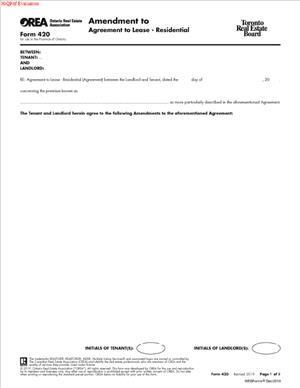
OREA Form 420 – Amendment to Agreement to Lease – Residential
Fill out nowJurisdiction: Country: Canada | Province or State: Ontario
If you are changing the terms of a residential lease agreement in Ontario, OREA Form 420 – Amendment to Agreement to Lease – Residential is the document designed for that purpose. It allows the landlord and tenant to formally adjust specific parts of an existing Agreement to Lease without starting over.
You might be looking at this form because something has changed since the original agreement was signed. Maybe the move‑in date needs to shift. Maybe the rent amount, including appliances, or other terms no longer reflect what both sides agreed to verbally. This form puts those changes in writing.
OREA Form 420 – Amendment to Agreement to Lease – Residential works as a written record of agreed modifications. It connects directly to the original Agreement to Lease and updates only the parts that are clearly identified. Everything else in the original agreement stays the same.
For self-represented landlords and tenants, clarity is critical. This form helps reduce confusion by showing exactly what is being changed, when it takes effect, and who agrees to the new terms. When completed carefully, it becomes part of the overall lease documentation for the property.
What is OREA Form 420 – Amendment to Agreement to Lease – Residential?
Clear definition
OREA Form 420 – Amendment to Agreement to Lease – Residential is a written amendment used to change specific terms in an existing residential Agreement to Lease. It does not replace the original agreement. Instead, it modifies certain clauses while leaving the rest intact.
An amendment is different from a new lease. You are not negotiating everything again. You are identifying particular sections that need to be updated and confirming those updates in writing.
The form typically refers to the original Agreement to Lease by date, property address, and the names of the parties. This ensures there is no confusion about which agreement is being amended.
Once signed by all parties, the amendment becomes part of the overall contract package. It must be read together with the original Agreement to Lease.
Who typically uses this form?
This form is commonly used by residential landlords and tenants in Ontario who previously signed an Agreement to Lease through a real estate transaction.
It may also be used by real estate representatives acting on behalf of landlords or tenants during the pre-occupancy stage. In many cases, the amendment is prepared after discussions between both sides about a change in circumstances.
Buyers and sellers do not use this form for property transfers. It is specific to residential leasing arrangements. The parties involved are usually the named landlord and the named tenant from the original Agreement to Lease.
If you are a tenant who negotiated certain terms before signing a final lease document, and something has shifted, this form provides a structured way to record the revised understanding.
Why might you need this form?
Changes often happen between signing an Agreement to Lease and the actual start of the tenancy. Life events, financing issues, renovation delays, or scheduling conflicts can require updates.
If you and the other party agree to modify a key term, it is important to reflect that change in writing. Verbal agreements are harder to prove and may lead to disputes later.
This form is also useful when minor details need correction. For example, a parking space number might be wrong, or an appliance list may need clarification. Rather than rewriting the entire agreement, an amendment targets the specific issue.
Using a formal amendment helps prevent misunderstandings. It shows that both parties reviewed and accepted the new terms, and it creates a clear paper trail.
Typical real-life scenarios
- A tenant signs an Agreement to Lease with a move-in date of July 1. The landlord later informs the tenant that renovations will not be finished until July 15. Both parties agree to change the possession date. An amendment is prepared to reflect the new date and any related adjustments.
- In another situation, a tenant agrees to pay a certain monthly rent based on one included parking space. Before occupancy, the tenant decides to rent a second parking space. The parties agree on an additional monthly amount. The amendment records the revised rent and parking arrangement.
- Sometimes, financing or employment circumstances change. A landlord may agree to modify the payment schedule for the first and last month’s rent. Instead of altering the original document by hand, the parties use an amendment to outline the new payment structure.
- There are also cases where conditions in the original Agreement to Lease were not fulfilled exactly as written, but both sides agree to proceed under slightly different terms. The amendment clarifies how those conditions are being adjusted or waived.
- In each of these examples, the key factor is mutual agreement. The amendment reflects a shared decision to update specific terms.
When would you use OREA Form 420 – Amendment to Agreement to Lease – Residential?
You would use this form after an Agreement to Lease has already been signed but before or during the period when changes are necessary. It is not used to create the original lease terms. It is used to modify them.
Timing matters. Amendments are commonly prepared between the signing date and the occupancy date. However, they may also be used later if the original Agreement to Lease still governs certain aspects of the tenancy.
Landlords often initiate the amendment when property-related details change. Tenants may request it when personal circumstances affect their ability to meet a specific term as originally written.
In transactions involving real estate representatives, the amendment may be circulated for review and signing by all parties. Each party reviews the updated wording before signing.
This form is generally used when both sides agree on the change. If there is no agreement, an amendment cannot force new terms into effect. It relies on mutual consent.
The form may also be used to clarify ambiguous language in the original agreement. Instead of disputing the interpretation later, the parties define the intended meaning through a written amendment.
Legal characteristics of OREA Form 420 – Amendment to Agreement to Lease – Residential
An amendment works because it is connected to an existing contract. The original Agreement to Lease provides the foundation. The amendment modifies that foundation only where specified.
For the amendment to function properly, it must clearly identify the original agreement. This usually includes the date of the original document and the names of the landlord and tenant. Without this reference, there may be uncertainty about which contract is being changed.
Clarity is critical. The sections being amended should be described precisely. Vague language can create more confusion than it resolves. For example, stating that “rent is changed” is less clear than stating the exact new monthly amount and the effective date.
Common problems arise when the amendment contradicts itself or conflicts with other clauses in the original agreement without clearly stating that it overrides them. Ambiguity can lead to disputes about which term controls.
Signatures are also essential. An unsigned amendment generally has no effect. All parties who signed the original Agreement to Lease typically need to sign the amendment for it to take effect.
In Ontario, residential tenancies are also governed by legislation that sets certain minimum standards. An amendment cannot remove rights or obligations that are mandatory under law. If a term conflicts with those rules, the legal framework may override it.
It is also important to understand what this form does not do. It does not terminate the lease. It does not automatically create a new tenancy. It does not replace statutory requirements related to standard lease forms. It simply adjusts agreed terms within the existing contractual relationship.
Is it legally binding?
In general, an amendment like this becomes legally binding when it meets the basic elements of a contract. There must be agreement between the parties, clarity about the changes, and proper signing.
If both landlord and tenant sign OREA Form 420 – Amendment to Agreement to Lease – Residential, and the changes are clear and lawful, it typically forms part of the binding agreement between them.
The binding nature depends on mutual consent. If one party signs but the other does not, there is usually no effective amendment. Both sides must indicate acceptance.
The amendment must also be sufficiently certain. Courts and decision-makers look for clear language that identifies what was changed. If the wording is too vague, it may be difficult to enforce.
Finally, the amendment operates together with the original Agreement to Lease. If a dispute arises, both documents are read as one combined contract, with the amendment modifying the specified sections.
How to fill out OREA Form 420 – Amendment to Agreement to Lease – Residential
Step 1 – Identify the original agreement
Start by clearly referencing the original Agreement to Lease. Enter the full names of the landlord and tenant as they appear in the original document. Include the date of that agreement and the full property address. This ensures there is no confusion about which contract you are amending.
Step 2 – State the purpose of the amendment
Indicate that the document is an amendment to the existing Agreement to Lease. The form’s title already reflects this, but the opening section typically confirms that the parties agree to amend specific terms. Review this section carefully so it accurately reflects the shared intention.
Step 3 – Describe each change in detail
For every term being modified, write out the change clearly. Identify the clause or section number from the original agreement, if applicable. Then state the new wording in full. Avoid partial phrases. Replace the old term with completely updated language so there is no uncertainty.
Step 4 – Clarify what remains unchanged
Most amendments include a statement that all other terms and conditions of the original Agreement to Lease remain in full force and effect. Read this part closely. It confirms that only the listed sections are being altered and everything else continues as originally written.
Step 5 – Confirm dates and timelines
If the amendment affects dates, such as possession, payment deadlines, or condition fulfillment periods, ensure the new dates are clearly written. Double-check the year and month. Small errors in dates can create significant confusion later.
Step 6 – Review financial adjustments
If rent, deposits, or additional fees are being changed, confirm the exact dollar amounts. Write the numbers clearly and consistently. Make sure the effective date of any financial change is specified so both parties understand when the new amount applies.
Step 7 – Check for consistency with the original agreement
Before signing, compare the amendment against the original Agreement to Lease. Ensure the new wording does not unintentionally conflict with other clauses. If a section is being replaced entirely, confirm that the old language is fully addressed by the new text.
Step 8 – Sign and date the amendment
Each party that signed the original Agreement to Lease should sign the amendment. Print names clearly and include the date of signing. The amendment generally becomes effective once all required signatures are in place.
Step 9 – Distribute copies
After signing, ensure that each party receives a complete copy of the amendment. Keep it together with the original Agreement to Lease. Both documents form part of the overall lease record for the property.
Legal terms you might encounter in OREA Form 420 – Amendment to Agreement to Lease – Residential
- Original Agreement to Lease: This is the lease agreement that you are changing. The amendment must clearly refer to the date and parties of the original agreement, so there is no confusion about which contract is being modified. If you misidentify the original document, the amendment may not apply as intended.
- Amendment: An amendment is a written change to an existing agreement. In this form, it sets out specific revisions while leaving the rest of the lease intact. It does not replace the entire agreement unless it clearly says so.
- Effective Date: This is the date when the changes become active. It may be the date both parties sign, or a future date you specify. The effective date controls when new terms, such as rent or occupancy, begin to apply.
- Parties: The parties are the landlord and the tenant named in the original lease. Their legal names must match the original agreement. If a corporation or trust is involved, the correct legal entity must be identified.
- Consideration: Consideration means something of value exchanged between the parties. In an amendment, this may not always be money. For example, extending the lease term in exchange for a rent increase can serve as consideration.
- Mutual Agreement: This confirms that both sides voluntarily agree to the changes. An amendment is only valid if both parties consent. One side cannot unilaterally impose changes through this document.
- Lease Term: The lease term refers to the length of time the tenant has the right to occupy the property. An amendment may extend, shorten, or otherwise adjust this period. Any change should clearly state the new start and end dates.
- Rent Adjustment: A rent adjustment is a change in the amount of rent payable. The amendment should clearly state the new rent, when it starts, and whether other charges are affected. Vague wording can create disputes later.
- Conditions: Conditions are requirements that must be met before certain changes take effect. For example, a rent change may be conditional on repairs being completed. The form should specify timelines and responsibilities.
- Ratification: Ratification means confirming that all other terms of the original lease remain unchanged. Most amendments include a clause stating that, except for the listed changes, everything else continues in full force.
FAQs
Do both the landlord and tenant have to sign this form for it to be valid?
Yes. This document only works if both parties sign it. An amendment changes a binding agreement, so both sides must clearly consent. Make sure the names and signatures match the parties listed in the original lease, and confirm the date beside each signature.
What information from the original lease do I need to include?
You need the full names of the landlord and tenant, the property address, and the date of the original agreement. Check the first page of your lease and copy the information exactly as written. If the lease included unit numbers or legal descriptions, use the same wording here.
Can this form change the rent amount and the lease term at the same time?
Yes, you can modify more than one term in the same document. Clearly separate each change in its own paragraph so there is no confusion. State the old term and the new term, and include exact dates for when each change starts.
What should I write in the section that says all other terms remain the same?
You do not need to rewrite the entire lease. The form usually includes standard wording confirming that all other terms stay in effect. Read it carefully and make sure it accurately reflects your understanding that only the listed changes apply.
What if one party signs on a different day than the other?
That is common. Each party can sign on different dates. The key point is that both signatures must appear on the document. The effective date of the changes should be clearly stated so there is no uncertainty about when the amendment takes effect.
Can I use OREA Form 420 – Amendment to Agreement to Lease – Residential to add new terms that were not in the original lease?
Yes, you can add new clauses if both parties agree. Write the new term clearly and state that it is being added to the original agreement. Make sure it does not contradict other parts of the lease unless you are intentionally replacing those sections.
Do I need to attach the original lease to this document?
You usually do not need to attach the full lease, but you must clearly identify it by date and parties. If you are changing a specific schedule or appendix, refer to it by name. Keep a copy of both documents together for your records.
Does this form need to be filed with any government office?
In most cases, this document is a private agreement between landlord and tenant and is not filed publicly. However, you should keep a signed copy with your important records. If your lease is part of a larger transaction handled by a brokerage, confirm how copies will be stored and shared.
Checklist: Before, During, and After OREA Form 420 – Amendment to Agreement to Lease – Residential
Before
- Review the original lease in full to understand exactly what you are changing.
- Confirm the legal names of all parties as written in the original agreement.
- Verify the property address and any unit number.
- Decide on the exact wording of each change.
- Confirm the effective date of the amendment.
- Check whether financial terms such as deposits or prepaid rent are affected.
- Ensure both parties are willing to sign.
- Gather a clean copy of the amendment form.
During
- Enter the date of the original lease accurately.
- Clearly describe each amendment in separate, numbered paragraphs.
- State old terms and new terms to avoid ambiguity.
- Specify effective dates for each change.
- Confirm that all other terms remain unchanged.
- Double-check spelling of names and property details.
- Have each party sign and date the document.
- Ensure signatures are complete and legible.
After
- Make copies of the fully signed amendment.
- Provide one copy to each party.
- Store the amendment with the original lease.
- Update rent payment systems if the amount has changed.
- Adjust internal calendars for new lease term dates.
- Monitor compliance with any new conditions added.
- Keep proof of delivery if copies were sent electronically.
- Review the amendment before the next rent cycle to confirm implementation.
Common mistakes to avoid with OREA Form 420 – Amendment to Agreement to Lease – Residential
- Mistake: Forgetting to clearly identify the original lease, which happens when you assume everyone knows which agreement you mean, and this can make the amendment unenforceable, so do not forget to include the original date and full party names.
- Mistake: Writing vague changes such as “rent will increase later,” which happens due to rushed drafting, and this creates disputes about timing and amount, so do not forget to specify the exact new rent and start date.
- Mistake: Changing terms verbally without reflecting them in writing, which happens when parties trust informal discussions, and this leads to conflicting expectations, so do not forget to document every agreed change in the amendment.
- Mistake: Allowing only one party to sign, which happens when you treat the amendment casually, and this can make it invalid, so do not forget that both landlord and tenant must sign.
- Mistake: Contradicting other parts of the lease without clarifying replacement language, which happens when amendments are drafted quickly, and this causes confusion about which term controls, so do not forget to state if a clause is being replaced entirely.
- Mistake: Using incorrect legal names, which happens when nicknames or shortened names are used, and this may create identification issues, so do not forget to copy the names exactly as shown in the original lease.
- Mistake: Failing to set a clear, effective date, which happens when signatures occur on different days, and this creates uncertainty about when changes apply, so do not forget to state the precise date the amendment takes effect.
- Mistake: Not updating payment systems after a rent change, which happens due to administrative oversight, and this leads to underpayment or overpayment, so do not forget to adjust automatic transfers and records immediately.
What to do after filling out OREA Form 420 – Amendment to Agreement to Lease – Residential
Once the amendment is signed, your focus shifts to implementation and recordkeeping. A signed document is only useful if you store it properly and follow its terms. Treat it as part of the original lease, not as a separate side note.
Start by reviewing the final signed version carefully. Make sure all pages are included and that there are no missing initials or signatures. Confirm that dates are filled in and readable.
- Step 1: Make at least two complete copies of the signed amendment.
- Step 2: Deliver a copy to the other party promptly, using the same communication method recognized in your lease.
- Step 3: Place the amendment together with the original lease in a secure file, whether digital or paper.
- Step 4: Update any rent payment instructions if the amount or due date changed.
- Step 5: Adjust your calendar for new lease term dates, renewal deadlines, or condition timelines.
- Step 6: Review any added obligations, such as repairs or improvements, and schedule them.
- Step 7: Confirm that automatic bank transfers reflect the new terms.
- Step 8: If a real estate professional is involved, ensure they also have a complete copy.
- Step 9: Revisit the amendment before the next major lease milestone to confirm compliance.
- Step 10: Keep the document accessible in case questions arise during the tenancy.
You should also communicate clearly. If the amendment affects practical matters like parking, storage, or utilities, confirm in writing how the changes will be carried out. Clear communication prevents misunderstandings.
Finally, treat the amendment as legally significant. If a dispute arises later, this document will be reviewed alongside the original lease. Keeping it organized, legible, and complete protects your position and reduces uncertainty.
Disclaimer: This guide is provided for informational purposes only and is not intended as legal advice. You should consult a legal professional.