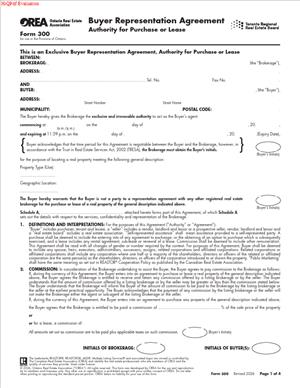
OREA Form 300 – Buyer Representation Agreement (Authority for Purchase or Lease)
Fill out nowJurisdiction: Country: Canada | Province or State: Ontario
The OREA Form 300 – Buyer Representation Agreement (Authority for Purchase or Lease) is a written contract between you and a real estate brokerage. It sets out how an agent will represent you when you are buying or leasing property in Ontario.
If you are about to sign this form, you are likely preparing to work closely with a real estate professional. This document defines that relationship. It explains what the brokerage agrees to do for you and what you agree to in return.
This agreement is not just a formality. It can affect how long you work together, how commission is handled, and what happens if you buy or lease a property during or shortly after the agreement period.
Understanding the structure and terms of the OREA Form 300 – Buyer Representation Agreement (Authority for Purchase or Lease) helps you know exactly what you are agreeing to before you sign.
What is OREA Form 300 – Buyer Representation Agreement (Authority for Purchase or Lease)?
Clear definition
The OREA Form 300 – Buyer Representation Agreement (Authority for Purchase or Lease) is a standard form agreement used in Ontario real estate transactions. It creates a formal agency relationship between you, as the buyer or tenant, and a brokerage.
Under this agreement, the brokerage is authorized to represent you in searching for and negotiating the purchase or lease of property. The form outlines the scope of that authority, the duration of the relationship, and how the brokerage will be paid.
It also sets out key terms such as the type of property you are looking for, the geographic area covered, and any commission arrangements. Once signed by both parties, it becomes a binding contract.
Who typically uses this form?
This form is commonly used by individuals who want professional help buying a home, condominium, investment property, or leasing residential or commercial space.
First-time buyers often encounter this document early in their property search. Experienced buyers may also sign it when they decide to work exclusively with a specific brokerage.
Real estate brokerages in Ontario use this form to clearly define their working relationship with clients. It protects both sides by putting expectations in writing.
Why might you need this form?
You may need this form if you want an agent to actively search for properties on your behalf. It is often required before an agent will dedicate time to showings, research, and negotiations.
The agreement clarifies that the brokerage owes you specific duties. These commonly include loyalty, confidentiality, and full disclosure of relevant information.
It also addresses compensation. Even if the seller’s brokerage pays the commission, the agreement typically explains how and when the brokerage representing you is entitled to be paid.
By signing, you move from informal conversations to a defined professional relationship. That structure can reduce misunderstandings later.
Typical real-life scenarios
- You decide to buy your first home in Ontario and start viewing properties with an agent. After a few showings, the agent asks you to sign a buyer representation agreement before continuing the search. This ensures they formally represent your interests.
- You are relocating for work and need to lease a property quickly. A brokerage agrees to help you find a rental. Before arranging multiple viewings and negotiating terms, they ask you to sign this agreement to outline responsibilities and compensation.
- You are looking for an investment property within a specific city and price range. You want one brokerage to monitor listings and alert you to opportunities. The agreement defines the area and type of property.
- You previously worked with several agents informally. Now you want one dedicated professional to negotiate aggressively on your behalf. Signing the agreement formalizes that commitment and usually limits you to that brokerage for a set time.
When would you use OREA Form 300 – Buyer Representation Agreement (Authority for Purchase or Lease)?
You use this form at the beginning of a professional relationship with a brokerage, usually before serious property searching begins. It often comes up once you decide to move forward with a specific agent.
It is commonly signed before making an offer on a property. Many brokerages require it before drafting and submitting an offer on your behalf.
You might also use it when your search becomes more focused. For example, once you narrow your criteria to a certain neighbourhood or property type, the agreement can define that scope clearly.
If you are entering a competitive market, a brokerage may require this agreement before investing significant time in arranging showings, reviewing comparable sales, and preparing negotiation strategies.
The form may also be used when transitioning from a casual relationship to an exclusive one. For example, if you have been attending open houses on your own and now want dedicated representation, this document sets the terms.
Legal characteristics of OREA Form 300 – Buyer Representation Agreement (Authority for Purchase or Lease)
This agreement is a contract. It outlines rights, obligations, timelines, and compensation terms. For it to be effective, it generally needs to be completed properly and signed by you and an authorized representative of the brokerage.
Key elements include identification of the parties, a clear start and end date, a description of the property type and location, and commission terms. Missing or unclear information in these areas can create confusion or disputes.
The agreement usually includes clauses about holdover periods. This means that if you purchase or lease a property introduced to you during the agreement period, the brokerage may still be entitled to commission even after the agreement expires.
Problems often arise when buyers do not understand the exclusivity clause. Many versions of this agreement give the brokerage exclusive rights within the defined area and time. If you purchase a property on your own during that period, commission may still be payable.
The form does not guarantee that you will find a property. It also does not guarantee that the brokerage will secure a successful offer. It defines the working relationship, not the outcome.
In Ontario, standard forms are widely used across brokerages. However, specific terms can be adjusted. The exact wording and structure may differ slightly depending on the version in use.
Is it legally binding?
Yes, once signed by both you and the brokerage, the agreement is generally legally binding. It creates enforceable obligations for both parties.
You agree to work with the brokerage under the terms set out in the document. The brokerage agrees to represent you according to the duties described in the agreement and under applicable professional standards.
The agreement becomes binding when all required signatures are in place, and the effective dates are clearly stated. If key sections are left incomplete, this can create uncertainty about enforceability.
Because it is a contract, breaching its terms can have financial consequences. For example, commission may be claimed if a purchase or lease occurs within the defined period and area covered by the agreement.
How to fill out OREA Form 300 – Buyer Representation Agreement (Authority for Purchase or Lease)
Step 1 – Identify the parties
Enter your full legal name exactly as it appears on your identification. If more than one person is buying or leasing, each person’s name is typically listed.
The brokerage’s full legal name is also inserted. This is the registered name of the brokerage, not just the individual agent’s name. The salesperson or broker working with you is usually identified within the form as well.
Step 2 – Define the type of property
Specify whether you are looking to purchase or lease. Indicate the type of property, such as residential freehold, condominium, commercial space, or another category described in the form.
This section may also allow you to describe key features. For example, you might define a price range or specific property characteristics. The clearer this section is, the easier it is to understand what is covered by the agreement.
Step 3 – Set the geographic area
The form includes a section to describe the geographic area where the brokerage will represent you. This could be a specific city, a region, or a defined boundary.
Be precise. A broad area may give the brokerage rights over a wide range of properties. A narrow area limits the scope of the agreement.
Step 4 – Insert the agreement period
Enter the start date and end date of the agreement. This defines how long the brokerage will represent you.
The duration can vary. Some agreements are for a few months. Others may be shorter or longer depending on your search. The dates must be clearly written to avoid confusion.
Step 5 – Review the commission terms
The form sets out how the brokerage will be paid. This often includes a percentage of the purchase price or a specific amount for a lease.
It may explain that the commission is typically paid by the seller’s brokerage, but also describes what happens if that amount is lower than agreed. Read this section carefully to understand how compensation is structured.
Step 6 – Understand the holdover clause
Locate the section describing the holdover period. This explains whether commission may still be payable if you complete a transaction shortly after the agreement ends.
The clause usually applies to properties introduced to you during the agreement period. Note the length of the holdover timeframe written in the document.
Step 7 – Confirm representation and agency details
Review the sections describing the brokerage’s duties to you. These often include loyalty, confidentiality, and disclosure obligations.
The form may also address situations involving multiple representations. This refers to cases where the brokerage represents more than one party in the same transaction. Ensure you understand how that is described in the document.
Step 8 – Check for additional terms or schedules
Some agreements include additional clauses or attached schedules. These may modify standard terms or add specific conditions.
Read every added paragraph carefully. Extra terms can change how the agreement operates compared to a standard version.
Step 9 – Sign and date the agreement
Once all sections are complete and reviewed, you sign and date the form where indicated. Any co-buyers or co-tenants also sign.
An authorized representative of the brokerage signs as well. The agreement typically becomes effective on the date specified in the document.
Legal terms you might encounter in OREA Form 300 – Buyer Representation Agreement (Authority for Purchase or Lease)
- Exclusive Representation: This means you agree to work only with the brokerage named in the agreement for the defined property type and area. If you buy or lease during the agreement period, the brokerage is entitled to compensation, even if you find the property yourself. This term limits your ability to use another agent for the same search.
- Commission: This is the amount payable to the brokerage if you successfully purchase or lease a property during the agreement period. The form sets out how the commission is calculated, such as a percentage of the purchase price or a flat fee. It also explains when it becomes payable.
- Holdover Period: This is a set number of days after the agreement expires. If you buy or lease a property introduced to you during the agreement within this time, commission may still be owed. The holdover clause protects the brokerage’s work during the active term.
- Designated Representation: In some cases, a specific salesperson represents you instead of the entire brokerage. The form may state whether representation is by the brokerage as a whole or by a designated representative. This affects who owes you duties and who may represent other clients.
- Multiple Representation: This occurs when the same brokerage represents both the buyer and the seller in the same transaction. The form outlines how this situation is handled and what consents are required. You usually must acknowledge and agree to this possibility in writing.
- Geographic Area: The agreement limits representation to a specific location, such as a city, region, or defined boundary. This is important because your exclusivity applies only within that area. If the area is broad, your obligation is broad.
- Property Type: The agreement specifies what kind of property you are looking for, such as residential freehold, condominium, commercial, or lease. Your exclusivity applies only to the listed type. If the type is too general, it may cover more than you intended.
- Effective Date: This is the date the agreement starts. It may be the date of signing or a later agreed date. The effective date determines when your obligations begin.
- Irrevocable Period: In some agreements, there is a short period during which the agreement cannot be revoked. If included, it prevents you from cancelling within that timeframe. You need to check whether this clause appears and how long it lasts.
- Customer Service Agreement: If you do not enter into a full representation agreement, you might instead sign a different document with fewer obligations. The Buyer Representation Agreement is different because it creates an agency relationship. This distinction affects your rights and duties.
FAQs
When does OREA Form 300 – Buyer Representation Agreement (Authority for Purchase or Lease) actually start and end?
Check the “commencement” or “effective date” line to confirm when the agreement begins. Then look at the expiry date written in the term section. Your obligations apply only between those two dates, plus any holdover period clearly stated in the document.
What information about me must match exactly on this form?
Your full legal name should match your government-issued identification and any name you plan to use in an offer to purchase or lease. If you are buying with someone else, both names must be written exactly, and both must sign. If a corporation is involved, the corporate name must match its official registration.
Can I cancel this agreement after I sign it?
You need to review the term and any cancellation wording in the agreement. Some agreements simply expire on the stated date. Others may require written mutual consent to terminate early. Look for any clause that mentions revocation, cancellation, or amendment, and confirm what steps are required.
What happens if I buy a property without telling my agent?
If you purchase a property that falls within the defined area and property type during the agreement period, the brokerage may still be entitled to commission. This applies even if you found the property on your own. The key details to check are the geographic area, property type, and dates written in the agreement.
Do I have to agree to multiple representations?
The document includes a section where you acknowledge how multiple representation is handled. You must review that section and confirm whether your consent is required in advance or at the time it arises. Pay attention to what changes in the level of advice or confidentiality if the same brokerage represents both sides.
How is commission calculated, and where do I see the exact amount?
The commission section sets out the formula, such as a percentage of the purchase price or a fixed amount for a lease. You must look for the blank where the percentage or dollar figure is inserted. Confirm whether the amount includes or excludes taxes and when it becomes payable.
What is the holdover period, and where is it written?
The holdover period is listed in a clause that specifies a number of days after the expiry date. You must check the exact number written in the blank space. This period applies only to properties you were introduced to during the active term of this document.
Do I need to attach anything else to this form?
Review whether any schedules or additional terms are referenced in the main body of the agreement. If a schedule is mentioned, it should be physically attached and initialed where required. Make sure every page, including attachments, is complete and signed where indicated.
Checklist: Before, During, and After OREA Form 300 – Buyer Representation Agreement (Authority for Purchase or Lease)
Before
- Confirm the full legal names of all buyers.
- Decide the exact property type you want covered.
- Define the geographic area as narrowly as possible.
- Agree on a realistic start and end date.
- Discuss the commission structure in detail.
- Ask how multiple representation will be handled.
- Clarify how to terminate early if needed.
- Review the holdover period length.
During
- Write the effective date clearly and accurately.
- Insert the precise expiry date.
- Fill in the commission percentage or amount.
- Confirm whether taxes are addressed in the commission clause.
- Check that the geographic area is clearly described.
- Ensure all additional schedules are attached.
- Initial any changes or handwritten edits.
- Make sure all buyers sign and date the agreement.
After
- Keep a signed copy for your records.
- Calendar the expiry date and holdover period.
- Inform family members involved in the purchase about the exclusivity.
- Direct all property inquiries within the area to your representative.
- Track properties introduced during the term.
- Store any attached schedules with the main document.
- Review the agreement before making any private purchase offers.
- Confirm in writing if the agreement is amended or extended.
Common mistakes to avoid with OREA Form 300 – Buyer Representation Agreement (Authority for Purchase or Lease)
- Mistake: Signing without checking the geographic area because it seems standard, which happens when you rush, leading to being tied to a larger region than intended and potential commission claims, so do not forget to narrow the area to what you truly need.
- Mistake: Leaving the expiry date blank or unclear because you assume it will be filled later, which can create confusion about when obligations end and risk disputes, so do not forget to confirm a specific end date is written in.
- Mistake: Ignoring the holdover clause because it appears technical, which often results in surprise commission claims after expiry, so do not forget to read the number of days and understand its effect.
- Mistake: Not confirming the commission amount in writing because you rely on a verbal explanation, which can lead to misunderstandings about payment, so do not forget to check the exact percentage or dollar figure inserted.
- Mistake: Failing to ensure all buyers sign because one person is unavailable, which may invalidate or complicate enforcement, so do not forget that every named buyer must sign and date.
- Mistake: Overlooking attached schedules because they seem secondary, which can add unexpected terms to your obligations, so do not forget to review and initial every attachment.
- Mistake: Assuming you can work with multiple agents informally because you are still exploring options, which can breach exclusivity and trigger commission liability, so do not forget that exclusivity applies during the written term.
- Mistake: Forgetting to keep a copy because you trust the brokerage to retain it, which leaves you without proof of dates and terms if a dispute arises, so do not forget to store your signed copy safely.
What to do after filling out OREA Form 300 – Buyer Representation Agreement (Authority for Purchase or Lease)
Once the agreement is signed, your focus shifts from paperwork to compliance and organization. You now have a binding arrangement that affects how you search for and secure property. Treat it as an active contract, not just a form you completed.
Start by reviewing the key business terms one more time. Confirm the effective date, expiry date, commission structure, geographic area, property type, and holdover period. These terms shape your obligations.
- Step 1: Save a complete signed copy, including all schedules, in both digital and paper format.
- Step 2: Mark the expiry date and the end of the holdover period in your calendar with reminders.
- Step 3: Inform any co-buyers or decision-makers about the exclusivity terms so no one independently contacts another agent.
- Step 4: Direct all property inquiries within the defined area and type to your designated representative.
- Step 5: Keep a written record of properties your representative introduces to you, including dates.
- Step 6: Before making any private offer, review whether the property falls within the agreement’s scope.
- Step 7: If your needs change, request a written amendment rather than relying on verbal discussions.
- Step 8: If you want to extend the term, ensure the extension is documented and signed before the original expiry date.
- Step 9: If you intend to end the relationship early, review the termination wording and obtain written confirmation of any mutual release.
- Step 10: Store all related correspondence with the agreement so you can show a clear timeline if questions arise.
You should also monitor how the relationship is working in practice. If communication breaks down or your search parameters change, address it promptly and in writing. Do not assume informal conversations override written terms.
Finally, before signing any agreement of purchase and sale or lease, re-read the Buyer Representation Agreement to confirm you are acting within its scope. This simple check helps you avoid unintended commission disputes and keeps your transaction aligned with the contract you signed.
Disclaimer: This guide is provided for informational purposes only and is not intended as legal advice. You should consult a legal professional.